Grok's Latest Model Gets a 'Bonus' from Cursor, Musk: Significant Improvement in Coding

marsbitPublished on 2026-05-26Last updated on 2026-05-26

Abstract

Elon Musk announced that xAI's new Grok foundation model, V9-Medium (1.5T), has completed training and is expected to launch in 2-3 weeks. Key improvements focus on programming capabilities, achieved by supplementing the model's training with substantial data from Cursor. Musk emphasized a "huge improvement" in coding performance. Concurrently, xAI's new AI programming agent tool, Grok Build, has entered an early beta testing phase. It functions as a CLI tool/agent for developers, featuring planning modes, parallel subagents, and integration capabilities. This move aligns with xAI's broader push into the AI coding space, following its $60 billion acquisition of Cursor last month and the recruitment of key Cursor engineering talent. The integration of Cursor's data and expertise is seen as a major boost for Grok's real-world engineering and coding proficiency.

You guys have been making coding products so competitive, forcing me, old Musk, to step in again!

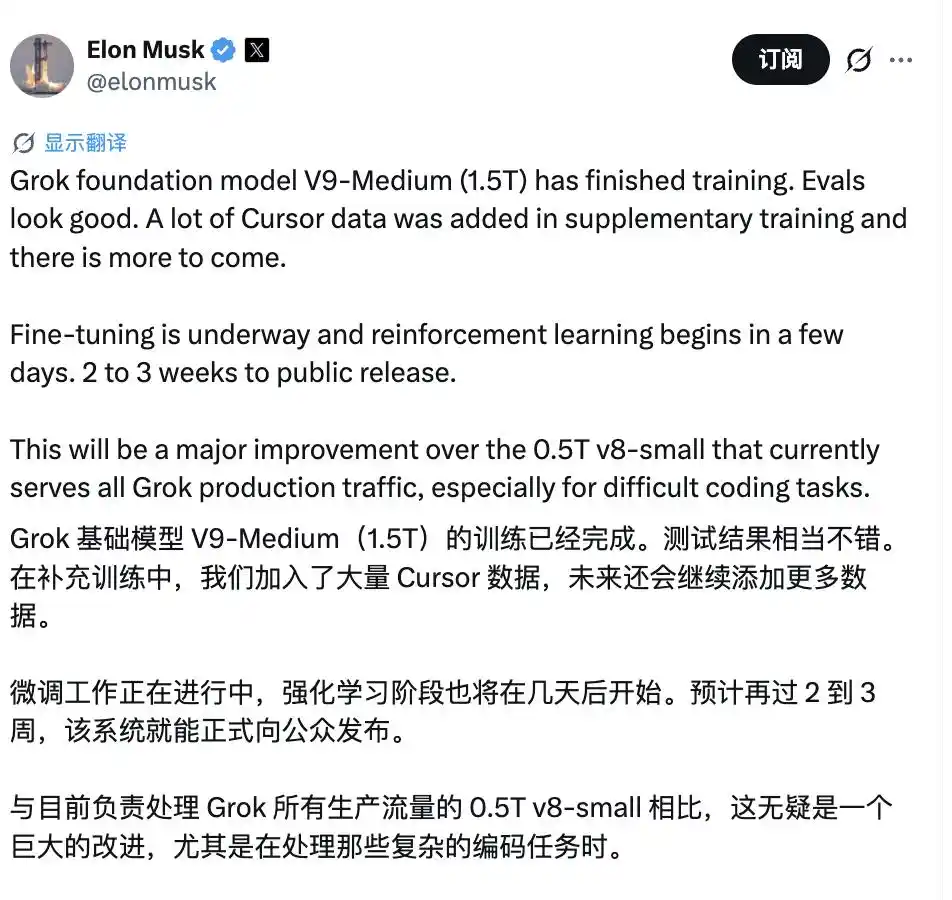
Musk posted on X, revealing that xAI's own Grok foundation model V9-Medium (1.5T) has completed training.

It is expected to be officially released in about 2 to 3 weeks:
Yes, this new model is clearly making a big push towards programming capabilities.

Musk specifically mentioned that a large amount of Cursor data was added to the supplementary training of V9-Medium, with more to be added later.

What does this mean—

(Probably suggesting, 'Look beyond the neighbors when it comes to coding, check out my house too~')

While hyping the new model, their own new programming product isn't idle either.

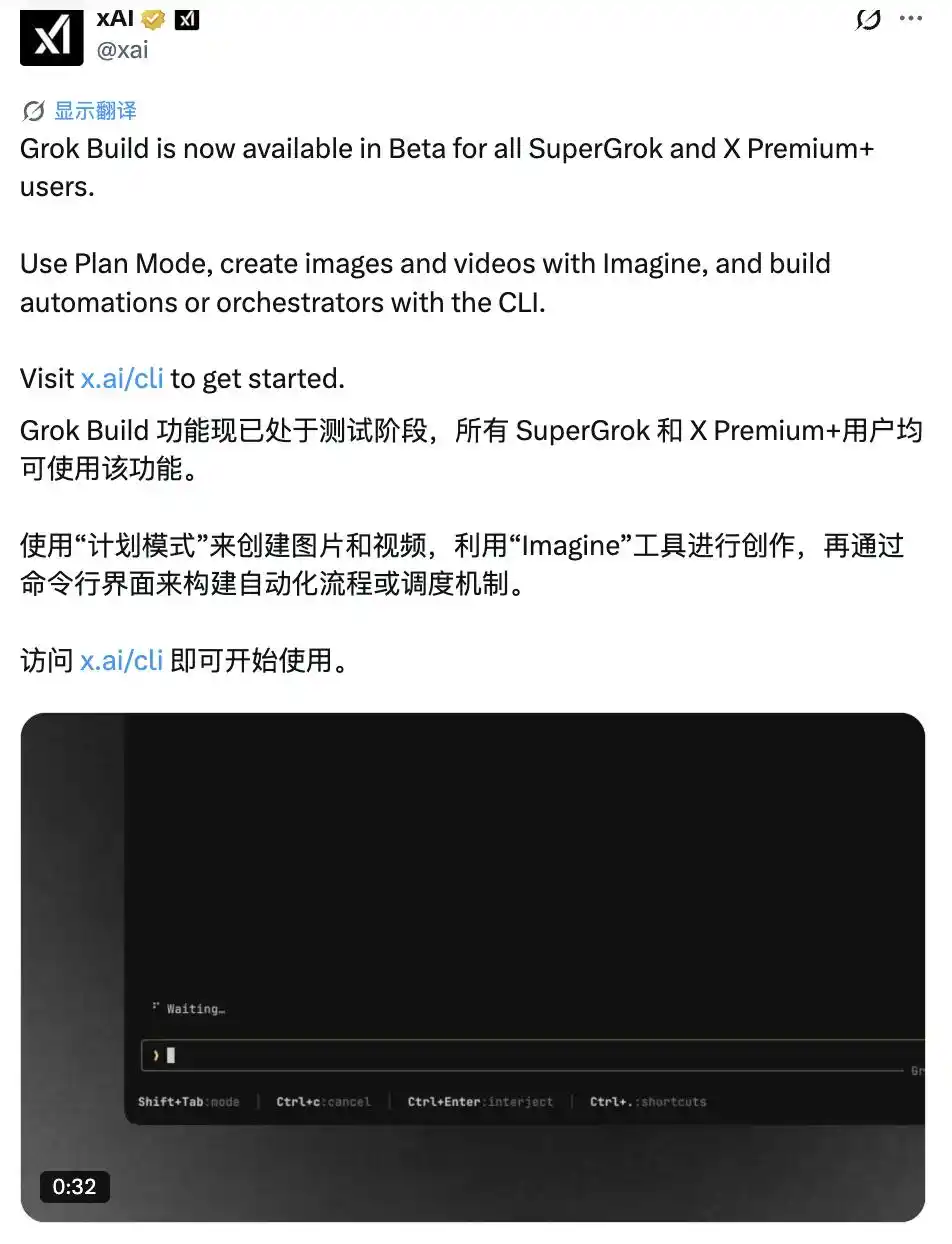
xAI's newly released AI programming agent tool Grok Build has also entered the early Beta testing phase, and some users can use it now~
Emm...

It's only been just over a month since acquiring Cursor, and Grok has already started getting its 'bonus meal'.

On one hand, feeding the new model with Cursor data; on the other hand, pushing their own AI programming Agent.

Anyway, Old Musk's Code, better late than never!

Grok's New Model Training is Complete!

Ultimately, this coding stuff is just too competitive...

Looking at the timeline, it's been almost a year since the Grok 4 series, based on the v8-small foundation model, was released.

Actually, the programming capabilities improved a bit with the last generation model, but they just couldn't keep up with how fast the neighbors are iterating!

So, this time xAI didn't choose incremental updates, but saved up for a big move~

Grok's new foundation model, V9-Medium (1.5T), is directly targeting programming capabilities and the developer market.

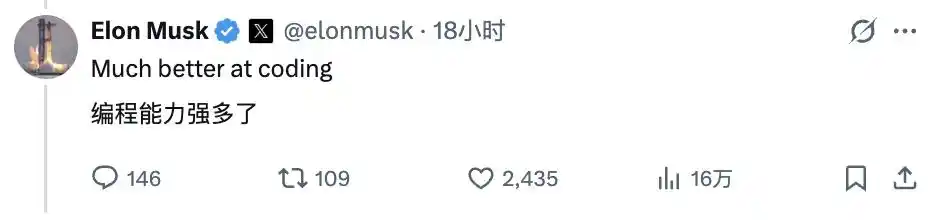
Even Musk himself couldn't wait to say: The coding ability is much stronger. (doge)
In terms of parameters, V9-Medium has directly reached a scale of 1.5T.

You know, currently all Grok's production traffic is carried by the 0.5T v8-small model, which is only 0.5T in size.

So calculating this way, it's a direct jump to three times the parameters???

The significant increase in parameter scale, of course, also means the model is expected to make considerable progress in deep reasoning capabilities and knowledge reserves.

A larger model capacity often allows it to better understand complex contexts, perform longer chain-of-thought reasoning, and handle more challenging real-world development tasks~

However!

The most interesting part of this new model isn't in the parameters, but in its programming prowess—

Old Musk specifically mentioned: xAI intentionally added a large amount of 'Cursor data' to the training of V9-Medium (1.5T).

Everyone should know that Cursor's data isn't an ordinary code repository; it's the real workflow of millions of developers.

Cursor data is more likely to tell the model how developers describe requirements, locate problems, have AI read context, modify files, fix errors, and continue asking questions in real projects.

Consider it a big boost of 'real-world engineering feel' for Grok......

As for when the model will be released?

The official word is that the foundation training of V9-Medium has been fully completed.

Fine-tuning work is in full swing, and the reinforcement learning phase will also start in a few days.

According to xAI's plan, this new model can be officially released to the public in 2 to 3 weeks.

Additionally, it's worth noting—

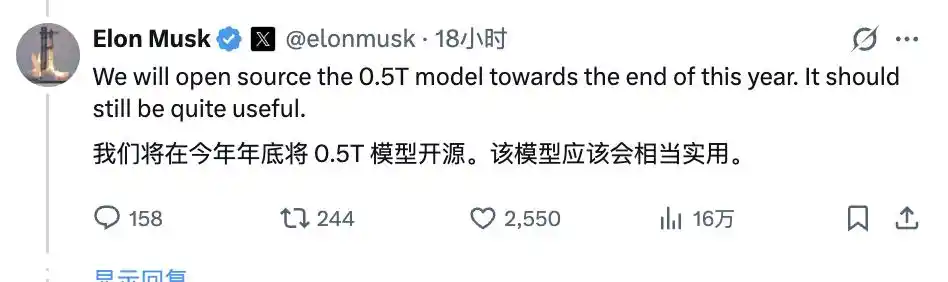
While promoting their new model, Musk also left an Easter egg in the comments:

The 0.5T model will be open-sourced by the end of this year, it's very practical too!
(You can look forward to it a little~)

AI Programming Tool Grok Build Also Starts Testing

Besides the new model, xAI's own new AI programming tool product has also made new progress.

Currently, the AI programming agent tool Grok Build has entered the early Beta testing phase.

Let me briefly introduce, Grok Build is xAI's own programming Agent and CLI tool.

In form, it's actually closer to terminal programming products like Claude Code, Codex CLI.

Developers can invoke it in a local project directory, letting the AI directly read the project, understand the context, plan changes, modify code files, and so on.
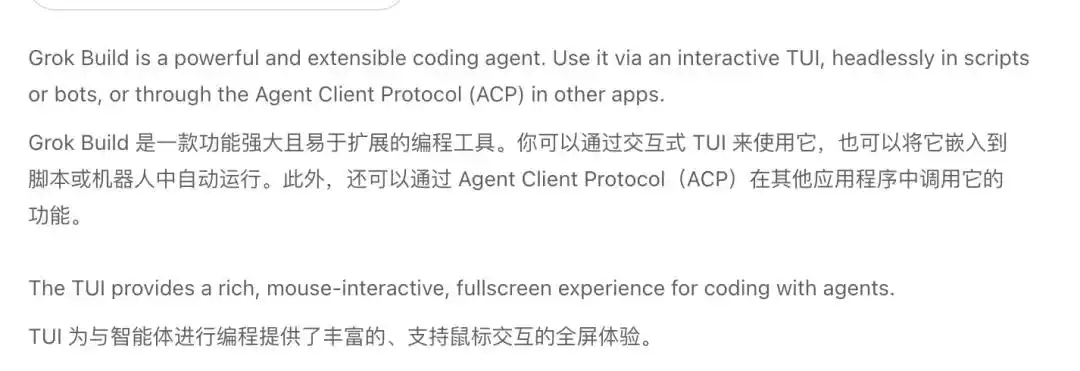
Judging from the official demo video, Grok Build's main promoted capabilities have a strong AI Coding flavor:

Plan Mode: After the user inputs a requirement, Grok Build won't act immediately. Instead, it first formulates a detailed execution plan, lets the user confirm, and then proceeds.

Multiple Subagents Working in Parallel: For large, complex tasks, Grok Build will delegate work to Subagents that run in parallel.

Skills, Marketplace, MCPs Integration: We can easily extend Grok Build's capabilities, invoking various ready-made tools and plugins.

Other Mentioned Capabilities: Supports creating images and videos, building automated workflows, etc.

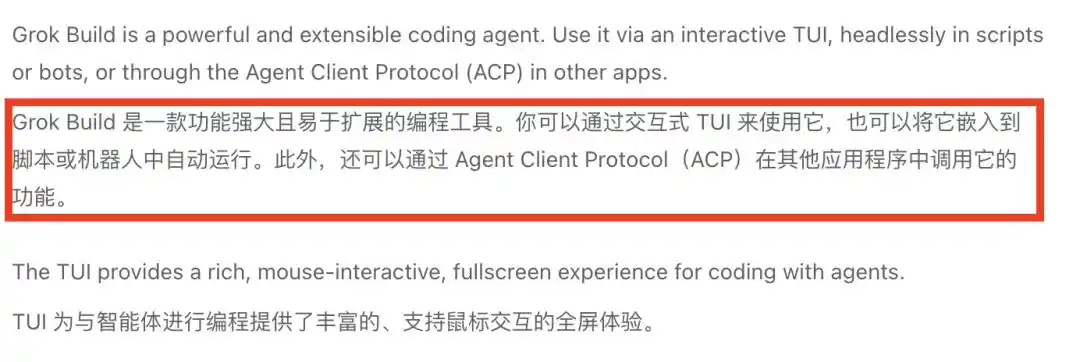
Regarding specific usage methods, xAI's official documentation also provides three entry points—

One is Interactive TUI.

That is, opening a full-screen interactive interface in the terminal where developers can directly converse back and forth with Grok Build, view plans, and execute tasks.

One is Headless Mode.

More suitable for being embedded into scripts, bots, or automated processes, letting it run tasks in the background according to instructions.

Another is through the Agent Client Protocol to integrate with other applications.

Turning Grok Build into a programming Agent that can be called by external tools.

(Many ways, no shortage of choices~)
On one side, xAI is strengthening the new generation foundation model's code capabilities with Cursor data.

On the other side, launching a programming Agent like Grok Build to directly enter the AI Code tool battlefield.

It seems Musk isn't planning to just compete with Grok in the chatbox this time. (doge)

After Acquiring Cursor, Musk Races to Catch the Coding Tailwind

Old Musk's move of feeding the new model with Cursor data and starting Grok Build testing isn't too sudden.

After all, a few months ago, while xAI was conducting internal layoffs and adjustments, they started heavily engaging with and bringing in Cursor's talent and experience—

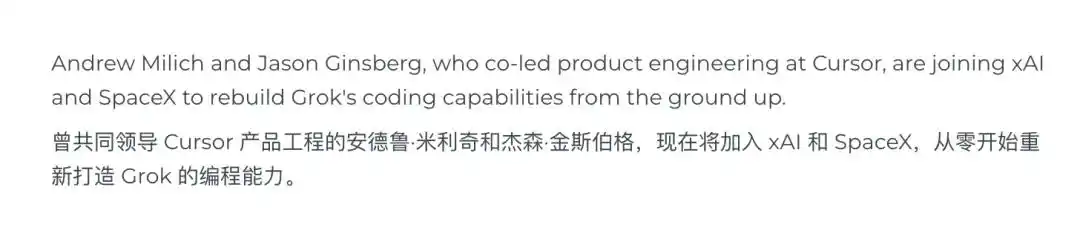
Andrew Milich and Jason Ginsberg, Cursor's two core engineering leads who helped grow Cursor from 0 to a valuation of tens of billions of dollars.

Joined xAI one after another, reporting directly to Musk, with the core task of rebuilding Grok's coding capabilities from the ground up.
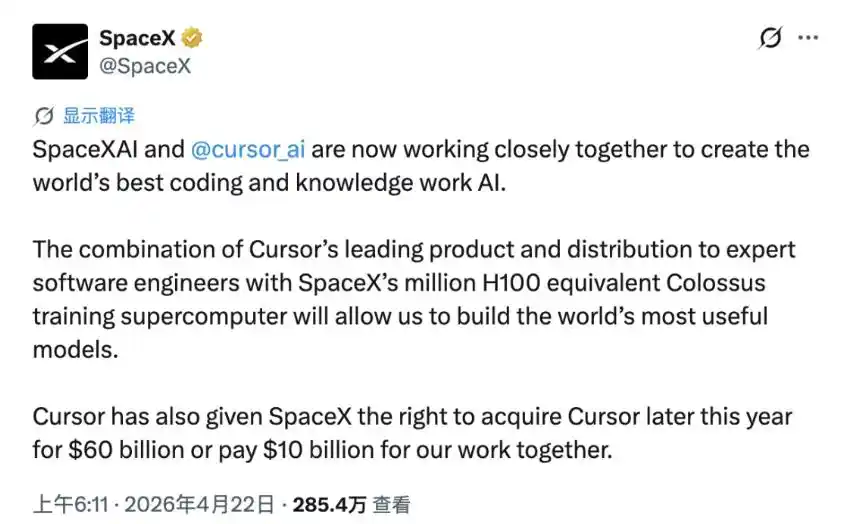
Then came last month.

Musk stopped playing the talent poaching game and directly targeted Cursor the company itself.

Acquiring Cursor for a price of $600 billion. You should know, this number is more than double Cursor's valuation from November last year…
So looking back, in just one month, Old Musk's Cursor 'stock-up' has already started showing effects on Grok:

Just half a month ago, Grok Build was only just appearing, now it's already starting broad testing in developers' hands.

As for V9-Medium, it was personally named by Musk, stating that a large amount of Cursor data was added to its supplementary training, with more to be added later.

Not only that, in between, Musk also revealed that the new Grok model is being trained normally on the Colossus 2 cluster.

So many actions, so much code vibes.

Therefore, when we look back at the phrase 'more to come' in V9-Medium, it now seems quite thought-provoking.
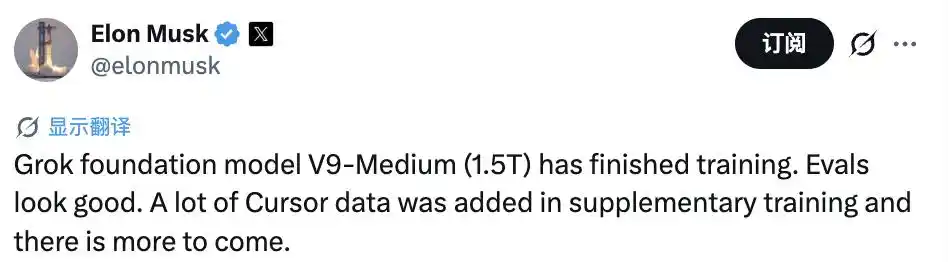
Translated, I guess it means—

Every extra day Cursor serves customers, Grok gets an extra day of bonus meals.

Next, let's see how Old Musk leads Grok formally into the Code fight, looking forward to it~

References:

[1]https://openrouter.ai/x-ai/grok-build-0.1?utm

[2]https://x.com/elonmusk/status/2058787384364265734

[3]https://x.com/JasonBud/status/2058974659648123084

[4]https://x.com/xai/status/2058973760708091907

This article is from the WeChat public account "Quantum Bit", author: Meng Yao

Trending Cryptos

Related Questions

QWhat is the name and key specification of Grok's new base model mentioned in the article, and when is its expected release?

AThe new base model is Grok's V9-Medium (1.5T). It is expected to be publicly released in about 2 to 3 weeks.

QAccording to the article, what specific type of data was added to the training of the V9-Medium model to enhance its programming capabilities?

AThe training of the V9-Medium model incorporated a large amount of 'Cursor data', which consists of real developer workflows and interactions.

QWhat is the name of xAI's new AI programming agent tool, and what is its current development status?

AThe new AI programming agent tool is called Grok Build. It is currently in an early Beta testing phase, available to some users.

QHow does the parameter size of the new V9-Medium model compare to the previous v8-small model that powers the current Grok?

AThe V9-Medium model has a parameter size of 1.5 trillion (1.5T), which is three times larger than the 0.5 trillion (0.5T) parameters of the previous v8-small model.

QWhat significant business move did Elon Musk's xAI make regarding Cursor, and how is it already benefiting Grok according to the article?

AxAI acquired the company Cursor. The benefits are already showing as Cursor's data is being used to train the new V9-Medium model, and Cursor's engineering talent has joined xAI to help rebuild Grok's coding capabilities from the ground up.

Related Reads

Will the Ethereum Foundation Evolve into a 'Mascot'? Diversified Organizations Are Fragmenting Its Functions

The Ethereum Foundation (EF) is undergoing significant internal turmoil and functional erosion. Following its largest-ever layoff of 54 staff (20% of its workforce) and a major organizational restructuring announced in June, its Protocol Support Team has been officially dissolved. This comes alongside the high-profile resignation of key figures like co-executive director Xiaowei Wang, bringing senior departures this year to at least eight. Criticism of EF's rigid structure, opaque decision-making, and perceived lack of a clear value narrative for ETH has intensified within the community. The layoffs have catalyzed the emergence of independent, non-profit organizations like Ethlabs and Ethereum Institutional, founded by former EF researchers and members. These entities are now taking on core functions such as protocol research/development and institutional adoption, effectively fragmenting the EF's traditional leadership role. Concurrently, EF's security team is adapting to technological change, deploying specialized AI agents to audit Ethereum's codebase, which successfully discovered a critical vulnerability (CVE-2026-34219). While EF states AI complements rather than replaces researchers, it signals a potential future shift in its operational model. Faced with these challenges—internal restructuring, talent drain, the rise of competing organizations, and AI integration—the Ethereum Foundation appears to be stepping back from a central commanding role. Analysts and community observers speculate it may increasingly transition towards a symbolic "ecosystem mascot" function, while decentralized initiatives drive Ethereum's future growth and institutional adoption.

marsbit16m ago

Will the Ethereum Foundation Evolve into a 'Mascot'? Diversified Organizations Are Fragmenting Its Functions

marsbit16m ago

Nearly a Hundred Players Rush into Embodied Data: With 4.47 Billion Yuan in Financing in One Year, Who Can Really Make Money by 'Selling Data'?

The domestic embodied AI data industry has attracted nearly 100 players, with 70 focused on data collection and 27 on data infrastructure. In the past year, 15 independent embodied data service providers raised approximately 4.47 billion yuan. Despite this growth, the sector remains early-stage, fragmented, and faces significant challenges. Data collection methods are diverse, categorized into four main routes: teleoperation of real robots, human demonstration without a robot (using motion capture, exoskeletons, etc.), simulation synthesis, and distillation from internet videos. Most companies (43%) adopt hybrid approaches, combining multiple routes, as no single method can meet all training needs. Teleoperation alone is pursued by 31% of players, often by state-owned platforms and robot companies, while newer firms favor asset-light, no-hardware human demonstration. Independent data service providers now form the largest player group (40%), indicating the emergence of a distinct industry segment rather than just a subsidiary function for robot makers. Two-thirds of all players are "embodied-native" startups, while one-third are companies that pivoted from fields like AI data annotation, which are more prevalent in the data infrastructure layer. Current annual industry capacity is estimated at 1.6-1.8 million hours plus 70-80 million data points, with a short-term goal to increase this 15-20 fold within 1-3 years. Data collection factories are spread across 20 provinces in China, concentrated in the Yangtze River Delta, Beijing-Tianjin-Hebei, and Pearl River Delta regions. Financially, the 4.47 billion yuan raised in the past year pales compared to the 43.8 billion yuan raised by the broader embodied intelligence sector in just the first half of 2026, highlighting that data remains a less "sexy" bet for investors. The 15 funded independent providers show clear stratification: a top tier led by a unicorn (Lightwheel Intelligence, 3.1 billion yuan), a middle tier of 11 firms raising tens to hundreds of millions, and an early-stage tier of 3 companies. Sixty-nine investment institutions have participated, but none have made concentrated bets, reflecting uncertainty about viable business models. Over half of these funded companies are less than a year old, most are at pre-A or A rounds, and profitability remains largely unproven. In summary, the embodied data industry has become an independent track creating jobs and local economic activity. However, it is still nascent, with unformed consensus, unsolved problems, and unproven business models. The coming 1-2 years will be a critical validation window to see if companies can build sustainable, profitable businesses purely by "selling data."

marsbit3h ago

Nearly a Hundred Players Rush into Embodied Data: With 4.47 Billion Yuan in Financing in One Year, Who Can Really Make Money by 'Selling Data'?

marsbit3h ago

Dialogue with Multicoin Partner: The Crypto Market Has Bottomed Out, Favoring Three Cryptocurrencies in This Cycle

In a recent interview, Multicoin Capital managing partner Tushar Jain shared his views on the crypto market. He believes the market has bottomed and is at an inflection point, citing that negative news no longer causes significant price declines and application adoption continues to grow. Jain remains highly bullish on Solana, viewing it as the correct architectural choice for internet capital markets, particularly for spot and tokenized security trading. He is also positive on Hyperliquid, noting its leadership in decentralized derivatives trading. His investment approach focuses on concentrating capital in top convictions rather than equal allocation. A distinct opportunity he highlights is Zcash (ZEC), which he sees as a return to the industry's cypherpunk ethos and a potential top-five asset by market cap. For assets like Zcash without cash flows, his valuation framework is based on relative market cap ranking. Regarding investment strategy, Jain employs a "three-part" entry method to avoid timing pitfalls and emphasizes long-term "active management" over "active trading." He outlines four sources of investment edge: informational, analytical, behavioral/psychological, and structural. On portfolio management, the fund uses Bitcoin as its "cash," selling assets into Bitcoin during market euphoria to reduce beta risk and using Bitcoin to buy dips. Sales occur only if a better opportunity arises, the investment thesis breaks, or valuations become excessively overheated. While respectful of Ethereum's resilience, he questions its unclear scaling roadmap. Finally, Jain reaffirms his commitment to the thesis that blockchains will form the foundational architecture for future capital markets.

marsbit3h ago

Dialogue with Multicoin Partner: The Crypto Market Has Bottomed Out, Favoring Three Cryptocurrencies in This Cycle

marsbit3h ago

Trading

Spot

Hot Articles

Discussions

Welcome to the HTX Community. Here, you can stay informed about the latest platform developments and gain access to professional market insights. Users' opinions on the price of S (S) are presented below.

活动图片