From "Silicon Valley's Sacred Shoes" to "GPU Computing Power": The Absurdity and Logic Behind Allbirds Renaming to NewBird AI

marsbitОпубликовано 2026-04-16Обновлено 2026-04-16

Введение

From "Silicon Valley's Favorite Shoe" to "GPU Computing Power": The Absurdity and Logic Behind Allbirds' Rebranding to NewBird AI On April 15, Allbirds, the maker of merino wool running shoes, announced a radical pivot from footwear to AI compute, rebranding as "NewBird AI." The move triggered a 582% surge in its stock price the same day. This followed the sale of its shoe business for $39 million—a fraction of its $4 billion IPO valuation in 2021. Allbirds rose to fame in 2016 with its comfortable, eco-friendly minimalist shoes, becoming a status symbol in tech circles. But after rapid expansion and failed attempts to attract Gen Z, revenue declined, losses mounted, and its value plummeted. By early 2026, all its U.S. stores had closed. Now, under CEO Joe Vernachio, the company is attempting a reboot. It secured $50 million in convertible notes from an undisclosed investor to purchase high-performance GPUs and offer "GPU-as-a-service" to AI developers. The company cites real market shortages in compute capacity, but questions remain about how a $50 million entry can compete in a capital-intensive industry dominated by giants like NVIDIA and CoreWeave. The move echoes past market frenzies, such as Long Island Iced Tea’s pivot to blockchain in 2017—a hype-driven strategy that ended in delisting and SEC action. While AI compute demand is real, NewBird AI’s operational capacity and execution plan remain unproven. The timing is suggestive: the stock soared based on a narrati...

A running shoe seller is now entering the computing power business.

On April 15, the manufacturer of merino wool sneakers, Allbirds, announced it would transform into an AI computing power company, renaming itself "NewBird AI," with its stock price soaring 582% at the close that day.

At the time of the announcement, the company's footwear business had just been sold to the brand management company American Exchange Group for $39 million, less than 1% of its peak valuation of $4 billion from its IPO less than five years ago.

The story of Allbirds is a standard narrative of brand decline.

In 2016, it gained popularity in Silicon Valley with a pair of merino wool running shoes, positioning itself as comfortable, eco-friendly, and minimalist, becoming the standard uniform for tech professionals. In November 2021, it went public on Nasdaq, raising over $300 million in its IPO, with the market valuing it at a high of $4 billion.

The minimalist design and the moral halo of "eco-friendliness" perfectly aligned with the aesthetic genes of the tech circle. From Google co-founder Larry Page, to former Twitter CEO Dick Costolo, to Apple CEO Tim Cook, venture capitalist Ben Horowitz, "Queen of the Internet" Mary Meeker, and even Jack Ma...

A saying began to circulate in Silicon Valley: "Wherever there are investors, nine times out of ten you can see a pair of Allbirds."

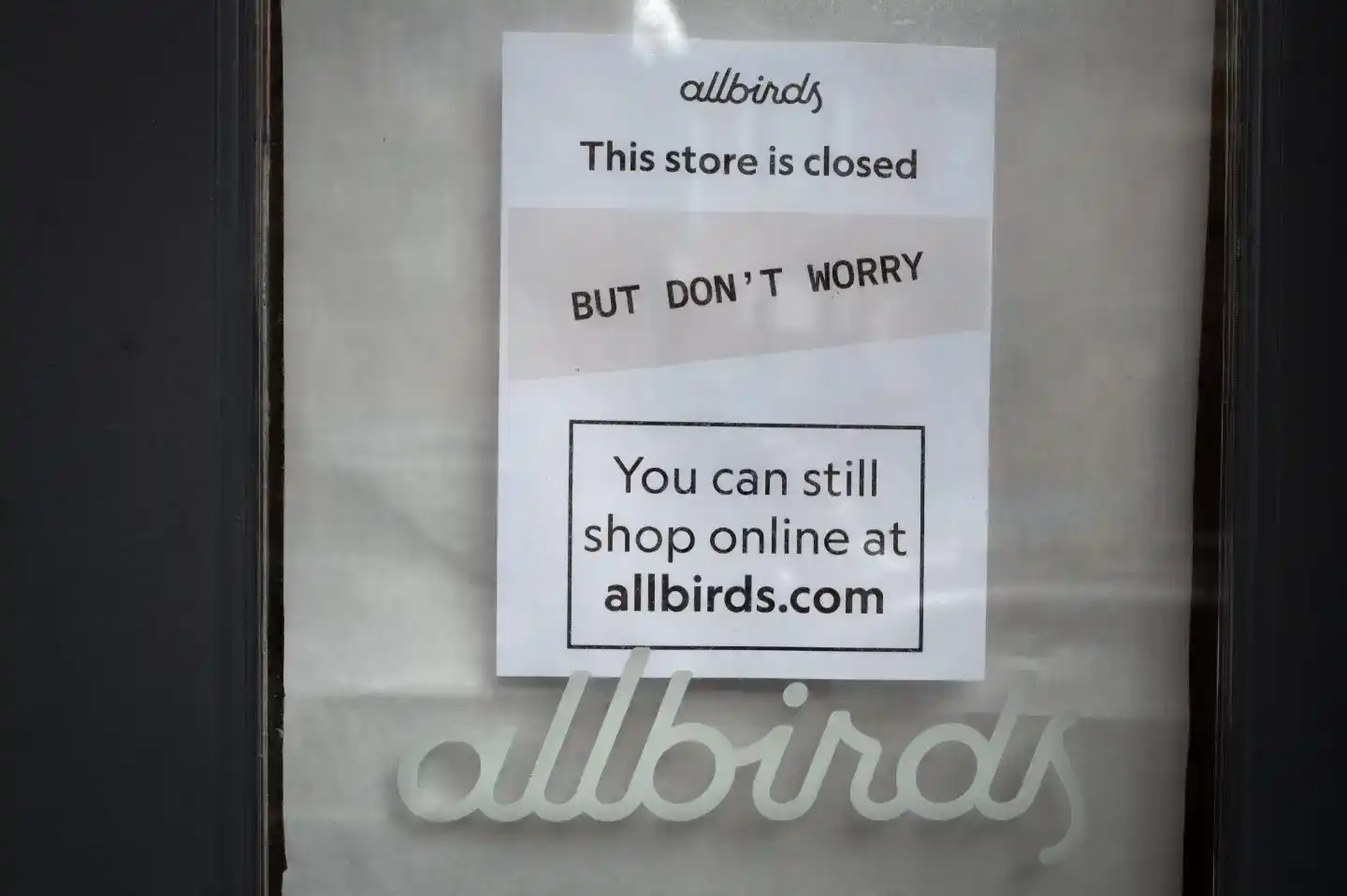
But the situation took a sharp turn. The company spent heavily on expanding physical stores, launched non-core products, and tried to capture Gen Z, but ended up failing on both fronts. Old customers felt it had changed, and new customers never came. Revenue declined continuously, with a net loss of $77.3 million in 2025, and the stock price fell 99% from its peak, becoming a true "penny stock." In February 2026, all full-price physical stores in the U.S. were closed.

The company had already died once. What remained was a shell listed on Nasdaq and a few people holding equity.

CEO Joe Vernachio, the firefighting captain who took over after former co-founder Joey Zwillinger resigned in March 2024, made a radical decision.

Completely burn the shoes and play a new card. After selling the footwear assets, the company had money from the shoe sale, a Nasdaq listing status, and the willingness to bet on the word "AI."

These three labels, perhaps in the market environment of 2026, are enough to support a new story.

From Sneakers to GPUs: The Self-Redemption of a Shell

The core of NewBird AI is a $50 million convertible bond financing from an "undisclosed institutional investor."

The company plans to use this money to purchase high-performance GPUs and lease them to AI developers and research institutions in a "GPU as a Service" model. The wording in the official press release is: "Data center vacancy rates in North America are at historic lows, and computing power scheduled to come online in mid-2026 has already been pre-booked. Enterprises, AI developers, and research institutions are unable to obtain the computing power they need from hyperscale cloud providers or the spot market."

The market reality described in this statement is real. The supply of high-end GPUs like the H100 is indeed tight, and Neocloud players like CoreWeave and Lambda Labs are frantically raising funds to expand production, but the barriers are extremely high. The question is, what position can $50 million secure on this battlefield?

Current high-end GPU rental prices remain high, having risen about 40% in early 2026. CoreWeave's latest funding round was in the tens of billions of dollars. NewBird AI entering with $50 million is like bringing a small knife to a tank battle. More crucially: Where will the GPUs be bought from, how will the supply chain be guaranteed, and who will operate the data center? These questions are not addressed in the official documents.

The identity of the placement agent is also noteworthy. The underwriter for this $50 million convertible bond is Chardan Capital Markets, an investment bank with extensive experience in SPACs and reverse mergers. Choosing Chardan is itself a signal, suggesting the structure of this deal is more complex than an "internal transformation," perhaps closer to a carefully orchestrated "backdoor listing" operation, just packaged as a narrative of autonomous transformation.

Who Profits from This Frenzy?

There is a precedent in the U.S. market.

In December 2017, the iced tea beverage company Long Island Iced Tea Corp. renamed itself Long Blockchain Corp., claiming it would transition into blockchain business, and its stock price surged 380% that day. The blockchain business never materialized, and Nasdaq subsequently delisted it in 2018 for "issuing a series of statements that misled investors and exploited the blockchain hype to inflate the stock price." Later, the SEC formally announced its delisting, and several insiders were charged with insider trading.

Allbirds' transformation bears a striking resemblance to this script: a failing public company, an unverifiable new direction, the hottest buzzword of the moment, and the ensuing stock price frenzy.

Of course, there are differences.

The AI computing power demand in 2026 is more substantive than blockchain in 2017; the computing power shortage is a real industry bottleneck, not just a narrative. But "real demand exists" and "this company can capture this demand" are two entirely different things.

On May 18, Allbirds/NewBird AI will hold a special shareholders' meeting to vote on the asset sale and convertible bond financing. A special dividend is expected to be distributed to shareholders of record in Q3.

This timeline is intriguing. The stock price had already surged 582% on the day the transformation was announced, rising from $2.49 to $16.99, with an intraday peak increase of over 800%. A large number of retail investors flooded in on the news, with trading volume soaring to over 150 million shares. Meanwhile, the shareholders' meeting has not yet been held, all transactions are not formally completed, and the company has no actual operating record in AI business.

During this window, who has the most motive, and the most ability, to cash out their chips? What is the equity structure of the executive layer, and what were their holdings changes before and after the transformation announcement? What protections do the convertible bond terms offer the original investors? These questions have no answers in the current public information.

Selling the computer before the cooling system is installed—this is one possible path in the 2026 "AI transformation wave."

The Shell on the Wind and the Market Under the Wind

The story of NewBird AI is a slice of the AI market in 2026.

In the current computing power gold rush, the real players are NVIDIA, Microsoft, Amazon, CoreWeave investing tens of billions, and large data center operators backed by national strategies. But the characteristic of the capital market is: where the wind blows, the sand piles up. Every time a new concept emerges, a batch of companies rush to label themselves, whether their main business is selling shoes, selling iced tea, or something else.

This doesn't mean every "AI transformation" is a scam, but it doesn't mean every "AI transformation" will succeed either. The market's cleverness lies in sometimes driving up the price before the scam is exposed, and then running away before reality checks come.

Allbirds' investors were once moved by the story of a wool shoe, then watched the stock price fall 99%. Now, the holders of the same stock ticker, who may be a completely different group of people, are being moved by another story.

Связанные с этим вопросы

QWhat was the original business of Allbirds before its transformation to NewBird AI?

AAllbirds was originally a manufacturer of merino wool running shoes, known for its comfortable, eco-friendly, and minimalist design.

QHow much did Allbirds' stock price increase on the day it announced its transformation to NewBird AI?

AAllbirds' stock price surged 582% on the day it announced its transformation to NewBird AI.

QWhat is the core business plan of NewBird AI after the transformation?

ANewBird AI plans to use $50 million in convertible notes to purchase high-performance GPUs and operate a 'GPU as a service' model, leasing computing power to AI developers and research institutions.

QWhat was the fate of Allbirds' footwear business prior to its transformation?

AAllbirds' footwear business was sold to the brand management company American Exchange Group for $39 million, which was less than 1% of its peak IPO valuation of $4 billion five years prior.

QWhat historical example does the article cite as a cautionary tale similar to Allbirds' transformation?

AThe article cites the example of Long Island Iced Tea Corp., which renamed itself Long Blockchain Corp. in 2017, causing its stock to surge 380%, but the blockchain business never materialized, leading to its delisting and SEC action.

Похожее

Why Not Short Even When Bearish? Munger Did the Math on a 'Losing Trade'

Why Not Short Even When Bearish? Charlie Munger's Calculated "Loss-Making Account" Many traders, drawn to speculative tools like futures contracts, often face repeated failures. As the article notes, unless one is a genius, such instruments should be avoided for long-term profit-seeking. Similarly, the practice of short selling is viewed with caution. The author firmly states a policy of not shorting, even when bearish, preferring to simply wait. The core reason? Successful short selling requires exceptionally difficult conditions to profit. Legendary investors Warren Buffett and Charlie Munger have themselves reflected on painful short-selling experiences. Munger highlights two critical flaws in the mathematical logic of shorting: 1. Asymmetrical Risk/Reward: A long position has a maximum loss of 100% but unlimited upside. A short position caps profit at 100% (if a stock falls to zero) but carries theoretically unlimited loss potential. 2. The "Promoter" Problem: Fraudulent or struggling companies can prolong their decline. As Munger said, "You can run out of money before the promoter runs out of ideas," meaning short sellers may be forced to cover positions at a loss before the company's true fate unfolds. The article cites Stanley Druckenmiller, a famed hedge fund manager. He once shorted 12 companies that all eventually went bankrupt. However, intense market rallies forced him to cover his positions within three weeks, resulting in massive losses—$200 million of his capital plus an additional $600 million. He concluded he likely never made money shorting in his career. His experience perfectly illustrates Munger's points: facing unlimited losses and being wiped out before being proven right. The conclusion is clear: for most investors, complex instruments like short selling and derivatives are not viable paths to stable, long-term gains. Self-reflection is advised before repeatedly wasting time and capital on such speculative strategies.

marsbit14 мин. назад

Why Not Short Even When Bearish? Munger Did the Math on a 'Losing Trade'

marsbit14 мин. назад

For Hedging, Buy Gold and Oil; For Explosive Growth, Buy AI; Bitcoin, the 'Outdated' Asset, Enters a Bear Market

Bitcoin’s price has recently fallen sharply, hitting a two-month low near $66,000, with Ethereum also dropping to a three-month low. While surface explanations point to ETF outflows, geopolitical tensions, and corporate selling, a deeper issue is emerging: Bitcoin is losing a crucial asset competition. For years, Bitcoin thrived in a low-rate environment where investors sought alternatives amid inflation fears and dissatisfaction with traditional options. Now, the market landscape has shifted, leaving Bitcoin stuck in an "awkward middle ground," facing challenges on three fronts: 1. **As an inflation hedge, gold is winning.** Investors worried about persistent inflation are turning to tangible assets like gold, energy stocks, and commodity producers, which offer more direct pricing power and physical backing. 2. **For growth exposure, AI is winning.** Those seeking high growth now favor AI-related companies with actual revenues and profits, an area where Bitcoin's lack of cash flow puts it at a disadvantage. 3. **Within crypto, infrastructure and stablecoins are winning.** Even investors wanting crypto exposure have alternatives like exchanges, stablecoin issuers, and tokenization firms, whose performance is directly tied to real-world adoption and offers clearer operational leverage. The recent market reaction to inflation warnings highlights this shift. Instead of boosting Bitcoin as "digital gold," such news now drives flows toward traditional inflation-sensitive assets. Therefore, recent events like ETF outflows and corporate selling are seen not as causes, but as symptoms of this new reality. Capital has more compelling options, and investors are becoming more selective. The emerging bear case for Bitcoin is no longer about it being a fraud or failed technology, but rather that **scarcity alone is no longer enough**. It is no longer seen as the best hedge, the best growth asset, or the only crypto play.

marsbit30 мин. назад

For Hedging, Buy Gold and Oil; For Explosive Growth, Buy AI; Bitcoin, the 'Outdated' Asset, Enters a Bear Market

marsbit30 мин. назад

SaaS Battle Royale: The Survivors Who Win All Share One Common Trait

**Summary** The AI revolution has triggered a "SaaS apocalypse," forcing a brutal market shakeout. The key dividing line is the pricing model. Companies like Snowflake and Datadog, which charge based on consumption (e.g., data processed or compute used), are thriving. AI workloads actively *generate* more demand for their services, fueling growth. Datadog's accelerating revenue is a prime example. Microsoft and Palantir, as platform/ecosystem players, also benefit by acting as essential channels for AI deployment. In contrast, traditional SaaS firms built on per-seat or per-task licensing (e.g., Intuit, Adobe) face direct pressure, as AI threatens to automate the very human tasks their software supports. Companies like Salesforce, a per-seat giant, are caught in the middle. While showing strong AI monetization (e.g., its Agentforce platform) and experimenting with consumption-based "Flex Credits," its stock remains under pressure, illustrating that the market rewards *completed* transitions, not just the intent. The recent Microsoft Build conference underscored key trends: AI is evolving from an assistant to an autonomous "agent," and platform providers like Microsoft are consolidating their control. The market's recovery is highly selective, focused on identifying which companies are "fed by AI" versus "eaten by AI." Future focus will be on the diffusion of this recovery to transforming companies and the real-world adoption data of AI agents like Microsoft Copilot.

marsbit47 мин. назад

SaaS Battle Royale: The Survivors Who Win All Share One Common Trait

marsbit47 мин. назад

Торговля

Спот
Фьючерсы

Популярные статьи

Как купить S

Добро пожаловать на HTX.com! Мы сделали приобретение Sonic (S) простым и удобным. Следуйте нашему пошаговому руководству и отправляйтесь в свое крипто-путешествие.Шаг 1: Создайте аккаунт на HTXИспользуйте свой адрес электронной почты или номер телефона, чтобы зарегистрироваться и бесплатно создать аккаунт на HTX. Пройдите удобную регистрацию и откройте для себя весь функционал.Создать аккаунтШаг 2: Перейдите в Купить криптовалюту и выберите свой способ оплатыКредитная/Дебетовая Карта: Используйте свою карту Visa или Mastercard для мгновенной покупки Sonic (S).Баланс: Используйте средства с баланса вашего аккаунта HTX для простой торговли.Третьи Лица: Мы добавили популярные способы оплаты, такие как Google Pay и Apple Pay, для повышения удобства.P2P: Торгуйте напрямую с другими пользователями на HTX.Внебиржевая Торговля (OTC): Мы предлагаем индивидуальные услуги и конкурентоспособные обменные курсы для трейдеров.Шаг 3: Хранение Sonic (S)После приобретения вами Sonic (S) храните их в своем аккаунте на HTX. В качестве альтернативы вы можете отправить их куда-либо с помощью перевода в блокчейне или использовать для торговли с другими криптовалютами.Шаг 4: Торговля Sonic (S)С легкостью торгуйте Sonic (S) на спотовом рынке HTX. Просто зайдите в свой аккаунт, выберите торговую пару, совершайте сделки и следите за ними в режиме реального времени. Мы предлагаем удобный интерфейс как для начинающих, так и для опытных трейдеров.

1.4k просмотров всегоОпубликовано 2025.01.15Обновлено 2026.06.02

Как купить S

Sonic: Обновления под руководством Андре Кронье – новая звезда Layer-1 на фоне спада рынка

Он решает проблемы масштабируемости, совместимости между блокчейнами и стимулов для разработчиков с помощью технологических инноваций.

2.3k просмотров всегоОпубликовано 2025.04.09Обновлено 2025.04.09

Sonic: Обновления под руководством Андре Кронье – новая звезда Layer-1 на фоне спада рынка

HTX Learn: Пройдите обучение по "Sonic" и разделите 1000 USDT

HTX Learn — ваш проводник в мир перспективных проектов, и мы запускаем специальное мероприятие "Учитесь и Зарабатывайте", посвящённое этим проектам. Наше новое направление .

1.8k просмотров всегоОпубликовано 2025.04.10Обновлено 2025.04.10

HTX Learn: Пройдите обучение по "Sonic" и разделите 1000 USDT

Обсуждения

Добро пожаловать в Сообщество HTX. Здесь вы сможете быть в курсе последних новостей о развитии платформы и получить доступ к профессиональной аналитической информации о рынке. Мнения пользователей о цене на S (S) представлены ниже.

活动图片