Crypto whales accumulate as bear market nears late stage: CryptoQuant

cointelegraphPublished on 2026-08-05Last updated on 2026-08-05

Abstract

According to CryptoQuant, large cryptocurrency holders, or "whales," are accumulating Bitcoin and Ethereum as valuations suggest the market is entering the final stage of a bear market. The analytics firm reports that Bitcoin whale holdings, excluding exchanges and mining pools, increased from 2.87 million to 3.06 million BTC between December 2025 and June, with accumulation accelerating after Bitcoin's price fell below $60,000. Similarly, large Ethereum wallets have reached record holdings. The report points to on-chain metrics like realized price—Bitcoin is currently above it, while Ethereum is below—as potential indicators the market is approaching a bottom. The pattern of whales accumulating during price weakness has historically preceded market recoveries, though further downside risk remains. This analysis aligns with other research suggesting possible bottoming signals for Bitcoin.

Large cryptocurrency holders are accumulating Bitcoin (BTC) and Ether (ETH) as valuations approach levels associated with the final stage of a bear market, according to CryptoQuant.

Rising whale balances during price weakness can reduce available supply and concentrate ownership among larger holders, the blockchain analytics company said in its latest Smart Money report seen by Cointelegraph.

Bitcoin whale holdings, excluding exchanges and mining pools, rose to about 3.06 million BTC from 2.87 million BTC in December 2025, with accumulation accelerating after Bitcoin dropped below $60,000 in June.
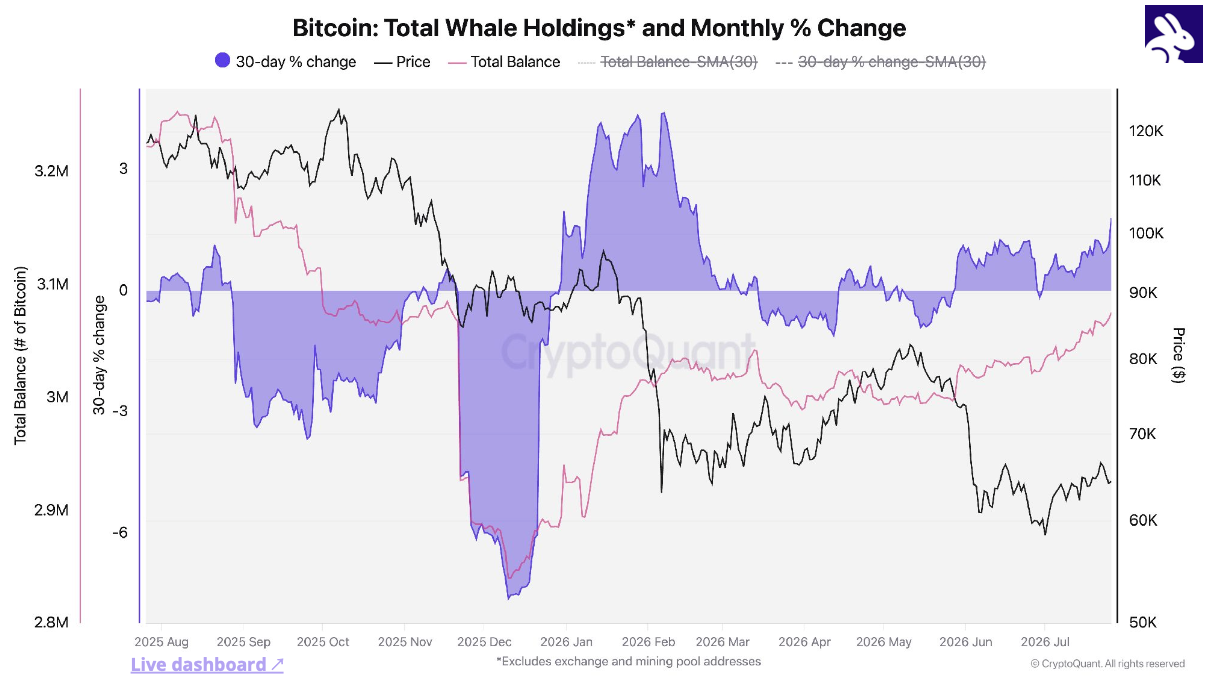
Source: CryptoQuant

Ethereum wallets holding 10,000 to 100,000 ETH collectively held a record 19.6 million ETH, while wallets holding more than 100,000 ETH added roughly 1.8 million ETH since mid-2025.

In XRP markets, average spot order sizes remained in CryptoQuant’s “big whale” category as the token traded between $1 and $1.20. However, neutral 90-day taker cumulative volume delta suggested passive absorption rather than aggressive buying, the report said.

Related: Bitcoin may have bottomed before its traditional cycle low: Grayscale’s Pandl

Valuations point to late-stage bear market

CryptoQuant also pointed to realized price, an estimate of the market’s average onchain cost basis, as evidence that the market may be approaching a bottom.

Bitcoin traded at $63,935 at the time of writing, according to CoinGecko, above its realized price of $52,900. Ether traded at $1,858, below its realized price of about $2,450. XRP traded at roughly $1.10 compared with a realized price of about $0.75.

“Rising whale balances into price weakness is the clearest smart-money tell,” CryptoQuant said, adding that the accumulation pattern has historically preceded market bottoms while cautioning that the market remains exposed to further downside.

CryptoQuant’s analysis comes as other researchers have also identified potential bottoming indicators.

On Monday, 10x Research said Bitcoin could confirm a bear-market bottom with a monthly close above $63,000. K33 said in a July 7 report that Bitcoin has historically reached cycle lows within weeks after more than half of its circulating supply was held at a loss.

Magazine: Do the Coldcard attacks mean all hardware wallets are now insecure?

Trending Cryptos

Related Questions

QAccording to CryptoQuant's report, what actions are large cryptocurrency holders (whales) taking as the bear market nears its late stage?

ALarge cryptocurrency holders (whales) are accumulating Bitcoin (BTC) and Ether (ETH) as valuations approach levels associated with the final stage of a bear market.

QWhat was the reported change in Bitcoin whale holdings (excluding exchanges and mining pools) from December 2025 to the time of the report?

ABitcoin whale holdings, excluding exchanges and mining pools, rose to about 3.06 million BTC from 2.87 million BTC in December 2025.

QHow does CryptoQuant interpret rising whale balances during price weakness, and what historical pattern does it mention?

ACryptoQuant interprets rising whale balances during price weakness as a 'smart-money tell' that can reduce available supply and concentrate ownership. The report adds that this accumulation pattern has historically preceded market bottoms.

QAccording to the article, what did CryptoQuant point to as evidence that the market may be approaching a bottom, besides whale accumulation?

ACryptoQuant also pointed to the 'realized price' (an estimate of the market's average on-chain cost basis) as evidence that the market may be approaching a bottom.

QWhat are two specific price-based conditions or analyses mentioned by other research firms (10x Research and K33) that could indicate a Bitcoin bear market bottom?

A10x Research suggested Bitcoin could confirm a bear-market bottom with a monthly close above $63,000. K33 stated in a July 7 report that Bitcoin has historically reached cycle lows within weeks after more than half of its circulating supply was held at a loss.

Related Reads

Robinhood's Bigger Basket

"Robinhood's Bigger Basket" A few weeks ago, the author described Robinhood as a financial supermarket, bundling services from stocks to crypto. After watching the Q2 2026 earnings call, this view was seen as an understatement. The real power is not just attracting new customers, but making existing users engage more deeply. Key performance highlights: * Revenue surpassed $5B annualized, faster than legacy brokers like Charles Schwab. * Paying users grew 7% YoY to 28.4M, but Average Revenue Per User (ARPU) surged 24% to $187. * User activity intensified: per-user stock notional volume rose 56% and options contracts rose 43%, while the number of users trading these assets grew much slower (13% and 3% respectively). The Robinhood Gold subscription is a critical engine. Nearly half of new users sign up for Gold, which then acts as a gateway. Gold users hold 4.2x more assets and are 3.1x more likely to use retirement products than regular users. This creates a powerful cross-sell flywheel where using one product (e.g., prediction markets) increases adoption of others (e.g., IRAs). The future catalysts are Robinhood Chain and the upcoming Robinhood Social feed. * **Robinhood Chain** integrates services (tokenized stocks, lending, perpetuals) into a single, composable platform, reducing friction for cross-product usage. * **Robinhood Social** will internalize the trading idea generation process. Verified portfolios within the app could build trust and move the entire "idea-to-execution" loop inside Robinhood. Together, these act as neutral layers that drive engagement and value accumulation across Robinhood's ecosystem, similar to how Costco's store layout drives membership sales. Despite cyclical concerns in areas like crypto trading, Robinhood's diversified portfolio of 13 business lines each with over $100M in Annual Recurring Revenue (ARR) creates stability. Different product cycles offset each other within a single user's account. The company's unique advantage is transforming a single customer relationship into a compounding, self-diversifying revenue node spanning traditional and crypto finance, amplified by its native blockchain.

marsbit52m ago

Robinhood's Bigger Basket

marsbit52m ago

Germany's Decades-Long Lead Lost as China's Machine Tools Quietly Rise to Global No.1

For decades, Germany held the top spot in global machine tool exports, but in 2025, China officially surpassed it for the first time, with its export value reaching 21% of the global market share. This article explores how China transformed from a heavily import-dependent nation to an export leader in this foundational industry for modern manufacturing. It begins by explaining the immense technical challenges in building high-end machine tools. Precision machining faces persistent physical obstacles like thermal expansion, vibration, and component wear, demanding top-tier core components like spindles, ball screws, and CNC systems. Historically, China relied on imports for over 90% of these critical components, and domestic machine tools suffered from short lifespans between failures (MTBF), making them unreliable for industrial use. The article credits the state-backed "04 Special Project" (2009-2020) for laying a crucial foundation. It boosted the market share of domestic high-end CNC systems from below 1% to nearly 32% and significantly improved overall machine reliability. However, the primary driver for China's rise was the massive and fast-evolving domestic market, particularly in the new-energy vehicle (NEV) sector. This created unique, high-demand applications like machining large integrated die-castings and complex battery housings. Domestic manufacturers, being close to the world's largest NEV market, rapidly iterated products to meet these new needs, gaining an edge over foreign competitors in certain emerging segments. Despite reaching the top spot in export value, the article stresses this is just a beginning. The current exports are often in specific categories like special-purpose processing machines (e.g., laser, EDM), with key markets in Asia and emerging economies. Furthermore, part of the "Chinese" export volume comes from foreign-owned factories within China. The true test for China's machine tool industry will be building the global trust and service infrastructure required for long-term, reliable operation overseas. The journey from being a buyer restricted by others' export controls to becoming a seller who must manage sensitive equipment exports and build a global support network has just entered a new, more demanding phase.

marsbit1h ago

Germany's Decades-Long Lead Lost as China's Machine Tools Quietly Rise to Global No.1

marsbit1h ago

Trading

Spot

Hot Articles

What is $BITCOIN

DIGITAL GOLD ($BITCOIN): A Comprehensive Analysis Introduction to DIGITAL GOLD ($BITCOIN) DIGITAL GOLD ($BITCOIN) is a blockchain-based project operating on the Solana network, which aims to combine the characteristics of traditional precious metals with the innovation of decentralized technologies. While it shares a name with Bitcoin, often referred to as “digital gold” due to its perception as a store of value, DIGITAL GOLD is a separate token designed to create a unique ecosystem within the Web3 landscape. Its goal is to position itself as a viable alternative digital asset, although specifics regarding its applications and functionalities are still developing. What is DIGITAL GOLD ($BITCOIN)? DIGITAL GOLD ($BITCOIN) is a cryptocurrency token explicitly designed for use on the Solana blockchain. In contrast to Bitcoin, which provides a widely recognized value storage role, this token appears to focus on broader applications and characteristics. Notable aspects include: Blockchain Infrastructure: The token is built on the Solana blockchain, known for its capacity to handle high-speed and low-cost transactions. Supply Dynamics: DIGITAL GOLD has a maximum supply capped at 100 quadrillion tokens (100P $BITCOIN), although details regarding its circulating supply are currently undisclosed. Utility: While precise functionalities are not explicitly outlined, there are indications that the token could be utilized for various applications, potentially involving decentralized applications (dApps) or asset tokenization strategies. Who is the Creator of DIGITAL GOLD ($BITCOIN)? At present, the identity of the creators and development team behind DIGITAL GOLD ($BITCOIN) remains unknown. This situation is typical among many innovative projects within the blockchain space, particularly those aligning with decentralized finance and meme coin phenomena. While such anonymity may foster a community-driven culture, it intensifies concerns about governance and accountability. Who are the Investors of DIGITAL GOLD ($BITCOIN)? The available information indicates that DIGITAL GOLD ($BITCOIN) does not have any known institutional backers or prominent venture capital investments. The project seems to operate on a peer-to-peer model focused on community support and adoption rather than traditional funding routes. Its activity and liquidity are primarily situated on decentralized exchanges (DEXs), such as PumpSwap, rather than established centralized trading platforms, further highlighting its grassroots approach. How DIGITAL GOLD ($BITCOIN) Works The operational mechanics of DIGITAL GOLD ($BITCOIN) can be elaborated on based on its blockchain design and network attributes: Consensus Mechanism: By leveraging Solana’s unique proof-of-history (PoH) combined with a proof-of-stake (PoS) model, the project ensures efficient transaction validation contributing to the network's high performance. Tokenomics: While specific deflationary mechanisms have not been extensively detailed, the vast maximum token supply implies that it may cater to microtransactions or niche use cases that are still to be defined. Interoperability: There exists the potential for integration with Solana’s broader ecosystem, including various decentralized finance (DeFi) platforms. However, the details regarding specific integrations remain unspecified. Timeline of Key Events Here is a timeline that highlights significant milestones concerning DIGITAL GOLD ($BITCOIN): 2023: The initial deployment of the token occurs on the Solana blockchain, marked by its contract address. 2024: DIGITAL GOLD gains visibility as it becomes available for trading on decentralized exchanges like PumpSwap, allowing users to trade it against SOL. 2025: The project witnesses sporadic trading activity and potential interest in community-led engagements, although no noteworthy partnerships or technical advancements have been documented as of yet. Critical Analysis Strengths Scalability: The underlying Solana infrastructure supports high transaction volumes, which could enhance the utility of $BITCOIN in various transaction scenarios. Accessibility: The potential low trading price per token could attract retail investors, facilitating wider participation due to fractional ownership opportunities. Risks Lack of Transparency: The absence of publicly known backers, developers, or an audit process may yield skepticism regarding the project's sustainability and trustworthiness. Market Volatility: The trading activity is heavily reliant on speculative behavior, which can result in significant price volatility and uncertainty for investors. Conclusion DIGITAL GOLD ($BITCOIN) emerges as an intriguing yet ambiguous project within the rapidly evolving Solana ecosystem. While it attempts to leverage the “digital gold” narrative, its departure from Bitcoin's established role as a store of value underscores the need for a clearer differentiation of its intended utility and governance structure. Future acceptance and adoption will likely depend on addressing the current opacity and defining its operational and economic strategies more explicitly. Note: This report encompasses synthesised information available as of October 2023, and developments may have transpired beyond the research period.

1.5k Total ViewsPublished 2025.05.13Updated 2025.05.13

What is $BITCOIN

Discussions

Welcome to the HTX Community. Here, you can stay informed about the latest platform developments and gain access to professional market insights. Users' opinions on the price of BTC (BTC) are presented below.

活动图片