Podcast Source: Creative Planning
Compiled & Edited: Deep Tide TechFlow
- Host: Charlie Bilello (Chief Market Strategist, Creative Planning)
- Guest: Jamie Battmer (Co-Chief Investment Officer, Creative Planning)
- Release Date: 2026-08-01
- Core Topics of this Episode: Sustainability of Asset Rotation, Semiconductors & Leverage Blow-ups, IPO Flood, Divergence Between Inflation and Bond Markets, Fiscal Deficit, AI Capital Expenditure Cycle, Employment & Business Formation Data.
- Disclaimer: Charlie Bilello and Jamie Battmer are both employees of Creative Planning. The firm is one of the largest independent Registered Investment Advisors (RIAs) in the U.S., with officially disclosed managed/advised assets of approximately $370B+ (as of June 2025). This episode focuses on broad market, sector, and macro frameworks and does not recommend any single security. However, the episode itself serves a client acquisition purpose for the Creative Planning brand. A standard disclaimer is presented at the video's beginning: the content does not constitute personalized investment advice.
Deep Tide Introduction: History doesn't repeat, but it often rhymes. This phrase echoes through almost every topic in this episode: value stocks, small-cap stocks, and emerging markets, neglected for 15 years, collectively staged a comeback; the semiconductor sector, after skyrocketing 237% in 14 months, gave back 20% in one month; a leveraged fund was halved in a month and forced to sell its positions to Citadel; SpaceX surged to a $3 trillion market cap upon listing only to quickly fall below its IPO price; IPO fundraising in 2026 to date has already surpassed the peak of the 2021 bubble. Meanwhile, the four major cloud providers' Q1 capital expenditures exploded by 87% year-over-year, Google recorded negative free cash flow for the first time in its history, Meta's free cash flow shrank by 91% year-over-year – asset-light tech giants are rapidly becoming capital-intensive companies. And the most dissonant voice comes from the bond market: core PCE has been above 2% for 64 consecutive months, and the 30-year Treasury yield hit a 19-year high of 5.2%. This is the first time in history that long-term rates have risen instead of fallen during a Fed easing cycle. The Chief Market Strategist and Co-Chief Investment Officer of Creative Planning, one of the largest independent investment advisors in the U.S., connected these threads into an August market map in 44 minutes.
Key Points Summary
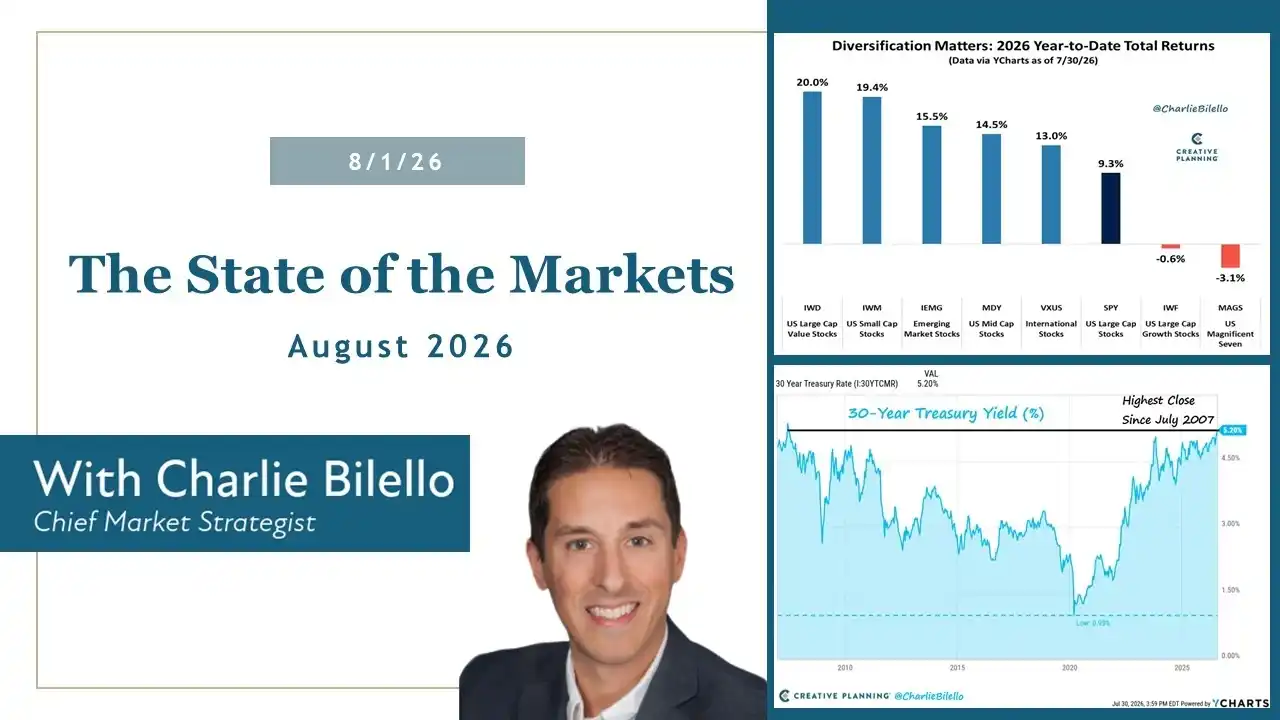
- Significant asset rotation this year: Value stocks up ~20%, small caps 19%, emerging markets 15%, international stocks 13%; U.S. large caps up 9%, but growth stocks slightly down, Magnificent 7 down 3%.
- This is a mean reversion after 15 years of one-sided outperformance by growth/tech stocks, but both host and guest agree this does not constitute a reason to chase value stocks or switch portfolios.
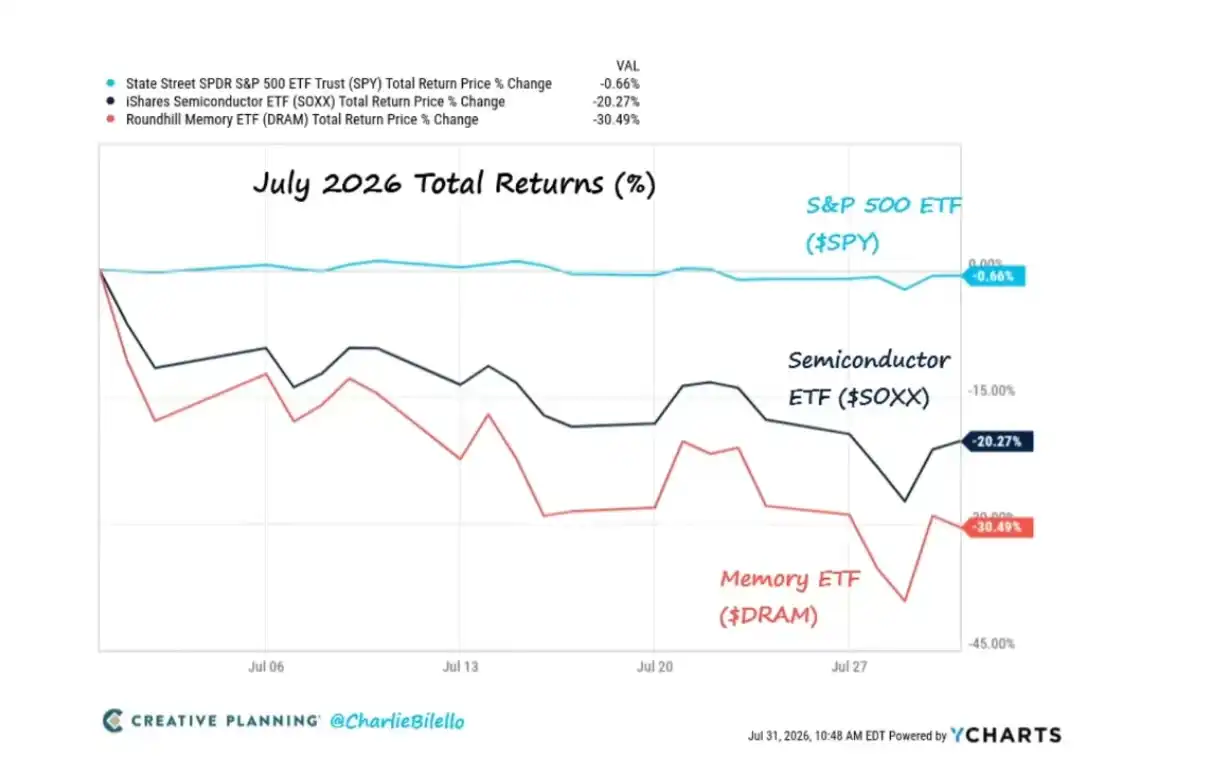
- The semiconductor sector showed what Charlie calls "speculative mania" by late June, rising 237% in 14 months, exceeding the run-up to the peak of the internet bubble; in July, the semiconductor index fell 20%, a DRAM ETF fell 30%.
- Korean retail investors with leveraged bets on SK Hynix and Samsung faced margin calls; the U.S. hedge fund Situational Awareness suffered extreme losses due to leveraged semiconductor bets, plummeting 67% in July and forced to sell positions to Citadel.
- After its IPO, SpaceX's market cap briefly exceeded $3 trillion, surpassing Google and Amazon, with a P/S ratio over 150x; it has since retreated over 50% from its high and fallen below the IPO price.
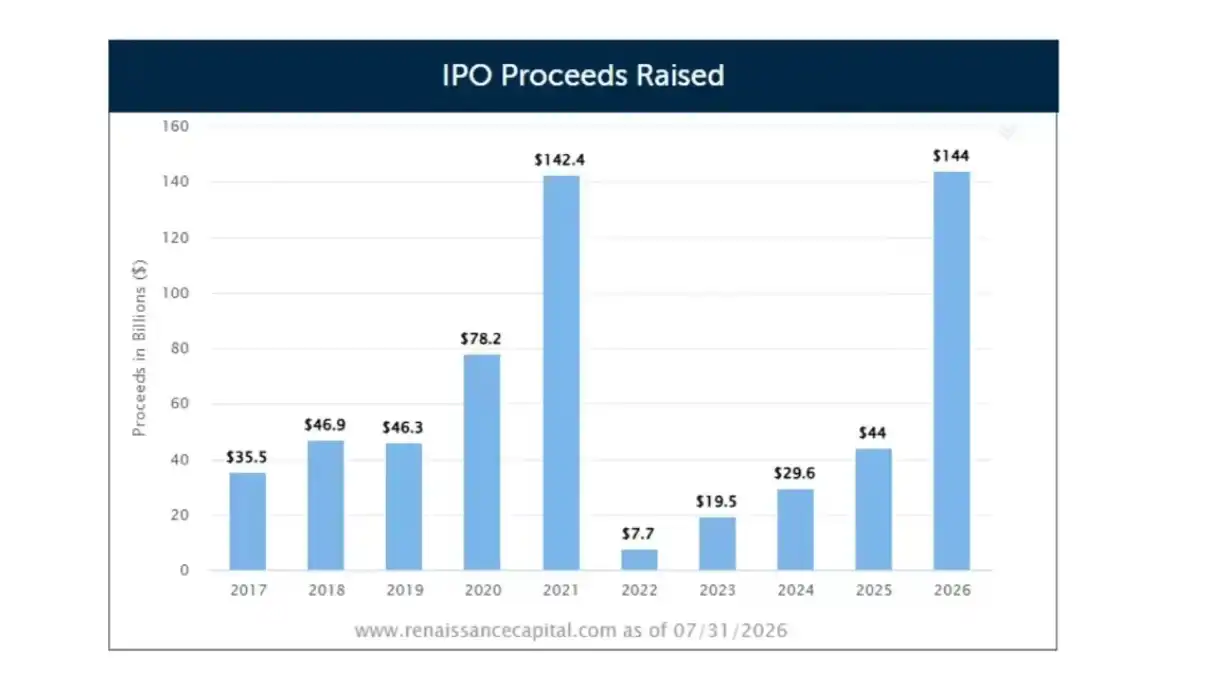
- U.S. IPO fundraising in 2026 to date is about $144 billion, already exceeding the 2021 peak; mega IPOs like OpenAI and Anthropic could further increase market supply.
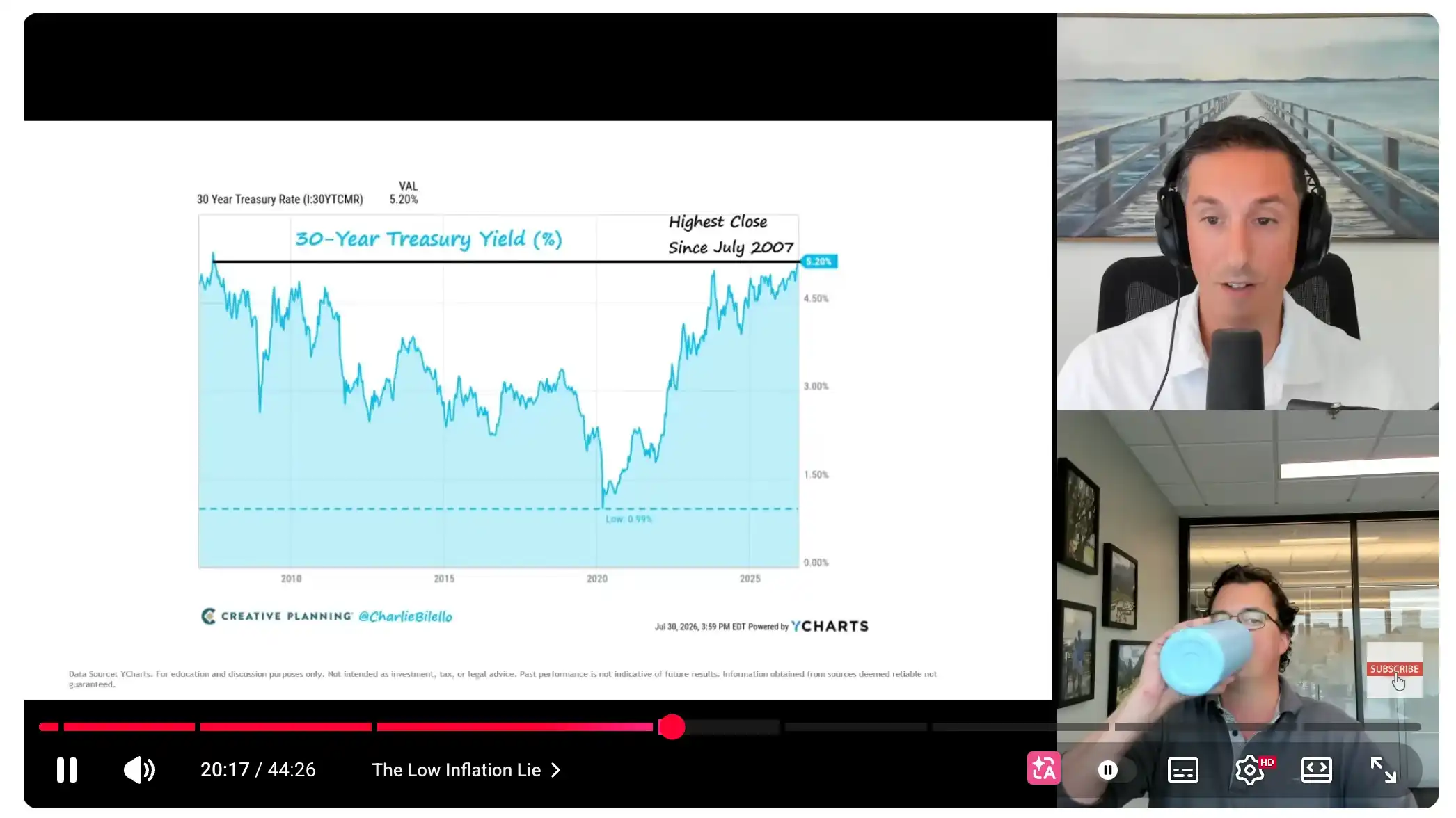
- Core PCE has been above 2% for 64 consecutive months; the 30-year Treasury yield rose to 5.2%, the highest since July 2007, and the first time it has risen instead of fallen during a Fed easing cycle.
- Average U.S. inflation over the past six years has been ~4%, double the target; the market is pricing in a 25 bps rate hike for September.
- U.S. Treasury debt has increased over $400 billion since July 1, nearing $40 trillion total; neither "growing out of debt" nor "tariff revenue repaying debt" narratives have materialized.
- The four hyperscalers (Amazon, Google, Microsoft, Meta) combined Q1 capital expenditure was $165 billion, up 87% year-over-year and 393% compared to three years ago.
- Google recorded negative free cash flow for the first time; Meta's free cash flow plummeted from $14 billion to $784 million, down 91% year-over-year.
- Initial jobless claims dropped to the lowest level since January 2024; new business formations in the information technology sector hit a record high, with barriers to starting a one-person company significantly lowered.
Excerpts of Notable Insights
- "These more value-oriented assets are finally outperforming after a long period of underperformance, but don't run out and chase them. It's like everyone rushing into value stocks after the 2000 tech crash, or pouring into BRICS after emerging markets doubled over a decade – it's often precisely the wrong time."
- "The four most expensive words in the history of financial innovation: 'This time is different.'"
- "The Fed says inflation is under control, but the bond market completely disagrees. A 5.2% yield on the 30-year, that's a 19-year high."
- "It's a disservice to drunken sailors to compare them to the federal government. At least the sailor eventually has to get back on the ship; the government's borrowing has no end."
- "The end of AI capital expenditure will either be running out of money, or someone in a dorm room figuring out a more efficient way. It's happened every time in history."
- "Excitement and investment returns are not correlated. Over the long term, it's often the boring things that win."
Chapter 1: Diversification Matters Again
Charlie Bilello: Over the past year, diversification became almost a dirty word. Many asked, why hold value stocks? Why hold small caps? Take these international stocks out of my portfolio. But this year, we've seen what I call "the great reversal." Value stocks up ~20%, small caps 19%, emerging markets 15%, mid caps 15%, international stocks overall up 13%. The U.S. market is still doing fine, up 9%, but growth stocks are actually slightly down this year, the Magnificent 7 is down 3%. How do you view this rotation? What lessons should investors take?
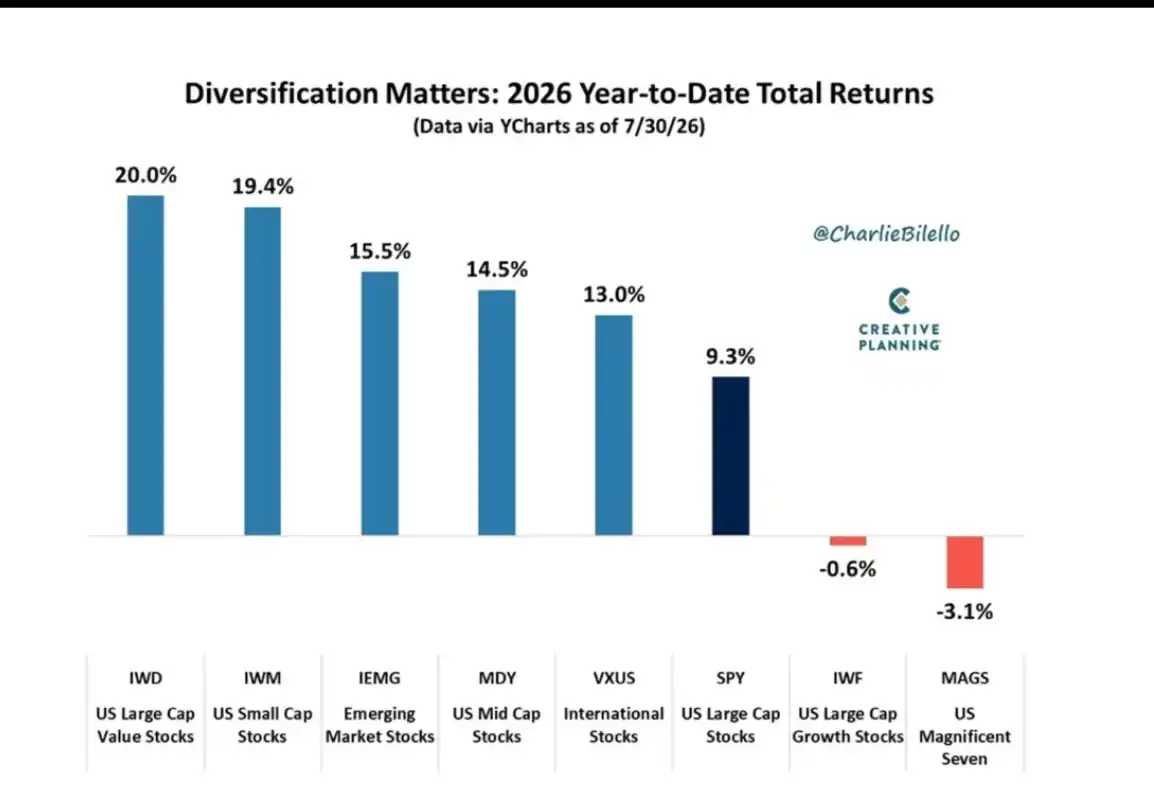
Jamie Battmer: Finally, and I'm actually glad. Because the one-sided outperformance of growth stocks, U.S. tech, had lasted about 15 years. The longer it goes, the more people tend to jump in and chase at the top. We've seen this movie too many times, in 2000, 2010. Back then, emerging markets and international stocks soared while U.S. large-cap tech fell 33%, and the S&P had nearly zero returns for a decade. So it's good to see this rotation happening. It means asset allocation and diversification are starting to work again, rather than everyone chasing the hot theme.
Charlie Bilello: Now, many questions we get are the opposite. A year ago, people asked "why hold these things," now they ask "value is up 20%, growth is down, this spread is one of the largest ever, is it too late for me to switch?" I'd show this chart, whether it's the large-cap/small-cap ratio or U.S./international ratio, it's the same story. Value relative to growth has just started to reverse, but we're coming off historical extremes, and this outperformance could very well continue for years. It won't be linear, of course, but given it was 15 years of persistent underperformance, just one year of reversal might still be early in terms of the timeframe.
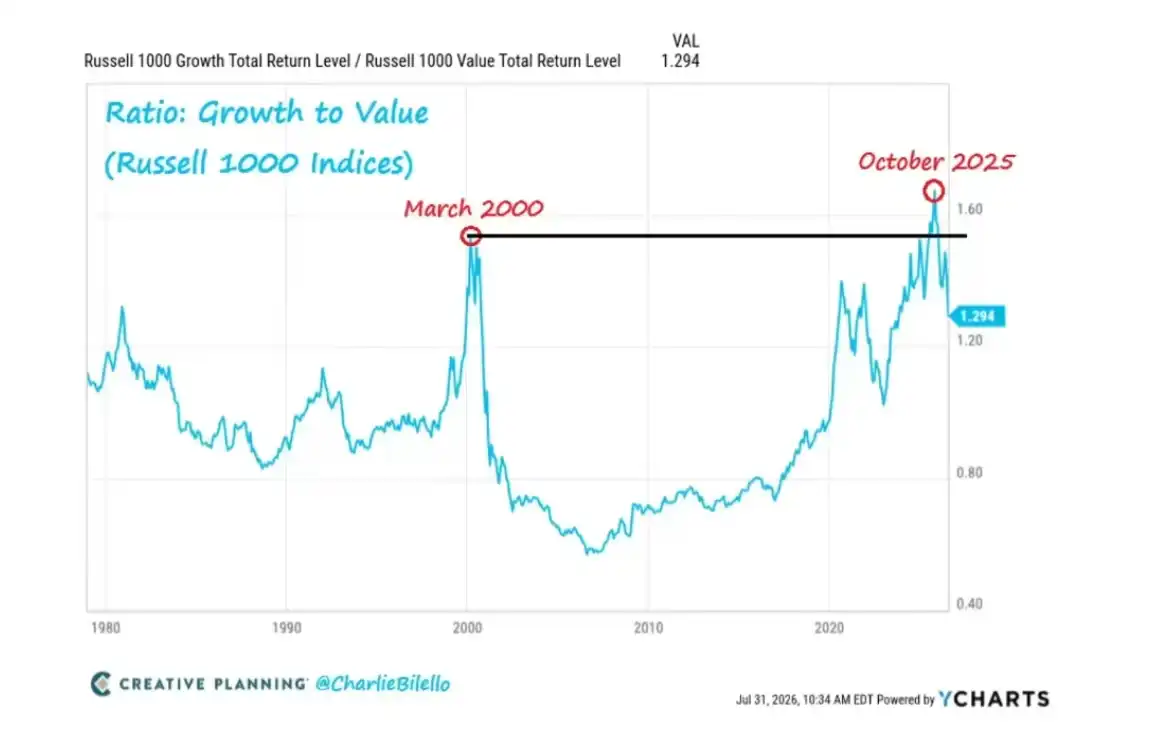
Jamie Battmer: Right, it could go on for another three months or another 30 years, nobody knows. But if you're already well-diversified, this becomes non-actionable for you. It's good that those long-lagging value-oriented assets are finally outperforming, but don't run out and chase them. Just like after the 2000 tech crash, people shifted their entire portfolio to value stocks and got the timing wrong; or after emerging markets surged over 100% in a decade, people piled into BRICS – also the wrong timing. These are parts of the portfolio; keep it balanced. It might reverse starting tomorrow for all we know long-term, but that's not a reason to adjust asset allocation.
Charlie Bilello: Totally agree. Predicting the future – if we could really do that, we should concentrate on what will win. But since we can't, that's why we diversify. We don't know what will happen, so we have to spread our bets, own everything.
Jamie Battmer: My crystal ball is as useless as anyone else's on Wall Street pretending to predict the future. The only difference is mine runs on a little battery, theirs charge an outrageous fee.
Chapter 2: Semiconductor Mania and Mean Reversion
Charlie Bilello: Next, I want to talk about what John Bogle called the "iron law of financial markets," mean reversion. The most overextended area before July, in my view, was semiconductors. I spent a lot of time on it, and the only term is speculative mania. We saw the sector rise 237% in 14 months, which even exceeded the run-up to the peak of the internet bubble. In the weeks before the peak, massive flows poured into semiconductor ETFs, the so-called "chase." There was a DRAM ETF, holding essentially three stocks, that raised nearly $30 billion in about 30 days, becoming the fastest-growing ETF ever. That almost never ends well. In July, the S&P was basically flat, down less than 1%, but semiconductors fell 20%, that DRAM ETF fell 30%. Did you hear a lot of people talking about semiconductors in June? Were many asking if they should buy?
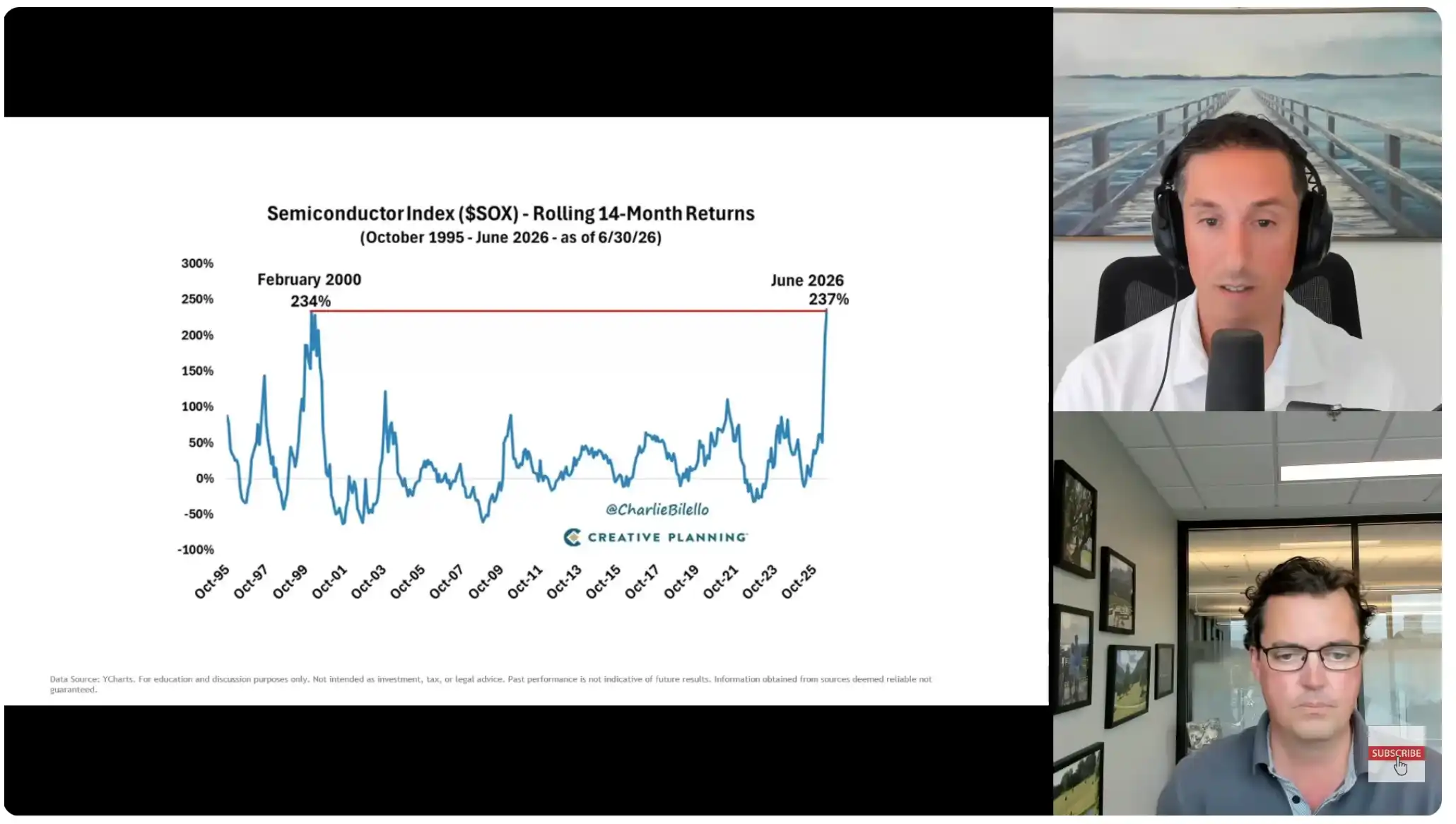
Jamie Battmer: Absolutely. The societal excitement about AI's step-change was so intense, everything semiconductor-related got bid up to the moon. You could argue about whether Nvidia is expensive – it's a large, legitimately profitable company. But many companies that rode along aren't large, aren't well-managed, just hitching a ride. It's like the last tech bubble, where adding .com to your name got you a 50% pop. Interestingly, our clients weren't overly participating, occasional questions. But from a portfolio management perspective, it did affect our public holdings. We do a lot of tax efficiency optimization and try to balance for clients holding large Nvidia positions with huge unrealized gains. When these extreme deviations based on greed and irrational exuberance happen, they create many challenges. But these things eventually self-correct, as recent data shows. It's a reminder not to get swept up in irrational excitement, not to chase.
Charlie Bilello: There's also a lesson about leverage here. We saw a proliferation of leveraged ETFs and related products, many stories about margin accounts. In Korea, massive retail blow-ups from leveraged bets on SK Hynix and Samsung. In the U.S., there was a hedge fund named Situational Awareness, somewhat ironic as they seemed to lack it. They took extreme leveraged bets on semiconductors, grew from a few hundred million to $45 billion in a few years, one of the fastest-growing hedge funds in the U.S., then it blew up. Essentially a margin call, forced to sell most of its stock positions to Ken Griffin's Citadel.
Jamie Battmer: That's basically a synonym for "we disappointed you this month," sorry, we're human. Humans get lit up by things and scared by things. All data overwhelmingly shows humans cannot beat public markets. Don't try to beat it; the optimal strategy is to own it. So when we design portfolios, we assume "this month might disappoint you." Markets may fall, economies may weaken, it will happen, but the portfolio is prepared for that and will recover. But when people overweight into these things, you get headlines like "sorry, we got greedy, excited, disappointed you." Those headlines are as old as newspapers.
Charlie Bilello: This fund was down 67% in July, clearly not what investors signed up for, although given its prior massive gains, extreme volatility was expected. As always, the problem is investors chasing past performance. They didn't get the upside but are getting the downside. A very true saying in investing is, you have to live to fight another day. When you use leverage and that leverage meets extreme volatility, you may lose that chance to fight another day. That's a good lesson for all investors.
Chapter 3: IPO History Rhymes Again
Charlie Bilello: Third topic, history rhyming again. We all know the saying, history doesn't repeat but often rhymes. I've been talking about the IPO market. In the first few days of SpaceX's listing, I posted many cautionary notes, saying its market cap briefly exceeded $3 trillion, higher than Google and Amazon, with a P/S over 150x. Many said, Charlie, you don't understand this company, this time is different, it won't have the typical IPO pattern. But as of today, the stock is down over 50% from its high, below the IPO price, below the first-day close. This time wasn't different, just as you wrote in your last quarterly letter.
Jamie Battmer: Thanks Charlie for throwing that back at me; actually, I stole all these charts from you. But seriously, that phrase "this time is different," Mark Twain's history rhyming, and my favorite book *This Time Is Different: Eight Centuries of Financial Folly* tell us this isn't just the last 15, 30 years, but something that's happened for a millennium. It goes back to human nature. It's normal for people to get excited; we have many excited clients too. If we can help them get a relatively higher allocation through our custodial partners and they want it, we'll arrange it, but the data tells us not to. What amazes me is Wall Street's pretense of knowing the future. Ask a hundred people if hot IPOs are good, should you participate, the answer is mostly yes. If those people held signs saying "come buy this IPO, on average you'll lose a third in a year," nobody would buy. But Wall Street manages to drum people in again and again.
Charlie Bilello: They are great salespeople, no doubt. The demand was there, oversubscribed many times. We've seen this movie; excitement peaks in the first few days of trading, and you're essentially providing exit liquidity for others. The sellers are those who bought at the IPO price. Next week we'll see the first real test, because SpaceX insiders and early investors haven't been allowed to sell yet. First earnings next week, two days later the first batch can sell. So that's the real test. If you have 10x, 20x, 30x paper gains on SpaceX, do you sell some? That seems a high-probability event.
Jamie Battmer: We have hundreds of SpaceX employee clients or related individuals. The key is, you can't control what the market does; things like lock-up periods of 3, 6 months are completely outside your control. But proper estate planning, risk mitigation, risk management – those are what you should focus on. That's what we do for SpaceX employee clients. For Anthropic, OpenAI, or anyone holding highly appreciated assets, future public market moves are a guessing game, but there's much you can control unrelated to stock price. That's the focus, not guessing where the stock goes tomorrow. Of course, what happens as lock-ups gradually expire is worth watching.
Charlie Bilello: And it's not over, five months left this year. Looking at this chart, U.S. IPO fundraising is already at a record, about $144 billion year-to-date 2026, surpassing the 2021 bubble peak. Of course, SpaceX contributed most. But as I've said, historically, whether 2021 or 2000, when such massive supply waves hit, when people are looking for exit liquidity, it often signals tougher markets ahead. Might not happen this time, but if history rhymes, it wouldn't be surprising if the IPOs of OpenAI, Anthropic coincide with a more difficult market period. Because supply suddenly increases so much.
Jamie Battmer: Right, Charlie and I have both been at this over 20 years. Those who remember the last tech mania, that was the last time there was such excitement about individual names. 2021 was more SPACs and financial engineering, but this excitement around names like SpaceX, Anthropic, brings back the vibe of Google, Facebook, even pets.com – we haven't seen that in 25 years. Those who lived through it know the endings usually aren't pretty; investors need to remember that now.
Charlie Bilello: Excitement and investment returns aren't correlated. Long-term, it's often the boring things that win. When Anthropic and OpenAI go public, there will be huge excitement, stocks might surge initially, but be wary of chasing that move expecting it to continue. S&P stood its ground this time, not changing rules to include SpaceX, the only index firm that didn't. Nasdaq changed, many large ETF issuers changed because demand was huge to include SpaceX. So far, sticking to the rules was right, as SpaceX isn't profitable, won't be index-eligible for at least a year.
Jamie Battmer: Short-term it worked well, long-term who knows. Zooming out, it speaks to a fact: 87% of companies with over $100 million revenue are still private. So we advise eligible clients to allocate to both public and private markets. Another Wall Street myth is that private markets are better, the holy grail. Not really, they're just different, for diversification. That way you get broader exposure to the entire economy. Short-term, SpaceX not being in indices is good, but future debates as more mega IPOs come will be interesting – will index firms hold their ground or compromise?
Charlie Bilello: And if you own a total market ETF, SpaceX's weight is only about 20 basis points due to low float. So exposure to SpaceX in a total market portfolio is tiny. But if you put 5%, 10%, 15%, 20% of your portfolio into SpaceX, that's a massive overweight, a huge bet.
Chapter 4: The Low-Inflation Lie and the Bond Market's Rebuttal
Charlie Bilello: Next, inflation, what I call the "low-inflation lie." The federal government and the Fed try to tell people inflation is under control, not that high. But the Fed's preferred inflation gauge, core PCE, has been above 2% for 64 consecutive months. Now we might be seeing the chickens come home to roost. The 30-year Treasury yield rose to 5.2%, the highest since July 2007, a 19-year high. The bond market is responding to many things, but certainly including this: inflation isn't as controlled as the Fed says, nor as close to the 2% target as implied. Another reminder: this is the first time during a Fed easing cycle that the 30-year yield not only didn't fall but is much higher than when easing began. To me, this signals a policy mistake and shows investor reluctance to hold long-term Treasuries.
Jamie Battmer: Hopefully, because you really shouldn't own bonds beyond what's needed for short- and intermediate-term cash flow needs. The risk also is someone saying "5% is nice, I can live off that." But data overwhelmingly shows bonds return about half of stocks long-term. And if rates spike like 2022, these so-called safe assets can fall 20%. A common misconception is bonds underperform long-term, but they also don't always provide shelter in a storm if the storm itself is rising rates. Back to your chart, inflation is the ultimate stealth tax, and many of these numbers we know are nonsense, like healthcare costs falling over the past decade – 100 out of 100 people know that's false. Take my household, three kids, midwest farm roots, eat a lot of bacon. Bacon prices have gone insane, I even have a pack saved in the freezer. I told the family, try cheaper bacon, the kids refused. So maybe they're just picky, or maybe it shows even ordinary folks feel the price hikes.
Charlie Bilello: Totally agree. The real issue is cumulative increase, something that bothers me. Listening to the Fed, they always talk about the last 12 months. But even that number, inflation is rising, not falling. The new Fed Chair, Kevin Warsh, was very hawkish this week. A quote from this week's press conference: "Household and business dissatisfaction with persistently high inflation has lasted 63, 64 months. We are on the job, we will deliver, we are laser-focused on doing so." Similar tough talk to his first conference in June. But so far no action, the Fed hasn't hiked, they're still doing some QE, balance sheet still expanding. And over the past six-plus years, U.S. inflation averaged ~4% annually, double the target. To me, the Fed must act. If you have a 2% target and want to regain inflation-fighting credibility, you need to hike. The market is pricing a 25 bps hike for September, I think that's a high probability. Your thoughts? Is the Fed behind?
Jamie Battmer: The only data-driven thought is, Wall Street's error rate predicting rates is as high as anything else. A year ago they predicted nine rate cuts, didn't happen. Interestingly, there's a misconception about the Fed Chair, thinking they're omnipotent, the alpha gorilla, but they're just one voting member. Almost like a president, gets too much credit and blame, but they're just one human voice pretending to know the future. Alan Greenspan was Fed Chair a long time, even wrote a book *Maestro*, saying he orchestrated everything. Then the worst recession since the Great Depression happened, many policies enacted under him. Conversely, Paul Volcker in the 70s/early 80s was blamed for causing recession, costing Carter the 1980 election to Reagan, because the Fed aggressively fought inflation. So yes, prices remain stubbornly high, action seems necessary, but it's a balance. Nobody knows tomorrow. Fighting inflation hurts the average worker, but higher rates also hurt average workers, average businesses, small businesses – small businesses hurt more than large ones that can negotiate lower rates. So it's a balance, future data will tell, but the fact is prices just keep rising, rising, rising, never falling, and it's gone on too long, a severe hangover from COVID-era policies.
Charlie Bilello: Many factors indeed, I often talk about the Fed, but clearly it's not just them. The federal government and fiscal situation are a big part, but somehow the Fed now says "we don't talk about that, not our purview." Doesn't make sense. They must, should talk about it, because it's a big part of the inflation picture. But the Fed also has responsibility, keeping rates super low for so long, flooding the system, their MBS operations in 2020, 2021, absolutely insane measures that certainly fueled inflation, still fanning the flames. So I come back to this: if you have a 2% target, you must stick to it. We haven't achieved it for over five years, you should hike to address it. Doesn't mean only you can solve inflation, no, but that's your job, you should do something. I think September will see a hike, we'll have you back then.
Chapter 5: Fiscal Deficit: Outspending the Drunken Sailor
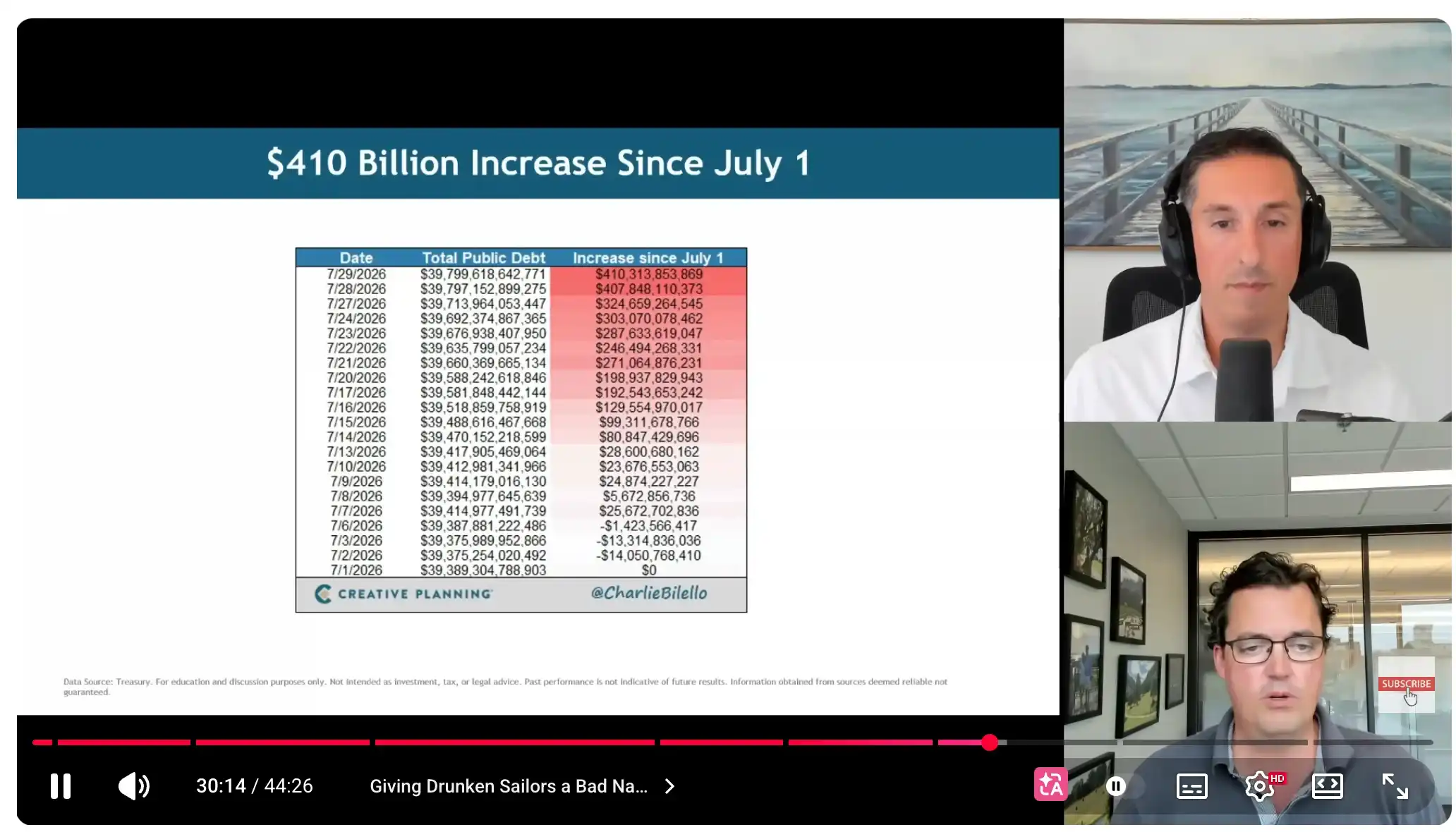
Charlie Bilello: Next topic, "A disservice to drunken sailors." The term sailor dates back to around the 17th century, they'd come ashore, spend all their sailing earnings on bars etc., until broke. I often say the federal government spends like a drunken sailor, but actually it's a disservice to drunken sailors. Because we not only spend the $7 trillion budget but also borrow beyond it. Since July 1, the national debt increased over $400 billion, an alarming pace. We're rapidly approaching $40 trillion in debt. Inflation isn't just the Fed's making; this massive borrowing and deficit spending, never stopped since COVID, is the elephant in the room few seriously discuss.
Jamie Battmer: Right, actually earlier, post-2008 it started, just getting worse. Any of us living like this would be in debtor's prison, kicked out of house, apartment, wouldn't work.
Charlie Bilello: Don't try this at home.
Jamie Battmer: Right. Back to drunken sailors, at least they eventually have to get back on the ship. Even if it's the Titanic, they leave, might hit an iceberg, but they're gone. Government borrowing never ends. Regardless of administration, it's stimulus, stimulus, more stimulus. Like a drug in medicine, once in the system, the economy says "more, more, more." The growth rate is frightening. I have three kids, was just complaining about bacon prices, half-joking, but the world's debt, obligations, checks we're writing, ultimately they may have to cash or mature. To me, that's leaving a terrible burden for future generations.
Charlie Bilello: I always say they'll pay for it somehow. Not necessarily direct repayment, more likely through inflation, lower future Social Security, etc. So we must do something. Also, the narrative that tariff revenue would balance the budget, repay debt – Scott Bessent earlier said with debt at $37.2 trillion tariffs could do it, now it's $39.8 trillion, clearly hasn't happened. Early 2025 at start of Trump's second term, many in administration talked about growing out of debt, discussing 5%, 6%, 7% real GDP growth. Nice on paper, hard in reality. 2024 growth 2.8%, 2025 2.1%, Q1 this year 2.1%, latest GDP only 1.5%. So the grow-out-of-debt idea, unless you have post-WWII growth rates, if you only grow 1-2%, the solution is only one thing, nobody wants to do, won't until real crisis: cut spending. Must have discipline.
Jamie Battmer: Like someone saying you must eat healthier, exercise more. Until a major heart attack, it's not a thing; once it happens, it's the biggest thing. Will we grow out of debt? Maybe AI can do something. Maybe. But history says no. Will tariffs be the answer? Maybe. History also says no. I mentioned the new Fed, Greenspan, Volcker, also Ben Bernanke, as Fed Chair really put these massive debt policies into overdrive. Famous for understanding Great Depression causes, called it the Holy Grail of macroeconomics. But massive tariffs enacted during economic collapse, all data shows they worsened problems, dragged global economy into worldwide depression. So history says no. The future isn't written, but putting more roadblocks to capitalism, they're more likely to have negative than positive effects, the probability seems low.
Chapter 6: How Long Can the AI Capex Dance Last?
Charlie Bilello: Two more topics. This is big, many things hinge on the AI infrastructure boom. Will we keep dancing until the music stops? Remember Chuck Prince's 2007 quote, he was Citigroup CEO, said they'd keep dancing until the music stops. Back then, big banks were dancing, then music stopped, financial crisis. Now, big tech is still dancing. Looking at Q1 earnings of Amazon, Google, Microsoft, Meta – the four hyperscalers, Oracle hasn't reported. Their capex all beat expectations. Combined Q1 $165 billion, staggering number, up 87% year-over-year, up 393% from three years ago. I keep asking, are we at least nearing peak capex growth rate? Nearing the music stopping moment? I suspect when it stops, it'll be because of this chart. Let's talk free cash flow. Last week I mentioned Google, first negative free cash flow in company history due to massive property & equipment spend on AI infrastructure. Meta got hit hard this week, free cash flow collapsed 91%, now just $784 million, last quarter $12 billion, quarter before $14 billion. Jamie, these companies were asset-light, that was part of their valuation premium, now they're rapidly transforming into capital-intensive businesses. Ultimately, will investors say "wait, I didn't sign up for this bleeding"? They were among the world's strongest free cash flow generators a few years ago, some now negative. These companies are giving all the money to semiconductor companies. How long can this last? Is today's growth rate sustainable? What would make them pull back spending plans?
Jamie Battmer: First, personally, I think Facebook is one of the most evil companies on Earth, so watching it burn cash doesn't bother me. But more broadly, infrastructure, we actually invest a lot in infrastructure. Like any asset class, you must avoid chasing the hot theme. Yes, there are hot elements, but also companies building roads, bridges, maintaining bridges, recycling centers, water purification plants. So don't dump an entire asset class, nor dump everything into one rapidly growing sector. Yes, it may keep growing, but we seem closer to the peak than the starting line. Interestingly, either they run out of money as this chart shows, or as has always happened, massive money and resources pour into something, making it expensive or depleting funds, then the next revolutionary innovation makes it more efficient. Maybe someone in a dorm room has the brilliant idea, leading to higher efficiency, reducing demand for such infrastructure. Hopefully at Stanford or University of Montana, not a North Korean government facility. But history's always been that way, oil price spikes drove more efficient extraction tech. Using history as a guide, the end might be they run out of money, or it fades slowly, or AI truly amazes for many, many years. Technological amazement might last our lifetimes, but there will be bumps, and the massive capital influx now, historically these are signs of irrational exuberance and danger.
Charlie Bilello: Right, these companies were asset-light, part of their high valuation, now rapidly becoming capital-intensive, and historically capital-intensive businesses haven't delivered great shareholder returns. Also quickly, this isn't even the latest financing arrangement – Nvidia announced $250 billion financing for OpenAI data centers. We're seeing more of these circular transactions, companies running out of money, either issuing debt or equity, even Google issued equity, which shocked me. They can no longer fund through free cash flow. OpenAI also doesn't seem to have enough money for its ambitions, now tied to Nvidia, Nvidia essentially guaranteeing financing for this project, using that to buy chips. This circular structure seems dangerous; looking back, Nvidia having to resort to this would be a danger signal.
Chapter 7: Positive Signals from Jobs and Business Formation
Charlie Bilello: Final topic, always end with something positive. Two very positive trends. First, late last year we often discussed labor market weakening, unemployment rising, even job losses outside recession. I called it the most confusing labor market ever. But past six months we've seen a reversal, jobs growing again, initial jobless claims dropped stunningly. Fears of AI causing mass unemployment, job losses persist, maybe future, but right now people aren't filing for unemployment en masse. Initial claims dropped to lowest since January 2024. On the other hand, regarding capex concerns, business formations in information technology are off the charts, as this chart shows. Massive new business creation, never easier to start a tech company, needing fewer employees, many one-person companies emerging. Regardless of market moves and returns, this leads to more innovation and competition. As you said, what ultimately cures high capital needs, high memory prices is innovation. Your thoughts on the labor market and surge in new businesses?
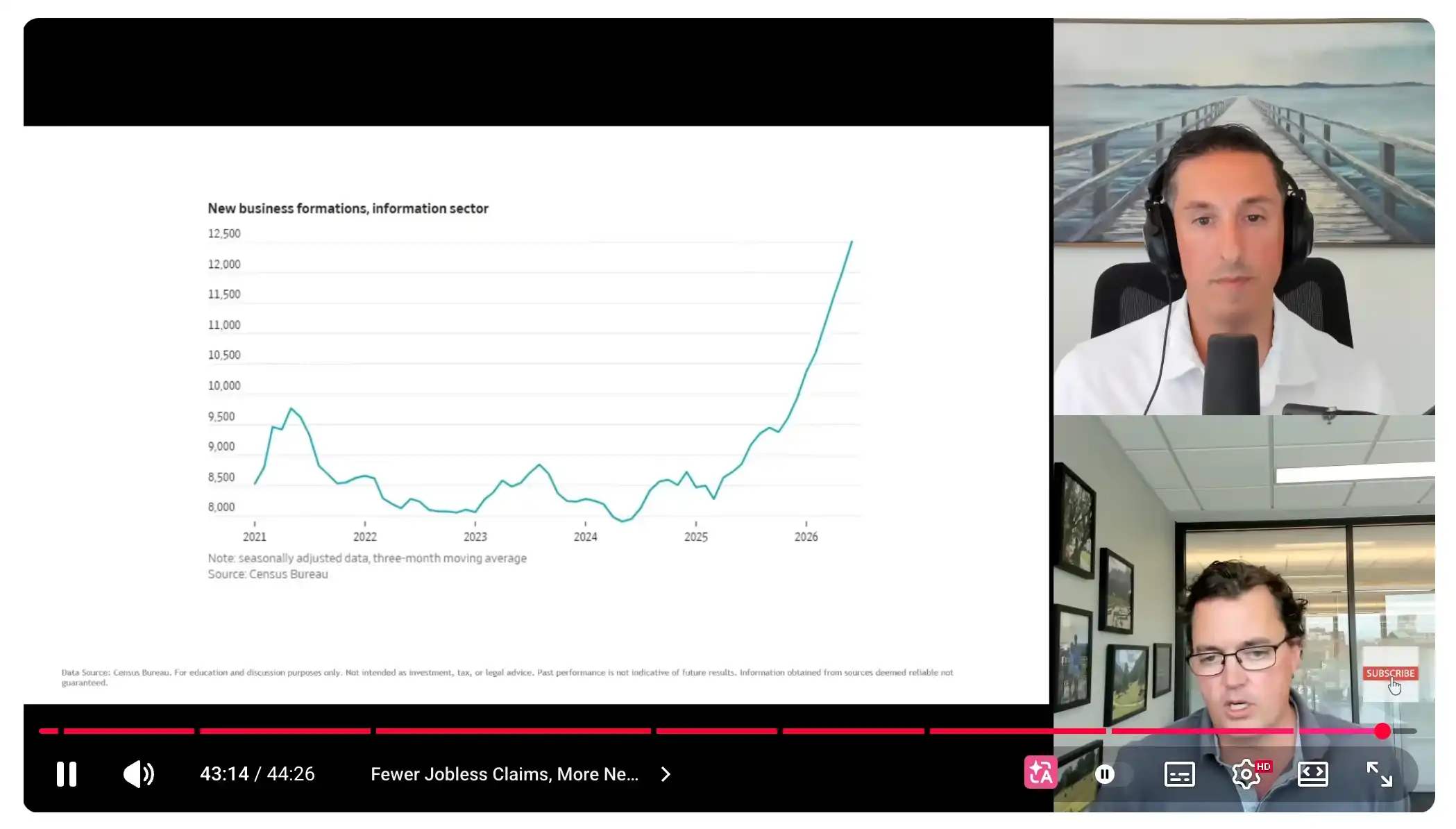
Jamie Battmer: I think it's great. It means someone has a good idea. You're right, the barrier to execution is dramatically lower. Someone stuck in a rut, tired of the daily grind, wanting to try something new – breaking that barrier is wonderful. Also glad fewer people have to go home and tell family they lost their job. AI may and will take some jobs, but history shows every technological quantum leap brought more jobs, more prosperity, more productivity. If this time is different, it'll be the exception to the rule. What works, what doesn't will change, but that's always changed. I think it's great, people with ideas, wanting change, can truly go for it, chase the American Dream. Many say the American Dream is dead, but data paints the opposite picture.
Charlie Bilello: Great. Jamie, great show today, thank you.
Jamie Battmer: Thanks Charlie.