Industry NewsNews

Tracks company news, strategic changes, funding activities, and personnel adjustments across the blockchain and crypto industries, delivering a full-spectrum industry overview for our users.

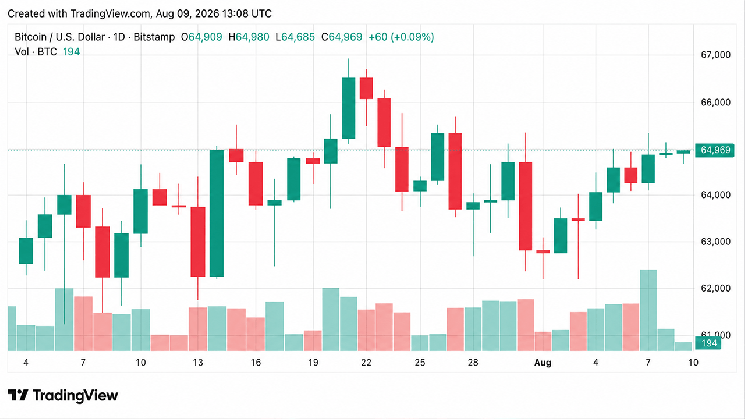
Bitcoin Price Remains Virtually Unchanged Amid Mass Coldcard Withdrawals and BIP-110 Failure

Bitcoin's price remained unusually stable, trading in a narrow range between roughly $64,500 and $65,250 over the weekend of August 9, 2026, despite two significant events. First, a security flaw in Coldcard hardware wallets led to substantial thefts, with high-confidence estimates ranging from 1,596 to 1,719 BTC (approx. $133M). The market appeared to view this as a product-specific security failure rather than a systemic Bitcoin issue, as the stolen coins were a tiny fraction of circulating supply and network operations continued normally. Second, the attempted activation of BIP-110, which required 55% miner signaling, failed dramatically, achieving only about 2.53% support. A minority chain formed but quickly stalled, controlling only a tiny fraction of the network's hash rate while inheriting Bitcoin's full mining difficulty, leaving it effectively dead in the water. Throughout both episodes, Bitcoin's price showed no sharp reaction. Technical indicators like the RSI and MACD were neutral, with immediate support seen at $64,000-$64,500 and resistance at $65,000-$65,500. The most notable aspect was the lack of a significant price move following a major wallet vulnerability and an actual chain split. Traders are now watching for a breakout from the $64,000-$66,000 corridor, which may depend more on liquidity, institutional ETF flows, and macroeconomic data than on these past events.

cryptonews.ru08/09 20:12

Bitcoin Price Remains Virtually Unchanged Amid Mass Coldcard Withdrawals and BIP-110 Failure

cryptonews.ru08/09 20:12

AMD Buys Taalas: Hardware AI Manages Without the Scarce HBM Memory

AMD has agreed to acquire Toronto-based startup Taalas, which addresses a major bottleneck in AI inference: the need to constantly transfer a neural network's model weights from memory to the processor for each token generated. Taalas's chips eliminate this operation by embedding the model weights directly into the transistors themselves. This data transfer is what currently limits inference speed and has made high-bandwidth memory (HBM) a critically scarce resource. Taalas, founded in 2023, has developed application-specific integrated circuits (ASICs). Its first test chip, fabricated on TSMC's 6nm process, reportedly ran Meta's Llama 3.1 8B model at speeds 48 times faster than Nvidia GPUs. The architecture features a mask ROM section for permanently stored weights and SRAM for adaptable components. AMD plans to integrate these chips into its Helios racks alongside its Instinct accelerators. However, this approach comes with a significant trade-off: each chip is permanently hardwired for a single model. Switching models requires a partial chip redesign, a process taking about two months even with Taalas's accelerated method. This limits its applicability to stable, widely-used models. The acquisition highlights a broader challenge in the semiconductor industry: the current memory shortage. HBM is sold out through 2026, and DRAM prices have surged. Yet, Taalas's technology demonstrates that this memory bottleneck is an engineering challenge, not an absolute physical limit. The industry is actively working on solutions, from Nvidia's model compression to Samsung's zHBM and new high-speed flash memory standards, all aimed at reducing reliance on scarce HBM. From an investment perspective, the deal challenges the assumption that AI-driven memory demand will keep prices permanently high. It serves as a reminder that memory has historically been a cyclical business, and current high prices are funding the very innovations designed to reduce future demand.

cryptonews.ru08/09 20:02

AMD Buys Taalas: Hardware AI Manages Without the Scarce HBM Memory

cryptonews.ru08/09 20:02

CryptoQuant Points Out Accumulation of Bitcoin, Ethereum, and XRP by Whales

Analysts at CryptoQuant have noted that large holders, or "whales," of Bitcoin, Ethereum, and XRP are accumulating these assets amid price pressure. Julio Moreno, head of research, stated that major holder groups are increasing their reserves while prices trade near or below their realized price. This behavior reduces selling pressure and resembles a final bear market phase. Bitcoin whale balances (excluding exchanges and mining pools) have risen to approximately 3.06 million BTC from a low of around 2.87 million in December 2025. The 30-day increase in whale balances has remained positive for most of 2026, with accumulation accelerating in June when Bitcoin's price approached $60,000. For Ethereum, the trend is mixed. Wallets holding 10,000 to 100,000 ETH have accumulated to a record 19.6 million ETH, while those with 1,000 to 10,000 ETH have reduced holdings from 15.6 million to 12.9 million ETH this year. Wallets with over 100,000 ETH increased their balance from 2.6 million to 4.6 million ETH. Moreno described this as capital concentration during a bear market. XRP whale activity is less direct, with large spot orders present in the $1-$1.2 range, but cumulative volume delta appears neutral, suggesting accumulation through absorbing supply rather than aggressive buying. Key current prices versus realized prices are: Bitcoin at ~$64,640 (realized $52,900), Ethereum at $1,900 (realized $2,450), and XRP at $1.1 (realized $0.75). Moreno noted the risk-reward ratio has declined, and while the model allows for another downside wave, accumulation by strong holders is a positive factor for when demand recovers.

cryptonews.ru08/06 11:14

CryptoQuant Points Out Accumulation of Bitcoin, Ethereum, and XRP by Whales

cryptonews.ru08/06 11:14

活动图片