Bitcoin’s Crash Triggered IBIT’s Biggest Trading Day, as $HYPER Keeps Pumping

bitcoinistPublished on 2026-02-06Last updated on 2026-02-06

Abstract

Bitcoin's recent crash triggered BlackRock's iShares Bitcoin Trust (IBIT) to record its second-worst daily price drop since launch, with a 13% decline erasing $10 billion in value. This volatility highlights a divergence between retail panic and institutional strategy, as major asset managers use the dip to accumulate Bitcoin at discounted prices through arbitrage opportunities in ETF mechanisms. Simultaneously, market focus is shifting from simple asset accumulation to functional utility. Capital is flowing into infrastructure projects like Bitcoin Hyper ($HYPER), which aims to solve Bitcoin's scalability and programmability issues. By integrating the Solana Virtual Machine (SVM) as a Layer 2 solution, Bitcoin Hyper promises sub-second transaction speeds and smart contract functionality while leveraging Bitcoin's security. The project's presale has raised over $31 million, indicating strong demand from whale investors. This reflects a broader trend where investors are betting on protocols that unlock Bitcoin's dormant capital for DeFi, gaming, and other high-throughput applications, signaling a maturation in the market's approach to Bitcoin's potential.

Trusted Editorial content, reviewed by leading industry experts and seasoned editors. Ad Disclosure

Quick Facts:

  • ➡️ The market crashes, causing BlackRock’s IBIT to experience its ‘second worst daily price drop since it launched’.
  • ➡️ Bitcoin Hyper uses the Solana Virtual Machine (SVM) to bring sub-second transaction speeds and smart contracts to the Bitcoin network.
  • ➡️ Whale wallets are actively accumulating presale tokens, with over $31M raised to build out the high-performance Layer 2 infrastructure.
  • ➡️ Market focus is shifting from simple asset holding to functional utility, favoring protocols that unlock Bitcoin’s liquidity for DeFi and gaming.

Bitcoin’s recent price action has been messy, exposing the widening gap between retail panic and institutional strategy. When spot prices tumble, the immediate retail reaction is often capitulation.

BlackRock’s iShares Bitcoin Trust (IBIT) reacted accordingly, recording the ‘second worst daily price drop since it launched‘, with $10B in the hole after a fall of 13%.
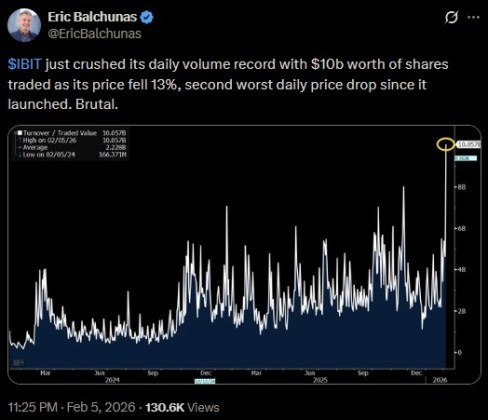
This inverse correlation suggests major asset managers are using deep liquidity to rebalance portfolios at discounted rates, effectively absorbing the sell-side pressure from fearful holders.

The mechanics are simple (though often missed). When Bitcoin crashes, the spread between the ETF’s Net Asset Value (NAV) and the spot price fluctuates, triggering arbitrage opportunities for Authorized Participants (APs).

These APs step in to create or redeem shares, resulting in massive trading volumes that seem to contradict the bearish price action. That matters because it signals a maturing market structure where volatility is no longer a bug, but a feature for high-frequency institutional accumulation.

While the ‘smart money’ is busy stacking the base asset, a second rotation is happening further out on the risk curve. Capital is flowing into infrastructure plays that promise to solve Bitcoin’s distinct lack of utility.

The market is shifting focus from merely holding digital gold to actually using it. Leading this charge is Bitcoin Hyper ($HYPER), a protocol designed to bridge the gap between Bitcoin’s security and high-speed execution. As ETF giants stabilize the floor, projects like Bitcoin

Hyper are raising the ceiling for what the network can actually achieve.

$HYPER is available here.

Bitcoin Hyper Merges SVM Speed With Bitcoin Security

Bitcoin development has always hit a wall: the ‘trilemma’ trade-off. The network is secure and decentralized, sure, but it’s also painfully slow for complex applications. Previous attempts to scale via sidechains often sacrificed security or user experience.

Bitcoin Hyper ($HYPER) changes the calculus by integrating the Solana Virtual Machine (SVM) directly as a Layer 2 solution. It’s not just a subtle upgrade; it’s a fundamental architectural shift.

By using the SVM, Bitcoin Hyper delivers sub-second finality and transaction costs that are effectively negligible, mirroring the performance that made Solana a DeFi favorite, but anchored to Bitcoin’s settlement layer.
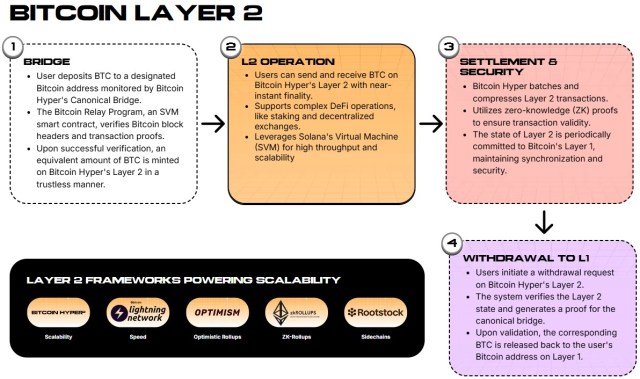
This addresses the critical lack of programmability in the Bitcoin ecosystem. Developers can now deploy high-speed Rust-based applications, from gaming dApps to high-frequency trading platforms, without leaving the security orbit of the world’s largest cryptocurrency.

The technical architecture relies on a modular approach: Bitcoin L1 handles the final settlement, while the SVM L2 handles real-time execution. A decentralized canonical bridge facilitates the transfer of assets, allowing users to move $BTC into a high-performance environment effortlessly.

This integration suggests the future of Bitcoin isn’t just as a store of value, but as a foundational layer for high-throughput commerce.

Check the $HYPER presale.

Presale Surpasses $31M as Whales Accumulate $HYPER

The market’s appetite for a functional Bitcoin Layer 2 is evident in the capital commitment metrics.

According to official data, Bitcoin Hyper has successfully raised $31.2M in its ongoing presale. That figure is significant, it implies massive demand for infrastructure that unlocks Bitcoin’s dormant capital ($1T) for DeFi use cases.
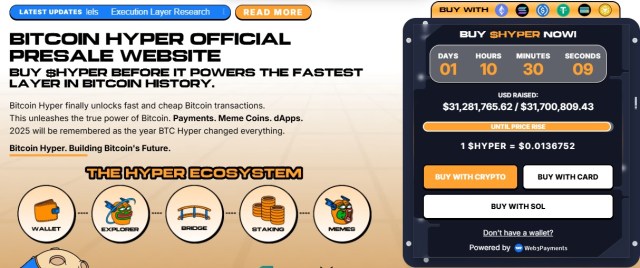
At the current token price of $0.0136752, early positioning appears to be a priority for smart money looking for asymmetrical upside compared to the mature Layer 1 asset.

Traders are also watching the staking incentives. The protocol offers immediate staking for presale participants with a high APY, designed to lock up supply early. Plus, there is a 7-day vesting period for presale stakers, a mechanism likely intended to prevent an immediate supply shock upon launch.

For a market accustomed to ‘pump and dump’ mechanics, these vesting structures signal a focus on long-term ecosystem stability rather than short-term liquidity extraction.

Join the Bitcoin Hyper presale.

Disclaimer: This article is for informational purposes only and does not constitute financial advice. Cryptocurrency investments, including presales and Layer 2 protocols, carry high risks. Always conduct independent due diligence before investing.

Editorial Process for bitcoinist is centered on delivering thoroughly researched, accurate, and unbiased content. We uphold strict sourcing standards, and each page undergoes diligent review by our team of top technology experts and seasoned editors. This process ensures the integrity, relevance, and value of our content for our readers.

patrubogdan

Follow

Full Profile

Related Posts

ETH Down to $1.8K – Will It Keep Crashing and Will LiquidChain Explode in 2026?

Winklevoss‑Backed Gemini Cuts Up To 25% Of Staff, Exits UK, EU, And Australia

New Virginia Bill Allows the State to Invest in Bitcoin, Signaling Institutional Shift for Bitcoin Hyper

Tether Pours $150M in Gold.com as $LIQUID’s Presale Turns Heads

XRP Retests $1.29 Support: Is $2 Still in Play or Will LiquidChain Capture the Momentum?

Bitcoin Teeters on Edge: Will $60K Hold or Is a V-Shape Recovery Imminent? $HYPER Keeps Pumping

Related Questions

QWhat was the performance of BlackRock's iShares Bitcoin Trust (IBIT) during Bitcoin's recent crash?

ABlackRock's iShares Bitcoin Trust (IBIT) recorded its 'second worst daily price drop since it launched,' falling 13% and resulting in a $10 billion loss.

QWhat is the core technological innovation of Bitcoin Hyper ($HYPER)?

ABitcoin Hyper integrates the Solana Virtual Machine (SVM) as a Layer 2 solution to bring sub-second transaction speeds, negligible costs, and smart contract functionality to the Bitcoin network.

QHow much funding has the Bitcoin Hyper ($HYPER) presale raised, and what does this indicate?

AThe Bitcoin Hyper presale has raised over $31 million, indicating significant market demand and 'smart money' interest in infrastructure that unlocks Bitcoin's liquidity for DeFi and other applications.

QAccording to the article, how are institutional players like asset managers behaving differently from retail investors during the market crash?

AInstitutional asset managers are using the deep liquidity of ETFs to rebalance portfolios and accumulate Bitcoin at discounted prices, absorbing sell-side pressure from retail investors who are panicking and capitulating.

QWhat problem does Bitcoin Hyper aim to solve for the Bitcoin ecosystem?

AIt aims to solve Bitcoin's distinct lack of utility and programmability by providing a high-performance Layer 2 that enables complex applications like DeFi and gaming, moving beyond its role as just a store of value.

Related Reads

Why Do You Always Lose Money on Polymarket? Because You're Betting on News, While the Pros Read the Rules

Why do you always lose money on Polymarket? Because you bet on news, while the pros study the rules. This article explains how top traders ("che tou") profit by meticulously analyzing market rules, not just predicting events. Polymarket, a prediction market platform, often sees disputes over event outcomes due to ambiguous rule wording. For instance, a market asking "Who will be the leader of Venezuela by the end of 2026?" was misinterpreted by many who bet on Delcy Rodríguez, assuming she held power. However, the rules specified "officially holds" as the formally appointed, sworn-in individual. Since Nicolás Maduro was still recognized as president officially, he won the market—even being in prison. To resolve such disputes, Polymarket uses a decentralized arbitration system via UMA protocol. The process involves: 1. Proposal: Anyone can propose a market outcome by staking 750 USDC, earning 5 USDC if unchallenged. 2. Dispute: A 2-hour window allows challenges with a 750 USDC stake; successful challengers earn 250 USDC. 3. Discussion: A 48-hour period on UMA Discord for evidence and debate. 4. Voting: UMA token holders vote in two 24-hour phases (blind then public). Outcomes require >65% consensus and 5M tokens voted; otherwise, four re-votes occur before Polymarket intervention. 5. Settlement: Results are final and automatic. Unlike traditional courts, Polymarket’s system lacks separation between arbitrators and stakeholders—voters often hold market positions, creating conflicts of interest. This leads to herd mentality in discussions and non-transparent outcomes without explanatory rulings, preventing precedent formation. Thus, success on Polymarket hinges on deep rule interpretation, not just event prediction, exploiting gaps between reality and contractual wording.

marsbit2h ago

Why Do You Always Lose Money on Polymarket? Because You're Betting on News, While the Pros Read the Rules

marsbit2h ago

DeepSeek Funding: Liang Wenfeng's 'Realist' Pivot

DeepSeek, a leading Chinese AI company, has initiated its first external funding round, aiming to raise at least $300 million at a valuation of no less than $10 billion. This move marks a significant shift from its founder Liang Wenfeng’s previous idealistic stance of rejecting external capital to maintain independence. Despite strong financial backing from its parent company, quantitative trading firm幻方量化 (Huanfang Quant), which provided an estimated $700 million in revenue in 2025 alone, DeepSeek faces mounting challenges. Key issues include a 15-month gap in major model updates, delays in its flagship V4 release, and the loss of several core researchers to competitors offering significantly higher compensation. The company is also undergoing a strategic pivot by migrating its infrastructure from NVIDIA’s CUDA to Huawei’s Ascend platform, a move aligned with China’s push for technological self-reliance amid U.S. export controls. However, DeepSeek lags behind rivals like智谱AI and MiniMax—both now publicly listed—in areas such as product ecosystem, multimodal capabilities, and commercialization. The funding round, though relatively small in scale, is seen as a way to establish a market-validated valuation anchor, making employee stock options more competitive and facilitating talent retention. It also signals DeepSeek’s transition from a pure research-oriented organization to a commercially-driven player in the global AI ecosystem.

marsbit2h ago

DeepSeek Funding: Liang Wenfeng's 'Realist' Pivot

marsbit2h ago

Trading

Spot
Futures

Hot Articles

Discussions

Welcome to the HTX Community. Here, you can stay informed about the latest platform developments and gain access to professional market insights. Users' opinions on the price of S (S) are presented below.

活动图片