Bitcoin’s Crash Triggered IBIT’s Biggest Trading Day, as $HYPER Keeps Pumping

bitcoinistPublished on 2026-02-06Last updated on 2026-02-06

Abstract

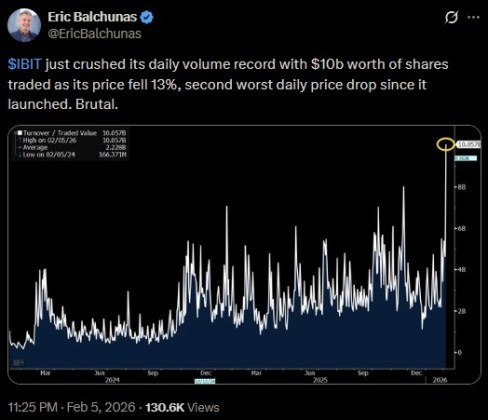
Bitcoin's recent crash triggered BlackRock's iShares Bitcoin Trust (IBIT) to record its second-worst daily price drop since launch, with a 13% decline erasing $10 billion in value. This volatility highlights a divergence between retail panic and institutional strategy, as major asset managers use the dip to accumulate Bitcoin at discounted prices through arbitrage opportunities in ETF mechanisms. Simultaneously, market focus is shifting from simple asset accumulation to functional utility. Capital is flowing into infrastructure projects like Bitcoin Hyper ($HYPER), which aims to solve Bitcoin's scalability and programmability issues. By integrating the Solana Virtual Machine (SVM) as a Layer 2 solution, Bitcoin Hyper promises sub-second transaction speeds and smart contract functionality while leveraging Bitcoin's security. The project's presale has raised over $31 million, indicating strong demand from whale investors. This reflects a broader trend where investors are betting on protocols that unlock Bitcoin's dormant capital for DeFi, gaming, and other high-throughput applications, signaling a maturation in the market's approach to Bitcoin's potential.

Trusted Editorial content, reviewed by leading industry experts and seasoned editors. Ad Disclosure

Quick Facts:

  • ➡️ The market crashes, causing BlackRock’s IBIT to experience its ‘second worst daily price drop since it launched’.
  • ➡️ Bitcoin Hyper uses the Solana Virtual Machine (SVM) to bring sub-second transaction speeds and smart contracts to the Bitcoin network.
  • ➡️ Whale wallets are actively accumulating presale tokens, with over $31M raised to build out the high-performance Layer 2 infrastructure.
  • ➡️ Market focus is shifting from simple asset holding to functional utility, favoring protocols that unlock Bitcoin’s liquidity for DeFi and gaming.

Bitcoin’s recent price action has been messy, exposing the widening gap between retail panic and institutional strategy. When spot prices tumble, the immediate retail reaction is often capitulation.

BlackRock’s iShares Bitcoin Trust (IBIT) reacted accordingly, recording the ‘second worst daily price drop since it launched‘, with $10B in the hole after a fall of 13%.

This inverse correlation suggests major asset managers are using deep liquidity to rebalance portfolios at discounted rates, effectively absorbing the sell-side pressure from fearful holders.

The mechanics are simple (though often missed). When Bitcoin crashes, the spread between the ETF’s Net Asset Value (NAV) and the spot price fluctuates, triggering arbitrage opportunities for Authorized Participants (APs).

These APs step in to create or redeem shares, resulting in massive trading volumes that seem to contradict the bearish price action. That matters because it signals a maturing market structure where volatility is no longer a bug, but a feature for high-frequency institutional accumulation.

While the ‘smart money’ is busy stacking the base asset, a second rotation is happening further out on the risk curve. Capital is flowing into infrastructure plays that promise to solve Bitcoin’s distinct lack of utility.

The market is shifting focus from merely holding digital gold to actually using it. Leading this charge is Bitcoin Hyper ($HYPER), a protocol designed to bridge the gap between Bitcoin’s security and high-speed execution. As ETF giants stabilize the floor, projects like Bitcoin

Hyper are raising the ceiling for what the network can actually achieve.

$HYPER is available here.

Bitcoin Hyper Merges SVM Speed With Bitcoin Security

Bitcoin development has always hit a wall: the ‘trilemma’ trade-off. The network is secure and decentralized, sure, but it’s also painfully slow for complex applications. Previous attempts to scale via sidechains often sacrificed security or user experience.

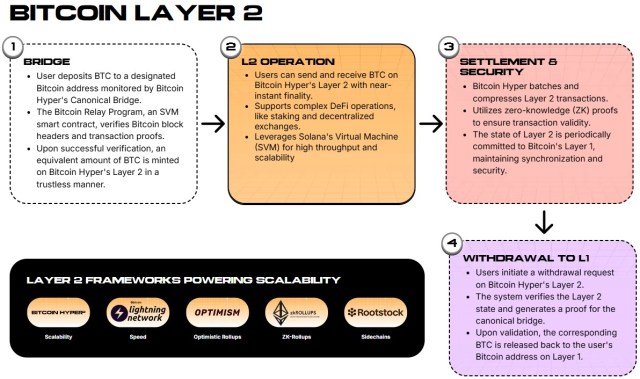
Bitcoin Hyper ($HYPER) changes the calculus by integrating the Solana Virtual Machine (SVM) directly as a Layer 2 solution. It’s not just a subtle upgrade; it’s a fundamental architectural shift.

By using the SVM, Bitcoin Hyper delivers sub-second finality and transaction costs that are effectively negligible, mirroring the performance that made Solana a DeFi favorite, but anchored to Bitcoin’s settlement layer.

This addresses the critical lack of programmability in the Bitcoin ecosystem. Developers can now deploy high-speed Rust-based applications, from gaming dApps to high-frequency trading platforms, without leaving the security orbit of the world’s largest cryptocurrency.

The technical architecture relies on a modular approach: Bitcoin L1 handles the final settlement, while the SVM L2 handles real-time execution. A decentralized canonical bridge facilitates the transfer of assets, allowing users to move $BTC into a high-performance environment effortlessly.

This integration suggests the future of Bitcoin isn’t just as a store of value, but as a foundational layer for high-throughput commerce.

Check the $HYPER presale.

Presale Surpasses $31M as Whales Accumulate $HYPER

The market’s appetite for a functional Bitcoin Layer 2 is evident in the capital commitment metrics.

According to official data, Bitcoin Hyper has successfully raised $31.2M in its ongoing presale. That figure is significant, it implies massive demand for infrastructure that unlocks Bitcoin’s dormant capital ($1T) for DeFi use cases.

At the current token price of $0.0136752, early positioning appears to be a priority for smart money looking for asymmetrical upside compared to the mature Layer 1 asset.

Traders are also watching the staking incentives. The protocol offers immediate staking for presale participants with a high APY, designed to lock up supply early. Plus, there is a 7-day vesting period for presale stakers, a mechanism likely intended to prevent an immediate supply shock upon launch.

For a market accustomed to ‘pump and dump’ mechanics, these vesting structures signal a focus on long-term ecosystem stability rather than short-term liquidity extraction.

Join the Bitcoin Hyper presale.

Disclaimer: This article is for informational purposes only and does not constitute financial advice. Cryptocurrency investments, including presales and Layer 2 protocols, carry high risks. Always conduct independent due diligence before investing.

Editorial Process for bitcoinist is centered on delivering thoroughly researched, accurate, and unbiased content. We uphold strict sourcing standards, and each page undergoes diligent review by our team of top technology experts and seasoned editors. This process ensures the integrity, relevance, and value of our content for our readers.

patrubogdan

Follow

Full Profile

Related Posts

ETH Down to $1.8K – Will It Keep Crashing and Will LiquidChain Explode in 2026?

Winklevoss‑Backed Gemini Cuts Up To 25% Of Staff, Exits UK, EU, And Australia

New Virginia Bill Allows the State to Invest in Bitcoin, Signaling Institutional Shift for Bitcoin Hyper

Tether Pours $150M in Gold.com as $LIQUID’s Presale Turns Heads

XRP Retests $1.29 Support: Is $2 Still in Play or Will LiquidChain Capture the Momentum?

Bitcoin Teeters on Edge: Will $60K Hold or Is a V-Shape Recovery Imminent? $HYPER Keeps Pumping

Related Questions

QWhat was the performance of BlackRock's iShares Bitcoin Trust (IBIT) during Bitcoin's recent crash?

ABlackRock's iShares Bitcoin Trust (IBIT) recorded its 'second worst daily price drop since it launched,' falling 13% and resulting in a $10 billion loss.

QWhat is the core technological innovation of Bitcoin Hyper ($HYPER)?

ABitcoin Hyper integrates the Solana Virtual Machine (SVM) as a Layer 2 solution to bring sub-second transaction speeds, negligible costs, and smart contract functionality to the Bitcoin network.

QHow much funding has the Bitcoin Hyper ($HYPER) presale raised, and what does this indicate?

AThe Bitcoin Hyper presale has raised over $31 million, indicating significant market demand and 'smart money' interest in infrastructure that unlocks Bitcoin's liquidity for DeFi and other applications.

QAccording to the article, how are institutional players like asset managers behaving differently from retail investors during the market crash?

AInstitutional asset managers are using the deep liquidity of ETFs to rebalance portfolios and accumulate Bitcoin at discounted prices, absorbing sell-side pressure from retail investors who are panicking and capitulating.

QWhat problem does Bitcoin Hyper aim to solve for the Bitcoin ecosystem?

AIt aims to solve Bitcoin's distinct lack of utility and programmability by providing a high-performance Layer 2 that enables complex applications like DeFi and gaming, moving beyond its role as just a store of value.

Related Reads

Anthropic's IPO Launch: Commercial Miracle or Valuation Bubble?

Anthropic has confidentially filed for an IPO, led by Morgan Stanley and Goldman Sachs, potentially going public by October. Following its latest $650 billion funding round, its pre-IPO valuation stands at $965 billion, with projections reaching up to $2 trillion at listing, which would make it the highest-valued private company ever. The article, written by Fu Sheng, addresses skepticism that this represents an AI bubble akin to the 2000 dot-com crash. It argues the current situation differs fundamentally. Unlike the internet bubble era, which relied on speculative narratives with little revenue, Anthropic's valuation is backed by unprecedented, measurable financial performance. Key data points include: * **Revenue Growth:** ARR skyrocketed from $10 billion in early 2025 to $470 billion by May 2026, targeting $100 billion by year-end—a growth curve unmatched in business history. * **Profitability:** It achieved operating profitability in Q2 2026 with an estimated $5.6 billion profit. * **Efficiency:** With ~3,000 employees and ~$470 billion ARR, its revenue per employee exceeds $10 million. Products like Claude Code, launched less than a year ago, already generate $25 billion in annualized revenue. * **Enterprise Adoption:** It boasts a strong enterprise client base, with 8 of the Fortune 10 and over 1,000 large firms spending over $1 million annually on Claude. The valuation is framed using a traditional SaaS model (e.g., a 10x Price-to-Sales multiple on $100 billion revenue). The author contends the core question for analysts has shifted from "How big could this be?" to "How much is it earning and will earn next quarter?" The discussion extends beyond Anthropic to a broader paradigm shift: the transition from a "carbon-based" to a "silicon-based" economy. Companies are increasingly prioritizing investment in compute and AI capabilities over human resources, as these directly scale productivity and competitive advantage. Anthropic's IPO is thus positioned not just as a corporate milestone, but as a price anchor for this new economic era.

链捕手54m ago

Anthropic's IPO Launch: Commercial Miracle or Valuation Bubble?

链捕手54m ago

Near Returns to the AI Stage: Transformation into a Public Chain Due to 'Payroll Difficulties,' Agent and Privacy Emerge as New Growth Narratives

NEAR Returns to AI Origins: From Payroll Struggles to Blockchain, Now Focusing on AI Agents and Privacy NEAR Protocol's journey began not with grand blockchain ambitions, but from a practical hurdle: its AI startup founders, including Transformer paper co-author Illia Polosukhin, couldn't efficiently pay international developers in 2017. This led them to pivot and build a high-performance, scalable blockchain. After years navigating various crypto narratives like sharding and cross-chain interoperability, NEAR is now leveraging its AI roots to re-enter the AI arena. A key driver is its "NEAR Intents" layer, which abstracts complex cross-chain transactions. Users simply state their goal (e.g., swap BTC for ETH), and a solver network finds the optimal route. This system has processed over $20B in cross-chain volume, generating significant fee revenue. A major growth area is private transactions via "Confidential Intents/Swaps," which hide trade details until settlement to protect against MEV and front-running. Remarkably, private swaps recently accounted for over 40% of NEAR's transaction volume, highlighting strong demand but also potential regulatory scrutiny. With its AI-founder pedigree, NEAR is positioning itself at the intersection of blockchain, AI agents, and privacy, aiming to become infrastructure for the emerging agent economy while navigating the challenges of its rapid adoption.

marsbit3h ago

Near Returns to the AI Stage: Transformation into a Public Chain Due to 'Payroll Difficulties,' Agent and Privacy Emerge as New Growth Narratives

marsbit3h ago

From Ethereum to AI's 'CROPS': What Exactly is This Set of 'Slow Variables' That Vitalik Repeatedly Emphasizes?

In recent discussions, Vitalik Buterin has frequently emphasized the concept of "CROPS," a framework defining core values for Ethereum's development. CROPS stands for Censorship Resistance, Capture Resistance, Open Source, Privacy, and Security. Initially outlined in the Ethereum Foundation's "EF Mandate," it represents a commitment to user sovereignty, ensuring that the network resists external control, remains open, protects privacy, and prioritizes security. The relevance of CROPS extends beyond Ethereum's foundational principles, becoming crucial in the context of AI integration. As AI agents begin handling wallet operations and automated transactions, the risk increases that users may cede control over their digital assets, privacy, and intentions to centralized AI service providers. A "CROPS AI" would therefore emphasize local execution where possible, privacy-preserving remote model calls (e.g., using zero-knowledge proofs), and transparent, verifiable processes to maintain user agency. Vitalik highlights a significant convergence between "CROPS Ethereum access layer" and "CROPS AI." Both address the same fundamental challenge: how users can access powerful services—be it blockchain data via RPCs or AI models—without exposing sensitive information or relinquishing ultimate control. This intersection points toward a future digital entry point that is more private, secure, and user-controlled. Ultimately, CROPS is not merely an abstract ideal but a practical guidepost. It steers development—from protocol resilience and wallet design to AI agent safety—towards a future where users retain self-sovereignty even as digital systems grow more complex and powerful. In an era of accelerating AI adoption, these "slow variables" of censorship resistance, openness, privacy, and security may define Ethereum's enduring value.

marsbit3h ago

From Ethereum to AI's 'CROPS': What Exactly is This Set of 'Slow Variables' That Vitalik Repeatedly Emphasizes?

marsbit3h ago

Trading

Spot
Futures

Hot Articles

Discussions

Welcome to the HTX Community. Here, you can stay informed about the latest platform developments and gain access to professional market insights. Users' opinions on the price of S (S) are presented below.

活动图片