Why Do You Always Lose Money on Polymarket? Because You're Betting on News, While the Pros Read the Rules

marsbitPublished on 2026-04-20Last updated on 2026-04-20

Abstract

Why do you always lose money on Polymarket? Because you bet on news, while the pros study the rules. This article explains how top traders ("che tou") profit by meticulously analyzing market rules, not just predicting events. Polymarket, a prediction market platform, often sees disputes over event outcomes due to ambiguous rule wording. For instance, a market asking "Who will be the leader of Venezuela by the end of 2026?" was misinterpreted by many who bet on Delcy Rodríguez, assuming she held power. However, the rules specified "officially holds" as the formally appointed, sworn-in individual. Since Nicolás Maduro was still recognized as president officially, he won the market—even being in prison. To resolve such disputes, Polymarket uses a decentralized arbitration system via UMA protocol. The process involves: 1. Proposal: Anyone can propose a market outcome by staking 750 USDC, earning 5 USDC if unchallenged. 2. Dispute: A 2-hour window allows challenges with a 750 USDC stake; successful challengers earn 250 USDC. 3. Discussion: A 48-hour period on UMA Discord for evidence and debate. 4. Voting: UMA token holders vote in two 24-hour phases (blind then public). Outcomes require >65% consensus and 5M tokens voted; otherwise, four re-votes occur before Polymarket intervention. 5. Settlement: Results are final and automatic. Unlike traditional courts, Polymarket’s system lacks separation between arbitrators and stakeholders—voters often hold market positions, creating co...

Author: Changan I Biteye Content Team

Do you know why you can't beat the pros on Polymarket? Because they scrutinize the rules, parsing every word like lawyers reviewing a contract.

In April 2026, a controversy over Venezuela's leader erupted in the Polymarket community.

There was a market on Polymarket asking, "Who will be the leader of Venezuela by the end of 2026?" Many traders intuitively thought: Maduro is in a U.S. prison, Delcy is presiding over the cabinet in Caracas, so the de facto ruler is obviously Delcy. They placed their bets on Delcy.

But the rules and supplementary notes were clear: "officially holds" refers to the person formally appointed and sworn in. The UN-recognized Venezuelan government has not formally removed or replaced Maduro; official government information still identifies him as president. The rules specifically added: "Temporarily authorized to exercise presidential powers does not equate to a transfer of the presidential office."

According to these rules, even if Maduro remains in a U.S. prison, he is still the legitimate president of Venezuela.

Similar examples abound:

  • After Polymarket issued a stablecoin, controversy arose over "What is the FDV of the Polymarket token?": Is a stablecoin considered a token? A single word makes all the difference.

  • Iran Uranium: The standard for "agreement"—conditional statements vs. formally signed agreements.

Behind these cases lies the same logic: On Polymarket, the rules are paramount. But when disputes arise over the rules, Polymarket has a complete adjudication process to resolve them. This article will explain how this mechanism operates, and where it resembles and fundamentally differs from traditional courts.

I. Polymarket's Adjudication Mechanism

Ambiguity in the rule text doesn't just cause pricing discrepancies; it becomes a formal dispute at settlement.

Polymarket sees numerous market settlements daily, with markets involving political statements, diplomatic postures, and military actions being particularly prone to controversy.

Disputed events are actually the norm in prediction markets. Ambiguity creates pricing divergence during trading and turns into conflict at settlement—it's the same issue at two different points in time.

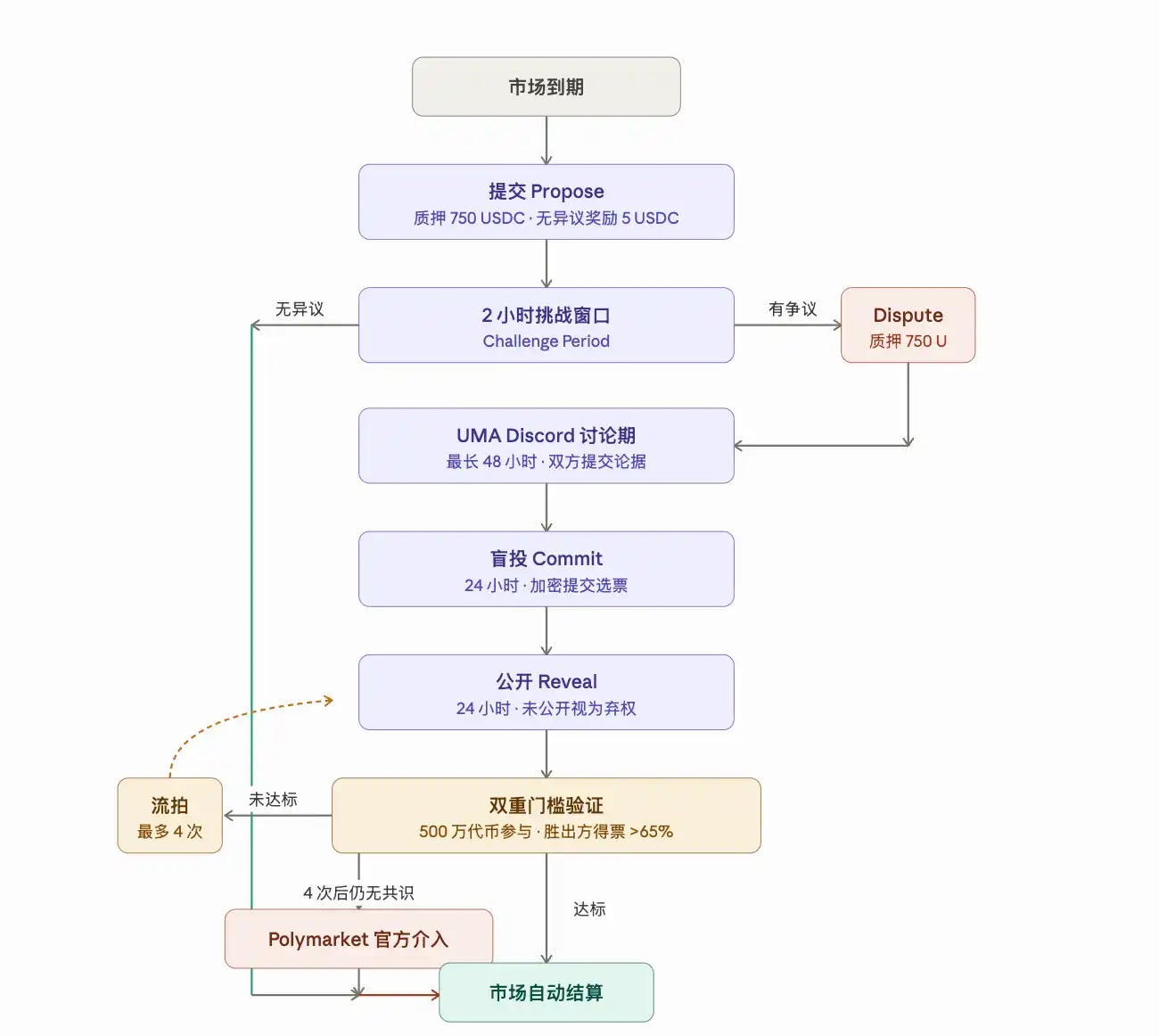
To resolve these disputes, Polymarket has established a complete adjudication process. The settlement process splits into two paths: normal settlement and dispute resolution.

Step 1: Submit a Proposal (Propose)

When a market meets the settlement conditions, anyone can submit a proposed resolution, declaring whether the market should be judged YES or NO. Submitting a proposal requires staking 750 USDC as a bond, which serves as the submitter's endorsement of their judgment. If the market has no objections, the user who submitted the proposal receives a 5 USDC reward.

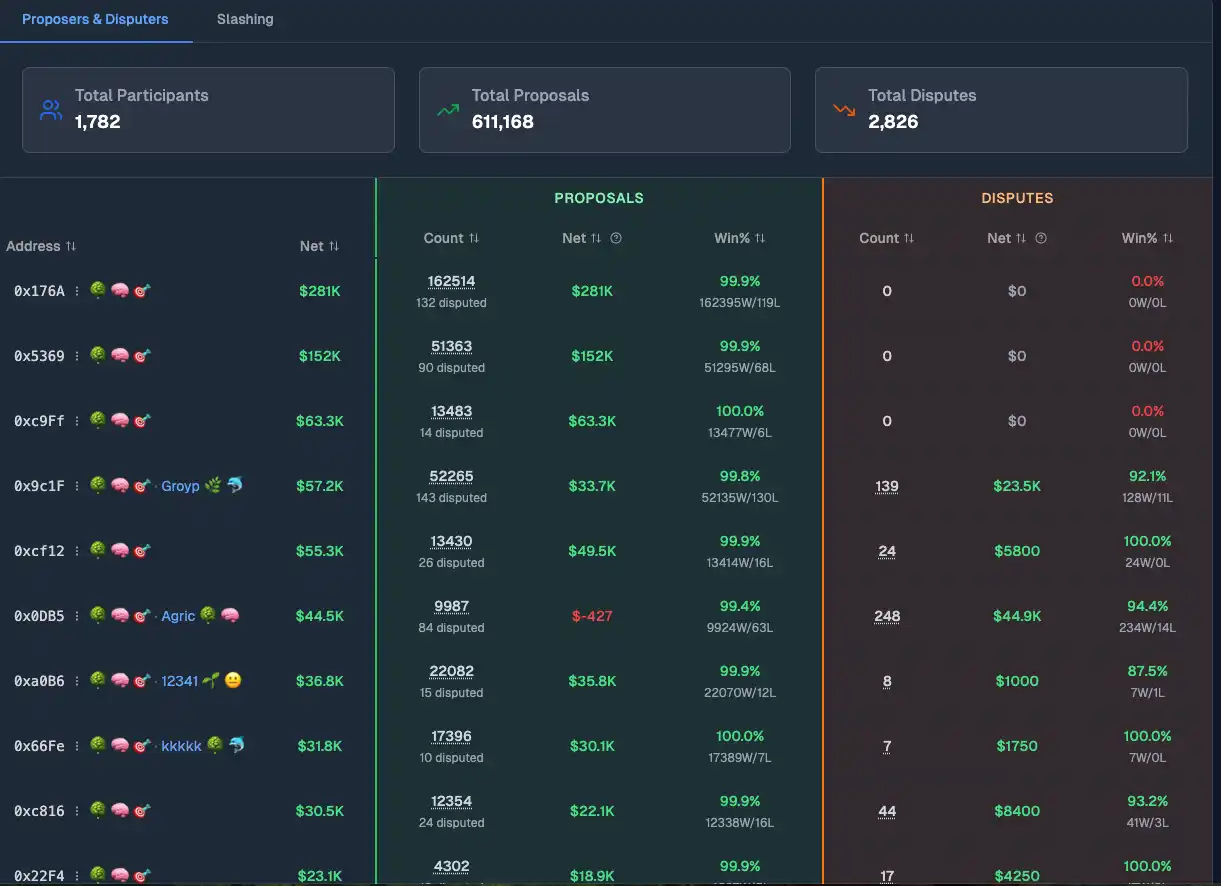
Currently, only 1782 users have submitted Proposals. The top-earning user has accumulated $281K.
Step 2: 2-Hour Challenge Window (Dispute)

After a proposal is submitted, it enters a 2-hour challenge period. This is the first fork in the entire process.

If no objections are raised within 2 hours, the system defaults the proposal as correct, the market settles directly, and the process ends. The vast majority of markets follow this path.

If someone believes the proposal result is incorrect, they can challenge it within this 2-hour window, also requiring a stake of 750 USDC. A successful challenge earns a 250 USDC bonus.

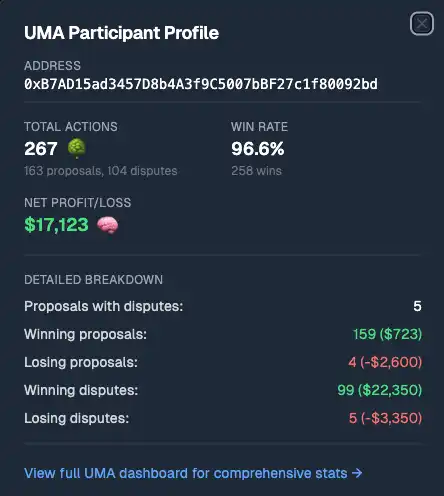
Very few users specialize in Disputes. The user who has earned the most from the Dispute环节 is 0xB7A, with profits of $17,123.
Step 3: Up to 48-Hour Discussion Period

Once entering the dispute track, both parties proceed to the UMA Discord discussion phase. This stage allows各方 to present arguments and evidence: interpretations of the rule text, relevant news reports, historical precedents, official statements—any material supporting their position can be presented at this stage.

The discussion period lasts up to 48 hours and is the only phase where reasons can be fully stated. The quality of this stage很大程度上 determines the direction of the subsequent vote.

Step 4: 48-Hour Voting

After the discussion, it enters the UMA token holder voting phase, divided into two 24-hour stages.

  • The first stage is blind voting. It forces each voter to make an independent judgment based on their understanding of the rules, rather than following big players.

  • The second stage is public. Votes not made public in this stage are considered abstentions and are directly invalidated.

After voting, UMA sets two settlement thresholds that must be met simultaneously for the adjudication to complete:

  • Participation level: At least 5 million tokens must participate in the vote, ensuring the裁决 has sufficient representativeness.

  • Absolute consensus: The winning side must have a vote share exceeding 65%, not a simple 51% majority.

If both thresholds are not met, the vote fails and enters a new round of re-voting, up to a maximum of 4 times. If no consensus is reached after 4 rounds, Polymarket officials have the right to intervene directly in the adjudication.

Step 5: Automatic Settlement

Once the vote result is confirmed, the market settles automatically, and funds are distributed according to the result. There is no appeal, no retrial, no recourse.

The entire dispute process, from challenge submission to final settlement, is typically completed within a week.
II. Polymarket vs. Traditional Courts: The Same Logic, Different Design

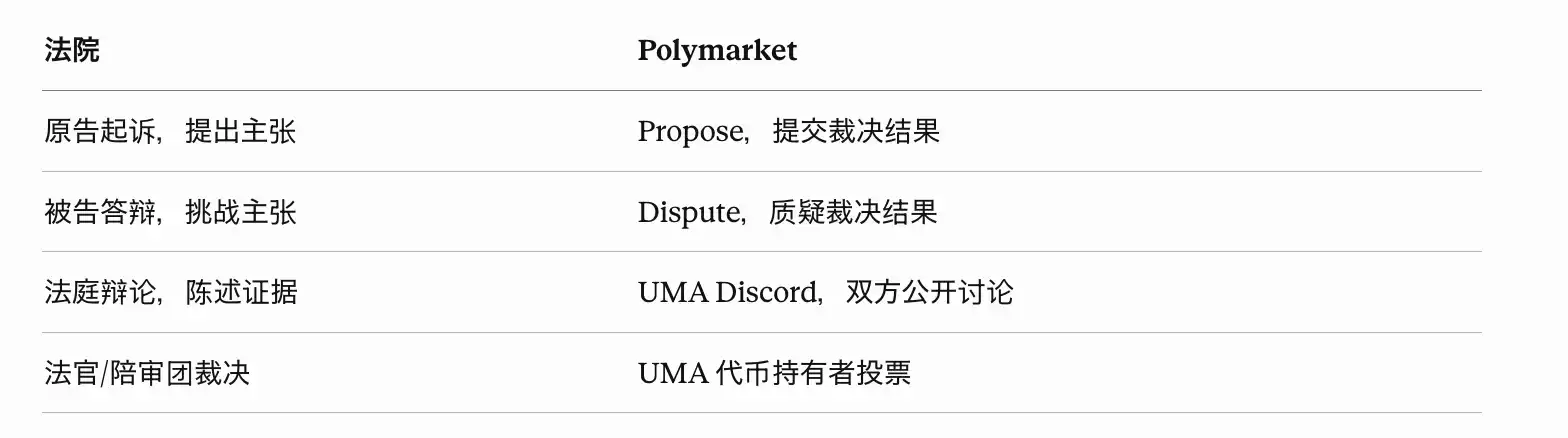
On the surface, Polymarket's adjudication process is highly similar to traditional courts: there is a party making a claim, a party challenging the claim, a discussion phase for statements, and finally an adjudicator who gives the result.

But the two systems differ fundamentally in one key design: separation of powers.
  1. Court power is isolated

In traditional courts, the plaintiff and defendant only have the right to state their case, not to adjudicate. The judge only has adjudication power, without a vested interest. Crucially, the judge must remain independent of the case. If the judge has any interest in the case, they must recuse themselves, and another judge takes over.

The adjudicator and the interested party are never the same person.

  1. Polymarket lacks this isolation

UMA token holders are the adjudicators, but they can simultaneously hold positions in the disputed market. Which direction they adjudicate directly affects their own profits and losses. The裁判者 and the interested party being the same person is called a conflict of interest in traditional courts, requiring mandatory recusal, but in Polymarket, it is legal and normal.

This design flaw is the root cause of the following two problems.

1️⃣ Why the discussion环节 fails

In court, the positions of the plaintiff and defendant are fixed from the moment of filing. Lawyers don't switch sides mid-trial, nor do they withdraw their statements because the other side is more assertive. Positions are clear, roles are defined, and the entire debate is built on this stability.

The UMA Discord discussion faces two problems simultaneously.

  • Herd mentality: The discussion is public and real-name. Once influential KOLs state their position, it's easy for others to follow. Many participants just post "P1" or "P2" without giving any理由.

  • Position switching: Participants also hold positions in the disputed market. When their positions change, their stance naturally changes with it. This is why posts in the UMA Discord are often deleted after being made.

Both problems stem from the same root: the adjudicator and the interested party are not separated. Courts use a mandatory recusal system to separate these two roles, ensuring the stability of positions during discussion. Polymarket lacks this isolation.

2️⃣ Why the adjudication results are opaque

In court, the judge hears the full arguments from both sides before making a ruling. The ruling document states which arguments were adopted, the basis for the decision, and the reasoning behind it. The losing party might disagree, but at least they know why they lost and can strengthen their arguments next time.

These rulings form a system of precedents that can be studied. Future judges, lawyers, and parties can cite them, making the adjudication standards searchable, learnable, and predictable.

After UMA voting concludes, there is only a result: YES or NO. The讨论 parties don't know what the voters saw, what they believed, or why they leaned one way. Winners don't know which argument worked; losers don't know where their persuasion fell short. Because the adjudication logic is never made public, the outcomes of disputes are difficult to learn from and accumulate.

Court rulings form a system of precedent; Polymarket's adjudications leave only a result.

III. Final Thoughts

Therefore, Polymarket is never just a market for "guessing events" correctly. It's more like a system that translates real-world events into legal text and then translates that legal text into settlement results.

Understanding the rules is as important as doing research. The pros' advantage often comes from their depth of understanding of the rules, knowing what this system acknowledges and what adjudications will recognize.

Those who realize earlier that a gap exists between "reality" and "the rules" have a better chance of profiting from the price deviations created by misreading, controversy, and emotion.


Related Questions

QWhat is the main reason why many traders lose money on Polymarket according to the article?

ABecause they bet based on news and intuition, while experienced traders focus on meticulously reading and interpreting the rules of each market.

QDescribe the first step (Propose) in Polymarket's dispute resolution process.

AWhen a market meets settlement conditions, anyone can submit a proposal for a YES or NO outcome. This requires staking 750 USDC as a bond. If the proposal is accepted without dispute, the submitter earns a 5 USDC reward.

QWhat is a fundamental design difference between Polymarket's UMA voting system and a traditional court system?

APolymarket's UMA token holders, who act as the arbitrators, are allowed to hold positions in the markets they are voting on, creating a conflict of interest. Traditional courts enforce strict separation, where judges must recuse themselves if they have any interest in a case.

QWhy does the article claim the discussion phase in the UMA Discord often fails?

AIt fails due to herd mentality, where participants follow influential KOLs without providing their own reasoning, and because participants can change their stated positions as their market positions change, since arbitrators are not isolated from having a financial stake.

QWhat key advantage do 'che tou' (car heads, or experienced traders) have over regular users on Polymarket?

ATheir advantage comes from a deeper understanding of the platform's rules—knowing how the system will interpret events and what evidence it will recognize during a dispute resolution—allowing them to profit from pricing discrepancies created by misreadings and emotions.

Related Reads

Must-Watch Events Next Week|CLARITY Act Could Face Senate Vote; SpaceX, Circle to Report Earnings (8.3-8.9)

**Summary: Key Events and Developments to Watch (August 3-9)** The upcoming week is marked by significant financial disclosures, key legislative deadlines, and notable product updates. **Major Financial Events:** Several companies are scheduled to release their Q2 2026 earnings. American Bitcoin (ABTC) will report on August 3, followed by SpaceX and Hut 8 Mining Corp. on August 4, and Circle on August 5. Notably, a significant portion of SpaceX shares (up to 12% of total shares) will be unlocked on August 6 following their earnings release. **Key Legislative Deadline:** The U.S. Senate faces an August 7 deadline to secure 60 votes for the CLARITY Act, a bipartisan bill aiming to establish a federal regulatory framework for cryptocurrencies. The Senate may hold a full vote on the bill during the week. **Economic Data:** The U.S. July Non-Farm Payrolls report will be released on August 7, providing crucial labor market data. **Technology & Product Updates:** * **Shutdowns:** DeFi portfolio tracker Zapper and wallet app Ctrl Wallet will cease operations on August 3. * **Upgrades:** LayerZero will deprecate its v1 relayers on August 3. XRP Ledger's new version 3.3.0, featuring five new functions, is expected next week. * **AI:** Elon Musk announced that the advanced Grok 4.6 AI model is set for release around August 7. * **Bitcoin:** The BIP-110 forced signaling for a potential Bitcoin network change is scheduled to begin around August 8. **Other Notable Events:** Chinese robotics firm Unitree Tech has set its preliminary price inquiry for its IPO for August 5. South Korean exchange Upbit will delist AQT and AERGO tokens on August 3.

marsbit8m ago

Must-Watch Events Next Week|CLARITY Act Could Face Senate Vote; SpaceX, Circle to Report Earnings (8.3-8.9)

marsbit8m ago

Stocks Are Plummeting More Sharply Than Cryptocurrencies. Where Has the Money Gone?

Stock Markets Plunge Deeper Than Cryptocurrencies: Where Did the Money Go? In late July, Seoul's Kospi index triggered circuit breakers for two consecutive days, plummeting over 40% from its June high. The collapse was led by heavyweight stocks like SK Hynix, whose record profits still disappointed investors, and devastating leveraged ETFs, with one major product losing over 83% of its value. This signaled a global, forced deleveraging targeting the most crowded trades. Interestingly, while stocks exhibited extreme volatility akin to crypto markets, Bitcoin rose nearly 15% in July after a prior steep drop. Analysis shows the money fleeing equities did not flow into Bitcoin. Instead, Bitcoin had already absorbed its sell-off in May-June, when U.S. spot Bitcoin ETFs saw historic outflows. The true safe-haven beneficiary was gold, whose price rose over 20% year-on-year, highlighting a decoupling between Bitcoin and gold as "digital gold." The sell-off was a targeted unwinding of leveraged positions in tech and semiconductors, accelerated by broker-dealer risk management and shifts in the AI narrative, including new competition from Chinese memory chipmakers. The retreat path was clear: from high-valuation tech stocks to cash and U.S. Treasuries, then to gold. For Bitcoin to attract sustained institutional inflows, conditions like eased global liquidity pressure, a "soft-landing" Fed rate cut, and U.S. regulatory clarity via legislation like the stalled CLARITY Act are needed. Currently, Bitcoin is not a safe haven but an already-cleared asset. Its low correlation with tech stocks, however, makes it a potential diversification play for institutional portfolios once the storm passes. The money isn't here yet, but the positioning is underway.

marsbit8m ago

Stocks Are Plummeting More Sharply Than Cryptocurrencies. Where Has the Money Gone?

marsbit8m ago

In Conversation with Ray Dalio: We Are Currently in an AI Bubble, with 1% of My Portfolio in Bitcoin

Ray Dalio, founder of Bridgewater Associates, warns in an interview that the current AI boom shows classic bubble characteristics, which could lead to significant economic downturns as seen in past cycles like 1929 or 2000. He explains that speculative enthusiasm, fueled by debt and overvaluation, often precedes a crash when rising rates or taxation force asset sales, causing widespread losses and recession. Dalio also outlines his "Big Cycle" theory, describing an approximate 80-year pattern where widening wealth gaps, massive government deficits, and shifting geopolitical power (like China's rise) create internal conflict and global instability. He emphasizes that we are in a late-cycle, transitional phase where traditional powers like the US and UK face decline. For personal wealth protection, Dalio advises diversification beyond cash into assets like stocks, bonds, real estate, and particularly gold, which he prefers over Bitcoin. While he holds about 1% of his portfolio in Bitcoin as a non-printable hard asset, he views gold as more secure from technological or governmental threats. Regarding AI's impact, Dalio believes it will disproportionately benefit capital owners, worsening inequality by replacing both physical and cognitive labor. He suggests that human intuition and emotional intelligence, combined with AI, will be key for future workers. On taxation, Dalio argues that wealth taxes are impractical and risk triggering asset sell-offs, reducing productive investment. He points to the UK as a cautionary example of debt, low productivity, and political strife. Geopolitically, Dalio foresees a more regionalized world, with the US showing weakness in prolonged conflicts like with Iran, akin to past imperial declines. The ideal outcome, he suggests, is coexisting powerful blocs (e.g., Americas, China-Asia Pacific) without major war.

marsbit4h ago

In Conversation with Ray Dalio: We Are Currently in an AI Bubble, with 1% of My Portfolio in Bitcoin

marsbit4h ago

Daily 7.2 Trillion KRW: Foreign Capital's Record Net Buying on Friday! Wall Street Says Headwinds for Korean Stock Fund Flows Have Subsided

South Korean stock market sees a dramatic shift in fund flows. On July 31, foreign investors made a record net purchase of approximately KRW 7.2 trillion in KOSPI stocks, marking a fundamental reversal from the persistent large-scale net outflows seen in previous months. This contributed to a significant narrowing of foreign net selling in July to KRW 9.8 trillion, down sharply from KRW 48.4 trillion in June and KRW 44.5 trillion in May. Simultaneously, domestic institutional pressure eased. South Korean pension funds and asset managers turned to a net buying position in July, purchasing KRW 1.0 trillion worth of KOSPI shares, contrasting with net sales in May and June. Market volatility is expected to be dampened by new financial regulations. Effective July 31, the Financial Services Commission tightened access for retail investors to single-stock leveraged ETFs by raising the minimum cash deposit requirement. Trading volumes for these products subsequently dropped to about 50% of their monthly average. Citigroup Research maintains its year-end KOSPI target of 10,000 points. The firm cites several supportive factors: the substantial easing of headwinds from capital outflows, a robust fundamental outlook for the semiconductor sector, historically low market valuations, strong economic fundamentals, and the potential for policy support from financial authorities if needed.

marsbit4h ago

Daily 7.2 Trillion KRW: Foreign Capital's Record Net Buying on Friday! Wall Street Says Headwinds for Korean Stock Fund Flows Have Subsided

marsbit4h ago

Trading

Spot
活动图片




