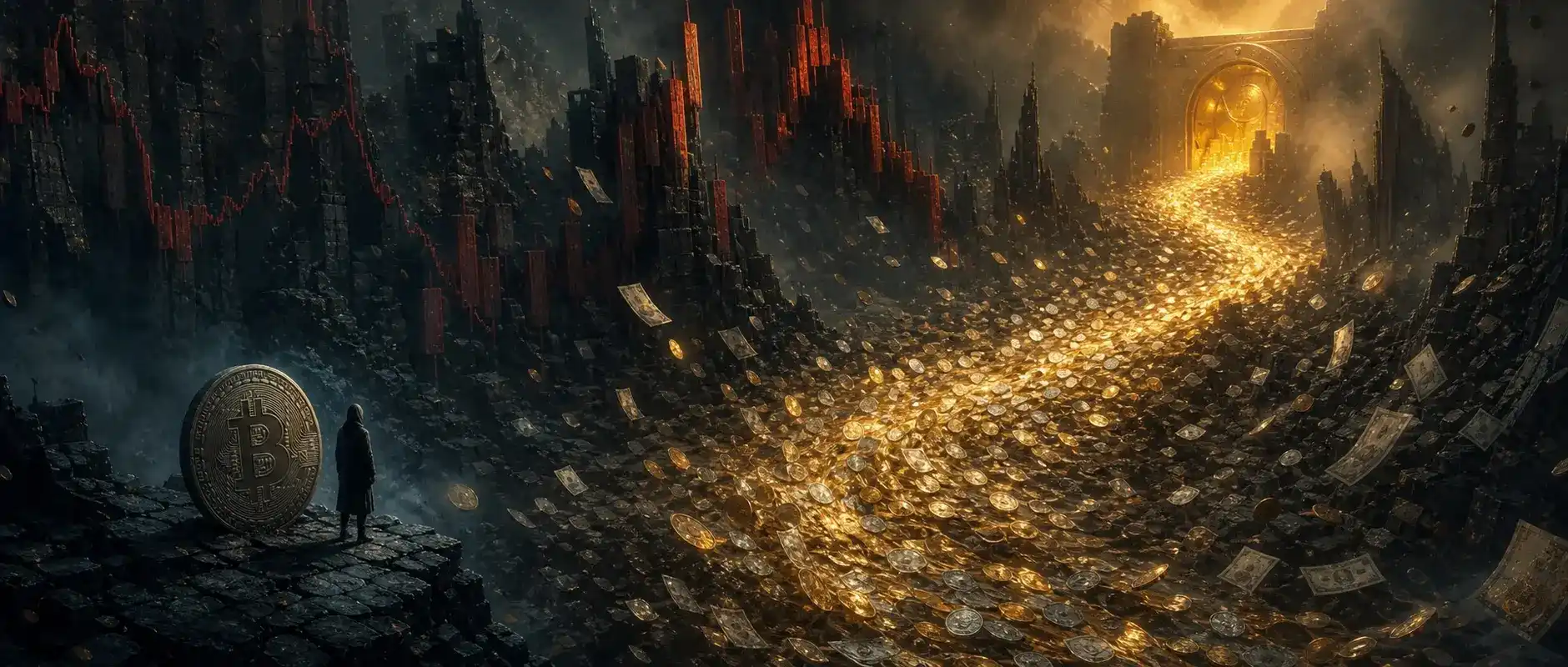
Bitcoin slides before Japan’s rate decision – History hints at…

ambcryptoPublished on 2025-12-15Last updated on 2025-12-15

Abstract

Bitcoin is declining ahead of the Bank of Japan's anticipated 25 basis point rate hike on December 19th, as traders de-risk early based on historical patterns. Previous BoJ hikes in March, July 2024, and January 2025 were followed by sharp BTC drawdowns of 23%, 26%, and nearly 31%, respectively. This time, early signs of selling are already visible through rising exchange inflows and falling, unstable funding rates, indicating proactive leverage unwinding. The market's reaction post-announcement may follow a "sell the rumor, buy the fact" dynamic. Bitcoin's next move will likely depend less on the hike itself and more on the yen's subsequent strength; a stronger yen could maintain pressure on risk assets, while a muted response might allow for a short-term relief rally.

er noopenBitcoin [BTC] is starting to feel the heat of next week’s Bank of Japan (BoJ) decision.

With a 25 basis point rate hike widely expected, markets appear to be adjusting ahead of time. Recent data says risk is already being trimmed, raising the odds that the sell-off happens ahead of the headline.

This leaves room for a “sell the rumor, buy the fact” reaction once the decision is out.

Sayonara, BTC gains!

Bitcoin is slipping ahead of the BoJ’s expected 25 bps rate hike on the 19th of December... and we know this setup all too well. Previous rate hikes have repeatedly aligned with sharp BTC drawdowns as yen liquidity tightened and risk appetite faded.

In March 2024, Bitcoin fell about 23% after a rate hike. In July 2024, it dropped another 26%. January 2025 saw an even bigger pullback of nearly 31%. With another hike widely anticipated, traders appeared to de-risk early, pushing BTC lower before the announcement.

The pattern of course, doesn’t guarantee a repeat. But it certainly explains why nerves are rising fast.

The selling may have started early

Investors aren’t waiting for the policy decision to react.

During earlier BoJ hikes, Bitcoin saw Exchange Inflows rise after the announcement, signaling panic-driven spot selling.

This time, Exchange Netflows already showed rising inflows ahead of 19 December. That pointed to early spot selling and proactive risk reduction.

Funding behaviors also have a similar reaction.

During prior hikes, Funding Rates collapsed after the decision. Now, they have already drifted lower and turned unstable, suggesting that leverage was unwinding in advance.

That move aligned with expectations, becoming fully priced

So what happens after the meeting?

That early adjustment changes how this plays out. Unlike past hikes, the BoJ’s shift has been talked about for months. Yen carry trades already unwound, and tighter liquidity was no longer a shock. As a result, much of the pressure may already be reflected in price.

What matters next is the yen’s reaction. If it gets stronger after the decision, risk assets (including Bitcoin) could stay under stress. But if the yen doesn’t beef up much, the market may have little left to sell. In that case, a short-term relief move isn’t off the table.

At this point, the hike itself matters less than how markets respond once it’s finally out of the way.


Final thoughts

  • Bitcoin is weak of the BoJ’s expected 25 bps rate hike. Traders are de-risking early and unwinding leverage.
  • BTC’s next move may depend on the yen’s reaction, not the rate decision itself.

Trending Cryptos

Related Reads

Stocks Fell Even More Violently Than Crypto, Where Did the Money Go?

From June to late July 2026, global stock markets, particularly technology and semiconductor stocks, experienced severe declines, with South Korea's KOSPI index facing historic circuit breakers and shedding 40% from its June peak. Key catalysts included SK Hynix's earnings miss despite record profits and competitive pressures from China's CXMT IPO. A global forced deleveraging event unfolded, devastating highly leveraged instruments like the 2x leveraged SK Hynix ETF, which lost over 80% of its value. Surprisingly, Bitcoin showed relative stability during this period, rising roughly 15% from its July low. The article clarifies this wasn't due to an inflow of equity flight capital but because Bitcoin had already undergone a significant correction in May and June, with U.S. spot Bitcoin ETFs seeing record outflows. True safe-haven flows went to gold, severing Bitcoin's short-term "digital gold" narrative. The sell-off is characterized not as an AI story collapse but a liquidity-driven清算 of crowded leveraged positions, potentially halfway through according to some analysts. For substantial capital to return to Bitcoin, the article cites necessary conditions: eased global liquidity pressure, a soft-landing Fed rate cut, and regulatory clarity from the stalled U.S. CLARITY Act. The conclusion is that Bitcoin is not a current safe haven but a pre-cleared asset. Its decoupling from tech stocks highlights its potential future role as a non-correlated asset for institutional portfolios, positioning it favorably for when global capital reallocates post-crisis.

marsbit1h ago

Stocks Fell Even More Violently Than Crypto, Where Did the Money Go?

marsbit1h ago

"The Final Phase Before the New Cycle". What Will Happen to Bitcoin in August

"Bitcoin Faces Crucial Test in August: Experts Predict Consolidation or Further Decline" The price of Bitcoin (BTC) is expected to remain under pressure in August, with experts anticipating either consolidation within a narrow range or a potential drop below $60,000. Despite a double-digit recovery from its July low near $58,000, BTC ended the month trading around $63,500, still roughly 50% below its October 2025 peak of $126,200. Analysts cite several headwinds: a challenging macroeconomic environment with high US interest rates and persistent inflation, which makes fixed-income assets more attractive than speculative ones like crypto. Furthermore, competition for capital is intense, with many investors favoring AI-related stocks. This is reflected in significant outflows from US spot Bitcoin ETFs, with a record $4.5 billion leaving in June and a net outflow of $5.4 billion for the first half of the year. Historically, August is a weak month for crypto, with a median return of -7.49% from 2013 to 2025. Experts also note regulatory uncertainty in the US, particularly the stalled CLARITY Act, as a dampening factor. Despite the bearish near-term outlook, several experts view the current phase as the "last phase before a new Bitcoin cycle" begins, potentially in Q4 2024. This makes it a favorable time for accumulating Bitcoin for the long term. Key price levels to watch are support at $60,000-$61,000, with a break below $58,000 potentially leading to $53,000-$55,000. A move above $67,000 could target $70,000-$75,000, though this is considered a lower probability scenario.

cryptonews.ru1h ago

"The Final Phase Before the New Cycle". What Will Happen to Bitcoin in August

cryptonews.ru1h ago

Trading

Spot

Hot Articles

Discussions

Welcome to the HTX Community. Here, you can stay informed about the latest platform developments and gain access to professional market insights. Users' opinions on the price of S (S) are presented below.

活动图片