Bitcoin Price Drops Below $64,000 Again, with $100 Million Liquidated in an Hour

cryptonews.ruPublished on 2026-07-28Last updated on 2026-07-28

Abstract

The price of Bitcoin has once again fallen below the $64,000 mark, with approximately $100 million in positions liquidated within just one hour. This level has been a battleground for traders in late July, following similar liquidations earlier in the week. The sell-off coincided with a sharp 8% drop in South Korea's KOSPI index, triggered by a slump in semiconductor stocks, highlighting the continued correlation between crypto and tech stocks as high-beta assets. Traders are now focused on the upcoming Federal Reserve policy decision, with rates expected to remain unchanged. Other potential catalysts include a U.S. digital asset market transparency bill vote and two anticipated Bitcoin forks in August. Despite recent pressure, options and leverage data show concentrated bets on a recovery toward the $65,000-$70,000 range. However, weak inflows into spot Bitcoin ETFs and a major firm's decision to hold cash instead of buying more Bitcoin are cited as near-term headwinds testing the current support level.

The $64,000 level has become a kind of battleground for Bitcoin traders in the second half of July. As Bitcoin.com News reported earlier, a drop below this level occurred late last week when the asset retreated from a high of nearly $67,000, triggering $87 million in position liquidations, of which $70 million were long positions and $17 million were short positions.
Three days later, Bitcoin made three unsuccessful attempts to break through resistance at $65,500, leading to a 24-hour total liquidation volume increase to $75 million, with the price dropping to a session low of $64,336. Today's move repeats the same pattern: approximately $100 million was liquidated in a single hour, occurring faster than in either of the two previous episodes this week.

Plunge in Chipmaker Stocks on KOSPI Adds to Risk-Off Sentiment

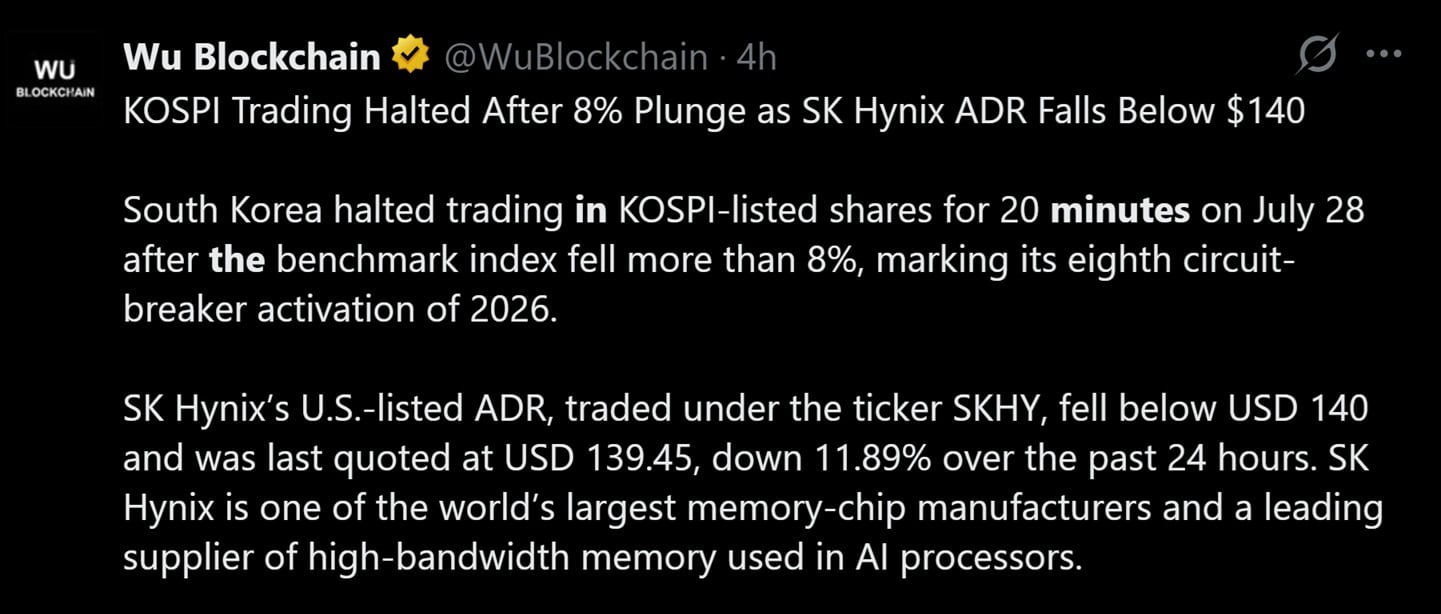
The liquidations coincided with a sharp sell-off in South Korean stocks: the KOSPI index fell 8.02%, or 542.24 points, to 6,213.51, triggering the eighth volatility curb activation of the year amid a tumble in U.S. semiconductor maker shares. This was another episode in a series of plunges triggered by chip stock declines this month; a similar KOSPI sell-off on July 13 marked the seventh activation of the exchange's volatility curb in 2026.

Cryptocurrencies and semiconductor company stocks have moved largely in sync for most of the year. A report on the mid-July sell-off, when the Philadelphia Semiconductor Index gave up gains accumulated amid AI infrastructure enthusiasm, noted that "over the past two years, cryptocurrencies have increasingly traded as a high-beta extension of the tech sector."

During that same episode, Bitcoin fell 1.2% to below $63,000 amid a broader tech sector decline, once again demonstrating how fluctuations in Seoul exchanges and the chip trading desks on Wall Street have repeatedly impacted digital asset prices.

Traders Now Eye Fed Rate Decision

A more significant catalyst may still be ahead, considering that the Federal Reserve under Chairman Kevin Warsh on July 28 opened its two-day meeting, at which the federal funds rate was left at 3.50–3.75% for a fourth consecutive meeting, with forecasts for the timing of a possible 2026 rate cut already being pushed later in several outlooks.

A monetary policy statement is expected tomorrow, and Bitcoin.com News cites the Fed's decision, along with the upcoming vote on the "Digital Asset Market Transparency Act" and two anticipated Bitcoin forks in August, as a collection of catalysts that could spark sharper price swings towards the month's end.

Nonetheless, none of these factors have been resolved yet, helping to explain why the $64,000 mark continues to be tested from both sides rather than being decisively broken. Option and leveraged positions have concentrated around strike prices ranging from $65,000 to $70,000, meaning traders are still betting on a recovery, even as short-term liquidations pile up at the lower end of this range.

Finally, weak inflows into spot Bitcoin ETFs and Strategy Inc.'s decision to hold $544.5 million in cash instead of replenishing its Bitcoin holdings are also cited as real headwinds that traders are likely to view as the next major test of the support level's strength.

end-content

Trending Cryptos

Related Questions

QWhy did the Bitcoin price fall below $64,000 again, and what significant event occurred within an hour?

AThe Bitcoin price fell below $64,000 due to a failed attempt to break through resistance at $65,500. This led to a scenario where approximately $100 million in cryptocurrency positions were liquidated within a single hour, which was a faster pace of liquidation than in previous similar episodes that week.

QWhat is the connection mentioned in the article between the cryptocurrency market and South Korea's stock index KOSPI?

AThe article states that the liquidation event in the cryptocurrency market coincided with a sharp sell-off in South Korean stocks, where the KOSPI index fell 8.02%. This connection is part of a broader trend where cryptocurrencies and semiconductor stocks have been moving largely in sync throughout the year, with price fluctuations in these sectors frequently impacting digital asset prices.

QWhat upcoming event from the Federal Reserve are traders closely monitoring, and why is it significant?

ATraders are closely monitoring the Federal Reserve's monetary policy statement, expected the day after the article's publication (July 29). This is significant as the market is watching for signals regarding the timing of a potential rate cut in 2026, and this decision is seen as a major catalyst that could cause sharper price swings.

QWhat does the article suggest is the reason why the $64,000 level for Bitcoin is being tested from both sides without a decisive breakout?

AThe article suggests that the $64,000 level continues to be tested from both sides because major catalysts, such as the Fed's policy decision, the vote on the Digital Asset Market Transparency Act, and the two anticipated Bitcoin forks in August, have not yet been resolved, creating market uncertainty.

QWhat are two real-world obstacles mentioned that traders might see as the next major test for Bitcoin's support level?

AThe two obstacles mentioned are weak inflows into spot Bitcoin Exchange-Traded Funds (ETFs) and the decision by Strategy Inc. to hold $544.5 million in cash instead of replenishing its Bitcoin holdings. These factors are seen as potential pressures on the market's support level.

Related Reads

Bank of Korea Reveals Results of Tokenized Deposit Testing

The Bank of Korea has announced the results of its pilot test for tokenized deposits. Involving 28 central banks and international financial organizations, the project saw participation from major South Korean banks including KB Kookmin Bank, NH NongHyup Bank, Shinhan Bank, Woori Bank, and Hana Bank. Transactions, from payment orders to final settlement, were completed in real time, averaging just 80 seconds. The test involved 30 transactions across 17 different scenarios—such as corporate and interbank transfers—and was conducted in six currencies, including the Korean won, US dollar, and euro, with a total transaction value reaching approximately $995,000. The central bank reported that the platform operated stably throughout, despite being only partially connected to the existing banking infrastructure. Settlements using tokenized deposits were executed seamlessly, quickly, and transparently. An internal transfer of 20 million won (about $13,890) between NH NongHyup Bank and Shinhan Bank was also successfully processed via the Project Agora platform, which involved connecting to the Bank of Korea's CBDC test platform, Project Hangang. Additionally, KB Kookmin Bank and Japan's MUFG Bank tested cross-border payments using these deposit tokens—digital certificates issued by commercial banks within the pilot, not directly by the central bank. The Bank of Korea plans to continue testing payments with tokenized deposits. This follows last year's pledge by South Korean authorities to tighten regulations for won-based stablecoins, which will require approval from both the central bank and the Financial Services Commission.

cryptonews.ru1h ago

Bank of Korea Reveals Results of Tokenized Deposit Testing

cryptonews.ru1h ago

Trading

Spot

Hot Articles

Discussions

Welcome to the HTX Community. Here, you can stay informed about the latest platform developments and gain access to professional market insights. Users' opinions on the price of S (S) are presented below.

活动图片