Bitcoin Long-Term Holder Losses Hit 14%—But Far Below Bear Bottom Levels

bitcoinistPublished on 2026-04-11Last updated on 2026-04-11

Abstract

Bitcoin long-term holders (LTHs), who have held coins for over 155 days, are currently experiencing significant unrealized losses equivalent to 14% of the market cap—the highest level since 2023. This increase is attributed to recent bearish price action and the maturation of coins purchased near the market peak into the LTH cohort. However, historical data shows that during previous bear market bottoms, LTH losses spiked to around 70%, suggesting current levels, while elevated, remain far below those extremes. Despite ongoing losses, Bitcoin price has recently recovered above $72,000.

The Bitcoin long-term holders have seen their losses balloon recently, but historical data shows bear markets bottomed out at yet higher levels.

Bitcoin LTH Losses Currently Equivalent To 14% Of The Market Cap

As pointed out by on-chain analytics firm Glassnode in an X post, the Unrealized Loss among the Bitcoin long-term holders has been elevated recently. The “long-term holders” (LTHs) here refer to to the BTC investors who have been holding their tokens since more than 155 days ago. This group is considered to include the resolute “HODLers” of the market.

Since the last quarter of 2025, BTC has significantly gone down along with the wider cryptocurrency sector, and these long-term holders have also naturally been affected. An indicator that can be useful for gauging the effect of a drawdown on investors is the “Unrealized Loss,” which measures, as its name suggests, the total amount of loss that BTC investors are carrying right now.

The metric works by going through the transaction history of each token in circulation to determine whether its last transfer price was greater than the current spot price. Coins that fulfill this condition are assumed to be at a loss equal to the difference between the two prices. The Unrealized Loss sums up this value for all tokens of the loss type.

In the context of the current topic, a modified form of the indicator called the Relative Unrealized Loss is of interest. This metric represents the holder loss as a percentage of the market cap.

Now here is the chart shared by Glassnode that shows the trend in the 30-day simple moving average (SMA) of the Bitcoin Relative Unrealized Loss for the LTHs:
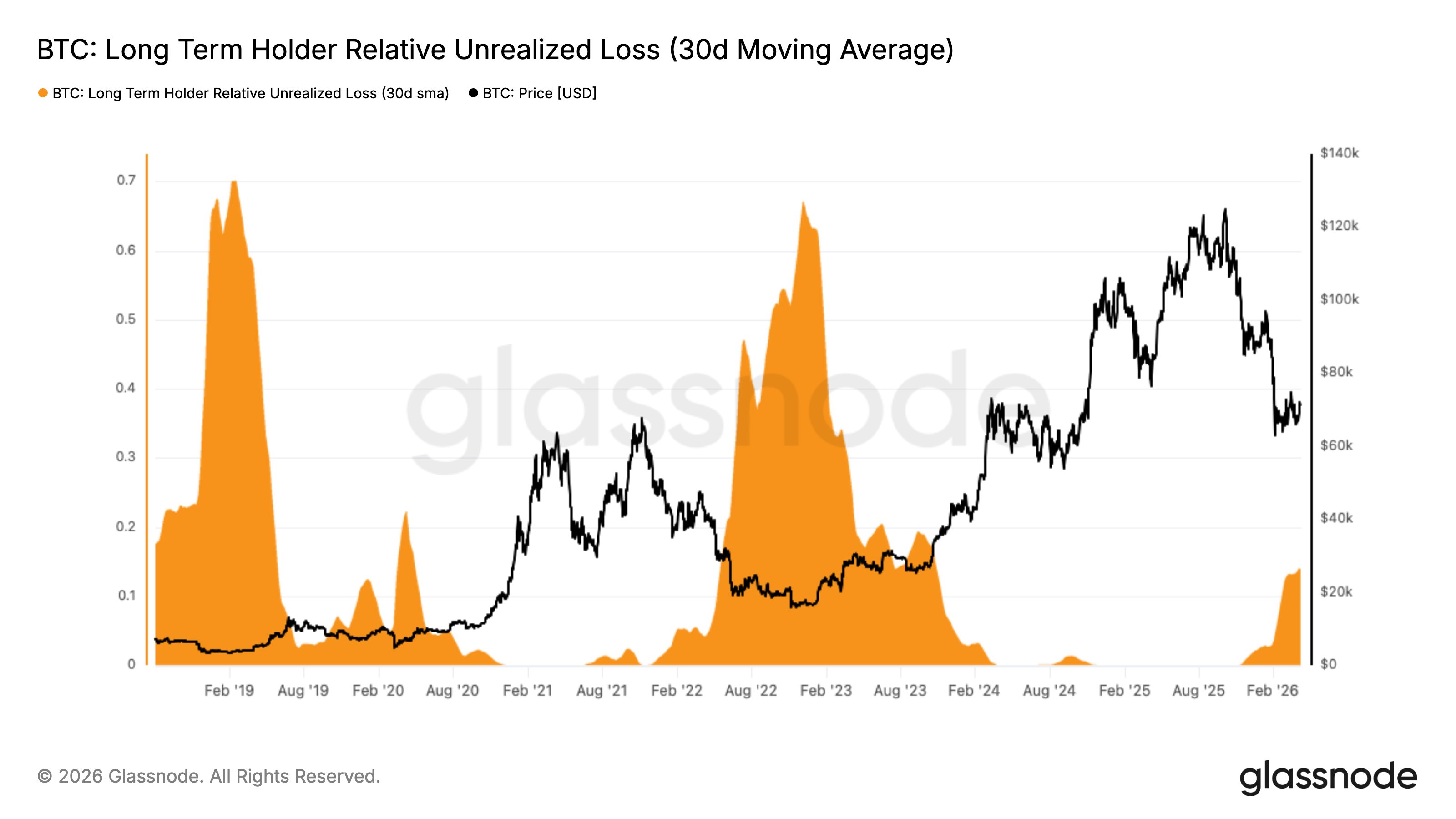
The value of the metric appears to have climbed in recent months | Source: Glassnode on X

As displayed in the above graph, the 30-day SMA of the Bitcoin LTH Relative Unrealized Loss has observed a rise over the last few months, a consequence of the bearish price action as well as the maturation of coins bought at the market top into the LTH cohort.

Today, the indicator’s value is sitting at 14%, meaning that the loss held by the diamond hands is equivalent to 14% of the total valuation of the cryptocurrency. This is the highest degree of pain that the LTHs have faced since 2023.

It’s visible from the chart, however, that the last two bear markets both saw the indicator spike to much higher levels, with notable peaks of around 70% forming during their bottoms.

While it’s uncertain whether the latest Bitcoin cycle will also have to see a similar level of pain among the LTHs before a bottom, the fact that the Relative Unrealized Loss still significantly lags behind could be noteworthy.

BTC Price

Bitcoin has recovered back above the $72,000 mark with its latest rally.

The trend in the price of the coin over the last five days | Source: BTCUSDT on TradingView


Trending Cryptos

Related Questions

QWhat is the current level of Bitcoin long-term holder (LTH) relative unrealized losses, according to Glassnode?

AThe current level of Bitcoin long-term holder relative unrealized losses is 14% of the market cap.

QHow does the current LTH losses compare to the levels seen at the bottom of the last two bear markets?

AThe current LTH losses of 14% are significantly lower than the peaks of around 70% seen at the bottom of the last two bear markets.

QWho is considered a 'long-term holder' (LTH) in the context of this analysis?

AA 'long-term holder' (LTH) is defined as a Bitcoin investor who has been holding their tokens for more than 155 days.

QWhat two main factors contributed to the recent rise in LTH unrealized losses?

AThe recent increase in LTH unrealized losses is a consequence of the bearish price action and the maturation of coins bought at the market top into the LTH cohort.

QWhat price level did Bitcoin recover to in its latest rally mentioned in the article?

AIn its latest rally, Bitcoin recovered back above the $72,000 mark.

Related Reads

Solana Price Forecast for August 2026: Can $19 Million from Morgan Stanley and 330,000 Korean Merchants Break SOL's Triangle?

**Solana Price Forecast for August 2026: Key Catalysts and Technical Setup** As of July 31, Solana (SOL) trades at $73.59, consolidating within a triangle pattern formed between its May peak (~$98) and June low (~$60.29). A decisive breakout from this pattern is anticipated. Key resistance levels are clustered around $74.79 (0.382 Fib), $75.33 (20-day EMA), $76.01 (50-day EMA), and a critical zone near $79 (0.5 Fib & 100-day EMA). Support lies at $73.42, $69.25 (0.236 Fib), and the June low of $60.29. Two major institutional catalysts emerged recently: 1. **Morgan Stanley's MSOL ETF:** Launched July 28, it saw $19.06 million in inflows on its second day—the largest single-day inflow for any US SOL ETF since mid-May. 2. **KSNET Partnership:** The Solana Foundation signed an MoU with South Korean payment processor KSNET (serving 330,000 merchants) to explore integrating Solana Pay for domestic and AI-powered transactions. Historically, August has been volatile for SOL, marked by extreme gains in 2020 and 2021 but otherwise weak performance. The forecast for August 2026 is bifurcated: * **Bullish Case:** An upside triangle breakout, sustained MSOL inflows, and positive momentum from the KSNET news could propel SOL toward the $79 resistance cluster, especially if the CLARITY Act is passed by August 8. * **Bearish Case:** A downside break below $73.42, fading excitement around the new ETF, and stalled regulatory progress could see SOL retest support near $69.25, exacerbated by macro risks.

cryptonews.ru9m ago

Solana Price Forecast for August 2026: Can $19 Million from Morgan Stanley and 330,000 Korean Merchants Break SOL's Triangle?

cryptonews.ru9m ago

AFX Trade Promises to Present "Goodwill Plan" on August 3 Following $24 Million Loss Incident

AFX Trade, a cryptocurrency platform, announced it will present a "goodwill plan" on August 3rd, following a security incident on July 22nd that resulted in a loss of $24.15 million. The company's brief update offered no specific details on compensation for affected users, investors, and employees, only urging calm while the team formulates next steps. The theft occurred from a USDC custody account on Arbitrum, with the stolen funds converted to Ethereum. Blockchain analysts traced the funds to a single wallet. AFX Trade and Arbitrum clarified the exploit targeted a third-party bridge, not Arbitrum's native bridge. An investigation revealed the attack began on July 9th with a social engineering scheme targeting a developer. The attacker then deployed malicious code within AFX's internal JFrog repository and infrastructure, eventually compromising bridge validators to authorize the fraudulent withdrawal. The company stated the exploit leveraged a "trust vulnerability," not a smart contract bug. AFX Trade's head of business development made an offer to the attacker, proposing they keep 30% of the funds as a white hat bounty if 70% is returned. The incident fits a 2026 trend identified by TRM Labs: while the number of crypto hacks hit a record, total losses decreased. However, infrastructure and operational breaches, though fewer, accounted for the majority of financial losses. The AFX breach is classified as an infrastructure incident involving private key compromise.

cryptonews.ru19m ago

AFX Trade Promises to Present "Goodwill Plan" on August 3 Following $24 Million Loss Incident

cryptonews.ru19m ago

Trading

Spot

Hot Articles

What is $BITCOIN

DIGITAL GOLD ($BITCOIN): A Comprehensive Analysis Introduction to DIGITAL GOLD ($BITCOIN) DIGITAL GOLD ($BITCOIN) is a blockchain-based project operating on the Solana network, which aims to combine the characteristics of traditional precious metals with the innovation of decentralized technologies. While it shares a name with Bitcoin, often referred to as “digital gold” due to its perception as a store of value, DIGITAL GOLD is a separate token designed to create a unique ecosystem within the Web3 landscape. Its goal is to position itself as a viable alternative digital asset, although specifics regarding its applications and functionalities are still developing. What is DIGITAL GOLD ($BITCOIN)? DIGITAL GOLD ($BITCOIN) is a cryptocurrency token explicitly designed for use on the Solana blockchain. In contrast to Bitcoin, which provides a widely recognized value storage role, this token appears to focus on broader applications and characteristics. Notable aspects include: Blockchain Infrastructure: The token is built on the Solana blockchain, known for its capacity to handle high-speed and low-cost transactions. Supply Dynamics: DIGITAL GOLD has a maximum supply capped at 100 quadrillion tokens (100P $BITCOIN), although details regarding its circulating supply are currently undisclosed. Utility: While precise functionalities are not explicitly outlined, there are indications that the token could be utilized for various applications, potentially involving decentralized applications (dApps) or asset tokenization strategies. Who is the Creator of DIGITAL GOLD ($BITCOIN)? At present, the identity of the creators and development team behind DIGITAL GOLD ($BITCOIN) remains unknown. This situation is typical among many innovative projects within the blockchain space, particularly those aligning with decentralized finance and meme coin phenomena. While such anonymity may foster a community-driven culture, it intensifies concerns about governance and accountability. Who are the Investors of DIGITAL GOLD ($BITCOIN)? The available information indicates that DIGITAL GOLD ($BITCOIN) does not have any known institutional backers or prominent venture capital investments. The project seems to operate on a peer-to-peer model focused on community support and adoption rather than traditional funding routes. Its activity and liquidity are primarily situated on decentralized exchanges (DEXs), such as PumpSwap, rather than established centralized trading platforms, further highlighting its grassroots approach. How DIGITAL GOLD ($BITCOIN) Works The operational mechanics of DIGITAL GOLD ($BITCOIN) can be elaborated on based on its blockchain design and network attributes: Consensus Mechanism: By leveraging Solana’s unique proof-of-history (PoH) combined with a proof-of-stake (PoS) model, the project ensures efficient transaction validation contributing to the network's high performance. Tokenomics: While specific deflationary mechanisms have not been extensively detailed, the vast maximum token supply implies that it may cater to microtransactions or niche use cases that are still to be defined. Interoperability: There exists the potential for integration with Solana’s broader ecosystem, including various decentralized finance (DeFi) platforms. However, the details regarding specific integrations remain unspecified. Timeline of Key Events Here is a timeline that highlights significant milestones concerning DIGITAL GOLD ($BITCOIN): 2023: The initial deployment of the token occurs on the Solana blockchain, marked by its contract address. 2024: DIGITAL GOLD gains visibility as it becomes available for trading on decentralized exchanges like PumpSwap, allowing users to trade it against SOL. 2025: The project witnesses sporadic trading activity and potential interest in community-led engagements, although no noteworthy partnerships or technical advancements have been documented as of yet. Critical Analysis Strengths Scalability: The underlying Solana infrastructure supports high transaction volumes, which could enhance the utility of $BITCOIN in various transaction scenarios. Accessibility: The potential low trading price per token could attract retail investors, facilitating wider participation due to fractional ownership opportunities. Risks Lack of Transparency: The absence of publicly known backers, developers, or an audit process may yield skepticism regarding the project's sustainability and trustworthiness. Market Volatility: The trading activity is heavily reliant on speculative behavior, which can result in significant price volatility and uncertainty for investors. Conclusion DIGITAL GOLD ($BITCOIN) emerges as an intriguing yet ambiguous project within the rapidly evolving Solana ecosystem. While it attempts to leverage the “digital gold” narrative, its departure from Bitcoin's established role as a store of value underscores the need for a clearer differentiation of its intended utility and governance structure. Future acceptance and adoption will likely depend on addressing the current opacity and defining its operational and economic strategies more explicitly. Note: This report encompasses synthesised information available as of October 2023, and developments may have transpired beyond the research period.

1.2k Total ViewsPublished 2025.05.13Updated 2025.05.13

What is $BITCOIN

Discussions

Welcome to the HTX Community. Here, you can stay informed about the latest platform developments and gain access to professional market insights. Users' opinions on the price of BTC (BTC) are presented below.

活动图片