Bitcoin Decline Signals Structural Weakness As Liquidity, Macro Conditions Worsen – Details

bitcoinistPublished on 2026-03-28Last updated on 2026-03-28

Abstract

A recent analysis by XWIN Research Japan indicates Bitcoin is exhibiting structural weakness due to deteriorating liquidity and adverse macroeconomic conditions. Trading volume has significantly declined for months, resulting in low market liquidity that amplifies the impact of news and short-term flows. This is compounded by a drop in active addresses, signaling weak demand and hindering recovery. While some on-chain metrics have slightly improved, they are insufficient to confirm a trend reversal. Macroeconomic pressures, particularly rising oil prices from the US-Israel-Iran conflict, have increased inflation expectations. This has led to anticipations of interest rate hikes and tighter financial conditions, causing simultaneous sell-offs in bonds, equities, gold, and cryptocurrencies—deviating from traditional risk-off behavior. Unless liquidity and on-chain activity show definite recovery, Bitcoin's price is expected to decline further in the near term. At the time of writing, Bitcoin was trading around $65,981, down 4.01% over the past day.

A recent evaluation of the Bitcoin market has surfaced, suggesting that the premier cryptocurrency is suffering from a lack of structural strength. Notably, the cause of the weakness is a combination of interrelated underlying factors.

Market Volatility On The Rise As Available Liquidity Tapers

In a recent CryptoQuant post via QuickTake, XWIN Research Japan highlights that the Bitcoin market is going through a critical phase, where slight institutional activity could offset major changes in its price. The research group points out reasons for this hypothesis, stating first that there has been a significant decline in trading volume.

According to XWIN Research, this fall in trading volume has occurred for several months, resulting in little market liquidity. In this condition, the market is highly sensitive to news and even short-term flows, creating an exponential effect on the market.

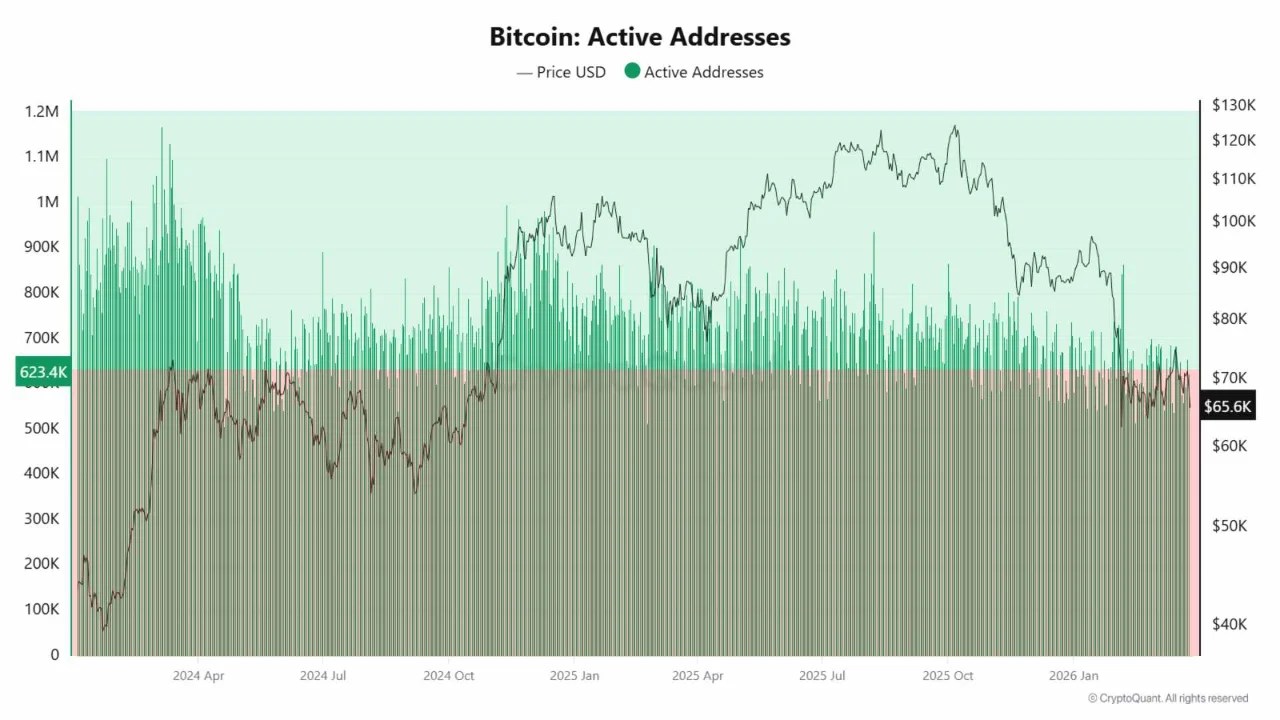
Source: CryptoQuant

This present situation is further reinforced by the Bitcoin: Active Addresses metric, which tracks the number of unique wallet addresses actively sending or receiving Bitcoin over a given period. When active addresses decline alongside price, it indicates a weak demand is present, and that the Bitcoin market is likely to struggle with a recovery.

Notably, XWIN Research Japan states that “while some on-chain metrics have recently improved, they are not strong enough to confirm a trend reversal.” As such, any reversal seen in the current market conditions could be merely temporary.

Growing Macroeconomic Pressures Widen Room For Fear

Aside from the internal dynamics of the Bitcoin market, broader macroeconomic forces are also playing a significant role in Bitcoin’s price weakness. The research group explains that the rise in oil prices caused by the US-Israel-Iran conflict has boosted inflation expectations higher than usual. For this reason, the macroeconomic market is witnessing a rise in expectations for a rate hike and tightening financial conditions.

Concurrently, inflation concerns have led to significant sell-offs of bonds, causing a simultaneous decline across equities, gold, and cryptocurrencies. Notably, this behavior is in contrast with that expected during traditional risk-off scenarios, where capital typically rotates into safer assets (bonds, for example).

Ultimately, XWIN Research Japan sees the Bitcoin price dropping further in the near-term, except in the event where current liquidity conditions and on-chain activity both see definite recovery. In this case, the central factor that would define the market conditions is the US-Israel-Iran conflict, as this influences inflation levels and interest rates, which would in turn affect the overall direction of the market.

At the time of writing, the price of Bitcoin stands at around $65,981. Per data from CoinMarketCap, the world’s leading cryptocurrency has been devalued by approximately 4.01% since the past day.

BTC trading at $66.197 on the daily chart | Source: BTCUSDT chart on Tradingview.com

Related Questions

QWhat are the main factors contributing to Bitcoin's structural weakness according to the article?

AThe main factors are a significant decline in trading volume leading to low market liquidity, weak demand indicated by declining active addresses, and worsening macroeconomic conditions including rising inflation expectations and potential interest rate hikes.

QHow does the decline in trading volume affect the Bitcoin market's sensitivity?

AThe decline in trading volume results in little market liquidity, making the market highly sensitive to news and even short-term flows, creating an exponential effect on price movements.

QWhat macroeconomic event is specifically mentioned as driving inflation expectations and how does this affect Bitcoin?

AThe US-Israel-Iran conflict is mentioned as driving up oil prices which boosts inflation expectations higher than usual, leading to expectations for rate hikes and tighter financial conditions that cause sell-offs across assets including Bitcoin.

QAccording to XWIN Research Japan, what is required for a Bitcoin trend reversal to be confirmed?

AWhile some on-chain metrics have recently improved, they are not strong enough to confirm a trend reversal. A definite recovery in both current liquidity conditions and on-chain activity would be required.

QWhat was Bitcoin's price and 24-hour performance at the time of writing according to the article?

AAt the time of writing, Bitcoin's price stood at around $65,981 and had depreciated by approximately 4.01% over the past 24 hours.

Related Reads

First Batch of Keynote Speakers and Partners Announced! Web2+3 Summit: Defining the Next Generation of Digital Economy

Web2+3 Summit: Defining the Next Generation of Digital Economy The 6th BEYOND International Technology Innovation Expo (BEYOND Expo 2026), Asia's largest tech and ecosystem exhibition, is launching a dedicated Web2+3 stage for the first time. Co-hosted by BEYOND Expo and ChainNeXT Group, the Web3 Summit will take place from May 28–30, 2026. Against the backdrop of accelerating global tech integration, the boundaries between Web2 and Web3 are rapidly blurring. With clearer global regulations for blockchain-driven internet (Web3) and the special issuance of a Hong Kong dollar stable币 license by the Hong Kong SAR government on April 10, 2026, Web3's decentralized principles are quickly merging with traditional industries (Web2) such as e-commerce, finance, and artificial intelligence. Focused on blockchain-driven digital economy elements, the summit will center on three core principles—implementability, commercial viability, and compliance. It will bring together top Web3 experts to discuss key integration areas like stablecoin payment finance (PayFi), real-world asset tokenization (RWA), and decentralized AI (DeAI), unveiling new opportunities for industrial innovation. The first wave of confirmed speakers includes Jack Kong (Director of Hong Kong Cyberport, Chairman of Nano Labs), Yat Siu (Chairman of Animoca Brands), Michael Wu (Co-founder & CEO of Amber Group), Michael Heinrich (Co-founder & CEO of 0G), and Art Abal (Co-founder of Vana). More Web3 ecosystem pioneers, AI, and fintech experts will be announced soon. Core forum topics include: - Web2+DeAI: New AI Paradigms Driven by Decentralized Infrastructure - Web2+RWA: Real-World Asset Tokenization and Global Liquidity - Web2+PayFi: Cross-Border Payments and Financial Innovation Powered by Crypto Infrastructure - Web2+3 AI: Autonomous Agents and the Crypto Economy - Web2+3 Wealth: On-Chain and Off-Chain Integrated Investment Ecosystems - Web2+3 Commerce: A New Landscape for Global Trade Driven by Stablecoins Additional agenda details will be released in the near future.

marsbit1h ago

First Batch of Keynote Speakers and Partners Announced! Web2+3 Summit: Defining the Next Generation of Digital Economy

marsbit1h ago

Trading

Spot
Futures

Hot Articles

What is $BITCOIN

DIGITAL GOLD ($BITCOIN): A Comprehensive Analysis Introduction to DIGITAL GOLD ($BITCOIN) DIGITAL GOLD ($BITCOIN) is a blockchain-based project operating on the Solana network, which aims to combine the characteristics of traditional precious metals with the innovation of decentralized technologies. While it shares a name with Bitcoin, often referred to as “digital gold” due to its perception as a store of value, DIGITAL GOLD is a separate token designed to create a unique ecosystem within the Web3 landscape. Its goal is to position itself as a viable alternative digital asset, although specifics regarding its applications and functionalities are still developing. What is DIGITAL GOLD ($BITCOIN)? DIGITAL GOLD ($BITCOIN) is a cryptocurrency token explicitly designed for use on the Solana blockchain. In contrast to Bitcoin, which provides a widely recognized value storage role, this token appears to focus on broader applications and characteristics. Notable aspects include: Blockchain Infrastructure: The token is built on the Solana blockchain, known for its capacity to handle high-speed and low-cost transactions. Supply Dynamics: DIGITAL GOLD has a maximum supply capped at 100 quadrillion tokens (100P $BITCOIN), although details regarding its circulating supply are currently undisclosed. Utility: While precise functionalities are not explicitly outlined, there are indications that the token could be utilized for various applications, potentially involving decentralized applications (dApps) or asset tokenization strategies. Who is the Creator of DIGITAL GOLD ($BITCOIN)? At present, the identity of the creators and development team behind DIGITAL GOLD ($BITCOIN) remains unknown. This situation is typical among many innovative projects within the blockchain space, particularly those aligning with decentralized finance and meme coin phenomena. While such anonymity may foster a community-driven culture, it intensifies concerns about governance and accountability. Who are the Investors of DIGITAL GOLD ($BITCOIN)? The available information indicates that DIGITAL GOLD ($BITCOIN) does not have any known institutional backers or prominent venture capital investments. The project seems to operate on a peer-to-peer model focused on community support and adoption rather than traditional funding routes. Its activity and liquidity are primarily situated on decentralized exchanges (DEXs), such as PumpSwap, rather than established centralized trading platforms, further highlighting its grassroots approach. How DIGITAL GOLD ($BITCOIN) Works The operational mechanics of DIGITAL GOLD ($BITCOIN) can be elaborated on based on its blockchain design and network attributes: Consensus Mechanism: By leveraging Solana’s unique proof-of-history (PoH) combined with a proof-of-stake (PoS) model, the project ensures efficient transaction validation contributing to the network's high performance. Tokenomics: While specific deflationary mechanisms have not been extensively detailed, the vast maximum token supply implies that it may cater to microtransactions or niche use cases that are still to be defined. Interoperability: There exists the potential for integration with Solana’s broader ecosystem, including various decentralized finance (DeFi) platforms. However, the details regarding specific integrations remain unspecified. Timeline of Key Events Here is a timeline that highlights significant milestones concerning DIGITAL GOLD ($BITCOIN): 2023: The initial deployment of the token occurs on the Solana blockchain, marked by its contract address. 2024: DIGITAL GOLD gains visibility as it becomes available for trading on decentralized exchanges like PumpSwap, allowing users to trade it against SOL. 2025: The project witnesses sporadic trading activity and potential interest in community-led engagements, although no noteworthy partnerships or technical advancements have been documented as of yet. Critical Analysis Strengths Scalability: The underlying Solana infrastructure supports high transaction volumes, which could enhance the utility of $BITCOIN in various transaction scenarios. Accessibility: The potential low trading price per token could attract retail investors, facilitating wider participation due to fractional ownership opportunities. Risks Lack of Transparency: The absence of publicly known backers, developers, or an audit process may yield skepticism regarding the project's sustainability and trustworthiness. Market Volatility: The trading activity is heavily reliant on speculative behavior, which can result in significant price volatility and uncertainty for investors. Conclusion DIGITAL GOLD ($BITCOIN) emerges as an intriguing yet ambiguous project within the rapidly evolving Solana ecosystem. While it attempts to leverage the “digital gold” narrative, its departure from Bitcoin's established role as a store of value underscores the need for a clearer differentiation of its intended utility and governance structure. Future acceptance and adoption will likely depend on addressing the current opacity and defining its operational and economic strategies more explicitly. Note: This report encompasses synthesised information available as of October 2023, and developments may have transpired beyond the research period.

363 Total ViewsPublished 2025.05.13Updated 2025.05.13

What is $BITCOIN

Discussions

Welcome to the HTX Community. Here, you can stay informed about the latest platform developments and gain access to professional market insights. Users' opinions on the price of BTC (BTC) are presented below.

活动图片