Bitcoin And Ethereum Whales Turn Bearish With Preference For Short Positions – What This Means

bitcoinistPublished on 2026-04-09Last updated on 2026-04-09

Abstract

Despite Bitcoin and Ethereum briefly reclaiming key levels of $71,000 and $2,200 respectively, on-chain data reveals a bearish sentiment among large investors, or "whales." Both Bitcoin and Ethereum whales are increasingly opening short positions, indicating expectations of a potential price decline. This shift contrasts with retail traders, who are growing more optimistic and taking long positions. Analysts describe the current market phase as a "compression" rather than a full reset, with Bitcoin's price action staying above deeper on-chain support levels but remaining below key short-term holder realized price. This divergence in sentiment between whales and retailers is likely to create significant market tension and influence the next major price move for both cryptocurrencies.

Bitcoin and Ethereum prices briefly surged on Wednesday, with BTC reclaiming $71,000 and ETH reclaiming $2,200. Despite the upside move, reports are showing that large investors across the market are heavily bearish toward the two leading cryptocurrency assets.

Whales Bet Against Bitcoin And Ethereum

Bullish momentum appears to have returned for Bitcoin and Ethereum as both assets are now trading above key resistance levels that previously triggered downside action. Even during the period, key traders’ sentiment remained unchanged, reflecting a negative outlook for these top assets.

An X post from Alphractal, an advanced investment and on-chain data analytics platform, is showing a notable shift in sentiment among large investors or whales. The signal is emerging from the Whale Vs Retail Delta metric.

Specifically, whales in both Bitcoin and Ethereum are increasingly favoring or opening short positions over long positions. This shift implies that some of the market’s most powerful players are preparing for a possible decline, even though price action may seem reasonably constant on the surface.
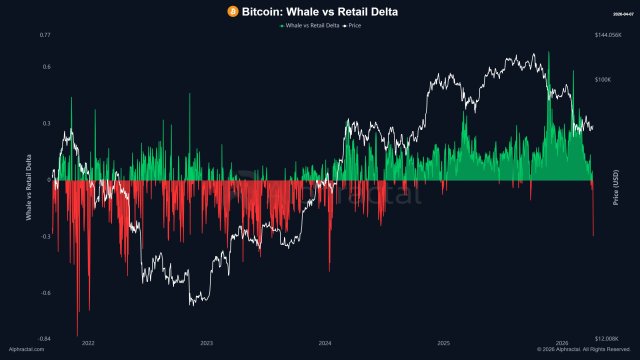
Source: Chart from Alphractal on X

When investors notably shift towards bearish bets, it usually implies that caution is building or investors are expecting the broader correction to extend. As whales continue to bet against the two leading assets, this pattern is likely to result in persistent selling pressure throughout the market.

According to the platform, whales are more interested in shorts than longs, whereas retail traders are doing the opposite and increasing their exposure. Retailers opening longs during a volatile period reflects growing optimism and confidence that the current phase offers buying opportunities.

This striking divergence between whales and retail holders’ sentiment and activity could create significant tension in the market. In the meantime, this pattern is likely to serve as a crucial part in shaping the next move for BTC and ETH.

A Compression Phase, Not A Reset

After examining the Bitcoin On-Chain Price Dynamics, Teddy highlighted that the current price action is more of a compression than a reset. While BTC has fallen roughly 50% from the 2025 high, the on-chain structure still does not look like a full reset.

During the time of the post, BTC’s price was located near $68,600. Meanwhile, Realized Price remained close to $54,100, Long-Term Holder Realized Price stayed near $42,200, and Investor Price was close to $49,500. At this point, this positioning is keeping the broader cost-basis structure intact.

The market has cooled, but the price has not yet broken into the deeper on-chain support band, with higher pressure on the structure. Currently, Bitcoin is trading below the STH Realized Price, which is close to $79,200, and the True Market Mean Price, which is close to $78,300.

Teddy noted that recent buyers remain under pressure as the rice has not yet reclaimed the zone where the structure begins to appear healthier. With sideways price action, profitability has reduced, and short-term holders are still underwater. However, the broader realized base has not yet been lost.

BTC trading at $70,971 on the 1D chart | Source: BTCUSDT on Tradingview.com

Trending Cryptos

Related Questions

QWhat is the current sentiment of Bitcoin and Ethereum whales according to the Whale Vs Retail Delta metric?

ABitcoin and Ethereum whales are bearish, as they are increasingly favoring or opening short positions over long positions, indicating they are preparing for a possible price decline.

QHow are retail traders behaving differently from whales in the current market?

ARetail traders are doing the opposite of whales by increasing their long positions, reflecting growing optimism and confidence that the current phase offers buying opportunities.

QWhat does the divergence between whale and retail sentiment likely create in the market?

AThe striking divergence between whale and retail holders' sentiment and activity could create significant tension in the market and is likely to be a crucial part in shaping the next price move for BTC and ETH.

QAccording to the on-chain analysis, is the current Bitcoin price action considered a full market reset?

ANo, the on-chain analysis by Teddy suggests the current price action is more of a compression than a full reset, as the broader cost-basis structure remains intact despite the price falling from its high.

QWhat key on-chain price levels are mentioned for Bitcoin, and where is the price currently trading in relation to them?

AKey levels mentioned are the Realized Price (~$54,100), Long-Term Holder Realized Price (~$42,200), and Investor Price (~$49,500). Bitcoin is currently trading below the STH Realized Price (~$79,200) and the True Market Mean Price (~$78,300).

Related Reads

Stable Vaults Are the Final Piece in Aave's Mass Commercialization Puzzle

Aave's introduction of "Stable Vaults" aims to bridge the gap between complex DeFi protocols and mainstream users by offering a simplified, predictable savings product. The core innovation is a fixed-yield layer built atop Aave's volatile underlying lending pools. Partnering platforms (like digital banks or wallets) can offer users a guaranteed interest rate (e.g., 4%), shielding them from market fluctuations. The partner absorbs the risk and profit/loss from the difference between this fixed rate and Aave's variable rate. From the user's perspective, Stable Vaults provide ease of use, predictable returns, and familiar services like customer support and account recovery, addressing key barriers like wallet management and volatility. However, users pay a price: they cap their potential earnings (forgoing higher market yields), add counterparty risk from the partner platform, and may lack transparency into the true spread being captured. For partners, Stable Vaults turn idle user funds into a revenue stream via the yield spread. For Aave, this strategy attracts sticky, "sticky" capital from mass-market applications, providing a stable fee revenue stream crucial for its tokenomics (e.g., buyback mechanisms), especially in bear markets. The article contrasts this approach with direct DeFi interaction, where users keep all yield but face complexity and volatility. It argues that Stable Vaults align with proven consumer behavior: most users prioritize convenience, safety, and predictability over maximizing returns, willingly paying a "peace of mind" premium. Examples like Coinbase and Robinhood offering similar "savings" products validate this demand. Thus, Stable Vaults represent Aave's strategic move to commercialize by catering to fundamental human preferences for simplicity and stability in finance.

marsbit45m ago

Stable Vaults Are the Final Piece in Aave's Mass Commercialization Puzzle

marsbit45m ago

Support Rate Less Than 1%, BIP-110 Still Pushes Bitcoin Towards a Soft Fork?

Title: BIP-110 Pushes Bitcoin Towards a Soft Fork Despite Less Than 1% Approval With its August mandatory activation window approaching, the controversial BIP-110 proposal is back in the spotlight. Proposed in December 2025 by Dathon Ohm and supported by Bitcoin Core developer Luke Dashjr, BIP-110 aims to impose a one-year limit on arbitrary/non-monetary data in Bitcoin transactions, primarily targeting large data storage like Ordinals and Bitcoin NFTs, to reduce network "spam" and refocus Bitcoin on its monetary function. However, the proposal faces overwhelming opposition. To activate, BIP-110 requires a 55% threshold, yet current miner support is below 1%. Of the 102,674 network nodes, only 14.64% (15,035) signal readiness to enforce it. Despite this lack of consensus, BIP-110 has a contentious "mandatory window" mechanism: if the threshold isn't met by block height 961,632, supporting nodes will begin rejecting non-compliant blocks from height 961,632 to 963,647, attempting to force activation by block 965,664. This could lead to a chain split in early August between a minority chain enforcing BIP-110 and the main chain. Proponents, led by Luke Dashjr (founder of Ocean mining pool), argue that inscriptions constitute an "attack" on Bitcoin, congesting block space and raising transaction fees, thereby undermining Bitcoin's primary use as money. They view BIP-110 not as a change but as a reversal of a harmful change. Opponents, including figures like Adam Back, Jameson Lopp, and Michael Saylor, contend that BIP-110 fails to solve the spam problem while creating new risks. They warn it could stifle future innovation (e.g., impacting BitVM), introduce transaction censorship—eroding Bitcoin's neutrality—and potentially cause a damaging chain split that fragments developer resources, hash power, and monetary consensus. They argue market-based fee pressure and block size limits already manage congestion effectively. Potential outcomes post-activation include: 1) The BIP-110 chain stalling due to insufficient hash power; 2) The BIP-110 chain becoming the longest chain if it gains majority miner support (though currently, Ocean holds only 2.6% of hash power vs. opponents like F2Pool at 13.6%); or 3) A persistent minority chain that remains economically unviable, potentially leading to a permanent fork. Most analysts and prediction markets deem BIP-110's success unlikely, with one market giving only a 10% probability that it will become the accepted longest chain by September 2026.

marsbit50m ago

Support Rate Less Than 1%, BIP-110 Still Pushes Bitcoin Towards a Soft Fork?

marsbit50m ago

Mining Stocks Are Moving Further Away from Crypto

Title: Mining Stocks Are Drifting Away from Crypto Summary: Despite Bitcoin (BTC) falling approximately 46% over the past year, leading Bitcoin mining stocks (e.g., HUT, WULF, IREN) have surged significantly. This divergence stems from a fundamental shift in how the market values these companies. Their stock prices are no longer tied primarily to crypto prices, mining output, or hash rates. Instead, investors are now pricing them as AI infrastructure plays. Mining companies possess critical assets for AI data centers: pre-permitted land, grid-connected power capacity, and operational expertise for high-load facilities—resources facing severe shortages and long lead times for new entrants. For example, CleanSpark signed a 20-year, ~$6.6 billion infrastructure lease for an AI data center, while Marathon Digital acquired a project with up to 2 GW of planned power capacity. Analysts note a strong correlation between a mining company's market valuation and its contracted or potential AI power capacity in North America. CoinShares predicts that by year-end, up to 70% of revenue for listed miners could come from AI/HPC, compared to about 30% at the start of 2026. However, this re-rating introduces new risks: 1) Valuation volatility linked to the broader AI/semiconductor sector, 2) Potentially low baseline return rates (estimated at 4-5% for some firms), and 3) Execution risks including massive financing needs, regulatory permits, and tenant quality. This strategic pivot is also changing miner behavior. They are selling BTC holdings more aggressively to fund AI capex, meaning selling pressure may persist regardless of Bitcoin's price. Furthermore, once power and sites are locked into long-term AI contracts, they are unlikely to return to Bitcoin mining, potentially altering the network's hash rate dynamics long-term. In essence, mining firms are being valued for what they are becoming—AI infrastructure providers—rather than pure-play crypto miners.

链捕手57m ago

Mining Stocks Are Moving Further Away from Crypto

链捕手57m ago

Trading

Spot

Hot Articles

What is $BITCOIN

DIGITAL GOLD ($BITCOIN): A Comprehensive Analysis Introduction to DIGITAL GOLD ($BITCOIN) DIGITAL GOLD ($BITCOIN) is a blockchain-based project operating on the Solana network, which aims to combine the characteristics of traditional precious metals with the innovation of decentralized technologies. While it shares a name with Bitcoin, often referred to as “digital gold” due to its perception as a store of value, DIGITAL GOLD is a separate token designed to create a unique ecosystem within the Web3 landscape. Its goal is to position itself as a viable alternative digital asset, although specifics regarding its applications and functionalities are still developing. What is DIGITAL GOLD ($BITCOIN)? DIGITAL GOLD ($BITCOIN) is a cryptocurrency token explicitly designed for use on the Solana blockchain. In contrast to Bitcoin, which provides a widely recognized value storage role, this token appears to focus on broader applications and characteristics. Notable aspects include: Blockchain Infrastructure: The token is built on the Solana blockchain, known for its capacity to handle high-speed and low-cost transactions. Supply Dynamics: DIGITAL GOLD has a maximum supply capped at 100 quadrillion tokens (100P $BITCOIN), although details regarding its circulating supply are currently undisclosed. Utility: While precise functionalities are not explicitly outlined, there are indications that the token could be utilized for various applications, potentially involving decentralized applications (dApps) or asset tokenization strategies. Who is the Creator of DIGITAL GOLD ($BITCOIN)? At present, the identity of the creators and development team behind DIGITAL GOLD ($BITCOIN) remains unknown. This situation is typical among many innovative projects within the blockchain space, particularly those aligning with decentralized finance and meme coin phenomena. While such anonymity may foster a community-driven culture, it intensifies concerns about governance and accountability. Who are the Investors of DIGITAL GOLD ($BITCOIN)? The available information indicates that DIGITAL GOLD ($BITCOIN) does not have any known institutional backers or prominent venture capital investments. The project seems to operate on a peer-to-peer model focused on community support and adoption rather than traditional funding routes. Its activity and liquidity are primarily situated on decentralized exchanges (DEXs), such as PumpSwap, rather than established centralized trading platforms, further highlighting its grassroots approach. How DIGITAL GOLD ($BITCOIN) Works The operational mechanics of DIGITAL GOLD ($BITCOIN) can be elaborated on based on its blockchain design and network attributes: Consensus Mechanism: By leveraging Solana’s unique proof-of-history (PoH) combined with a proof-of-stake (PoS) model, the project ensures efficient transaction validation contributing to the network's high performance. Tokenomics: While specific deflationary mechanisms have not been extensively detailed, the vast maximum token supply implies that it may cater to microtransactions or niche use cases that are still to be defined. Interoperability: There exists the potential for integration with Solana’s broader ecosystem, including various decentralized finance (DeFi) platforms. However, the details regarding specific integrations remain unspecified. Timeline of Key Events Here is a timeline that highlights significant milestones concerning DIGITAL GOLD ($BITCOIN): 2023: The initial deployment of the token occurs on the Solana blockchain, marked by its contract address. 2024: DIGITAL GOLD gains visibility as it becomes available for trading on decentralized exchanges like PumpSwap, allowing users to trade it against SOL. 2025: The project witnesses sporadic trading activity and potential interest in community-led engagements, although no noteworthy partnerships or technical advancements have been documented as of yet. Critical Analysis Strengths Scalability: The underlying Solana infrastructure supports high transaction volumes, which could enhance the utility of $BITCOIN in various transaction scenarios. Accessibility: The potential low trading price per token could attract retail investors, facilitating wider participation due to fractional ownership opportunities. Risks Lack of Transparency: The absence of publicly known backers, developers, or an audit process may yield skepticism regarding the project's sustainability and trustworthiness. Market Volatility: The trading activity is heavily reliant on speculative behavior, which can result in significant price volatility and uncertainty for investors. Conclusion DIGITAL GOLD ($BITCOIN) emerges as an intriguing yet ambiguous project within the rapidly evolving Solana ecosystem. While it attempts to leverage the “digital gold” narrative, its departure from Bitcoin's established role as a store of value underscores the need for a clearer differentiation of its intended utility and governance structure. Future acceptance and adoption will likely depend on addressing the current opacity and defining its operational and economic strategies more explicitly. Note: This report encompasses synthesised information available as of October 2023, and developments may have transpired beyond the research period.

862 Total ViewsPublished 2025.05.13Updated 2025.05.13

What is $BITCOIN

Discussions

Welcome to the HTX Community. Here, you can stay informed about the latest platform developments and gain access to professional market insights. Users' opinions on the price of BTC (BTC) are presented below.

活动图片