On August 3, Phong Le, CEO of Strategy Inc. (Nasdaq: MSTR), stated that since adopting its Bitcoin-focused investment strategy, MSTR has outperformed Bitcoin in returns over every rolling four-year holding period. The company compared the annualized returns of investments made between August 2020 and August 2022, showing that the stock yielded higher returns than Bitcoin over each rolling four-year investment period.
Le stated:
"Since adopting the Bitcoin-focused strategy, MSTR shares have delivered higher returns than $BTC over every four-year holding period. This is by design and aligns with our long-term vision."
Rolling holding periods allow for comparing returns based on multiple investment start dates, rather than relying on a single entry point, providing a broader view of long-term performance. Bitcoin's historical four-year cycle is often linked to halving events, so Strategy's analysis using a rolling window represents an alternative approach to assessing long-term returns.
Le's comments also align with the view of Strategy's Executive Chairman Michael Saylor that institutional capital, exchange-traded funds (ETFs), and corporate treasury adoption of Bitcoin are shifting the cryptocurrency's historical trading patterns. In his recent remarks, he describes a market increasingly driven by sustained demand rather than traditional four-year cycles.
Institutional Investor Share Continues to Grow
In the first quarter, institutional investors continued to build positions in MSTR stock: 13 of the 15 largest shareholders of Strategy increased their aggregate holdings by 27%. Capital Group, Vanguard, BlackRock, Fidelity, and State Street were among the largest firms to boost their investments, according to Phong Le's May 20 update on institutional investor portfolios for Q1.
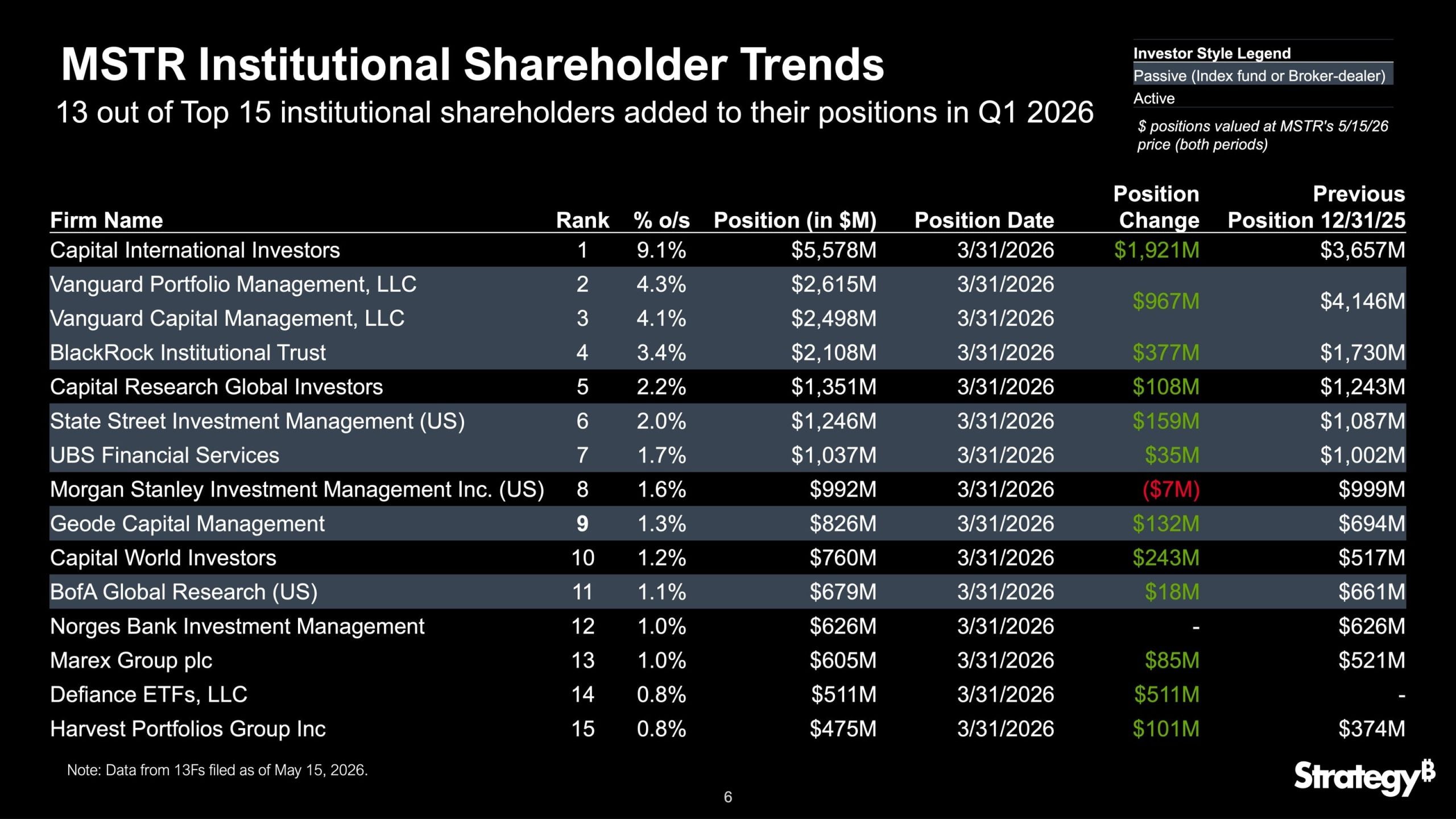
These holdings facilitate broader indirect exposure to the Bitcoin market through mutual funds, pension plans, retirement accounts, and exchange-traded funds (ETFs) serving millions of investors.
Investors are increasingly valuing MSTR above the market value of its Bitcoin assets, reflecting Strategy's ability to issue equity and preferred securities, effectively raise capital, and use those funds to acquire additional Bitcoin. The company asserts that these financing capabilities create value beyond the underlying assets.
Second Quarter Results Demonstrate Strategy's Capital Market Scale
In its Q2 earnings report, Strategy reported holding 843,775 bitcoins as of July 27, year-to-date $BTC returns of 4.5% as of July 26, and raising $17.06 billion under its capital-raising programs in 2026.
The company's financing model also carries balance sheet risks and share dilution risks alongside the potential to increase Bitcoin-per-share. The latest filing with the U.S. Securities and Exchange Commission (SEC) notes that changes in Bitcoin prices, capital market conditions, financing costs, and future securities offerings could materially affect the company's financial results and shareholder interests.
Investors can track $BTC returns, $BTC appreciation, Bitcoin per diluted share, leverage level, and premium to net asset value to assess whether the company's financial strategy is leading to an increasing Bitcoin share over time. The latest performance metrics are updated concurrently with changes in the company's Bitcoin reserves and capital structure.
Bitcoin Sales Intensify Debate on Preferred Financing Methods
Following the Q2 report, Strategy completed its third Bitcoin sale of 2026 to fulfill obligations related to preferred securities. This transaction reduced the company's holdings from 843,775 to 842,138 bitcoins, with the majority of its accumulated assets preserved.
This use of treasury assets has intensified scrutiny of the financing model built on preferred equity, share issuance, and allocation of Bitcoin-backed capital. Economist Peter Schiff argues that selling Bitcoin to finance preferred stock dividends erodes value from MSTR shareholders, questioning management's claim that diversified financing supports long-term treasury expansion.
Current obligations demonstrate how the company's preferred securities can influence capital allocation, even as it retains a significant Bitcoin reserve. Preferred dividend payments are backed by a $3.75 billion reserve covering over 2.1 years of dividends and interest. Strategy has also authorized separate $1 billion share repurchase programs for MSTR and its digital credit securities, with the MSTR program remaining unused as of July 26.