a16z Weekly Chart: Tech Giants Rely on 'Side Hustle' Investments for Income, Great AI Products Can Sell Out in a Day

marsbitPublished on 2026-05-09Last updated on 2026-05-09

Abstract

a16z Weekly Charts: Four Counterintuitive Signals in Tech 1. **Super Platforms' "Other Income"**: Amazon and Google recorded exceptionally high "other income" in Q1, largely from unrealized gains in their private investment portfolios (e.g., Amazon's Anthropic stake). This contributed to over one-third of their net profit, far above the historical 5-10%. The broader trend shows tech capital expenditure is now the primary driver of US GDP growth, accounting for 55% of all business investment. 2. **AI-Generated eBook Proliferation**: Since ChatGPT's launch, monthly eBook releases on Amazon have tripled to over 300,000, flooding the platform with AI-generated content. However, research indicates this has also increased the volume of "decent" books, providing a net gain in consumer surplus by 2025. AI tools have particularly boosted productivity for established authors. 3. **Call Center Jobs Defy AI Replacement**: Contrary to predictions, call center employment in the Philippines has grown steadily from 1.15 million in 2016 to 1.9 million in 2025, with further growth projected. In the US, customer service job postings are outperforming the overall market. The key reason: the full cost of voice AI agents remains roughly equal to human agents (~$92 vs. ~$90 per day). Cases like Klarna show initial replacement can lead to quality issues and re-hiring. 4. **Rapid Adoption of AI Mobile Apps**: AI app downloads, revenue, and user time spent on mobile nearly doubled year-over-year i...

Author: a16z New Media

Compiled by: Deep Tide TechFlow

Deep Tide Intro: This week's a16z Chart covers four topics: Super platforms recorded unusually high 'Other Income' from private investments in Q1; AI-generated eBooks are flooding the market, but the volume of quality content is also growing; Employment in Filipino call centers is rising against the trend, as voice AI costs still haven't caught up with human labor; Mobile AI app downloads, revenue, and usage time have all doubled, with Codex's single-day installs surpassing Claude Code. Four charts, four counter-intuitive signals.

'Other Income': The VC Business of Tech Giants

Profit growth in the public markets is already exaggerated, and Wall Street expects it to be even higher this year.

But beneath the profit figures lies an uncommon detail: not all of the super platforms' income comes from their main businesses. In Q1, 'Other Income' accounted for a surprisingly large portion of net profit.
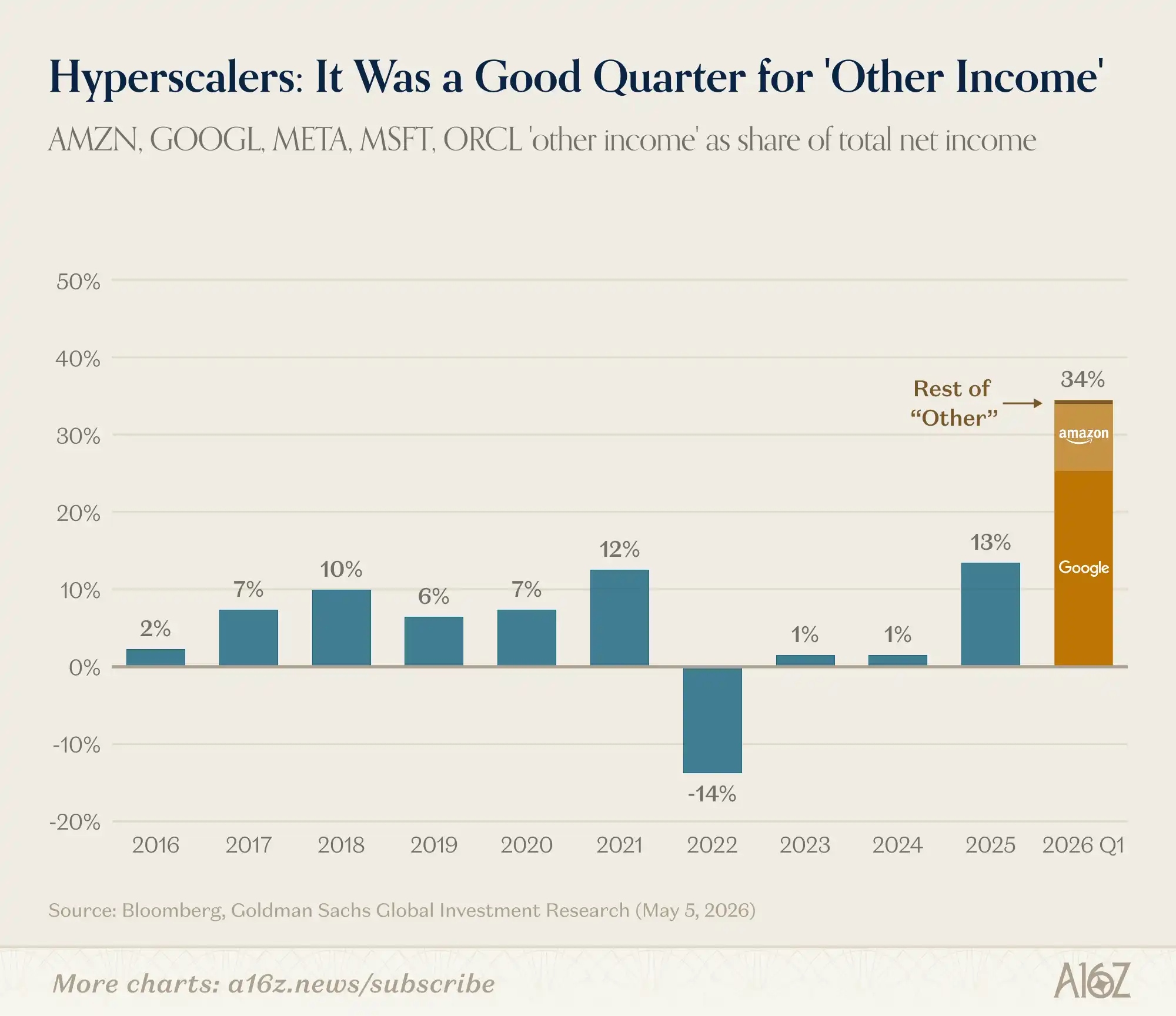
Chart Note: Super platforms' 'Other Income' as a percentage of net profit, exceeding one-third in Q1, historically around 5%-10%.

In Q1, 'Other Income' accounted for over one-third of net profit, historically this figure has been around 5% to 10%.

Where does this money come from? Primarily from private investment returns of Amazon and Google, totaling about $53 billion. Alphabet's CFO stated on the earnings call that 'other income and expense was $37.7 billion, primarily from unrealized gains on non-marketable equity investments'; Amazon disclosed a $15.6 billion net gain from its Anthropic investment in its 10-Q.

In a nutshell: Super platforms are doing pretty well as venture capitalists.

But tech investing is no longer just a game for giants. KKR estimates show that tech-related capital expenditure is currently the only category of capital expenditure driving GDP growth:
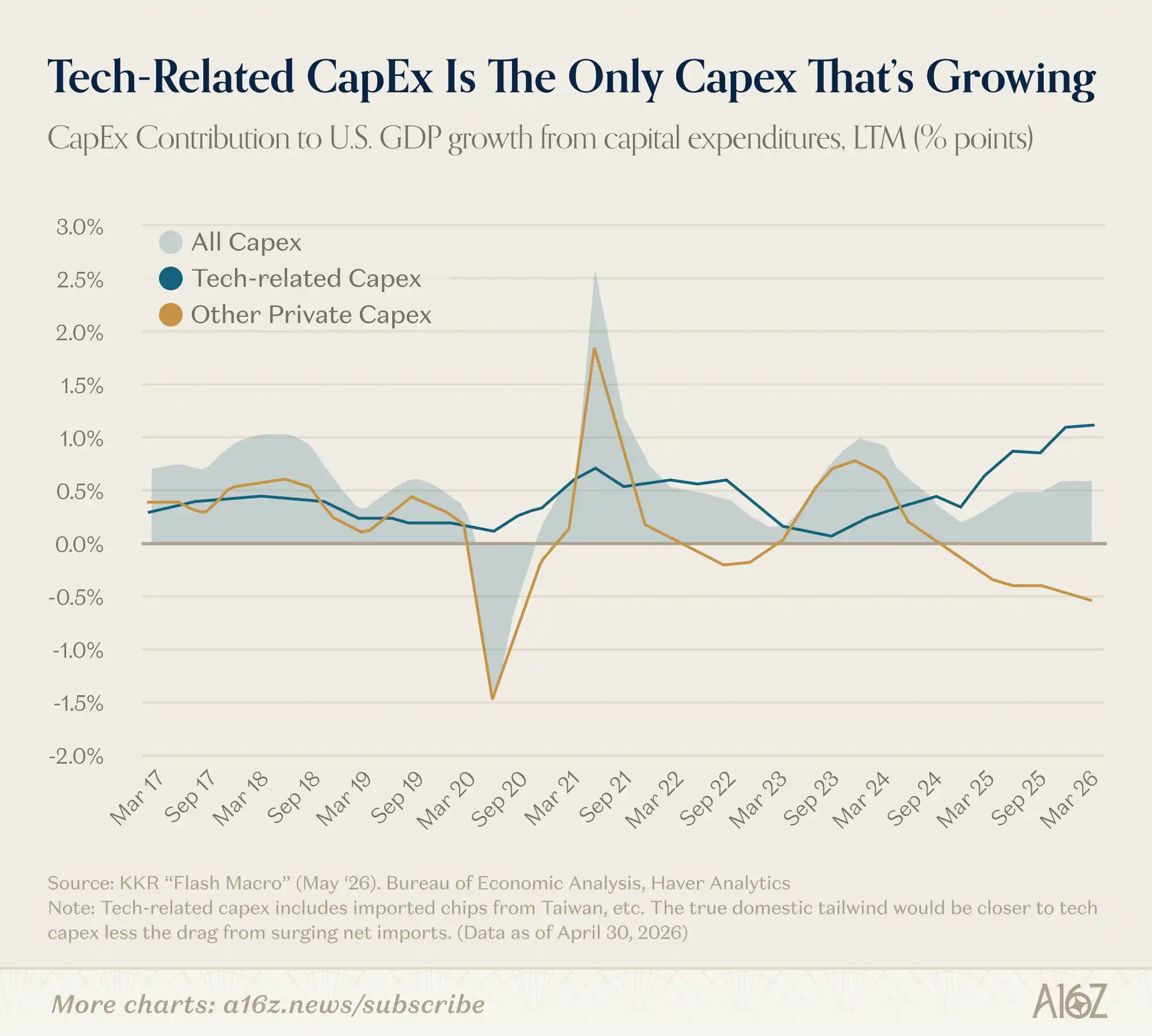
Chart Note: Of the 2% growth in US GDP in Q1, tech capital expenditure contributed 1.9%, accounting for almost all of it.

US GDP grew by 2% in Q1, with tech capital expenditure contributing 1.9%. Meaning, without tech investment, GDP would have basically stagnated.

Taking a broader perspective, according to the Bureau of Economic Analysis (BEA) statistics on total business capital expenditure (including R&D and software), tech now accounts for 55% of all US business investment:
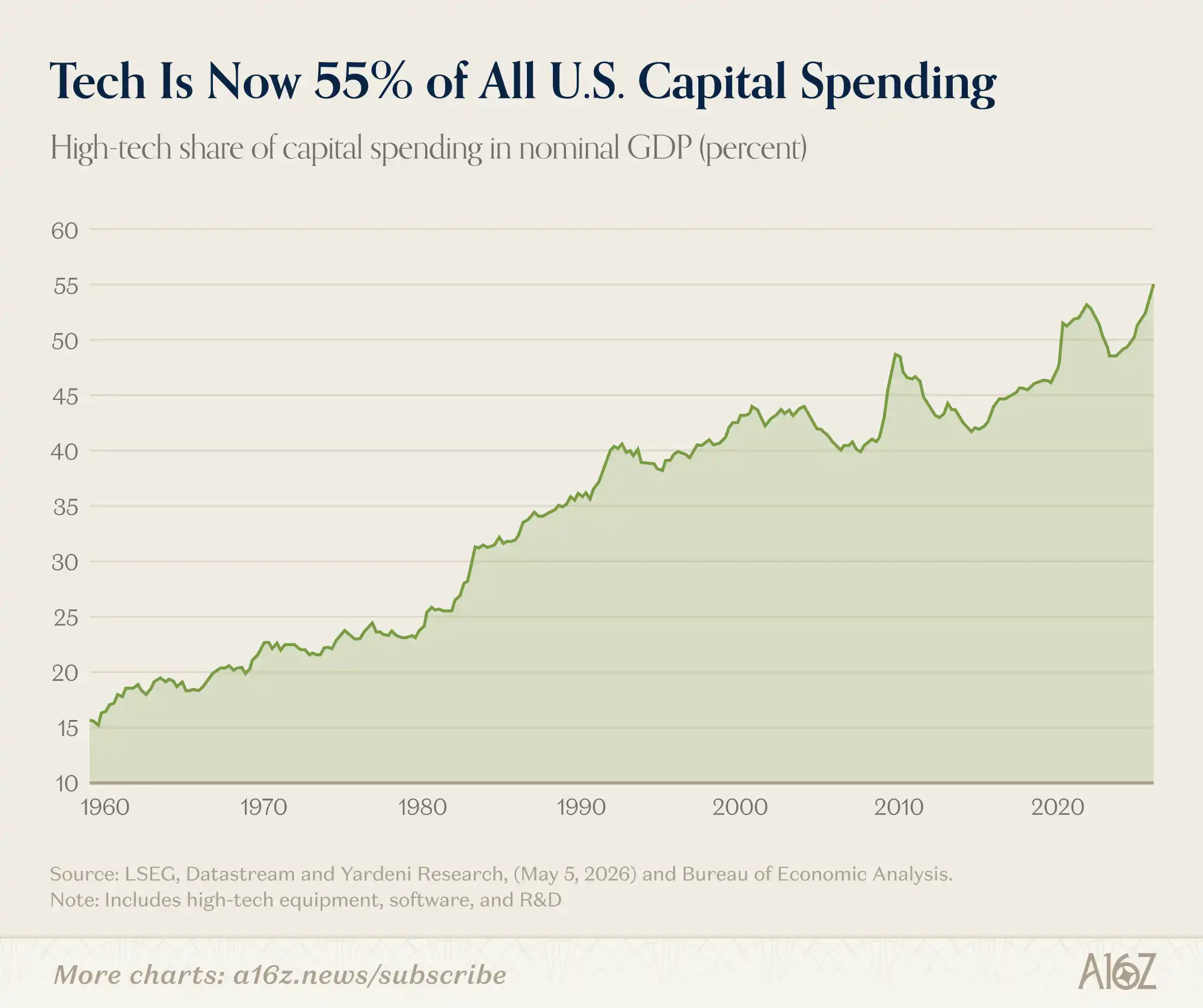
Chart Note: The share of technology in total US business capital expenditure has been climbing steadily and now stands at 55%.

This proportion has been climbing for a long time, and AI might accelerate this trend. Yardeni Research proposes an interesting framework: economics textbooks list three factors of production—land, labor, and capital. Now a fourth should be added: data. AI makes data more useful, and the more useful data becomes, the greater the demand for tools to invest in and process data.

Amazon and Google doing well as VCs is one thing. The bigger reality is: everyone is a tech investor now.

AI Junk Books Are Flooding the Market, But Quality Content Is Also Increasing

Good news: There are far more eBooks on Amazon than before. Bad news: The increase is mostly AI-generated junk.
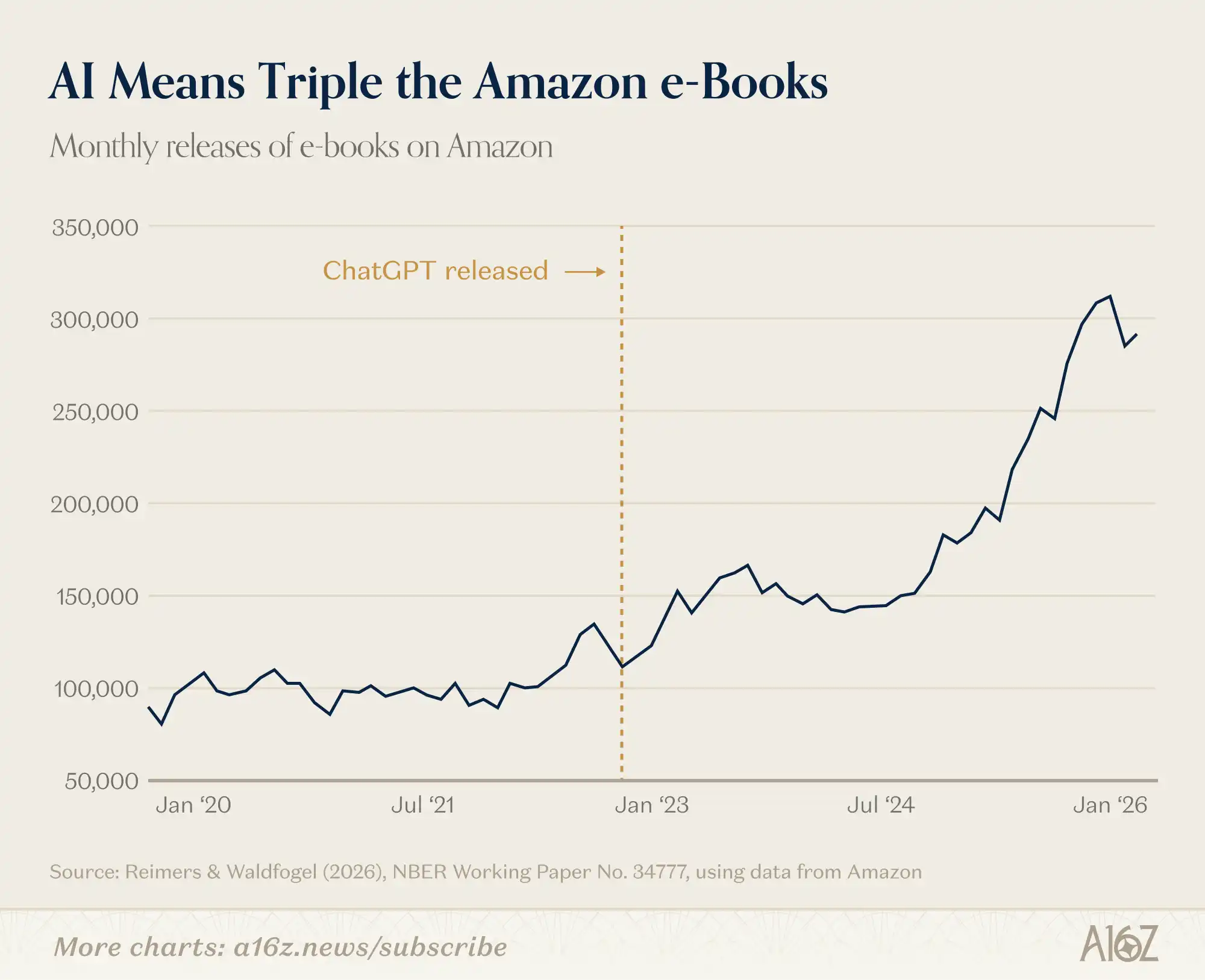
Chart Note: Monthly eBook releases on Amazon have tripled since ChatGPT's launch, exceeding 300,000 per month by late 2025.

Since ChatGPT's launch, monthly eBook releases on Amazon have increased from about 100,000 to over 300,000.

There are two ways to read this chart.

The first is intuitive: AI arrived, a tsunami of junk content followed, and Amazon is flooded with machine-generated low-quality books.

The second is more thought-provoking: Junk has indeed increased, but there are also more 'decent' books than before. A recent NBER paper by professors from Cornell and Minnesota quantified this—using a nested Logit demand model, they estimated the 2025 eBook selection set provided about 7% more consumer surplus compared to a counterfactual baseline of purely human creation. Readers in 2023 gained almost nothing, but by 2025, the gains were perceptible.

Another finding is even more interesting: AI helps 'old authors' (those publishing before LLMs) the most.
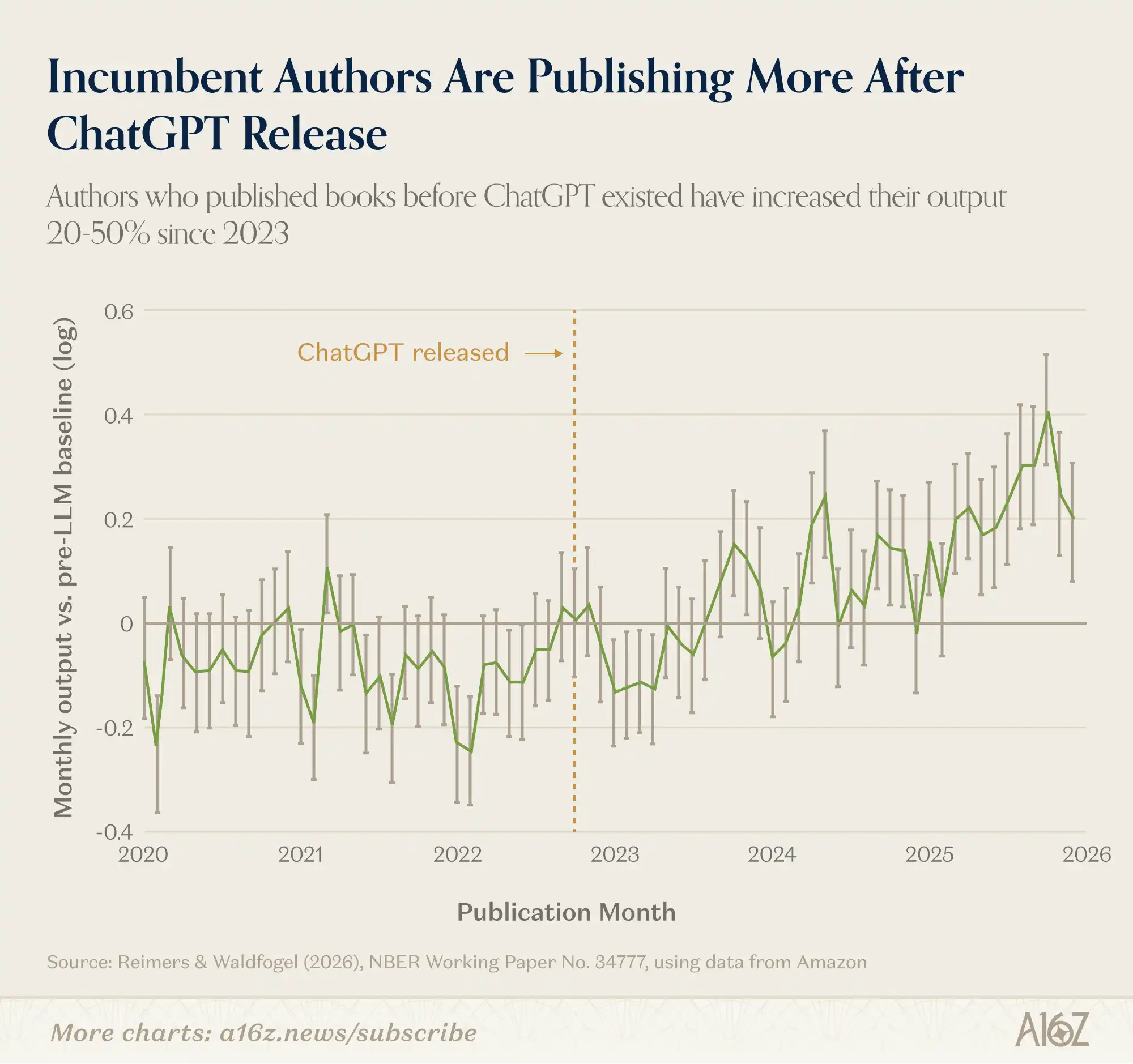
Chart Note: After 2023, output by 'old authors' (those published before LLMs) increased significantly; AI boosted their productivity.

AI didn't just create a bunch of robot authors; it also made human authors more productive.

Marc Andreessen predicted years ago on David Perell's podcast: writing is becoming too easy, so low-quality content will flood the market; but at the same time, with tools this powerful, high-quality content should also experience explosive growth. The junk is real, but the surplus value is also real. Good writers are now writing more.

Call Centers Aren't Dead, Voice AI Is Still Too Expensive

David George just wrote an article arguing that AI replacing jobs is a myth. He distinguishes between 'substitution' and 'augmentation'—customer service is the prime candidate for substitution; AI can answer all questions and has infinite patience.

The logic is sound. But the data doesn't agree.
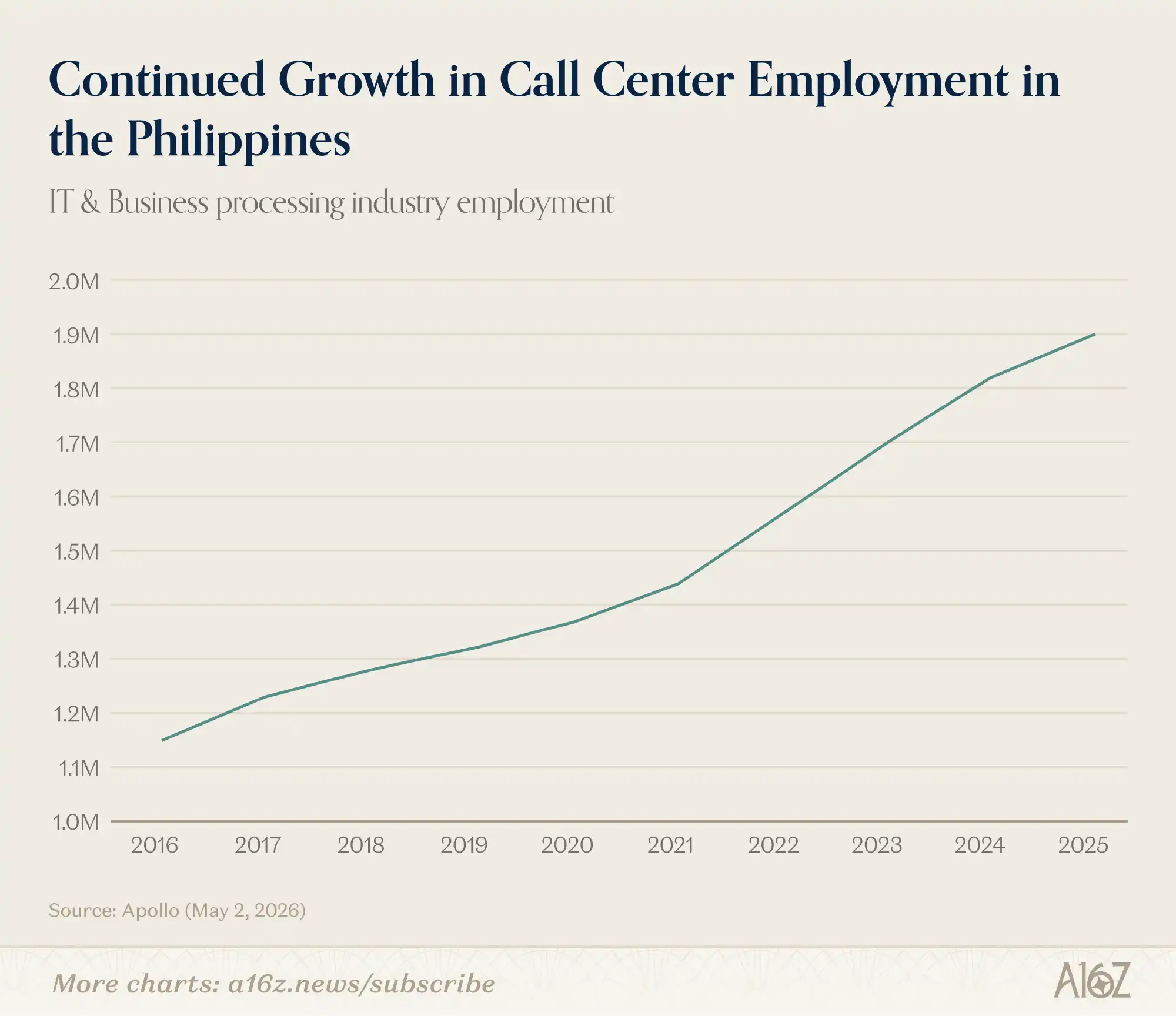
Chart Note: Employment in the Philippines IT and business process outsourcing industry grew from 1.15 million in 2016 to 1.9 million in 2025, spanning every major AI capability leap.

The Philippines is the call center capital of the world. Apollo data shows employment in the IT and business process outsourcing industry grew from 1.15 million in 2016 to 1.9 million in 2025—spanning every major AI upgrade. The industry association projects an additional 70,000 jobs in 2026, a 3.7% year-on-year increase.

The situation in the US is similar. Indeed data shows that customer service job postings haven't decreased; they're actually outperforming the broader market:
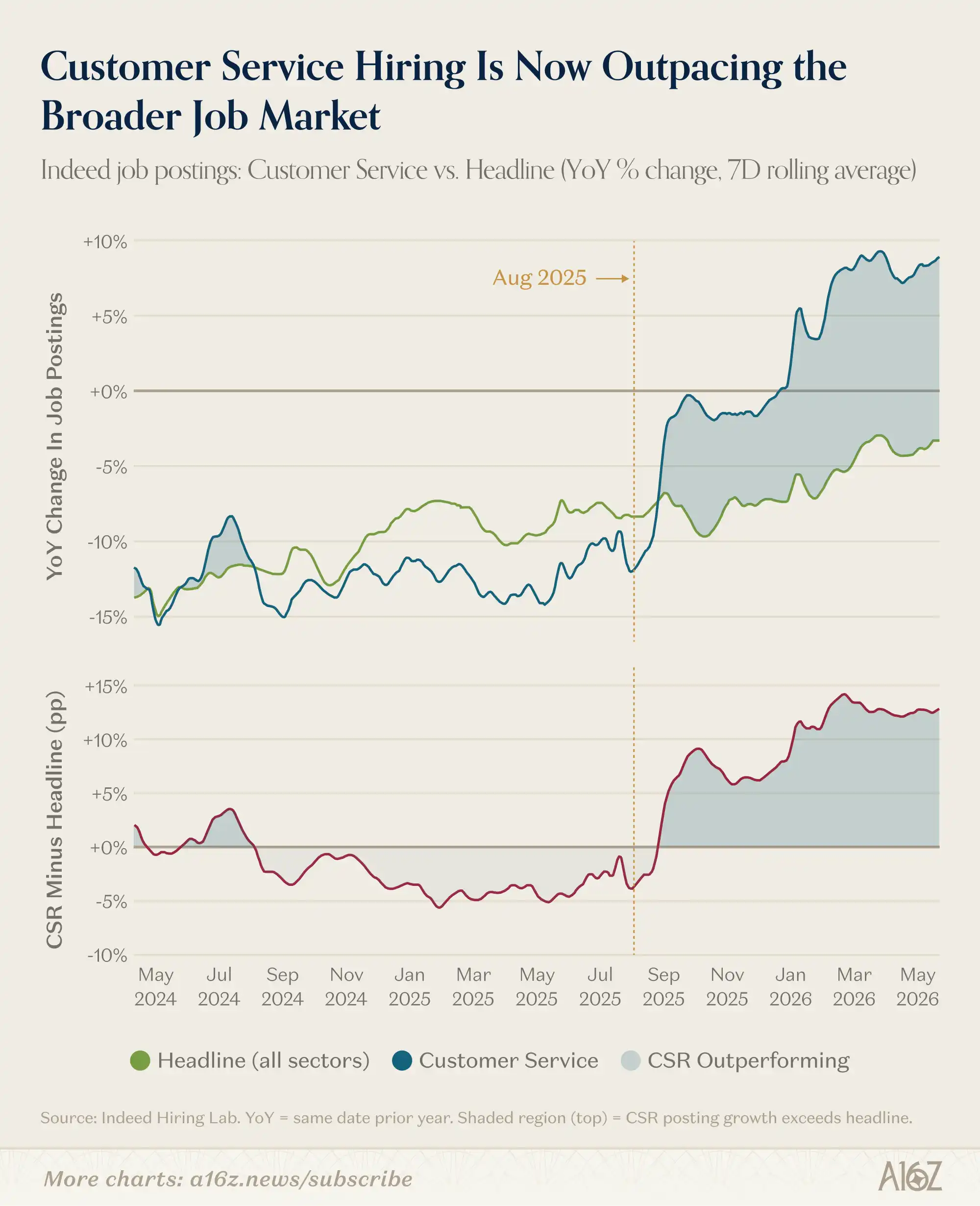
Chart Note: Indeed data shows customer service job postings' year-on-year growth rate is about 10 percentage points higher than overall hiring; the flip happened in August 2025.

The year-on-year growth rate for customer service hiring is about 10 percentage points higher than the overall job market. And this flip only happened recently, in August 2025.

Does this mean AI is actually a boon for the customer service industry? Probably not.

The core reason is cost. Text LLM output is cheap, but voice AI is still expensive. Goldman Sachs conducted an internal test comparing the total cost of AI customer service agents versus human agents:
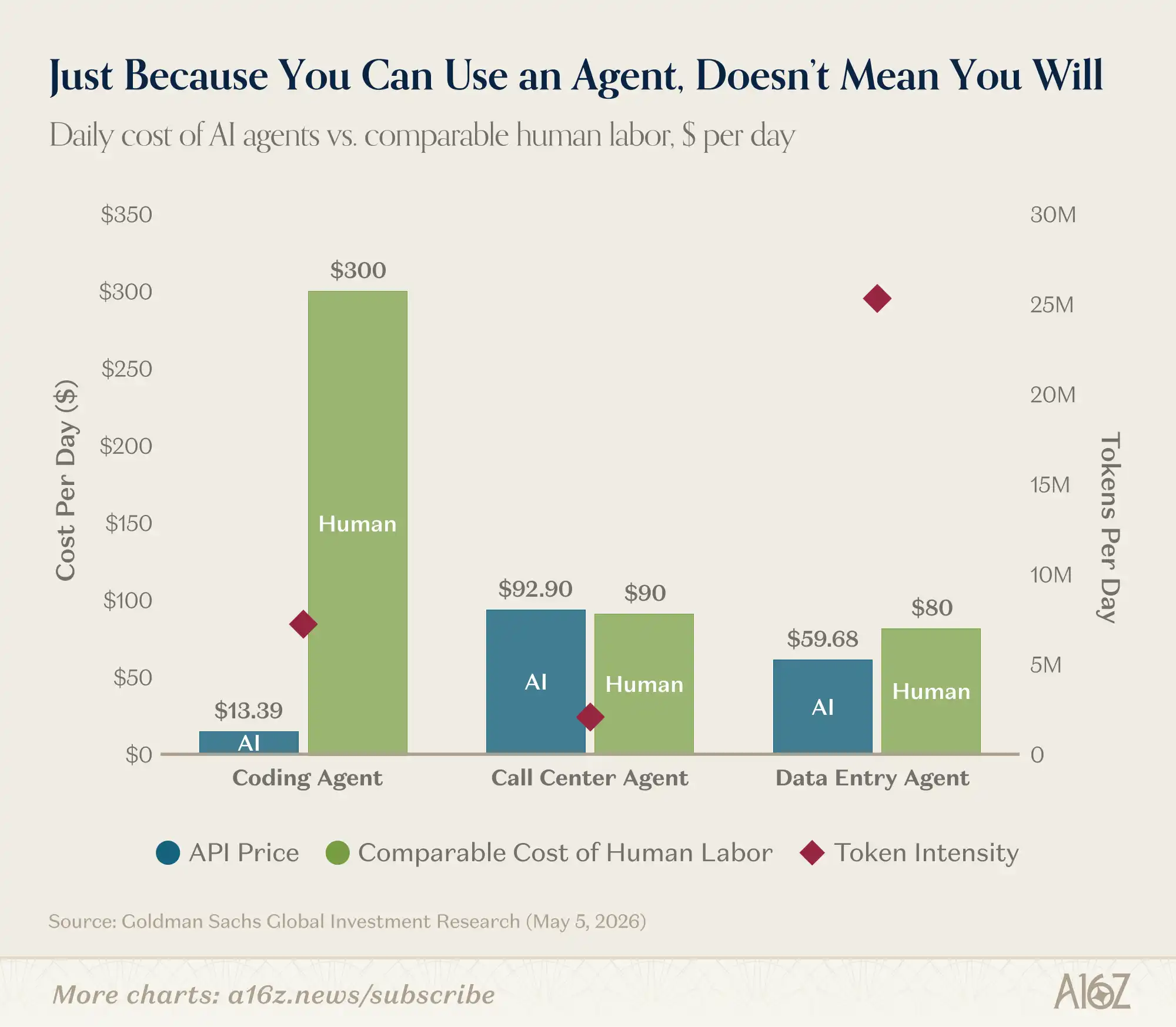
Chart Note: Goldman Sachs estimates the all-in cost of an AI agent is about $92/day, vs. a human agent at about $90/day, roughly equal.

The all-in cost for an AI agent is about $92/day, versus about $90/day for a human agent. Roughly equal. Compare this to coding agents—pure text output, costs are orders of magnitude lower than human labor. The difference between code and customer service is that the potential demand for code far exceeds that for customer service, so the leverage from cost reductions is completely different.

The Klarna story is the best footnote. In early 2024, Klarna announced replacing 700 customer service agents with AI, with the CEO saying AI was doing everyone's job. This became a benchmark case for 'AI replacing humans.' By May 2025, the CEO backtracked, starting to rehire—service quality declined, and users received cookie-cutter responses.

This situation won't last forever. API costs are falling rapidly, companies like Decagon are growing fast, and the cost comparison might look completely different in 18 months.

Great AI Products Explode Rapidly

The penetration speed of AI on mobile is astonishing:
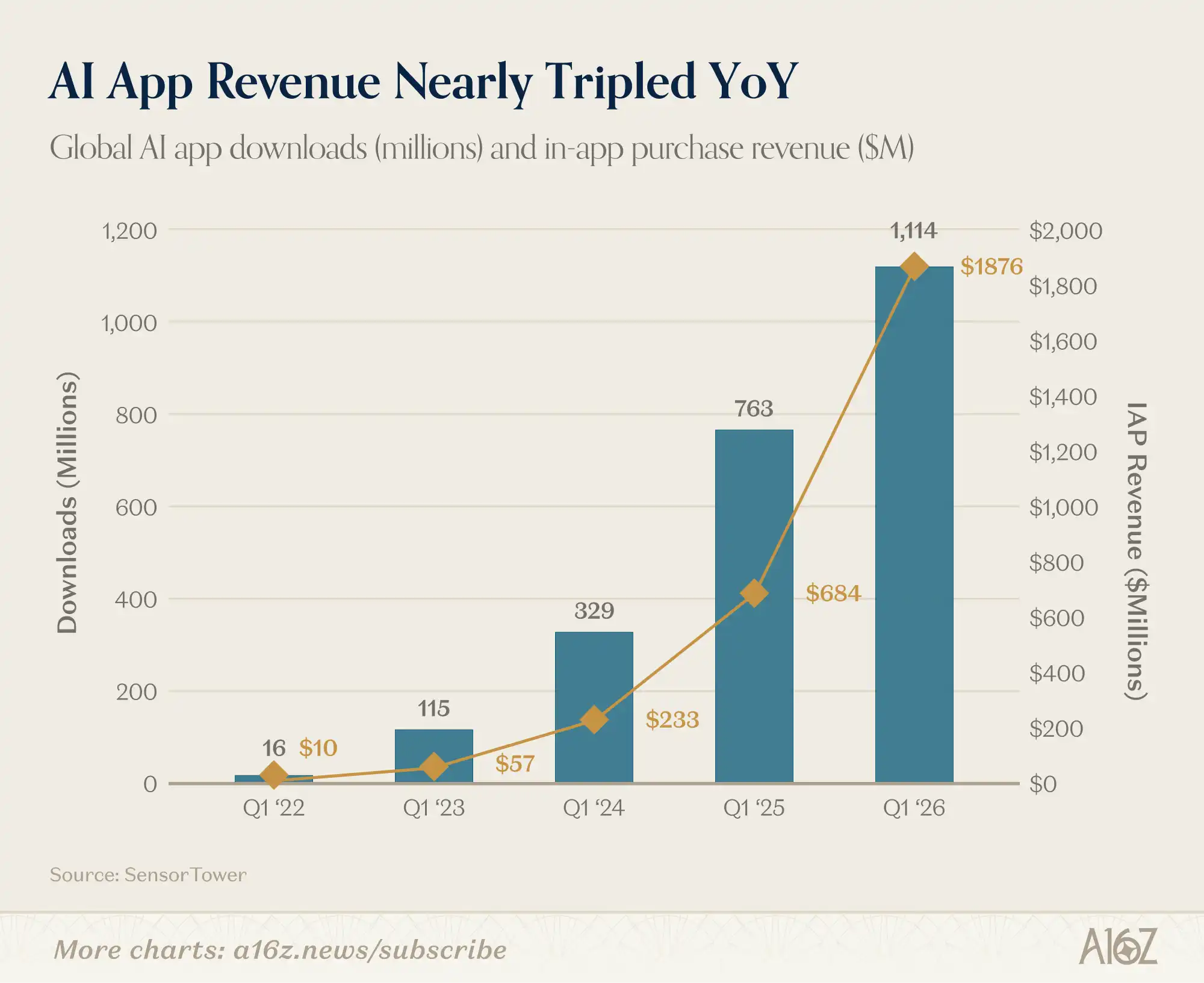
Chart Note: Q1 data for AI app mobile downloads, revenue, and usage time.
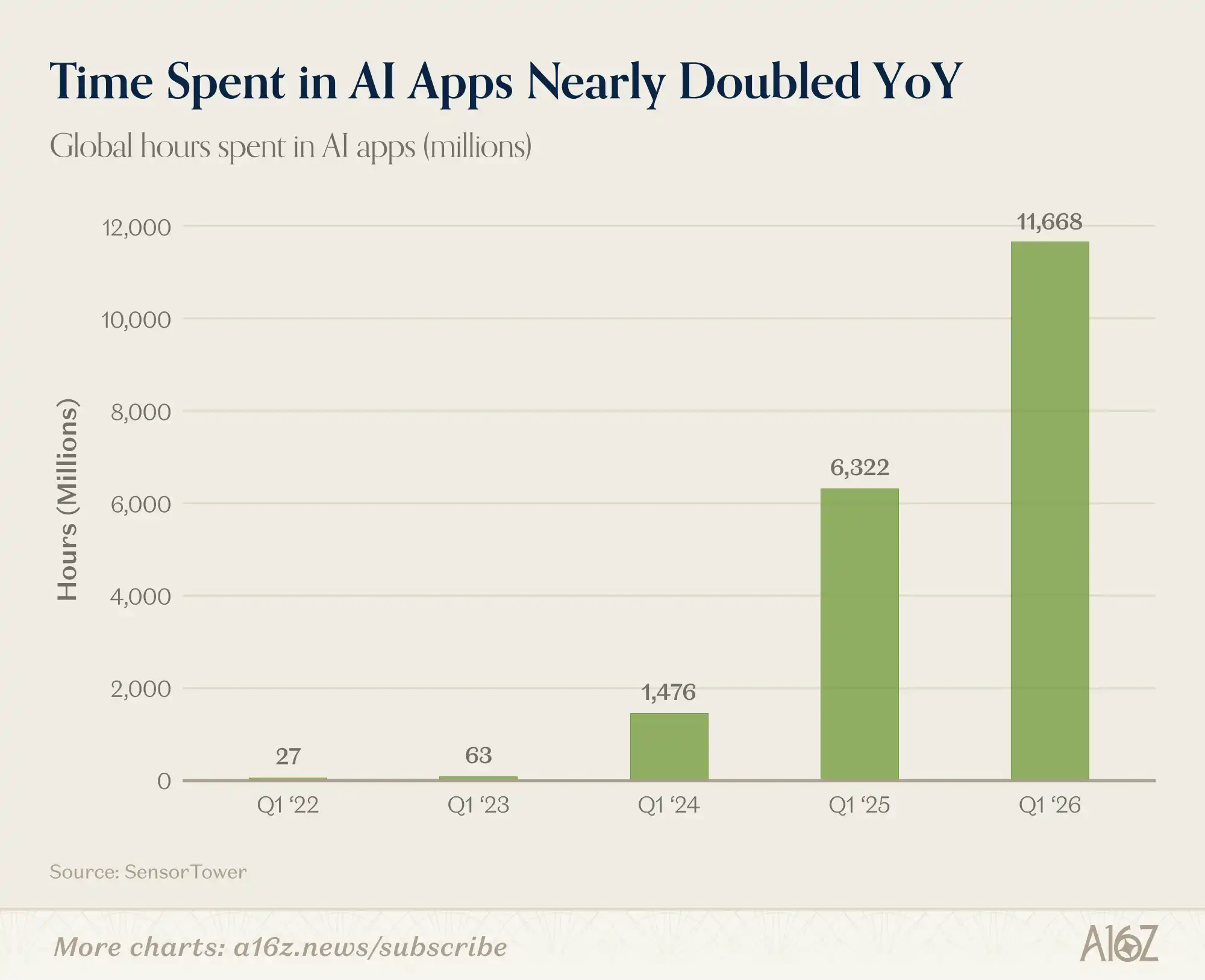
Chart Note: Monetization and usage time for AI apps nearly doubled year-on-year in Q1.

Downloads, monetization, and usage time all turned upward in Q1, with monetization and usage time nearly doubling year-on-year.

Maybe people are spending less time on social media because they're vibe coding with AI on their phones? Not necessarily a bad thing.

Speaking of vibe coding, a new contender has arrived:
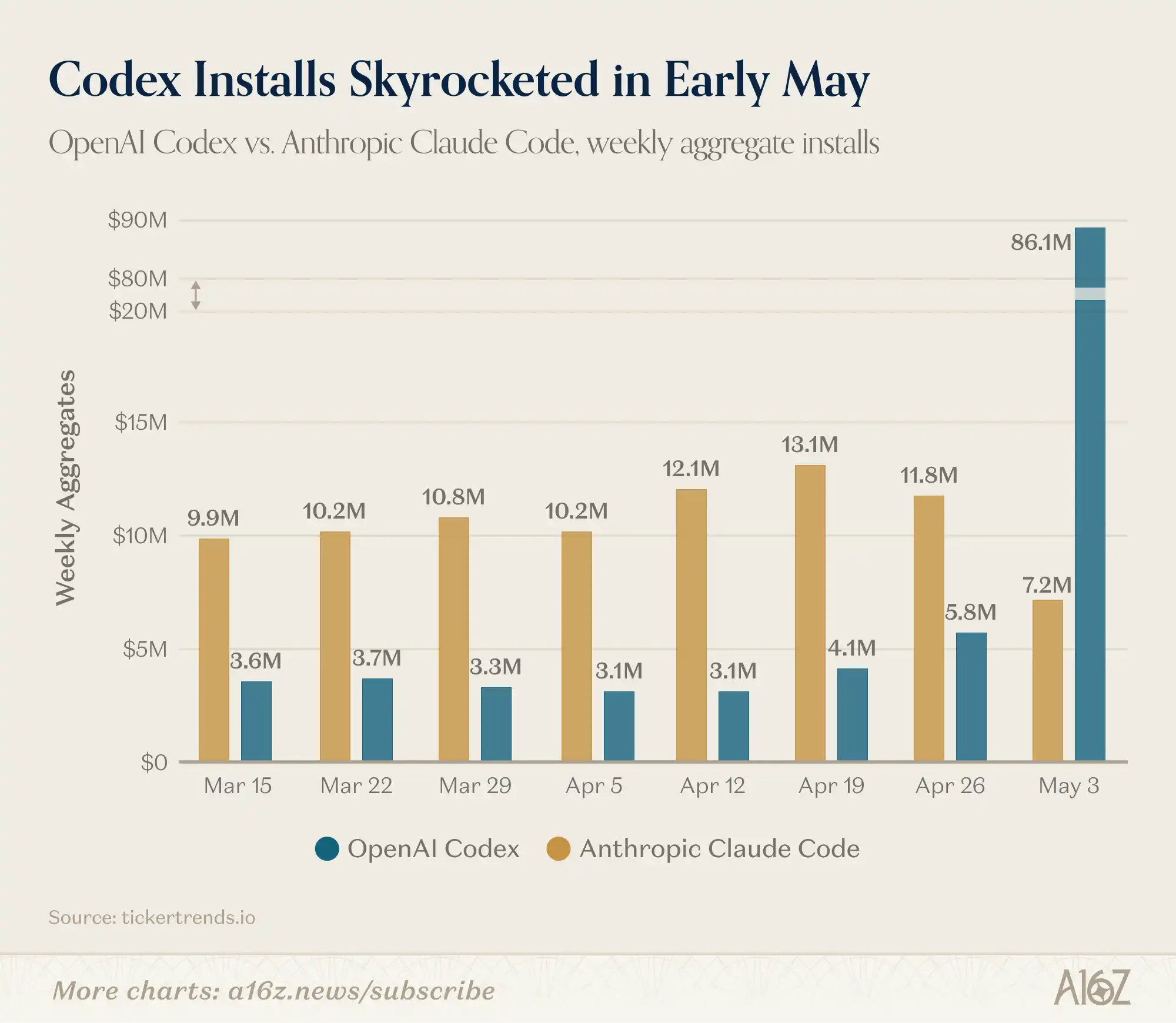
Chart Note: Codex's daily installs surged in May, exceeding Claude Code in a single day—the latter had been the king of code tools for the past year.

Codex's daily installs surged in May, surpassing Claude Code in a single day. Of course, this is just single-day data, and the base is lower, but it illustrates a point: great products spread extremely fast.

Jeff Bezos said something in 2012: You used to be able to sell a mediocre product with marketing, but that's getting harder and harder. A great product will get users to spread the word for you.

In the AI field, this logic is taken to the extreme. Signals propagate quickly, users are highly willing to switch, and no one feels loyalty to a platform or model.

The same holds true in the B2B realm:
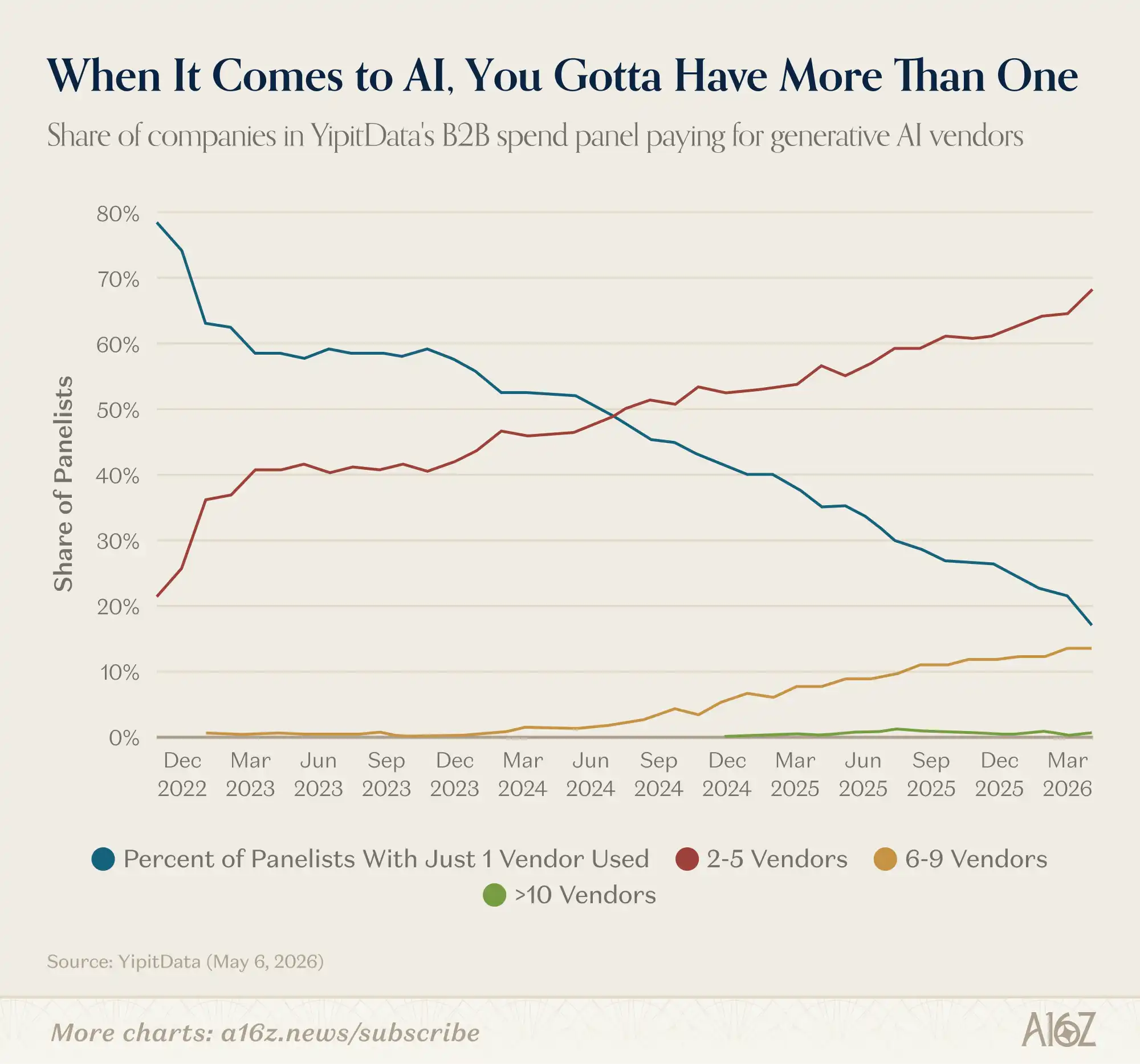
Chart Note: YipitData shows the proportion of enterprises using 2-5 and 6-9 AI vendors is rising steadily, with less than 20% using just one.

The proportion of enterprises using multiple AI vendors continues to rise, with those using just one now below 20%. The B2B AI market has no winner-take-all dynamics, for now.


Related Questions

QAccording to the article, what does the exceptionally high proportion of 'Other Income' in Q1 earnings for super-platforms mainly come from?

AThe exceptionally high proportion of 'Other Income' in Q1 earnings for super-platforms like Amazon and Google mainly comes from their private equity investment returns, specifically from unrealized gains in their non-public equity investment portfolios and investments like Amazon's in Anthropic.

QWhat are the two interpretations the article offers for the surge in e-book titles on Amazon following ChatGPT's release?

AThe two interpretations are: 1) An intuitive view that there has been a 'spam tsunami' of low-quality, AI-generated content flooding Amazon. 2) A more nuanced view that while spam has increased, the number of 'decent' books has also grown, providing measurable consumer surplus gains.

QWhy does the article suggest that voice-based AI hasn't significantly replaced human call center jobs, using the Philippines as a case study?

AThe article suggests voice-based AI hasn't significantly replaced human call center jobs because its cost is still not competitive with human labor. Goldman Sachs estimates show the all-in cost for an AI customer service agent is roughly equal to that of a human agent, making widespread replacement economically unattractive currently.

QWhat trend does the data show about the adoption and usage of AI applications on mobile devices in Q1?

AThe data shows a sharp upward trend for AI applications on mobile devices in Q1, with downloads, revenue, and user engagement (time spent) all increasing significantly. Revenue and time spent nearly doubled year-over-year.

QWhat point does the article make about enterprise adoption of AI, based on the YipitData chart showing vendor usage?

AThe article points out that the enterprise AI market is not currently a winner-takes-all market. The data shows a growing proportion of enterprises using multiple AI vendors (2-5 or 6-9), while the share using only one vendor has fallen below 20%.

Related Reads

Smart Money Hoards $40 Billion in Cash, Retail Bets $2.6 Trillion on Calls: The Critical Moment of the US Stock Market's AI Narrative

Title: Smart Money Hoards $40 Billion in Cash, Retail Traders Bet $2.6 Trillion on Call Options: The Tipping Point for the AI Narrative in U.S. Stocks The U.S. stock market is experiencing a striking divergence. While the S&P 500 hits new highs, the financial sector is down 6% year-to-date, underperforming more than during the 2008 and COVID crises. In contrast, a record $2.6 trillion in S&P 500 call options traded in a single day, and the Philadelphia Semiconductor Index RSI is at its highest since 1999. This reflects a clear split: "smart money" is retreating while retail traders chase gains. Key data points highlight this critical juncture in the AI-driven rally: 1. SoftBank had to cut its $10 billion loan target against its OpenAI stake to $6 billion, as lenders questioned the valuation of the private AI giant, signaling primary market skepticism. 2. The explosive $2.6 trillion daily options volume, with 60% being calls, is described by a Goldman Sachs partner as a "semi-irrational chase," drawing parallels to the 1999 tech bubble. 3. The financial sector's severe underperformance relative to the S&P 500 is a classic technical warning signal, indicating potential underlying economic stress. 4. Apollo Global Management, despite strong earnings, is building a $40 billion cash buffer in its insurance business, preparing for what its CEO calls a 30-35% probability of an exogenous shock from geopolitics, inflation, and AI's economic disruption. 5. Consumer behavior mirrors this split: while Whirlpool plunged on a worsening macro outlook for big-ticket items, DoorDash rose on strong demand for small, immediate services. Together, these conflicting signals from primary markets, secondary markets, leading sectors, and top institutions suggest market risk premia have compressed to a precarious level. The current price action may be increasingly reliant on speculative sentiment rather than fundamental support, marking a potential tipping point for the AI investment narrative.

marsbit1h ago

Smart Money Hoards $40 Billion in Cash, Retail Bets $2.6 Trillion on Calls: The Critical Moment of the US Stock Market's AI Narrative

marsbit1h ago

Tiger Research: AI Agents Will Now Need Identity Verification

Tiger Research: AI Agents Now Need "ID Verification" AI agents are increasingly capable of autonomously executing contracts, making payments, and conducting trades. However, a critical issue remains unresolved: how to verify the identity of the agent on the other side of a transaction. This article examines the emerging competition to establish a KYA (Know Your Agent) standard and the current state of regulatory progress. **Core Points:** 1. As AI agents operate independently in A2A (agent-to-agent) scenarios, the focus shifts from KYC (Know Your Customer) to KYA for identity verification. 2. KYA is not universally required; it's essential primarily when independently deployed agents interact with open ecosystems like DEXs, engage in A2A payments, or pay merchants, not within centralized platforms. 3. A standards battle is underway, with four key players approaching KYA from different angles: * **ERC-8004:** A blockchain-native approach, creating agent IDs as NFTs with on-chain registries for identity, reputation, and validation. * **Visa TAP:** Leverages Visa's payment network to issue verified "Agent Intent" credentials, bundling agent identity into its payment rails. * **Trulioo:** Adapts the SSL certificate model to issue dynamic "Digital Agent Passports," verifying both developer (KYB) and user (KYC) credentials. * **Sumsub:** Focuses on real-time risk detection and re-verification of the human behind an agent during suspicious transactions, rather than pre-issuing certificates. 4. Regulatory momentum is building. The EU AI Act, the U.S. NIST, and Singapore's national AI governance framework are prioritizing agent identity management. The rollout of KYA standards is likely to follow a pattern similar to the FATF Travel Rule, becoming a watershed moment for the industry. The market is unlikely to have a single winner. Different approaches will dominate specific niches: ERC-8004 for on-chain autonomous transactions, Visa TAP for payment-bound commerce, Trulioo for regulated finance, and Sumsub for fraud-prone scenarios. The key differentiator will be which players successfully integrate their identity infrastructure earliest as adoption scales.

marsbit1h ago

Tiger Research: AI Agents Will Now Need Identity Verification

marsbit1h ago

Perspective: The current AI supercycle will last 15 years, but most are still buying stocks in the first FOMO stage

This article outlines a 15-year AI supercycle, segmented into four investment stages. It argues that while most investors are still focused on the first stage, smart money is already moving to the third. **Stage 1: The Foundation (2023-2025) - Priced In** The semiconductor layer (e.g., NVIDIA, AMD) is complete. While growth continues, the historic entry opportunity is over as risk/reward has compressed. **Stage 2: The Build-Out (2025-2027) - In Progress** This phase involves building the necessary physical infrastructure: power/utilities (CEG), cooling (VRT), networking (ANET), and nuclear SMRs (OKLO, SMR). Significant upside remains, but obvious names have already moved. **Stage 3: The Asymmetric Bet (2026-2028) - Positioning Window** AI moves into the physical world. Key areas include robotics/autonomy (Tesla Optimus), space/defense/drones (Rocket Lab, LUNR), and critical materials. This stage presents the best asymmetric risk/reward and is where positioning should occur now. **Stage 4: The Endgame (2028+) - Software Dominance** The mega-cap cloud platforms (Microsoft, Alphabet, Amazon, Meta), with their massive capital expenditure, will build the AI software layer and AGI infrastructure, aiming to win the entire cycle. **Core Conclusion:** The cycle is confirmed in Stage 2. Stage 3 (robotics, space, defense, nuclear SMRs) is where capital is currently rotating for maximum opportunity, while the majority of investors are expected to be 12 months behind this shift.

marsbit2h ago

Perspective: The current AI supercycle will last 15 years, but most are still buying stocks in the first FOMO stage

marsbit2h ago

Trading

Spot
Futures

Hot Articles

Discussions

Welcome to the HTX Community. Here, you can stay informed about the latest platform developments and gain access to professional market insights. Users' opinions on the price of AI (AI) are presented below.

活动图片














