Bitcoin Retail Exits As Wallets Decline At Fastest Pace In 2 Years

bitcoinistPublished on 2026-05-09Last updated on 2026-05-09

Abstract

Bitcoin is experiencing its fastest decline in non-zero balance wallets in nearly two years, with 245,000 addresses liquidated in just five days, according to on-chain data from Santiment. This significant drop in the "Total Amount of Holders" metric suggests a potential retail investor exodus. The selloff follows a recent price surge, indicating these smaller investors may be taking profits due to skepticism about the rally's sustainability. Historically, similar periods of wallet capitulation, whether during price rises or falls, have preceded the start of major bull runs for Bitcoin. As the trend unfolds, Bitcoin's price has remained relatively stable around $80,100 after retracing from its recent highs.

On-chain data shows the Bitcoin network is observing the fastest exodus of holders in nearly two years, a potential sign that retail is taking profits.

Bitcoin Total Amount Of Holders Has Declined Recently

According to data from on-chain analytics firm Santiment, the Total Amount Of Holders has observed a notable drop for Bitcoin recently. This metric tracks, as its name suggests, the total number of addresses present on the BTC blockchain that are carrying a non-zero balance.

When the value of the indicator goes up, it means new investors are joining the network or old ones who had sold earlier are returning to the market. The trend can also emerge due to existing users creating multiple wallets for a purpose like privacy.

In general, all of these factors are assumed to be simultaneously at play whenever the Total Amount Of Holders rises. As such, some adoption of the cryptocurrency can be assumed to have occurred.

On the other hand, the metric witnessing a decline implies some investors have decided to clear out their balance, potentially because they are exiting from the asset.

Now, here is the chart shared by Sanitment that shows the trend in the Total Amount Of Holders for Bitcoin over the last couple of years:
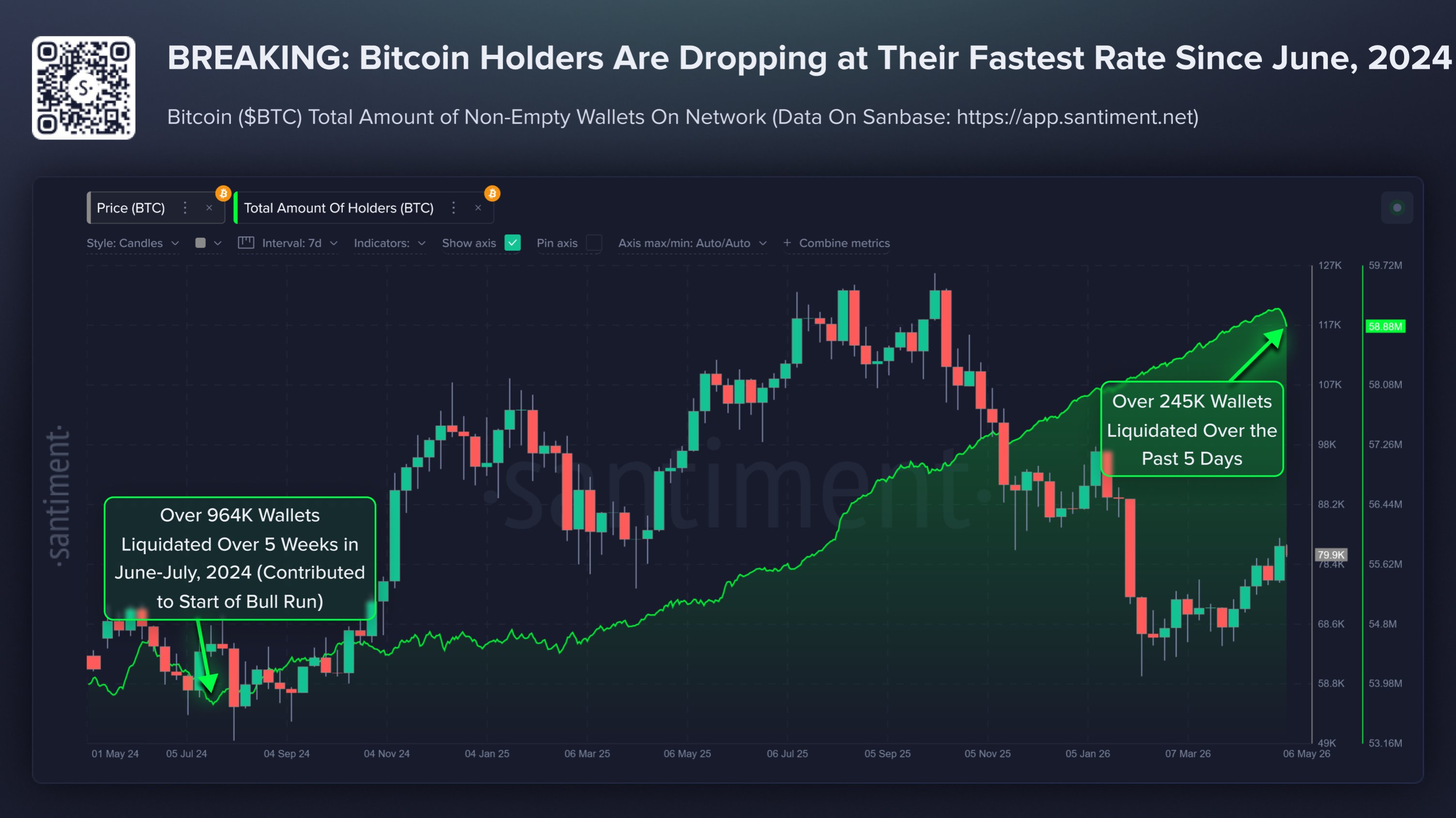
Looks like the value of the metric has gone down in recent days | Source: Santiment on X

As displayed in the above graph, the Bitcoin Total Amount Of Holders grew during 2025 and the first few months of 2026, but May has seen a shift in direction for the indicator. During the past five days alone, BTC investors have liquidated 245,000 wallets.

Considering the sheer number of addresses involved, the trend is likely to correspond to the activity of the small entities, rather than the whales, who tend to be much fewer in population.

The drawdown in the metric has appeared after a price surge in the cryptocurrency, so it’s possible that retail investors are using the price surge to take profits. In other words, they may not believe that the surge is going to last.

The latest decline in the Total Amount Of Holders is the fastest witnessed since Summer 2024, nearly two years ago. Back then, holders cleaned out over 946,000 wallets in a period of five weeks.

Interestingly, what followed this earlier exodus of retail investors was the start of a bull rally for Bitcoin. As Santiment explained:

Capitulation is one of the key ingredients to the beginning of bull runs, and wallets can drop out during both a price fall (out of fear of losing more) or on a price rise (expecting prices to not go any higher).

It now remains to be seen whether the new Bitcoin retail selloff will extend in the coming days or if the trajectory in the Total Amount Of Holders will reverse.

BTC Price

Bitcoin has overall moved sideways over the past five days as its price is still floating around the $80,100 mark.

The price of the coin has retraced from its earlier high | Source: BTCUSDT on TradingView


Trending Cryptos

Related Questions

QWhat does the recent decline in Bitcoin's Total Amount Of Holders indicate according to the article?

AThe recent decline in the Total Amount Of Holders indicates a significant exodus of investors, likely retail holders, who are liquidating their wallets. This could be a sign they are taking profits following a price surge, doubting the rally's sustainability.

QHow many Bitcoin wallets were liquidated in the five days leading up to the report?

AIn the five days leading up to the report, Bitcoin investors liquidated 245,000 wallets.

QWhat similar event occurred in Summer 2024, and what followed it?

AIn Summer 2024, there was a similar exodus where holders cleaned out over 946,000 wallets in a five-week period. This event was followed by the start of a bull rally for Bitcoin.

QAccording to Santiment, what is one of the key ingredients to the beginning of bull runs?

AAccording to Santiment, capitulation (where wallets drop out, either from fear during a price fall or profit-taking during a price rise) is one of the key ingredients to the beginning of bull runs.

QWhat was the approximate price of Bitcoin at the time of the report?

AAt the time of the report, Bitcoin's price was floating around the $80,100 mark.

Related Reads

GPT-5 Also Has Tip-of-the-Tongue Moments, Google Tested 4.5 Million Times: The Keys Are Lost

Google researchers have discovered that advanced AI models like GPT-5 and Gemini 3 experience a phenomenon akin to the human "tip-of-the-tongue" state, where they possess knowledge but fail to retrieve it. Their study, "Empty Shelves or Lost Keys?" (ICML 2026), introduces the "Knowledge Portrait" framework to analyze factual knowledge in models, distinguishing between failure to encode a fact versus failure to recall it. Testing on 13 models across 2.15 million queries from the WikiProfile benchmark revealed that state-of-the-art models successfully encode 95-98% of facts into their parameters. However, when asked directly, they fail to recall 26-34% of these known facts. Enabling chain-of-thought ("thinking") reasoning reduces this recall failure to 11-12%, recovering 40-65% of the previously unrecalled but encoded facts. The research identifies two key bottlenecks: recalling obscure ("long-tail") facts and answering reversed queries (e.g., "Who is Tom Cruise's mother?" vs. "Whose son is Tom Cruise?"). While scaling model size effectively reduces encoding failures, it does little to improve recall rates. In larger models, recall failure becomes the dominant source of factual errors, accounting for over 70% of mistakes in GPT-5.2. The findings suggest that for top models, the primary challenge is no longer storing knowledge but accessing it efficiently. Future accuracy gains may depend more on improved inference-time methods and "meta-cognitive" abilities, enabling models to recognize when they need to engage in deeper reasoning to retrieve information they already know.

marsbit3m ago

GPT-5 Also Has Tip-of-the-Tongue Moments, Google Tested 4.5 Million Times: The Keys Are Lost

marsbit3m ago

The Dollar is a Technology: Stablecoins Are Exporting U.S. Institutions to the World

This article argues that stablecoins and blockchain infrastructure are becoming a vehicle for exporting American financial systems globally. The core thesis is that the U.S. dollar, as a "technology," is increasingly embedded in blockchain rails, moving beyond a reserve currency to represent the institutional stability of the United States itself. The piece highlights three key areas where this is happening: 1. **Cross-border payments and trade finance:** Companies like Keyrails use stablecoins and blockchain to streamline and secure trade finance for emerging markets (e.g., Nigeria-China trade), offering faster, often cheaper dollar liquidity than traditional systems. 2. **Programmable collateral and credit:** Platforms like SemiLiquid allow institutions to use tokenized assets (e.g., treasuries, stocks) as "programmable collateral" for loans without moving them from custody, unlocking capital efficiency and improving transparency in institutional lending. 3. **Financing real-world assets:** Protocols like USD.AI create lending markets for productive, hard-to-finance assets like AI GPUs, connecting global stablecoin liquidity to physical capital. The author concludes that the true value of these new blockchain-based financial platforms lies not just in transaction volume, but in the deep, hard-to-replicate "context" (data, trust, operational knowledge) they build around specific economic activities like trade and asset finance. This represents crypto's evolution into an operating system for real-world capital formation, moving beyond speculation.

marsbit7m ago

The Dollar is a Technology: Stablecoins Are Exporting U.S. Institutions to the World

marsbit7m ago

Ethereum Glamsterdam Upgrade: Largest-Scale Underlying Restructuring Yet, Mainnet Date Still Undecided

The upcoming Ethereum "Glamsterdam" upgrade is viewed by core developers as the most significant protocol-level refactoring since The Merge, fundamentally altering how the network processes transactions and manages its state to advance L1 scaling. Its core goals are: accelerating processing via parallelization, increasing capacity, and enhancing sustainability through adjusted fees that better reflect long-term data storage costs. The upgrade features two headline proposals. First, **ePBS (EIP-7732)** on the consensus layer aims to formalize proposer-builder separation directly within the protocol, eliminating reliance on off-chain relayers. This built-in mechanism is designed to provide a more secure and efficient block production pipeline, extending the critical validation window to allow the network to handle more data, particularly for Layer2s. Second, **BALs (EIP-7928)** on the execution layer introduces block-level access lists. These lists specify the data each transaction will access beforehand, allowing the network to identify and safely execute non-conflicting transactions in parallel, rather than strictly sequentially. This also speeds up new node synchronization. Glamsterdam also includes配套 proposals to reprice storage costs (aiming for a predictable ~120 GiB annual state growth) and the cost of data-reading operations to better align with modern hardware costs and prevent spam. Regarding the timeline, the initial schedule targeting a mainnet activation on September 16, 2026, has likely been delayed. Following the launch of a new dedicated testnet (Plataberget), the deployments on the Sepolia and Holesky testnets are now expected in September, with the mainnet launch potentially pushed to Q4 2026 or later, as developers prioritize correctness over a fixed date.

marsbit7m ago

Ethereum Glamsterdam Upgrade: Largest-Scale Underlying Restructuring Yet, Mainnet Date Still Undecided

marsbit7m ago

Trading

Spot

Hot Articles

What is $BITCOIN

DIGITAL GOLD ($BITCOIN): A Comprehensive Analysis Introduction to DIGITAL GOLD ($BITCOIN) DIGITAL GOLD ($BITCOIN) is a blockchain-based project operating on the Solana network, which aims to combine the characteristics of traditional precious metals with the innovation of decentralized technologies. While it shares a name with Bitcoin, often referred to as “digital gold” due to its perception as a store of value, DIGITAL GOLD is a separate token designed to create a unique ecosystem within the Web3 landscape. Its goal is to position itself as a viable alternative digital asset, although specifics regarding its applications and functionalities are still developing. What is DIGITAL GOLD ($BITCOIN)? DIGITAL GOLD ($BITCOIN) is a cryptocurrency token explicitly designed for use on the Solana blockchain. In contrast to Bitcoin, which provides a widely recognized value storage role, this token appears to focus on broader applications and characteristics. Notable aspects include: Blockchain Infrastructure: The token is built on the Solana blockchain, known for its capacity to handle high-speed and low-cost transactions. Supply Dynamics: DIGITAL GOLD has a maximum supply capped at 100 quadrillion tokens (100P $BITCOIN), although details regarding its circulating supply are currently undisclosed. Utility: While precise functionalities are not explicitly outlined, there are indications that the token could be utilized for various applications, potentially involving decentralized applications (dApps) or asset tokenization strategies. Who is the Creator of DIGITAL GOLD ($BITCOIN)? At present, the identity of the creators and development team behind DIGITAL GOLD ($BITCOIN) remains unknown. This situation is typical among many innovative projects within the blockchain space, particularly those aligning with decentralized finance and meme coin phenomena. While such anonymity may foster a community-driven culture, it intensifies concerns about governance and accountability. Who are the Investors of DIGITAL GOLD ($BITCOIN)? The available information indicates that DIGITAL GOLD ($BITCOIN) does not have any known institutional backers or prominent venture capital investments. The project seems to operate on a peer-to-peer model focused on community support and adoption rather than traditional funding routes. Its activity and liquidity are primarily situated on decentralized exchanges (DEXs), such as PumpSwap, rather than established centralized trading platforms, further highlighting its grassroots approach. How DIGITAL GOLD ($BITCOIN) Works The operational mechanics of DIGITAL GOLD ($BITCOIN) can be elaborated on based on its blockchain design and network attributes: Consensus Mechanism: By leveraging Solana’s unique proof-of-history (PoH) combined with a proof-of-stake (PoS) model, the project ensures efficient transaction validation contributing to the network's high performance. Tokenomics: While specific deflationary mechanisms have not been extensively detailed, the vast maximum token supply implies that it may cater to microtransactions or niche use cases that are still to be defined. Interoperability: There exists the potential for integration with Solana’s broader ecosystem, including various decentralized finance (DeFi) platforms. However, the details regarding specific integrations remain unspecified. Timeline of Key Events Here is a timeline that highlights significant milestones concerning DIGITAL GOLD ($BITCOIN): 2023: The initial deployment of the token occurs on the Solana blockchain, marked by its contract address. 2024: DIGITAL GOLD gains visibility as it becomes available for trading on decentralized exchanges like PumpSwap, allowing users to trade it against SOL. 2025: The project witnesses sporadic trading activity and potential interest in community-led engagements, although no noteworthy partnerships or technical advancements have been documented as of yet. Critical Analysis Strengths Scalability: The underlying Solana infrastructure supports high transaction volumes, which could enhance the utility of $BITCOIN in various transaction scenarios. Accessibility: The potential low trading price per token could attract retail investors, facilitating wider participation due to fractional ownership opportunities. Risks Lack of Transparency: The absence of publicly known backers, developers, or an audit process may yield skepticism regarding the project's sustainability and trustworthiness. Market Volatility: The trading activity is heavily reliant on speculative behavior, which can result in significant price volatility and uncertainty for investors. Conclusion DIGITAL GOLD ($BITCOIN) emerges as an intriguing yet ambiguous project within the rapidly evolving Solana ecosystem. While it attempts to leverage the “digital gold” narrative, its departure from Bitcoin's established role as a store of value underscores the need for a clearer differentiation of its intended utility and governance structure. Future acceptance and adoption will likely depend on addressing the current opacity and defining its operational and economic strategies more explicitly. Note: This report encompasses synthesised information available as of October 2023, and developments may have transpired beyond the research period.

1.8k Total ViewsPublished 2025.05.13Updated 2025.05.13

What is $BITCOIN

Discussions

Welcome to the HTX Community. Here, you can stay informed about the latest platform developments and gain access to professional market insights. Users' opinions on the price of BTC (BTC) are presented below.

活动图片