Crypto market’s weekly winners and losers – ADA, LIT, VVV, PI

ambcryptoPublished on 2026-07-05Last updated on 2026-07-05

Abstract

This week's crypto market saw a technical recovery, shifting momentum from Bitcoin to altcoins and driven by project-specific catalysts rather than speculation alone. The top weekly gainer was **MemeCore [M]**, surging 110% following a buyback announcement. **Cardano [ADA]** gained 33.5%, its strongest weekly performance since Q1 2025, ahead of its Van Rossem hard fork. **Lighter [LIT]** rose 31%, with bullish momentum continuing. Other notable high-movers included Pop Planet and Vanta Network. Among losers, **Venice Token [VVV]** fell 14%, breaking below key support with sellers in control. **Pi [PI]** dropped over 8%, losing critical support levels, while **Canton [CC]** extended its decline with a nearly 6% weekly loss. Broader market decliners included SkyAI and Xeffy. The week highlighted a market where fundamentals and technical developments were key drivers of price action.

Crypto markets saw a technical recovery this week.

Bitcoin [BTC] reclaimed key support after an early-week selloff and helped improve sentiment across the market. The rebound triggered a rotation into altcoins, allowing several mid- and low-cap tokens to post outsized gains.

However, the biggest winners weren’t driven by broad market momentum alone. Instead, developer-led catalysts, protocol upgrades, and project-specific announcements dominated price action, reinforcing that fundamentals, rather than pure speculation, were behind many of this week’s top performers.

Weekly winners

MemeCore [M] rally has a long way ahead!

MemeCore [M] topped this week’s gainers with a 110% rally, recovering sharply after last week’s 70.5% correction pushed it onto the weekly losers list. In that context, this week’s move looks more like a trend reversal than just a dead-cat bounce.

The big question now is whether M can keep the momentum going. Fundamentally, the rally has backing. As AMBCrypto reported, MemeCore announced a $10 million buyback program, reducing the token’s circulating supply and adding a strong scarcity narrative behind the price action.

The market reacted immediately, sending M into a parabolic rally. Even so, the weekly chart still leaves room for further upside. Despite the triple-digit gain, the weekly RSI hasn’t reached overbought territory yet, suggesting bullish momentum hasn’t been fully exhausted.
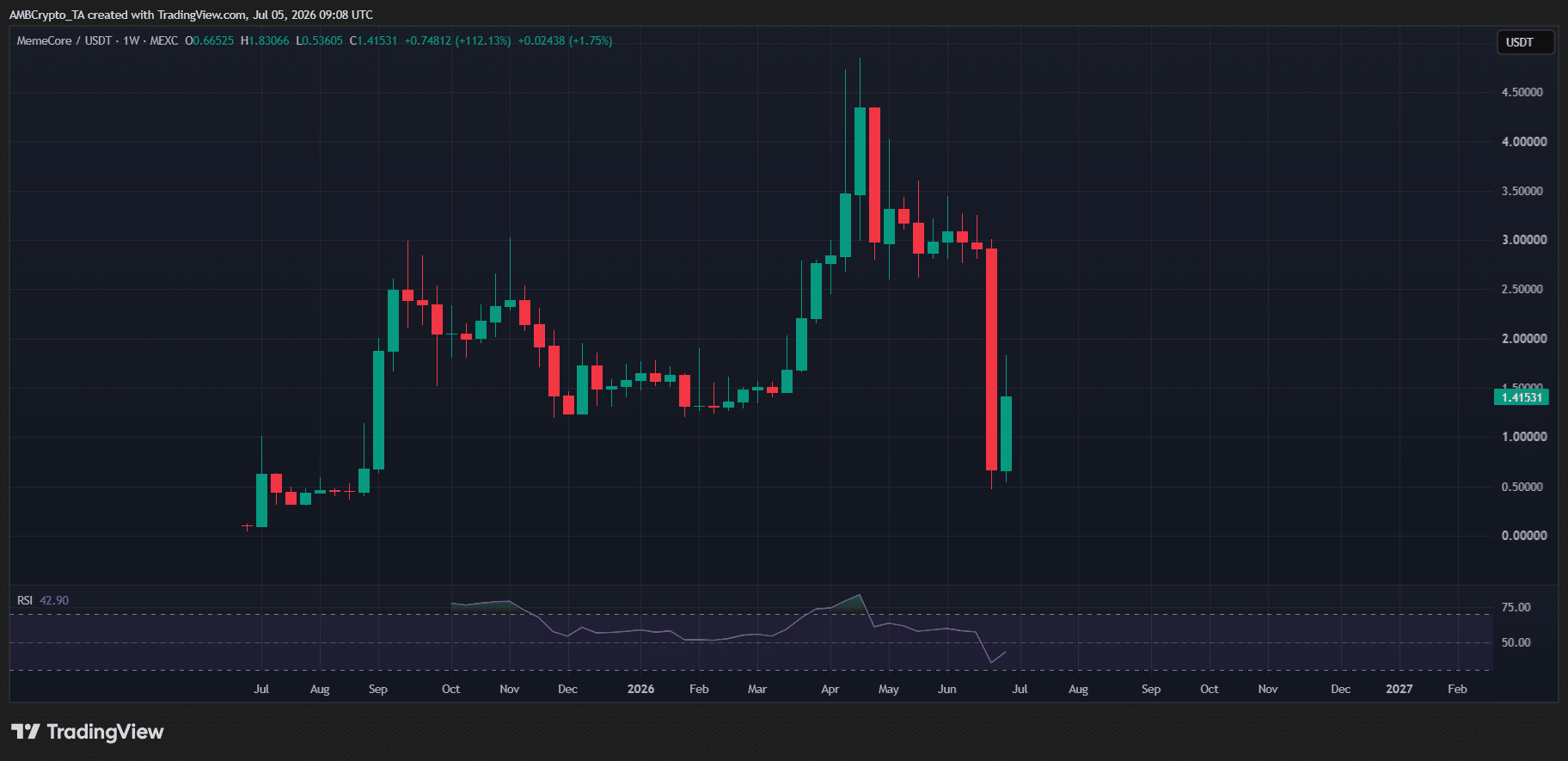
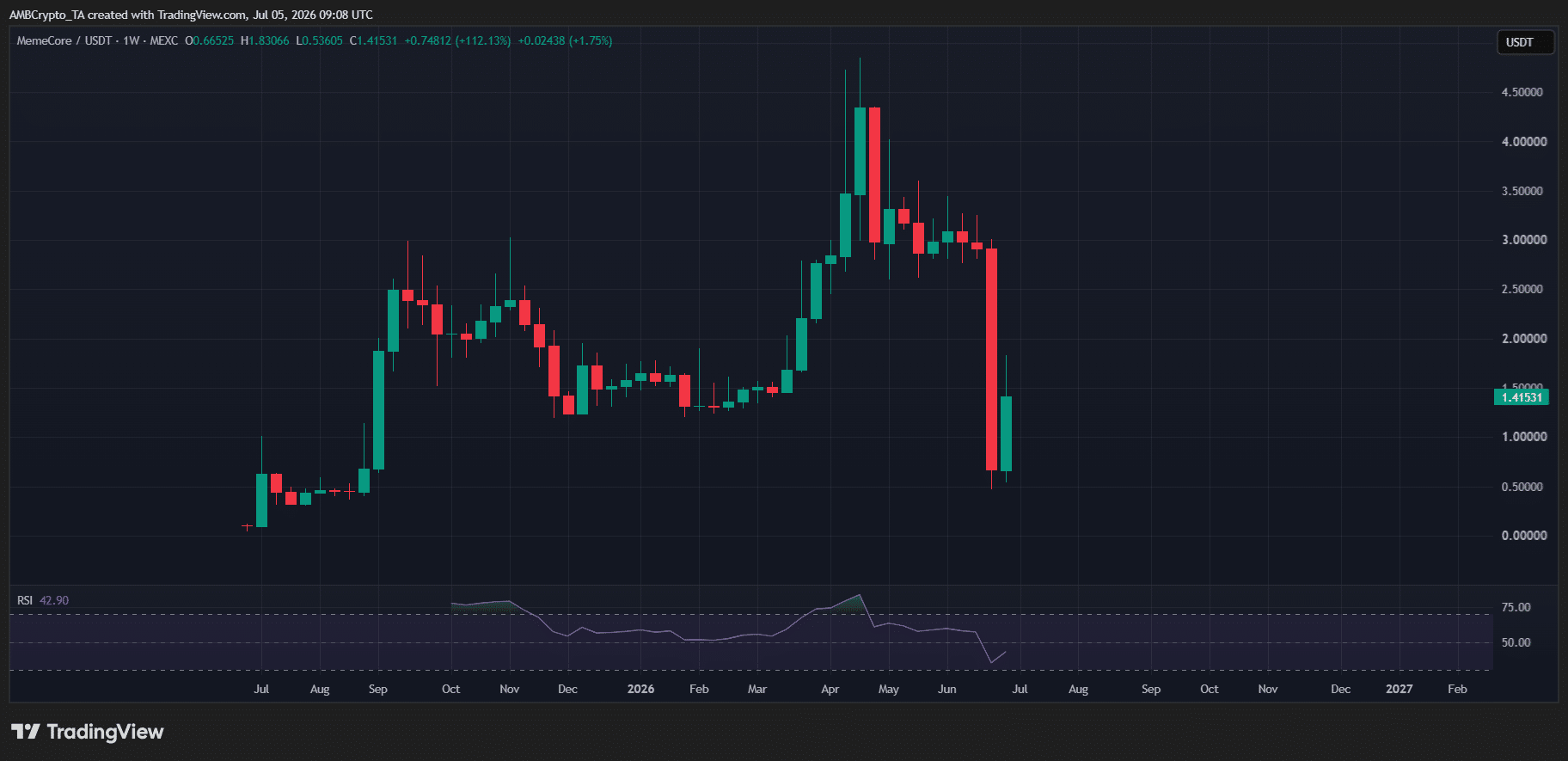
Source: TradingView (M/USDT)

If buying pressure holds, M could have enough fuel to extend its recovery into next week.

Against this backdrop, M’s nearly 13% dip over the past 72 hours doesn’t look too concerning. After a 110% weekly rally, a pullback like this is fairly normal. It helps cool off overheated momentum, shake out weak hands, and clear excess leverage.

If buyers continue to defend the current structure, this pullback could end up being a healthy reset rather than a reversal, keeping M well-positioned to make a run toward the $2 mark next week.

Cardano [ADA] records its strongest weekly run

Cardano [ADA] emerged as this week’s second-biggest gainer with a strong 33.5% rally. More importantly, it marked ADA’s strongest weekly performance since Q1 2025, suggesting the move was driven by more than just short-term dip buying.

As AMBCrypto reported, the rally comes ahead of the upcoming Van Rossem hard fork, Cardano’s upgrade to Protocol Version 11. The upgrade introduces more efficient smart contracts, improved security, and enhanced developer tools, all while keeping the network running without disrupting existing applications.

Those improvements have naturally boosted investor confidence, helping fuel ADA’s rally. On the charts, ADA is also looking stronger. It’s trading around $1.20 with momentum building on the daily timeframe. If buyers keep up the pressure, clearing this resistance could open the door for another leg higher next week.

Lighter [LIT] moves towards price discovery

Lighter [LIT] took the third spot among this week’s top gainers with a 31% rally. The move also sparked a noticeable jump in leveraged activity in the derivatives market, with the $2.20 level emerging as an area where traders are heavily positioned.

From a technical view, LIT still looks constructive. Bulls have consistently bought the dips on both the daily and weekly charts, triggering short squeezes and pushing the token into price discovery. More importantly, the RSI is still well below extreme overbought levels, suggesting the rally isn’t overstretched just yet.

As long as buyers continue absorbing profit-taking, the trend remains intact. With momentum still on the bulls’ side and no clear signs of exhaustion, LIT looks well placed to extend its rally into the coming week.

Other notable winners

Outside the majors, altcoin movers also stood out this week.

Pop Planet [P] led the action with a +7456% move, followed by Vanta Network [SN8] surging +5221%, while The Black Bull [ANSEM] climbed +1420%, rounding out the list of biggest movers.

Weekly losers

Venice Token [VVV] breaks down below a key support level

Venice Token [VVV] topped this week’s losers chart with a 14% correction. More importantly, the charts are still leaning bearish, with the $10 support level now coming under pressure.

On the weekly chart, VVV has spent the last six weeks in a steady downtrend, with only one week of meaningful buying. Even then, bulls couldn’t hold the recovery, showing that sellers are still firmly in control.

The daily chart isn’t much different. VVV opened the week with an 8%+ drop, bounced 8.7% the next day to briefly reclaim the $15 area, but the recovery quickly faded. Sellers stepped back in and pushed the token down nearly 15% over the following three sessions.
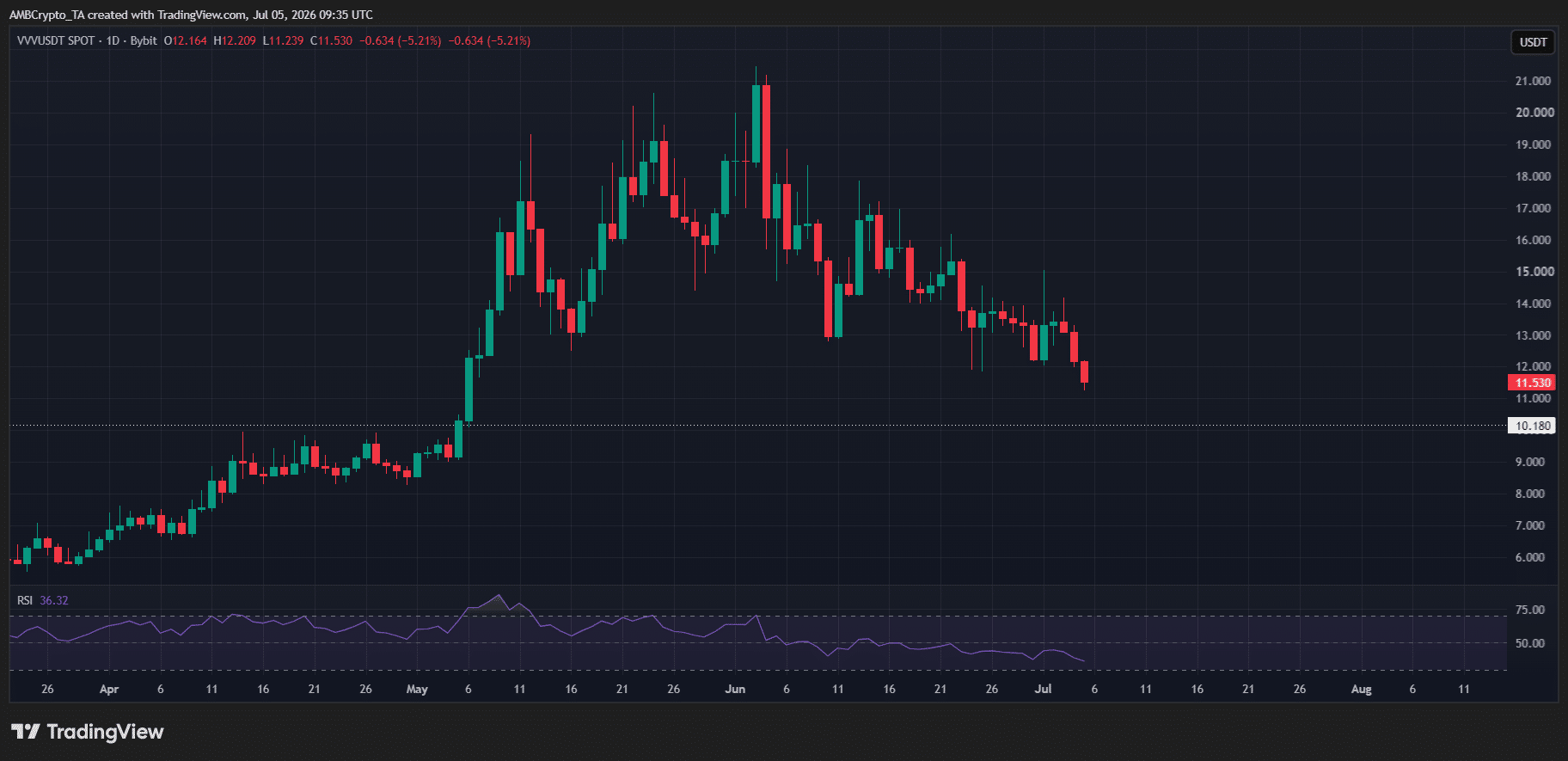
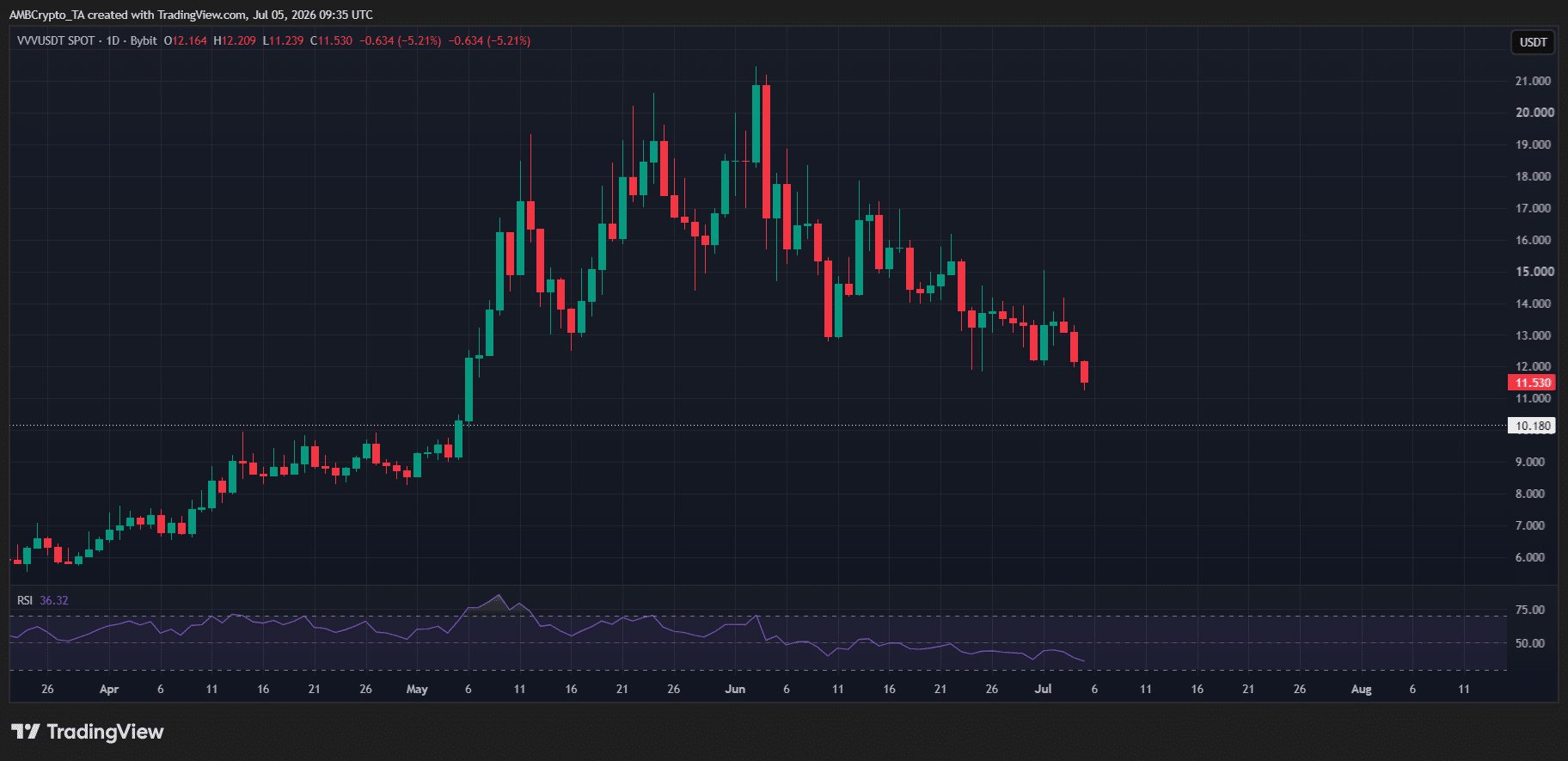
Source: TradingView (VVV/USDT)

Right now, every bounce is being met with fresh selling, which isn’t what you want to see if you’re looking for a trend reversal. Unless buyers step in soon, the odds of VVV losing the $10 support continue to rise. If that level breaks, a deeper correction could be next.

Pi [PI] bears take control from the bulls

Pi [PI] emerged as this week’s second-biggest loser with an 8%+ decline. The charts tell a similar story to VVV, with bears continuing to control the trend while buyers struggle to build any meaningful momentum.

From a technical standpoint, there’s still no clear sign of a bottom. Over the past month, PI has lost two key support levels. The first was around $0.15, which acted as a solid floor back in February. But when price revisited that area in June, buyers couldn’t hold it, allowing sellers to take over again.

This week’s 8% drop has now pushed PI below the $0.13 range where it had spent the last three weeks consolidating. That breakdown shifts the focus toward the $0.10 level. Unless bulls can quickly reclaim the lost support, the current setup continues to favor more downside.

Canton [CC] records extended weekly losses!

Canton [CC] took the third spot among this week’s biggest losers with a near 6% decline. Compared to the other top losers, the drop was relatively modest, but the charts are still pointing lower.

From a technical standpoint, this week’s losses simply add to the ongoing weakness. CC has now posted four straight weeks of declines, sliding from around $0.17 to $0.14, with sellers staying firmly in control.

The weekly chart also shows CC trading at its lowest level since the January rally, leaving many recent buyers underwater. That’s usually not a great sign, as it can trigger more selling into any short-term bounce. Unless buyers step in soon, the current trend continues to favor a move toward the $0.10 level.

Other notable losers

In the broader market, downside volatility hit hard.

SkyAI is a crypto asset in the emerging token segment recorded a 75% drop, followed by Xeffy falling 63.6%, and Velvet slipping 62.5%, as momentum sharply cooled.

Conclusion

This week was a rollercoaster. Big pumps, sharp dips, and nonstop action. As always, stay sharp, do your own research, and trade smart.


Final Summary

  • MemeCore [M], Cardano [ADA], Lighter [LIT] led the week in gains.
  • Venice Token [VVV], Pi [PI], Cranton [CC] saw significant declines.

Trending Cryptos

Related Questions

QWhat was the primary reason for Cardano's (ADA) strong performance this week, according to the article?

AThe article attributes ADA's strong performance primarily to investor optimism ahead of the upcoming Van Rossem hard fork (Protocol Version 11), which promises more efficient smart contracts, improved security, and enhanced developer tools.

QAccording to the technical analysis, why might the pullback in MemeCore (M) be considered healthy after its 110% rally?

AThe article suggests the pullback could be healthy as it helps cool off overheated momentum, shake out weak hands, and clear excess leverage. This creates a potential reset, positioning M to make a run toward the $2 mark if buyers defend the current structure.

QWhat key support level is Venice Token (VVV) at risk of breaking, and what could be the consequence?

AVenice Token (VVV) is at risk of breaking below the $10 support level. If that level breaks, the article warns that a deeper correction could follow, as the overall trend remains bearish with sellers in control.

QBesides the top three gainers, which altcoins had the most outsized weekly gains in percentage terms?

AOutside the top three, the altcoins with the most outsized gains were Pop Planet (P) +7456%, Vanta Network (SN8) +5221%, and The Black Bull (ANSEM) +1420%.

QWhat general factor did the article highlight as driving this week's biggest winners, rather than just broad market speculation?

AThe article highlighted that developer-led catalysts, protocol upgrades, and project-specific announcements (fundamentals) dominated price action for the biggest winners, rather than pure speculation or broad market momentum alone.

Related Reads

Anthropic Creates an AI Jailbreak 'Penal Code': Your Requests, Four Ways to Die

Anthropic has publicly detailed its security measures and a new "Cyber Jailbreak Severity" (CJS) framework following the controversial takedown of its Fable 5 model. The incident, triggered by simple user requests like counting letters or stating a profession, highlighted overzealous safety filters. Anthropic classifies cybersecurity-related prompts into four tiers: malicious activities (blocked), high-risk dual-use (like pentesting, with strict limits), low-risk dual-use (often blocked by "safety margin" errors), and harmless tasks (theoretically allowed but still frequently flagged). The company admits its classifiers are tuned for high sensitivity, leading to many false positives. The newly proposed CJS framework aims to objectively score the severity of AI "jailbreaks" (prompts that bypass safety rules) on a 0-10 scale across four dimensions: Capability Gain (does it grant new attack abilities?), Breadth (does it work across multiple attack types?), Weaponization Ease (how hard is it to turn into a real attack?), and Discoverability (how easy is it to find?). The score determines the response, from no action (CJS-0) to a potential model takedown (CJS-4). The score is context-dependent; for example, discovering a major unknown vulnerability today scores high, while asking about a well-known one scores low. The article raises concerns about Anthropic's dual role: it is both creating powerful models (like the restricted Mythos 5) and defining the rules (CJS) for judging their misuse, potentially giving it disproportionate influence. This is set against the backdrop of U.S. export controls, which for the first time directly restricted API access to a model (Fable 5), creating a "tiered" system where public models are heavily filtered and advanced ones are limited to vetted partners. The CJS framework is portrayed as potentially providing regulators with a metric to justify future API shutdowns. For users, the advice is to carefully phrase prompts, watch for signs of being downgraded to a weaker model, and wait indefinitely for promised filter improvements.

marsbit26m ago

Anthropic Creates an AI Jailbreak 'Penal Code': Your Requests, Four Ways to Die

marsbit26m ago

$100M Annual Revenue, Two Berkeley Roommates in Their 20s Build the Most Profitable AI Business

Arena, the AI model ranking platform, has become a $100 million annual revenue business just eight months after launching its commercial service. Originally a UC Berkeley open-source research project called Chatbot Arena, it created a "battle arena" where users blind-test and vote on anonymous AI model responses. This has generated a highly trusted, community-driven leaderboard based on over 10 million user evaluations and 82 million votes. Major AI companies like OpenAI, Google, and Anthropic submit their flagship models to be ranked. The core monetization strategy is its AI Evaluations service, where model developers and large enterprises pay for in-depth performance analysis from Arena's massive user community. This provides real-world feedback on model strengths, weaknesses, and hallucinations—a critical service as models become more complex. The company, spun out from Berkeley in early 2025, quickly raised $100 million in seed funding at a $600 million valuation and later secured a $150 million Series A at a $1.7 billion valuation. The founding team includes CEO Anastasios Angelopoulos, a mathematician focused on rigorous model evaluation; CTO Wei-Lin Chiang, creator of the popular Vicuna chatbot; and co-founder Ion Stoica, a renowned Berkeley professor. Arena is now expanding beyond chat benchmarks into "Agent Mode," evaluating AI agents on complex, multi-step tasks like coding and research. The company's success illustrates the growing value and cost of independent, real-world AI model evaluation as the industry intensifies.

marsbit30m ago

$100M Annual Revenue, Two Berkeley Roommates in Their 20s Build the Most Profitable AI Business

marsbit30m ago

Racking Up 24,000 Stars: With One Command, AI Can Now Find Its Own Skills

Vercel, known for its developer tools like Next.js, has launched 'skills', a package manager for AI coding agents, garnering 24,000 GitHub stars. It allows developers to add specialized capabilities, such as React best practices, to AI assistants like Claude Code or Cursor with a single command: `npx skills add <package>`. Skills are shareable, reusable modules that define an AI agent's behavior for specific tasks, moving beyond one-off prompt engineering towards standardized 'capability engineering'. A key innovation is the 'find-skills' skill, which acts as an internal search engine, allowing an agent to autonomously find and install the right skill for a user's request. This lowers the barrier for non-developers to leverage advanced AI coding assistance. However, this 'npm moment' for AI brings significant security risks. Security audits of thousands of skills on platforms like skills.sh and ClawHub found over 30% contained security flaws, with about 13% classified as severe. Threats include malicious scripts that can access local files and credentials, and prompt injection hidden within skill documentation. Unlike traditional code packages, skills blend instructions, code, and system access, posing a direct risk to user machines and data. Experts advise treating skills like code—reviewing them carefully before installation, especially their scripts, and being wary of excessive permissions. Ultimately, Vercel's initiative represents a major shift towards modular, reusable AI capabilities, but its rapid adoption requires developers to bring the same caution used in managing traditional software dependencies.

marsbit31m ago

Racking Up 24,000 Stars: With One Command, AI Can Now Find Its Own Skills

marsbit31m ago

Claude Engineer Finally Unveils Fable 5's Ultimate Strategy, Teaching You How to Bridge the Information Gap with AI Models

This article, titled "Claude Engineer Finally Releases Fable 5 'Skill-Burning' Guide, Teaching How to Bridge the Information Gap with Models," details a blog post by Claude Code engineer Thariq Shihipar. The core concept is the "information gap" or "unknowns"—the disconnect between a user's instructions (the "map") and the actual task requirements (the "territory"). The article argues that with powerful models like Claude Fable 5, work quality depends on the user's ability to identify and clarify these unknowns. Shihipar categorizes unknowns into four types: Known Knowns (explicit instructions), Known Unknowns (awareness of gaps), Unknown Knowns (implicit, unstated knowledge), and Unknown Unknowns (unforeseen issues). The blog provides a framework for addressing these gaps throughout the workflow: * **Before Implementation:** Techniques include "Blindspot Scanning" to uncover Unknown Unknowns, brainstorming/prototyping for visual or complex tasks, having Claude ask clarifying questions, using reference code/examples, and creating implementation plans. * **During Implementation:** Maintaining an "implementation notes" file for Claude to document deviations and decisions made due to encountered edge cases. * **After Implementation:** Creating summary documents for review and having Claude generate quizzes to ensure the user fully understands the completed changes. The article concludes that as models become more capable, the key to success is systematically discovering and defining these unknowns through low-cost methods like prototyping and planning, allowing for more effective collaboration.

marsbit35m ago

Claude Engineer Finally Unveils Fable 5's Ultimate Strategy, Teaching You How to Bridge the Information Gap with AI Models

marsbit35m ago

Trading

Spot

Hot Articles

Discussions

Welcome to the HTX Community. Here, you can stay informed about the latest platform developments and gain access to professional market insights. Users' opinions on the price of S (S) are presented below.

活动图片