Token Devours One-Third of Payroll, Silicon Valley's AI Bill is Spinning Out of Control

marsbitPublished on 2026-07-06Last updated on 2026-07-06

Abstract

The article discusses the dual reality of AI token costs in Silicon Valley. While research firm SemiAnalysis reports spending 30% of its employee salary budget on internal LLM tokens—translating to massive productivity gains like converting complex Excel models in minutes—other giants are struggling with ballooning, uncontrolled AI bills. Uber exhausted its annual AI budget in months after rapid engineer adoption, and Microsoft is cutting third-party AI tools due to high costs. NVIDIA's CEO argues tokens are becoming "means of production" and plans substantial AI budgets per engineer. Despite current cost concerns, the analysis emphasizes that cost collapse is just beginning. Through software optimizations (like 14x throughput boosts) and next-gen hardware (e.g., GB300 NVL72 with 17-32x H100 performance), real token costs can fall far below list prices. Anthropic's gross margins reportedly soared as token prices dropped. Gartner predicts a >90% inference cost drop by 2030. The piece highlights a split: massive AI capex ($740B announced) contrasts with tech layoffs and minimal measured economic impact so far. The transition mirrors past infrastructure shifts—investment precedes widespread productivity. For early adopters like SemiAnalysis, tokens already deliver high leverage; for others, the choice is to adopt now or risk falling behind.

Only $0.99 per million Tokens.

This is the real cost on the bill of SemiAnalysis—Silicon Valley's most hardcore semiconductor research firm.

But what's even more shocking is this number: Internal large model Token expenditure already accounts for 30% of total employee salaries.

It sounds like a lot—but flip the calculation: the output bought with this money previously required several times the human resource cost to cover. Per capita consumption nears 5 billion Tokens monthly, over five times Meta's per capita level, with core contributors' monthly consumption exceeding 100 billion.

Tasks that used to take junior analysts hours to complete, like converting Excel models or creating financial report charts, are now done in minutes, costing just a few dollars.
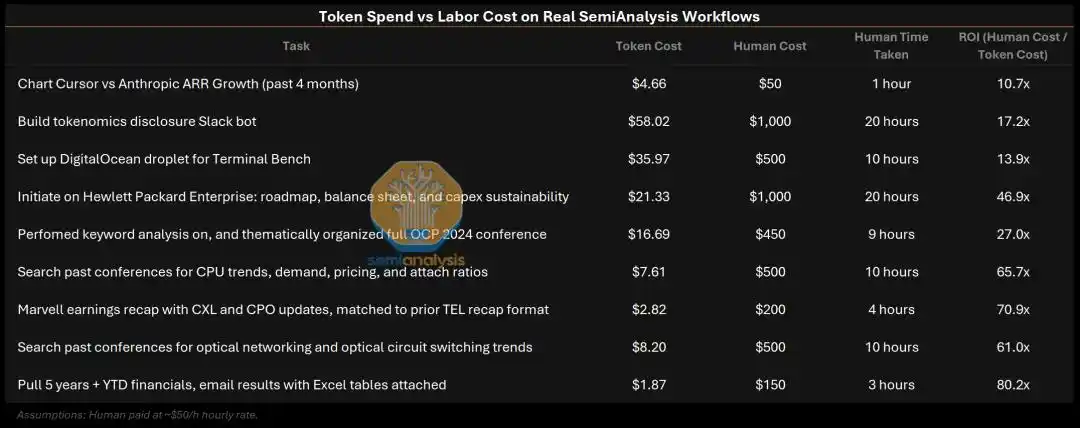
SemiAnalysis's own assessment hits the nail on the head: This isn't a 10% efficiency boost; it's the unit economics of professional services being rewritten.

Research firms, hedge funds, law firms—for all industries reliant on human intellect, Token expenditure reaching 20-30% of payroll is only a matter of time.

NVIDIA CEO Jensen Huang is more anxious than anyone.

At this year's GTC conference, he put it bluntly: An engineer with a $500k salary spends less than $250k on Tokens by year-end?

"I would be absolutely furious."
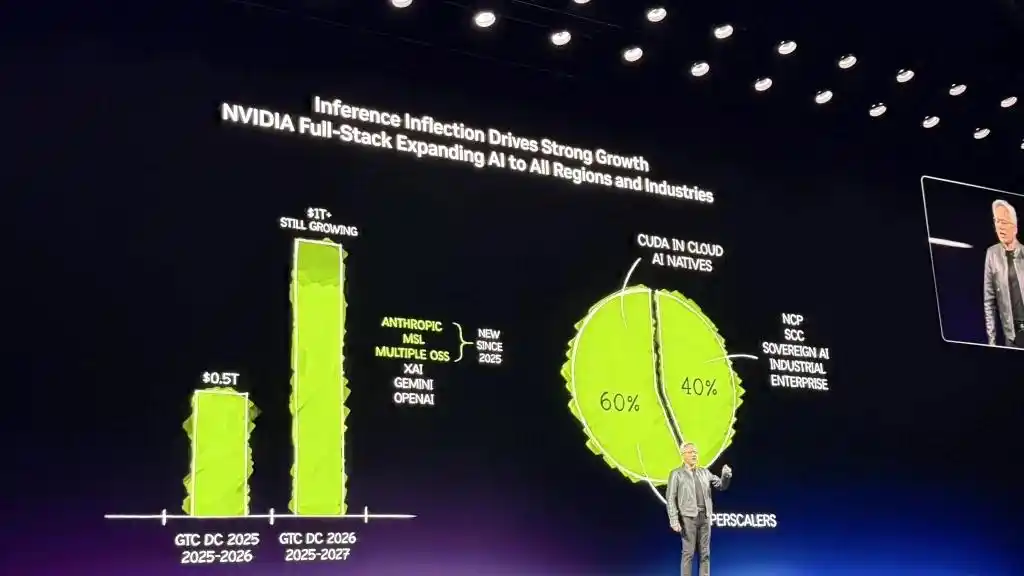
He plans to give every NVIDIA engineer a Token budget equivalent to six months' salary, and have 75,000 employees work alongside 7.5 million AI agents.

Not using AI? Huang says it's no different than a chip designer insisting on paper and pencil.

Token is no longer just a tool; it's becoming the "means of production" of the new era.

But the Other Half of Silicon Valley is Furious Over the AI Bill

Interestingly, while SemiAnalysis is saving real money with Tokens, giants in the Valley are tearing their hair out over AI bills.

Uber is the classic case.

Late last year, the company promoted Claude Code to 5,000 engineers, even creating leaderboards—more usage meant higher rank, fueling internal competition.

It worked too well: Engineer adoption was 32% in February, skyrocketed to 84% in March, and by April, 95% of engineers used AI monthly, with 70% of submitted code AI-generated. The annual budget? Already spent.

The CTO said they had to "redo the budget from scratch." Later it got stricter—Bloomberg reported Uber set a $1,500 monthly Token cap per employee, requiring special approval to exceed.

But COO Andrew Macdonald admitted on a podcast: AI usage is indeed rising, but its connection to consumer feature innovation... isn't visible yet.

Microsoft's situation is even more bizarre. Last month, The Verge reported Microsoft is canceling most Claude Code licenses, shifting to its own GitHub Copilot CLI.

The reason is simple: Money was being spent faster than value was being produced.

NVIDIA's VP of Applied Deep Learning, Bryan Catanzaro, was more direct in April: "For my team, compute costs far exceed employee costs."

An MIT 2024 study: In jobs primarily involving visual content, AI automation is economically viable in only 23% of scenarios.

In the remaining 77%, hiring people is cheaper than using AI.

There are even engineers complaining about AI agents "destroying his database and network" during use—he called it the cost of "overuse."

Sky-high budgets, runaway usage, constant mishaps—Silicon Valley is in the most fractured phase of AI economics.

On one side, unprecedented productivity gains; on the other, bills inflating at an equally unprecedented pace.

The Cost Collapse Has Only Just Begun

But SemiAnalysis's core argument is: Don't focus on today's price; the cost collapse has just started.

First, the software side.

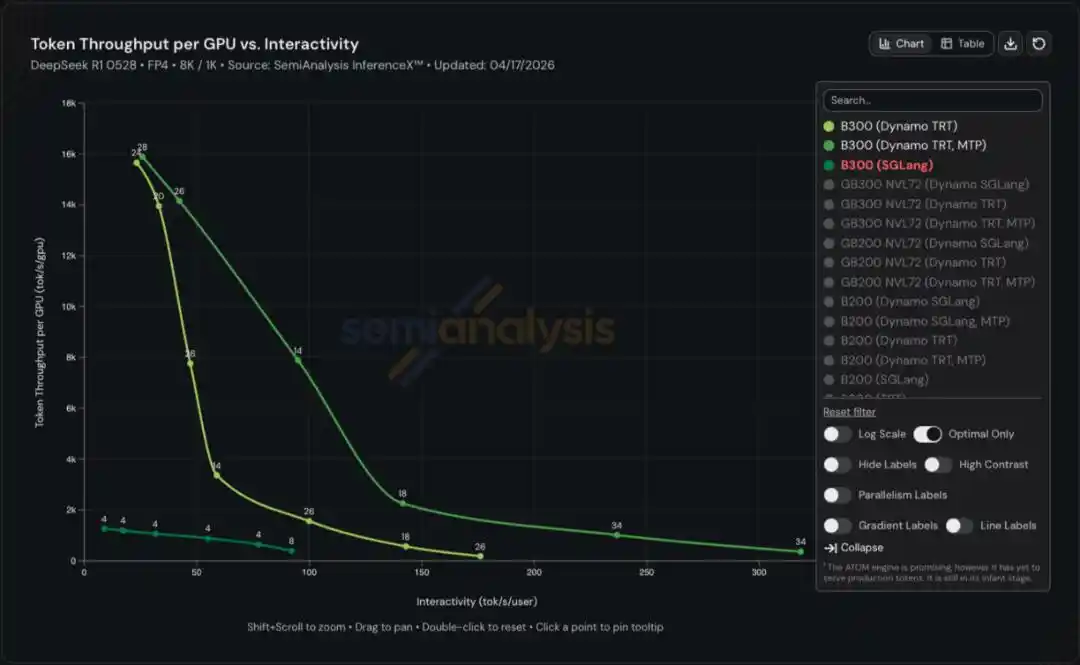
Running DeepSeek R1 on a B300, with pure software optimizations via wideEP, disaggregation, and MTP, single GPU throughput can jump from a baseline of 1,000 tokens/second to 14,000 tokens/second—a 14x boost, purely through code.
Now, the hardware side.

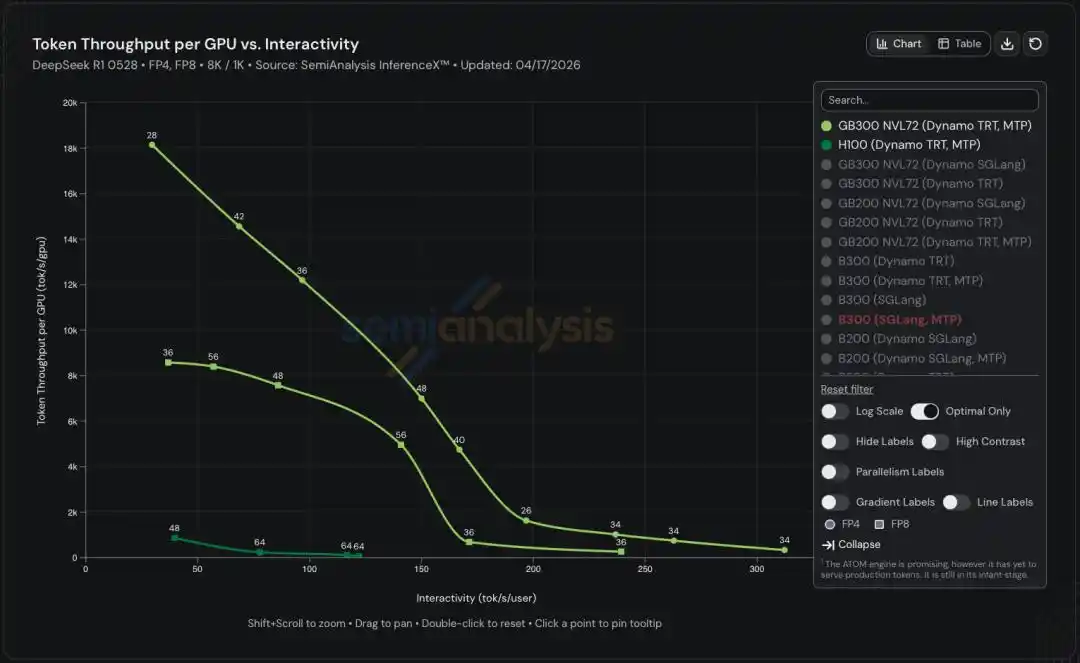
An optimally configured GB300 NVL72 has 17x the throughput of an H100, jumping to 32x when switching to FP4 precision.
Opus 4.7 is priced at $5 per million input, $25 per million output, which seems expensive.

But due to agent workloads having an input-to-output ratio as high as 300:1, plus over 90% cache hit rate, the actual blended cost is compressed to $0.99.

Less than one-fifth of the list price.

Combine software and hardware, and one conclusion is hard to avoid: The gross margin expansion of large models isn't a one-off pricing coincidence; it's a structural trend.

Anthropic's ARR surged from $9 billion to over $44 billion this year, with gross margins jumping from 38% to over 70%—Tokens are getting cheaper, but the sellers are getting richer.

A Gartner report from March corroborates this: By 2030, the inference cost for trillion-parameter models will be over 90% lower than in 2025.

SemiAnalysis's judgment is clear: If you want to predict Token prices in 2027, the answer is one word—down.

The Money is Spent. What's Next?

This is precisely the most fractured aspect of AI today: Global tech companies have announced $740 billion in AI capital expenditure this year, a 69% surge from last year; simultaneously, tech industry layoffs are already outpacing last year's total.

Money is burning, people are being laid off, but Goldman Sachs' chief economist told a blunt truth—The actual economic impact of AI has been essentially zero so far.

It's not that AI is ineffective, but the growing pains of every infrastructure revolution: First, spend to build the pipes, then wait for the water to flow.

It was true for the electrical grid, the internet, and AI is no exception.

The only difference is that the speed of pipe-laying and the speed of water arriving are on a scale previous generations never saw.

SemiAnalysis is already on the side where the water is flowing—30% of payroll is buying several-fold output leverage, and the cost curve is still plummeting.

As for other companies: Wade across the river now, or chase after the cities are already built on the other side.

References:

https://x.com/SemiAnalysis_/status/2070915305858007345

This article is from WeChat public account "New Zhiyuan", author: ASI Revelation, editor: Solomon


Trending Cryptos

Related Questions

QWhat percentage of employee salary does the internal large model token expenditure account for at SemiAnalysis?

AThe internal large model token expenditure accounts for 30% of total employee salary at SemiAnalysis.

QWhat is the key argument of SemiAnalysis regarding the current AI economic situation?

ASemiAnalysis argues that we should not focus on today's AI prices, as a cost collapse has just begun, driven by both software and hardware optimizations leading to structurally lower token costs.

QAccording to the article, what was a major issue Uber faced with its AI tool adoption among engineers?

AUber faced a major issue where the adoption of its AI tool, Claude Code, was so successful that usage surged from 32% of engineers in February to 95% in April, exhausting the annual budget within months.

QWhat does NVIDIA CEO Jensen Huang say about engineers who do not use AI?

AJensen Huang says that not using AI is equivalent to a chip designer insisting on using paper and pencil.

QWhat is the projected trend for the inference cost of trillion-parameter large models by 2030 according to Gartner?

AAccording to Gartner's report, by 2030, the inference cost for trillion-parameter large models is projected to decline by over 90% compared to 2025.

Related Reads

After Close Observation of Wash, Morgan Stanley's Chief Economist Insists: The Fed Will Not Raise Rates This Year

After close observation of Federal Reserve Chair Wash, Seth Carpenter, Morgan Stanley's Chief Global Economist, asserts that the Fed will not raise interest rates this year. Following Wash's speech at the ECB's Sintra forum, Carpenter notes a marginal dovish shift: Wash now more clearly balances the Fed's dual mandate of price stability and maximum employment, rather than focusing nearly exclusively on inflation. Importantly, Wash highlighted that the latest policy meeting (coinciding with falling oil prices) has already lowered market inflation expectations and term premiums, signaling no urgency for a July rate hike. Carpenter's view is supported by data. Recent non-farm payroll figures provide room for the Fed to remain patient. Morgan Stanley's inflation forecasts are below the median FOMC projection, and methodological revisions to PCE inflation could further lower readings. These factors make Carpenter "comfortable" with the call for no hikes in 2024. Carpenter also pushes back against the simplistic narrative that AI will be deflationary and lead to rate cuts. He argues AI investment is currently boosting inflation marginally. More broadly, the business cycle will dictate policy; AI's productivity gains could boost demand and, crucially, raise the equilibrium interest rate (r*), weakening the case for cuts. In contrast, the ECB's path remains more hawkish. Carpenter interprets President Lagarde's Sintra comments as leaving the door open for another 25 basis point hike in September, though softer recent data and falling oil prices provide some flexibility. A July hike or more than one additional hike this year is seen as unlikely.

marsbitJust now

After Close Observation of Wash, Morgan Stanley's Chief Economist Insists: The Fed Will Not Raise Rates This Year

marsbitJust now

StarDynamics Secures 2.5 Billion in Two Months, State-Owned Capital Consortium Joins In

Star Era Raises 25 Billion Yuan in Two Months with State Capital Leading the Charge. Chinese humanoid robotics leader Star Era has secured a new 10-billion-yuan funding round led by state-owned capital, including funds like Chengtong Fund under the SASAC, marking 25 billion yuan raised within two months. The company, a spin-off from Tsinghua University, has built a comprehensive capital matrix combining state guidance, top-tier financial backers, and industrial partners. Founded in 2023 by Dr. Chen Jianyu, one of Tsinghua's youngest doctoral supervisors, Star Era stands out for its early and pioneering work on "world models" for embodied AI, notably releasing its PAD world action model ahead of major global players. The company follows an AI-native, full-stack R&D strategy from data and AI brain to control, dexterous hands (XHAND series), and robot bodies (bipedal L7, wheeled Q5). A core innovation is its fully direct-drive dexterous hands, which act as high-fidelity data collectors for training its AI models like the ERA-42 and VLAW, creating a virtuous cycle of data and intelligence. Star Era claims to possess one of the world's largest real-world dexterous hand datasets. Commercially, Star Era has achieved product-market fit, most notably in logistics, with robots operating 24/7 in distribution centers for partners like SF Express and China Post, handling over 1,200 parcels per hour. It is also expanding into high-end manufacturing (Samsung, Geely) and commercial services. Its hardware components are used by nine of the global top ten tech firms and leading research institutions. The article positions 2026 as an inflection point where success shifts from model capabilities to proven, scalable commercial deployment. Star Era's rapid funding and industrial traction highlight its position in this competitive race.

marsbit4m ago

StarDynamics Secures 2.5 Billion in Two Months, State-Owned Capital Consortium Joins In

marsbit4m ago

U.S. Stock Market Trend (July 6th): Gold and Crypto Lead Rebound Ahead of Stocks, Fed Minutes Set Weekly Direction

**U.S. Market Trends (July 6): Gold & Crypto Lead, Fed Minutes to Set Tone** Markets rebounded ahead of the U.S. Independence Day holiday, with Nasdaq 100 futures rising over 1% as AI sector concerns eased. Gold posted its best week in over a month, breaking a four-week losing streak despite ongoing Russia-Ukraine tensions, as Middle East risk premiums faded. Brent crude extended its decline for a fourth week. The week ahead is packed with key events. On Tuesday, SpaceX makes a record-fast entry into the Nasdaq 100 index, forcing passive fund flows, while U.S. tariff hearings and the Sun Valley Conference—notably missing NVIDIA's Jensen Huang and Tesla's Elon Musk—add complexity. OpenAI's scheduled GPT-5.6 release intensifies the AI model rollout race. The main focus is Thursday's release of the first Fed meeting minutes under Chair Wash. With half the FOMC already leaning toward a rate hike this year per the June dot plot, the minutes' tone will be critical for market direction. Hawkish confirmation could reverse recent risk-on sentiment, likely signaled first by a pullback in high-volatility assets like Bitcoin and Ethereum, which significantly outperformed last week. Other events include SK Hynix's large U.S. ADR listing and the start of the Q2 earnings season with reports from PepsiCo and Delta Air Lines. The market's path hinges on whether the liquidity and optimism built during the holiday can withstand the combined tests of Fed policy, trade tensions, and major corporate events.

marsbit5m ago

U.S. Stock Market Trend (July 6th): Gold and Crypto Lead Rebound Ahead of Stocks, Fed Minutes Set Weekly Direction

marsbit5m ago

World's Largest Data Center Project Scrapped

Blackstone Abandons Plans for World's Largest Data Center, Signaling Wider AI Infrastructure Headwinds Blackstone has halted construction of its massive "Digital Gateway" data center campus in Virginia, which was planned to be the world's largest. The project's cancellation follows a five-year battle with local residents concerned about historical preservation, environmental impact, and strain on local resources. A procedural error in the zoning approval process ultimately led a state court to invalidate the project's permits. This move comes shortly after Blackstone sold other mature data center assets, suggesting a strategic pivot by the asset management giant. Industry analysts see this as a potential sign of "peak" investment enthusiasm, mirroring Blackstone's past exits from overheated sectors like office real estate. The cancellation highlights significant bottlenecks facing the AI-driven data center boom across the U.S. Key challenges include severe power grid constraints, with data centers' electricity demand projected to triple nationally by 2035, and mounting grassroots opposition. A report notes over $130 billion worth of U.S. data center projects were delayed in Q1 2026 alone, primarily due to power shortages and community resistance. Local and state governments are also beginning to implement stricter regulations, including new taxes and moratoriums on construction. Blackstone's exit underscores that the breakneck expansion of AI infrastructure is colliding with practical limits, from physical resource caps to social license, forcing a more realistic assessment of costs and feasibility.

marsbit32m ago

World's Largest Data Center Project Scrapped

marsbit32m ago

Trading

Spot

Hot Articles

Discussions

Welcome to the HTX Community. Here, you can stay informed about the latest platform developments and gain access to professional market insights. Users' opinions on the price of S (S) are presented below.

活动图片