Bitcoin stable as Fed fave PCE inflation sees first monthly drop in six years

cointelegraphPublished on 2026-07-30Last updated on 2026-07-30

Abstract

Bitcoin remained stable around $64,500 despite the release of key U.S. inflation data. The June Personal Consumption Expenditures (PCE) index, the Federal Reserve's preferred inflation gauge, showed a year-on-year increase of 3.7%, matching expectations and ending a recent uptrend with its first monthly decline since 2020. However, analysts cautioned that inflation remains nearly double the Fed's 2% target. Concurrently, U.S. stock markets rebounded, easing pressure on crypto assets. Following the Fed's decision to leave interest rates unchanged, Bitwise CIO Matt Hougan predicted Bitcoin will become less sensitive to future Fed rate changes, anticipating more modest policy adjustments ahead.

Bitcoin (BTC) shook off volatility on Thursday as US stocks rebounded on the back of inflation-data relief.

Key points:

  • Bitcoin avoids a snap reaction to US personal consumption expenditures (PCE) inflation data, which reverses a local uptrend.
  • Analysis remains wary of inflationary tendencies despite PCE conforming to expectations.
  • Bitwise predicts that going forward, Bitcoin will become less sensitive to Fed interest-rate changes.

PCE ends uptrend while staying above Fed inflation target

Data from TradingView showed BTC price action focusing on $64,500, broadly unchanged from the day prior.
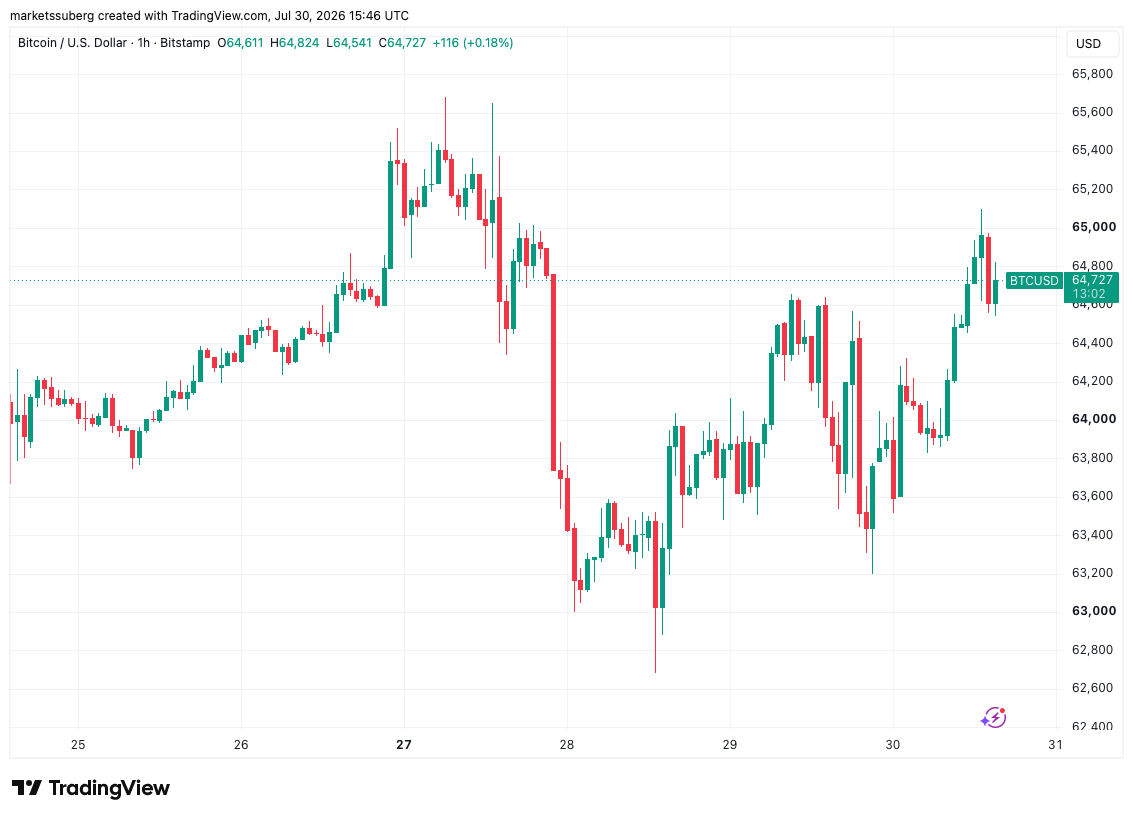
BTC/USD one-hour chart. Source: Cointelegraph/TradingView

The major risk-asset headwind from earlier in the week in the form of a mass sell-off in semiconductor stocks eased on the day, sparing crypto during the US trading session. The S&P 500 index and Nasdaq Composite index were up 1% and 2.3%, respectively, at the time of writing.
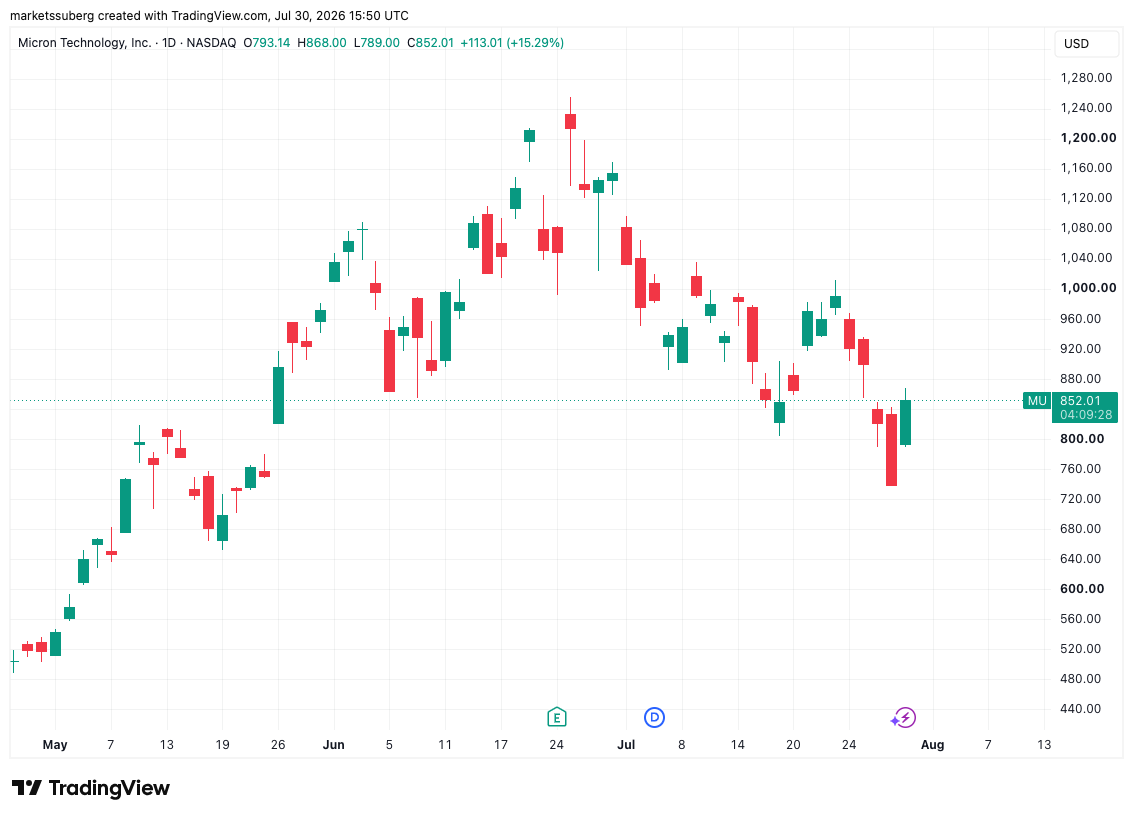
Nasdaq Composite Index one-day chart. Source: Cointelegraph/TradingView

The June print of the US Personal Consumption Expenditures (PCE) index added another positive catalyst, this coming in at 3.7% year-on-year — in line with market expectations. May’s PCE print, at 4.1%, was the highest in three years.

PCE is considered the Federal Reserve’s preferred inflation measure as it offers a broader and more comprehensive measure of inflation and more quickly picks up adjustments in consumers’ choices in response to price changes, according to the Federal Reserve Bank of Cleveland.

“The increase in current-dollar personal income in June primarily reflected increases in compensation, personal income receipts on assets, and government social benefits that were partly offset by a decrease in farm proprietors’ income,” the US Bureau of Economic Analysis (BEA) said. The BEA said in its data release:

“The $65.2 billion increase in current-dollar PCE in June reflected increases of $58.2 billion in spending on services and $7.0 billion in spending on goods.”
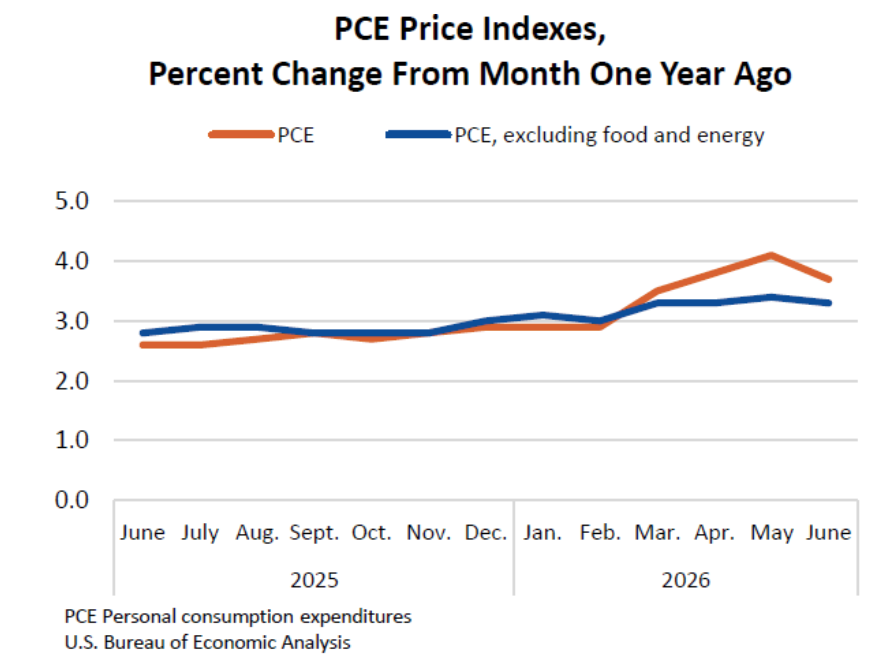
US PCE data percentage change (screenshot). Source: BEA

While ending an uptrend in PCE numbers and showing the first month-on-month decline since 2020, the June print sparked conservative reactions. Trading resource The Kobeissi Letter noted that the 3.7% figure was still the second-highest result since October 2024.

“US inflation continues to run at nearly double the Fed’s 2.0% target,” it said on X.

Johns Hopkins economist Steve Hanke described inflation as “the genie the Fed just can’t put back in the bottle,” while also noting the mismatch with its 2% target.

Bitwise CIO sees BTC brushing off future rate cues

The Federal Reserve left interest rates unchanged at its latest meeting on Wednesday, with an emerging split among the Federal Open Market Committee (FOMC) members regarding appropriate policy.

Related: South Korean crypto trading surges amid stock market plunge

Following the event, Matt Hougan, chief investment officer at crypto asset manager Bitwise, forecast that future interest-rate announcements would have less impact on BTC price performance.

“Rationale: Throughout bitcoin’s history, interest rates swung wildly -- from 0% to 2.5% to 0% to 5% to 3.5%. Changes have been measured in whole percentage points. But future changes seem likely to be more modest; the CME expects a 50bps rise over the next year,” he told X followers, referring to rate expectations as measured by CME Group’s FedWatch Tool.
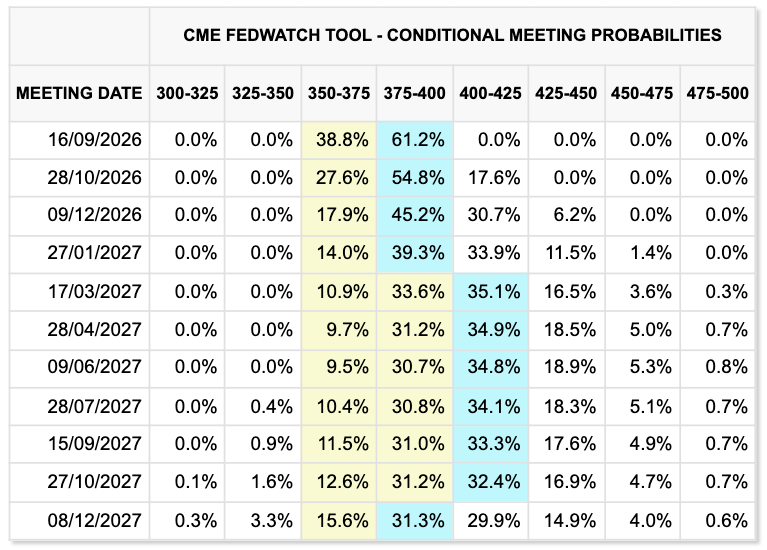
Fed target-rate probabilities (screenshot). Source: CME Group

Hougan said that new Fed chair, Kevin Warsh, will likely echo former chair Alan Greenspan with the scale of rate changes, diverging from his immediate predecessor, Jerome Powell.

Prior to Warsh’s appointment, US president Donald Trump gave repeated signals that he expected Warsh to adopt a dovish stance on the issue, a move that would bolster risk-asset performance.


Trending Cryptos

Related Questions

QWhat is the significance of the June PCE data for inflation trends according to the article?

AThe June PCE data, at 3.7% year-on-year, showed the first month-on-month decline since 2020, thereby ending a local uptrend. However, it is noted that this figure remains the second-highest since October 2024 and is nearly double the Federal Reserve's 2% target.

QWhat was Bitcoin's price reaction to the release of the PCE inflation data?

ABitcoin avoided a snap reaction to the PCE data release. Its price remained broadly unchanged, focusing on around $64,500, as the major risk-asset headwind from earlier in the week eased and US stocks rebounded.

QWhat prediction does Bitwise CIO Matt Hougan make about Bitcoin's future sensitivity to Federal Reserve interest rate changes?

AMatt Hougan forecasts that future Federal Reserve interest rate announcements will have less impact on Bitcoin's price performance. He reasons that future rate changes are likely to be more modest compared to the large swings seen historically, citing CME expectations of only a 50bps rise over the next year.

QHow did key US stock indices perform on the day, as mentioned in the article?

AThe S&P 500 index was up 1% and the Nasdaq Composite index was up 2.3% at the time of writing, rebounding on the back of inflation-data relief.

QAccording to the article, why is PCE considered the Federal Reserve's preferred inflation measure?

APCE is considered the Federal Reserve's preferred inflation measure because it offers a broader and more comprehensive measure of inflation and more quickly picks up adjustments in consumers' choices in response to price changes.

Related Reads

With Two Consecutive Quarters of Losses, Coinbase Must Rely on Paths Beyond Trading

Coinbase posted its second consecutive quarterly net loss of $359 million on $1.22 billion in revenue for Q2, highlighting its vulnerability to crypto market cycles where weaker prices and lower volatility reduce user trading. However, the report also reveals a strategic shift in its business model. Despite a 25% quarter-over-quarter decline in global spot trading volume, Coinbase increased its market share to a company-record 10.3%. This suggests its position as a compliant U.S. on-ramp is strengthening even in a cooler market. A key development is the diversification of revenue streams. Transaction revenue fell to $599 million, nearly equaling subscription and services revenue of $555 million. Stablecoin services, generating $292 million, are becoming a crucial revenue "floor." This income, derived from interest on the $20 billion average USDC balance held on its platform, is less tied to daily trading activity. Furthermore, while spot trading volume dropped significantly, derivatives volume held steady at $1.03 trillion. Coinbase is pushing to integrate spot, stablecoin, and derivatives liquidity to create a more interconnected and sticky ecosystem for users. The GAAP net loss includes non-cash expenses like stock-based compensation and crypto asset valuation changes. Its adjusted EBITDA remained positive at $208 million for the 14th straight quarter, indicating core operations can cover ongoing costs. The company is also reducing expenses to manage the downturn. The central question moving forward is whether Coinbase's growing market share, stablecoin revenues, and expanding product integration can sufficiently offset the inherent cyclicality of its core trading business during future market contractions.

marsbit10m ago

With Two Consecutive Quarters of Losses, Coinbase Must Rely on Paths Beyond Trading

marsbit10m ago

In the Age of Artificial Intelligence, We Need 'Magicians,' Not 'Managers'

In the AI era, leadership must shift from management to magic. As knowledge rapidly expires, value shifts from what leaders know to what they can facilitate. Traditional "inside-out" management, driven by internal experience, is giving way to "outside-in" thinking focused on external opportunities, customer needs, and disruptive change. The core challenge is fostering new ideas that may invalidate existing knowledge. While technologies like steam, electricity, and AI provide the "skeleton" for innovation, it is human vision—connecting technology to customer dreams—that creates magic. Historical figures like Richard Arkwright and Eldridge R. Johnson succeeded not by inventing core technologies, but by reimagining work and business models from the outside in. Leaders must transition from controllers to "architects of flourishing." Their role is to design environments where empowerment, creativity, and adaptive learning thrive. This involves granting autonomy, fostering partnerships, and building resilient systems that scale innovation. Critical leadership qualities now include judgment, creativity, and the ability to learn continuously rather than relying on static expertise. Therefore, cultivating future leaders requires a focus on timeless fundamentals, humanities for broader perspective, and social acuity, rather than over-specialization in quickly outdated technical skills. The future rewards those who respond to the unseen and create conditions for better answers to emerge. Leadership in the AI age is less about having all the answers and more about enabling others to discover them—creating organizations where people explore, imagine, and thrive.

marsbit45m ago

In the Age of Artificial Intelligence, We Need 'Magicians,' Not 'Managers'

marsbit45m ago

Trading

Spot

Hot Articles

What is $BITCOIN

DIGITAL GOLD ($BITCOIN): A Comprehensive Analysis Introduction to DIGITAL GOLD ($BITCOIN) DIGITAL GOLD ($BITCOIN) is a blockchain-based project operating on the Solana network, which aims to combine the characteristics of traditional precious metals with the innovation of decentralized technologies. While it shares a name with Bitcoin, often referred to as “digital gold” due to its perception as a store of value, DIGITAL GOLD is a separate token designed to create a unique ecosystem within the Web3 landscape. Its goal is to position itself as a viable alternative digital asset, although specifics regarding its applications and functionalities are still developing. What is DIGITAL GOLD ($BITCOIN)? DIGITAL GOLD ($BITCOIN) is a cryptocurrency token explicitly designed for use on the Solana blockchain. In contrast to Bitcoin, which provides a widely recognized value storage role, this token appears to focus on broader applications and characteristics. Notable aspects include: Blockchain Infrastructure: The token is built on the Solana blockchain, known for its capacity to handle high-speed and low-cost transactions. Supply Dynamics: DIGITAL GOLD has a maximum supply capped at 100 quadrillion tokens (100P $BITCOIN), although details regarding its circulating supply are currently undisclosed. Utility: While precise functionalities are not explicitly outlined, there are indications that the token could be utilized for various applications, potentially involving decentralized applications (dApps) or asset tokenization strategies. Who is the Creator of DIGITAL GOLD ($BITCOIN)? At present, the identity of the creators and development team behind DIGITAL GOLD ($BITCOIN) remains unknown. This situation is typical among many innovative projects within the blockchain space, particularly those aligning with decentralized finance and meme coin phenomena. While such anonymity may foster a community-driven culture, it intensifies concerns about governance and accountability. Who are the Investors of DIGITAL GOLD ($BITCOIN)? The available information indicates that DIGITAL GOLD ($BITCOIN) does not have any known institutional backers or prominent venture capital investments. The project seems to operate on a peer-to-peer model focused on community support and adoption rather than traditional funding routes. Its activity and liquidity are primarily situated on decentralized exchanges (DEXs), such as PumpSwap, rather than established centralized trading platforms, further highlighting its grassroots approach. How DIGITAL GOLD ($BITCOIN) Works The operational mechanics of DIGITAL GOLD ($BITCOIN) can be elaborated on based on its blockchain design and network attributes: Consensus Mechanism: By leveraging Solana’s unique proof-of-history (PoH) combined with a proof-of-stake (PoS) model, the project ensures efficient transaction validation contributing to the network's high performance. Tokenomics: While specific deflationary mechanisms have not been extensively detailed, the vast maximum token supply implies that it may cater to microtransactions or niche use cases that are still to be defined. Interoperability: There exists the potential for integration with Solana’s broader ecosystem, including various decentralized finance (DeFi) platforms. However, the details regarding specific integrations remain unspecified. Timeline of Key Events Here is a timeline that highlights significant milestones concerning DIGITAL GOLD ($BITCOIN): 2023: The initial deployment of the token occurs on the Solana blockchain, marked by its contract address. 2024: DIGITAL GOLD gains visibility as it becomes available for trading on decentralized exchanges like PumpSwap, allowing users to trade it against SOL. 2025: The project witnesses sporadic trading activity and potential interest in community-led engagements, although no noteworthy partnerships or technical advancements have been documented as of yet. Critical Analysis Strengths Scalability: The underlying Solana infrastructure supports high transaction volumes, which could enhance the utility of $BITCOIN in various transaction scenarios. Accessibility: The potential low trading price per token could attract retail investors, facilitating wider participation due to fractional ownership opportunities. Risks Lack of Transparency: The absence of publicly known backers, developers, or an audit process may yield skepticism regarding the project's sustainability and trustworthiness. Market Volatility: The trading activity is heavily reliant on speculative behavior, which can result in significant price volatility and uncertainty for investors. Conclusion DIGITAL GOLD ($BITCOIN) emerges as an intriguing yet ambiguous project within the rapidly evolving Solana ecosystem. While it attempts to leverage the “digital gold” narrative, its departure from Bitcoin's established role as a store of value underscores the need for a clearer differentiation of its intended utility and governance structure. Future acceptance and adoption will likely depend on addressing the current opacity and defining its operational and economic strategies more explicitly. Note: This report encompasses synthesised information available as of October 2023, and developments may have transpired beyond the research period.

1.1k Total ViewsPublished 2025.05.13Updated 2025.05.13

What is $BITCOIN

Discussions

Welcome to the HTX Community. Here, you can stay informed about the latest platform developments and gain access to professional market insights. Users' opinions on the price of BTC (BTC) are presented below.

活动图片