June Quarter for Earth's Most Valuable Tech Company: Apple's Revenue Breaks $100 Billion for the First Time

marsbitPublished on 2026-07-31Last updated on 2026-07-31

Abstract

On July 30, Apple announced its quarterly results, with revenue surpassing the $100 billion mark for the first time in a June quarter, reaching $109.4 billion—a 16.4% year-over-year increase. This record performance was driven by all-time highs for the period in iPhone, Mac, and Services sales. Key to this growth was the iPhone, which accounted for nearly two-thirds of the $15.4 billion revenue increase compared to the same period last year. Both Europe and Greater China contributed significantly, with the latter seeing 22.4% growth. While Services revenue represented only 28.1% of total revenue, it contributed 42.4% of gross profit due to its high 75.6% gross margin, acting as a profit stabilizer alongside the hardware surge. Notably, EPS grew 28.7%, faster than revenue. However, Apple disclosed that a one-time tariff refund added approximately 2 percentage points to the gross margin and $0.11 to EPS. Excluding this impact, the adjusted EPS growth rate would be approximately 21.7%. This distinction highlights two separate dynamics: operational growth from core businesses and a temporary boost to profitability. The report ultimately paints a picture of broad-based growth, with hardware driving scale, Services enhancing profitability, and a one-time item influencing the profit growth rate.

On July 30, Apple disclosed its latest fiscal quarter results. The company's revenue reached $109.4 billion for the first time, which Apple called its strongest June quarter ever. According to the company's press release, iPhone, Mac, and Services businesses all set new records for the period.

What's truly worth unpacking are two curves moving at different speeds. Revenue grew 16.4% year-over-year, while EPS grew 28.7%. The former indicates Apple sold more, while the latter also includes the effect of a tariff refund. According to the earnings press release Apple issued on the same day, this refund was separately noted in the explanations for gross margin and earnings per share.

How the $100 Billion Threshold Was Crossed
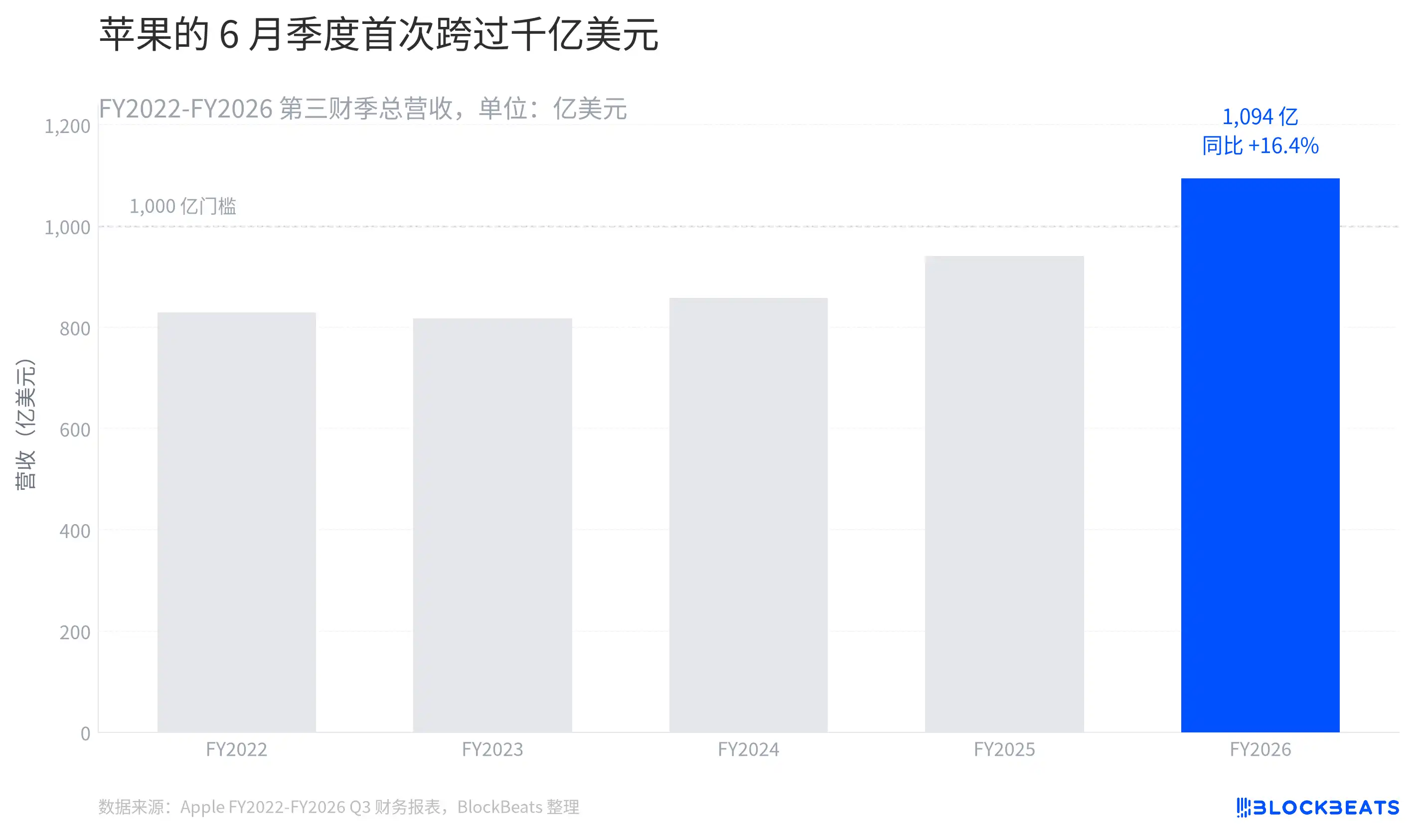
The last blue bar in the chart shows a clearly visible gap compared to the previous four June quarters. Apple didn't sprint here from a straight, upward runway. Revenue in the same period of FY2023 had actually seen a slight dip, before accelerating year after year. According to Apple's consolidated financial statements for each quarter, this quarter's growth rate is the fastest among these five comparable periods.

According to Apple's FY2026 Q3 earnings report, the significance of $109.4 billion lies not in crossing an integer threshold. It pushes the quarter most easily labeled as a "new product lull period" for Apple to a scale close to that of traditional peak seasons. This scale itself changes the intuitive perception of the June quarter's position within Apple's fiscal year.

The revenue increase wasn't confined to just one market either. Apple's segment table shows all five geographic regions achieved double-digit growth. Europe contributed the largest absolute increase, while Greater China's year-over-year growth rate tied with Europe for the highest. Looking at these regions together, Apple's growth this quarter is broader than if it relied solely on the Americas market.

What Pushed the Increment onto the iPhone
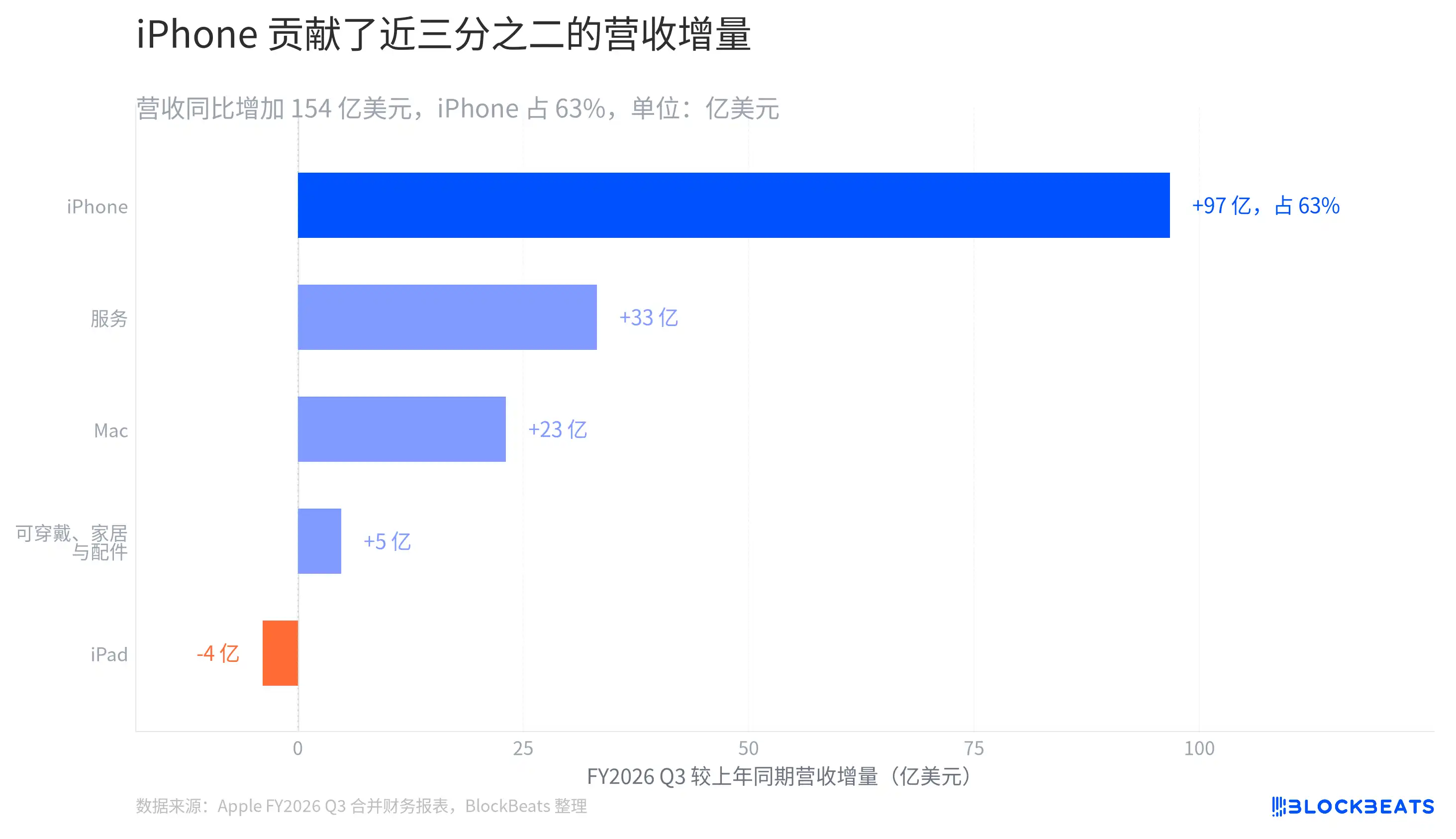
According to Apple's consolidated financial statements for this quarter, the company generated $15.4 billion more in revenue compared to the same period last year. The iPhone alone accounted for nearly two-thirds of that increase, represented by the longest blue bar in the chart. This explains why the pace of this quarter's earnings report feels faster than the June quarters of the past few years.

Services and Mac haven't receded into the background either. The former brought in the second-largest amount of new revenue, with the latter following closely. iPad was the only category to decline. The picture formed by the bars is straightforward: Apple didn't rely on a single product category to pull the numbers up this quarter, though the thrust from the iPhone was exceptionally strong.

This distinction is important. If the Services business alone supported the growth, readers would see a company gradually reducing hardware volatility. The current combination is more like two engines accelerating simultaneously, with hardware providing a longer runway for acceleration, and the Services business continuing to fill in the high-margin portions within it. According to Apple's earnings report, iPhone, Mac, and Services businesses all refreshed their own June quarter records this quarter.

Beyond the product table, the segment table adds another layer of explanation. According to Apple's segment table for this quarter, Europe ranked first in absolute revenue increment, while revenue in Greater China grew 22.4% year-over-year. Changes in these two markets don't alter the fact that the iPhone is the largest source of incremental revenue, but they mean the answer to "where is growth coming from" is no longer confined to a single region.

Services Make Every Dollar of Revenue Thicker
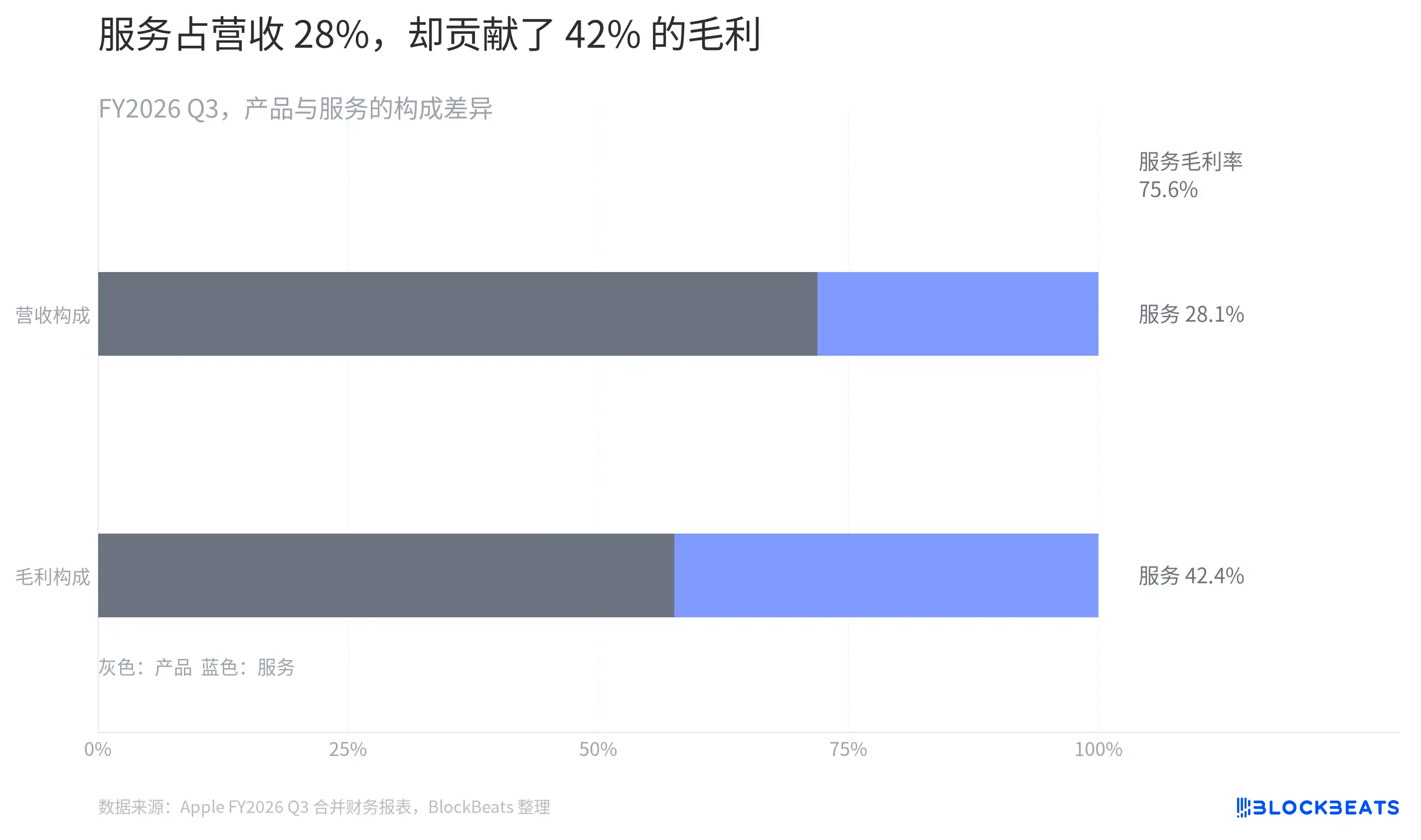
Apple's consolidated statements contain a detail rarely carried away by news headlines. It separately lists the cost of sales for Products and for Services. This allows the layer of gross profit beyond revenue to also be examined separately.

According to Apple's quarterly earnings report, Services accounted for only 28.1% of the company's revenue, yet contributed 42.4% of the gross profit. In everyday terms, for every hundred dollars of revenue Apple generates, Services makes up less than thirty dollars, but the gross profit it leaves behind is already close to half.

The gross margin for the Services business is 75.6%, compared to 40.1% for the Products business. The former acts like a thick base layer; when more devices are sold, this layer continues to support the entire company. This structure also explains why Services revenue didn't capture the largest share of new revenue, yet remains an unavoidable part of reading the earnings report. According to Apple's consolidated financial statements, these two percentages are derived by subtracting the respective cost of sales from their respective revenue.

The majority of the new gross profit this quarter still came from the Products business. According to Apple's consolidated financial statements, it contributed 77.2% of the incremental gross profit. This connects with the rebound of iPhone and Mac seen in the previous chart. Services hasn't taken over hardware's role; it makes the profit left behind when hardware scales up even thicker.

What Did That Refund Change About the Profit Curve
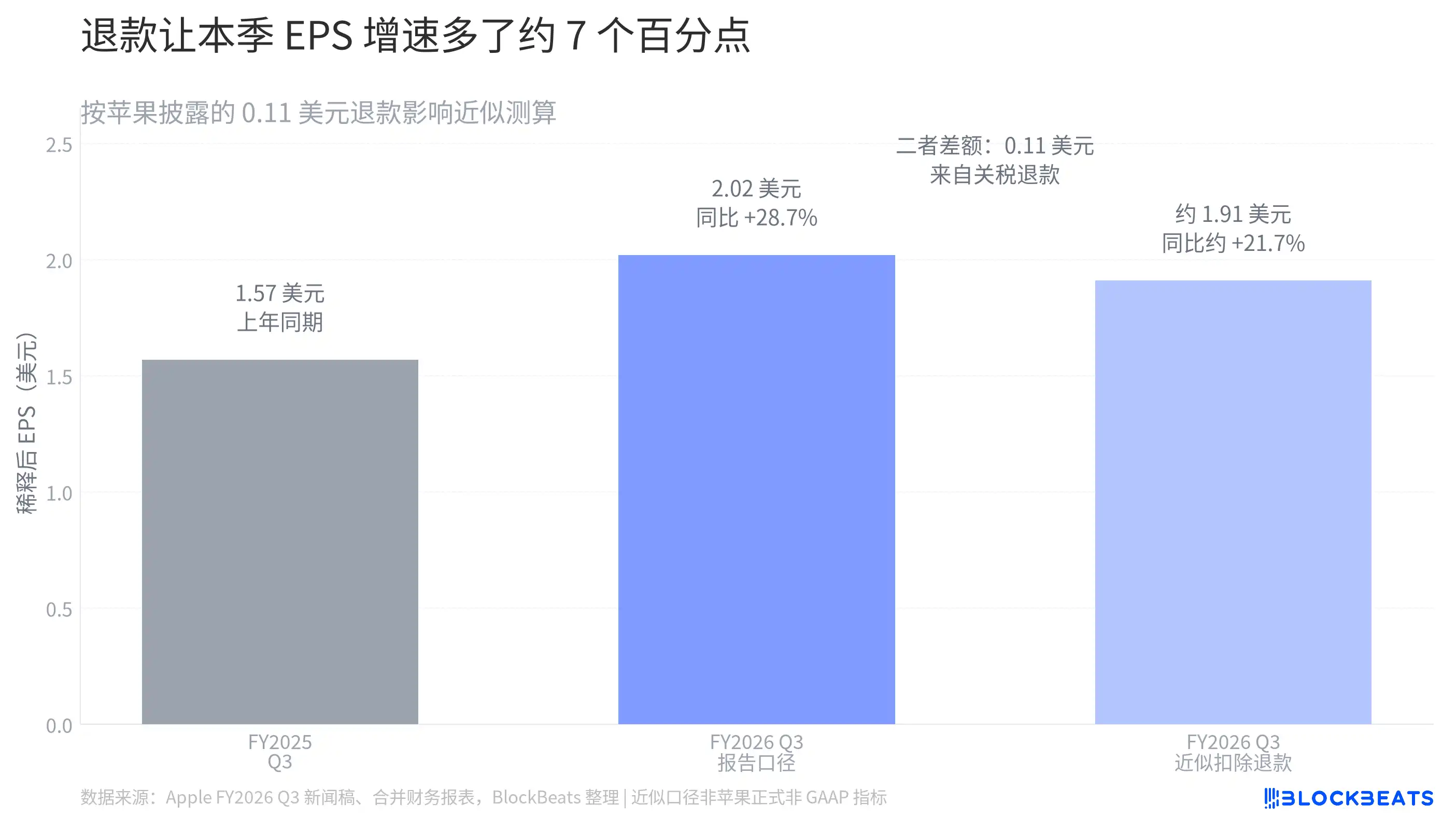
Apple disclosed in its press release that the tariff refund had a positive impact of approximately 2 percentage points on this quarter's gross margin and added $0.11 to EPS. This isn't a number easily spotted at first glance in the main financial statements, but it's significant enough to alter the interpretation of profit growth.

Making an approximate deduction based on the disclosed impact, the year-over-year growth rate for EPS this quarter would be about 21.7%. The reported figure differs from this approximate figure by about 7 percentage points. The light blue bar in the chart is not a non-GAAP metric released by Apple; it merely separates the refund impact already given in the press release from the reported numbers.

This breakdown doesn't erase Apple's operating performance. Even after deducting the refund, EPS still grew faster than revenue. It simply separates two things: one is the growth driven collectively by iPhone, Mac, and Services businesses; the other is the slope added to the profit curve by the one-time refund.

The outline of Apple's earnings report thus becomes clear: hardware recovery has re-accelerated scale, Services makes every dollar of revenue thicker, and a refund reminds us that the slope of profit should be read after being taken apart.


Trending Cryptos

Related Questions

QWhat milestone did Apple achieve in its latest June quarter according to the article?

AApple's revenue surpassed $100 billion for the first time in a June quarter, reaching $109.4 billion.

QWhich two product segments, alongside the iPhone, set new June quarter records for Apple?

AThe Mac and Services business segments also set new June quarter records.

QHow did the Services segment contribute to Apple's gross profit despite its smaller share of revenue?

AServices contributed 42.4% of Apple's total gross profit while accounting for only 28.1% of total revenue, due to its significantly higher gross margin of 75.6% compared to 40.1% for Products.

QWhat was the significant impact of the tariff refund mentioned in Apple's earnings press release?

AThe tariff refund positively impacted the gross margin by approximately 2 percentage points and increased EPS by $0.11 for the quarter.

QWhich two geographic regions showed the strongest year-over-year revenue growth rates in Apple's June quarter?

AGreater China and Europe showed the strongest year-over-year revenue growth rates, with Greater China growing at 22.4%.

Related Reads

The Turning Point of the AI Bull Market: Leverage Blow-ups, Overcapacity in Compute, Why This Macro Analyst is Fully Bearish

AI Bull Market Reaches Inflection Point: Analyst Turns Bearish Due to Leverage, Chinese Competition, and Overcapacity Fidenza Macro analyst Geo Chen explains his decision to sell all AI semiconductor and infrastructure holdings in June, offering a comprehensive bearish thesis. He argues the AI-driven bull market has peaked, citing several key factors. First, unsustainable buying pressure: a massive influx of "low-quality" capital from Korean retail investors using highly leveraged ETFs on stocks like SK Hynix created a parabolic, fragile rally. Recent liquidations have wiped out billions and impacted over a million accounts, removing a key market driver. Second, a competitive threat: the rapid rise of powerful, cost-effective open-source AI models from China, such as MoonShot AI's Kimi K3 and Alibaba's Qwen 3.8, is commoditizing intelligence. This undermines the pricing power and high-valuation financing prospects of closed-source leaders like OpenAI and Anthropic, potentially creating a "single point of failure" for the ecosystem. Third, an impending capacity glut: while AI compute and components are currently in shortage, Chen warns this is typical of a cycle top. Massive, committed capex from cloud providers will likely lead to a supply overhang within 1-2 years. Data shows token spending has already peaked and declined since June, while bond spreads for data center companies are widening, signaling rising credit risk. Chen also highlights broader macro headwinds: the protracted Iran conflict acts as a persistent stagflationary force, and the Federal Reserve under Chair Kevin Warsh is losing credibility in its inflation fight. Long-term Treasury yields breaking above 5.2% present a new challenge for equities. In summary, Chen believes the convergence of speculative excesses, competitive disruption, looming overcapacity, and adverse macroeconomic conditions marks a significant turning point for the AI investment theme.

marsbit15m ago

The Turning Point of the AI Bull Market: Leverage Blow-ups, Overcapacity in Compute, Why This Macro Analyst is Fully Bearish

marsbit15m ago

Saeed Al-Marri: How Tokenization Unlocks New Opportunities for Shipping Funds

Said Al-Marri: How Tokenization Opens New Opportunities for Shipping Funds For centuries, commercial shipping has been a capital-intensive asset class limited to institutional funds and shipping dynasties. Said bin Saleh Al-Marri, CEO of Ethra Invest and Ethra Ship, aims to break down these barriers by combining Real World Asset (RWA) tokenization with conservative private equity principles. This bridges decentralized finance (DeFi) with the physical realities of global trade. Tokenization allows fractional ownership of ships on a blockchain, giving smaller investors access to previously inaccessible markets. However, Al-Marri warns it is not a regulatory loophole or a cure for asset illiquidity. The core physical risks are isolated in Special Purpose Vehicles (SPVs) for qualified investors. While tokenization enhances transparency and ownership record-keeping, Al-Marri stresses that a liquid secondary market depends on transparent asset valuation and must not interfere with ship operations managed by professionals. Regarding legal enforcement, smart contracts cannot physically seize a ship. Legal recourse still relies on traditional maritime courts, ship mortgages, and flag state laws, with blockchain records needing to mirror legal ownership in the SPV perfectly. Beyond ownership, the industry faces administrative hurdles like paper-based bills of lading. Al-Marri argues the bottleneck is legal and operational standardization, not technology. He advocates for a hybrid model combining digital trade documents and programmable settlements with support from regulated financial institutions, rather than a full crypto replacement for tools like Letters of Credit. A major challenge is decarbonizing the global fleet by 2050. Transitioning to green fuels requires massive upfront investment. Al-Marri emphasizes a conservative, holistic approach to underwriting these projects, evaluating technology, fuel availability, safety, and resale value. Investments must be justified under conservative forecasts, not just optimistic ones. By combining pragmatic risk management with digital infrastructure, leaders like Al-Marri show that the evolution of maritime finance is about mobilizing capital to build a modernized and sustainable global fleet, not just putting ships on a blockchain.

cryptonews.ru30m ago

Saeed Al-Marri: How Tokenization Unlocks New Opportunities for Shipping Funds

cryptonews.ru30m ago

Trading

Spot

Hot Articles

Discussions

Welcome to the HTX Community. Here, you can stay informed about the latest platform developments and gain access to professional market insights. Users' opinions on the price of S (S) are presented below.

活动图片