By: Bao Yilong
The war of words between Elon Musk and Sam Altman has escalated once again, coinciding with the release of flagship new models by their respective AI companies in the same week, heightening the competitive tension.
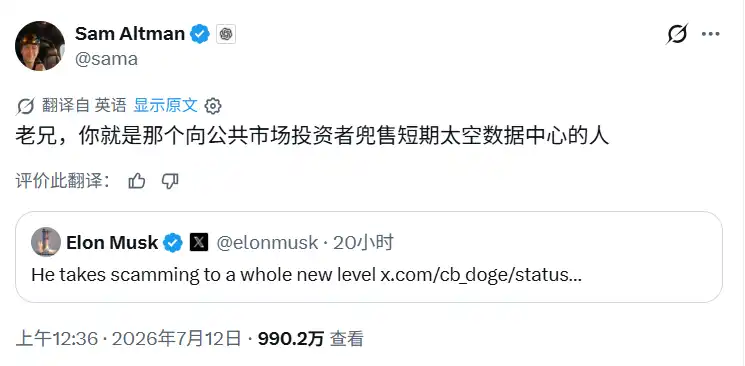
On July 11, Musk posted on platform X, accusing OpenAI CEO Sam Altman of 'taking fraud to a whole new level,' targeting OpenAI's commercial practices with users and customers.

Altman promptly fired back, implying that Musk has been pitching the concept of 'short-term space data centers' to public market investors.
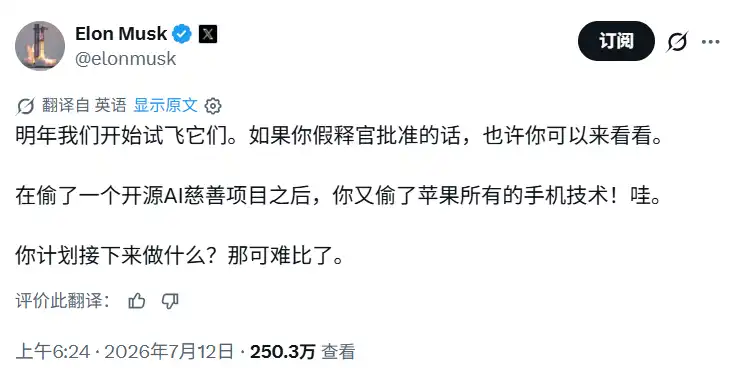
Musk countered, claiming Altman not only 'stole an open-source AI charity,' but is also accused of 'stealing Apple's mobile phone technology' amidst the Apple vs. OpenAI lawsuit, and sarcastically remarked that Altman needs to check with his parole officer for travel.
This exchange occurred in the same week that OpenAI launched GPT-5.6 and SpaceXAI released Grok 4.5, with the two products directly competing in the AI agent arena, making the spat more market-worthy.
Musk Fires, Altman Retorts with Space Data Center
According to Musk's post on platform X on July 11, he directly targeted Altman with blunt and strong language. Altman reposted it and responded:
Dude, you're the one pitching short-term space data centers to public market investors.
Musk immediately countered again, stating these space data centers 'start flying next year,' and snidely suggested that perhaps Altman could visit if his 'parole officer' approves.
Musk further accused Altman of 'first stealing an open-source AI charity, then stealing all of Apple's phone technology,' and questioned:
What next? This will be hard to top.
Musk's reference to 'Apple technology' is directly related to the recent lawsuit Apple filed against OpenAI.
As reported by Wall Street News, Apple filed a lawsuit on Friday in the U.S. District Court for the Northern District of California, accusing OpenAI of deliberately orchestrating the leak of unreleased product information, components, schematics, and other materials by Apple employees to serve its own plans for developing hardware devices.
Apple demands OpenAI immediately cease these actions, destroy all relevant proprietary materials, and redesign upcoming products to ensure they contain no Apple technology.
OpenAI responded, stating it has no interest in other companies' trade secrets and remains focused on building innovative technology.
This lawsuit will profoundly impact the trajectory of cooperation between the two companies. OpenAI has long provided key technical support for Apple's Apple Intelligence platform and Siri voice assistant, a partnership officially announced two years ago at Apple's Worldwide Developers Conference.
GPT-5.6 vs. Grok 4.5: Two Flagship Models Go Head-to-Head
This week, OpenAI and SpaceXAI successively released their latest flagship models, creating a direct confrontation.
OpenAI launched GPT-5.6, while SpaceXAI released Grok 4.5. Both products are positioned as AI agents, meaning they are agentic models capable of autonomously handling multi-step tasks. In terms of performance focus, the two products have different strengths:
- GPT-5.6 excels in broad reasoning, business workflows, and cybersecurity;
- Grok 4.5 is more efficient in autonomous programming and developer workflows, and its usage cost is lower than GPT-5.6.
However, in certain capability dimensions like abstract reasoning, OpenAI's model still leads over Grok.
For investors and enterprise users, the differentiated positioning of the two products means the choice depends on specific use cases. Enterprises seeking versatile reasoning capabilities may lean towards GPT-5.6, while developers prioritizing cost-effectiveness and code automation might prefer Grok 4.5.