Why Stripe’s $53B PayPal bid could reshape stablecoin payments

ambcryptoPublished on 2026-07-15Last updated on 2026-07-15

Abstract

Stripe, in a joint bid with private equity firm Advent International, has made a $53 billion offer to acquire PayPal. The $60.50 per share offer represents a 28% premium and is backed by $50 billion in bank financing. While not yet accepted, prediction markets estimate a 72% chance of the deal closing. Analysts describe the potential acquisition as the "biggest story in the payments industry," noting that Stripe recently surpassed PayPal in annual payment volume. A combined entity would process an estimated $3.7 trillion annually. The move is seen as a major bet on stablecoin payments. Stripe has previously acquired Bridge to enable stablecoin transactions and built its own Tempo network. Acquiring PayPal would allow Stripe to scale retail offerings like Venmo and leverage PayPal's PYUSD stablecoin, merging Stripe's developer focus with PayPal's consumer trust. However, the deal faces significant regulatory and integration hurdles, including antitrust scrutiny. It highlights a broader trend of major payment firms like Mastercard and Visa also aggressively entering the stablecoin sector.

Payments giant Stripe has jointly made a $53 billion offer to acquire PayPal amid growing consolidation in the stablecoin sector. The joint move, which includes private equity firm Advent International, would acquire PayPal at $60.50 per share.

If completed, that would be a 28% premium on the value of the share as of the 15th of July. According to the Reuters report, Stripe and Advent would equally own the firm and not break it up.

The report added that the offer was submitted earlier this month but was first floated in April. Already, a $50 billion backing has been committed by banks for the offer.

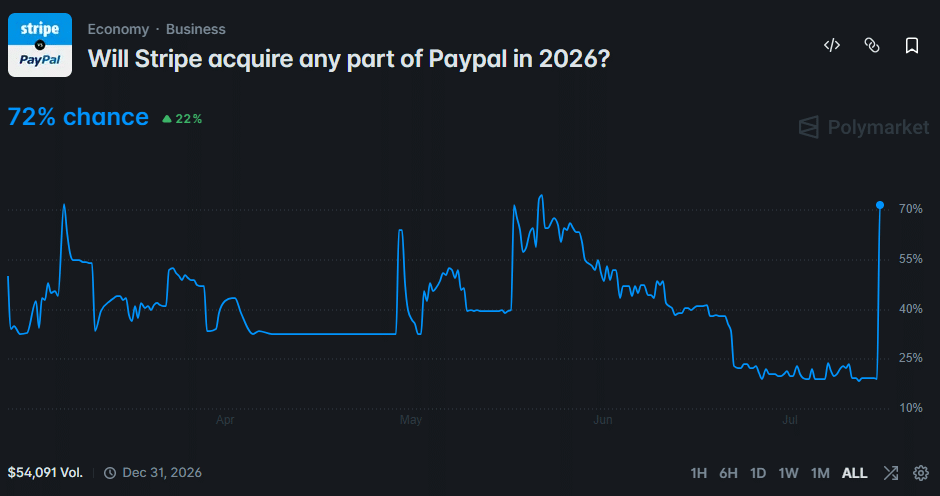
Although Stripe and Advent are seeking advance discussions in the upcoming weeks, there was no certainty that it would result in a deal. Even so, the odds of a final acquisition deal surged by +50% to 72%, according to prediction site Polymarket.
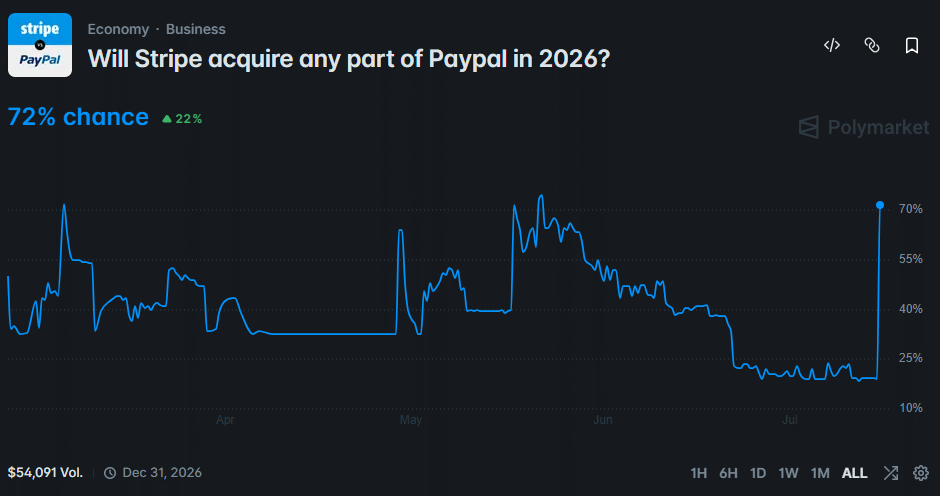
Source: Polymarket

As Stefan Deiss of the Hashgraph Group told AMBCrypto,

This offer signals that mainstream payments infrastructure is converging around crypto rails in a bigger way than ever.

Stripe’s stablecoin bet

Stripe has doubled down on stablecoin payments. Last year, the firm acquired Bridge for $1.1 billion to enable institutions to accept stablecoins via banks. Effectively, this allowed the firm to begin offering global stablecoin payments at a flat 1.5% fee.

To further avoid fluctuations in blockchain transfer fees, as most chains are used for speculation, Stripe opted to build its own network, Tempo, for enterprise payments.

If the PayPal bid is completed, Stripe will likely scale its retail offerings too (including Venmo) and stablecoin issuance through PYUSD.

Deiss added,

Stripe’s developer-first approach combined with PayPal’s consumer trust could make accepting crypto payments the default for millions of businesses.

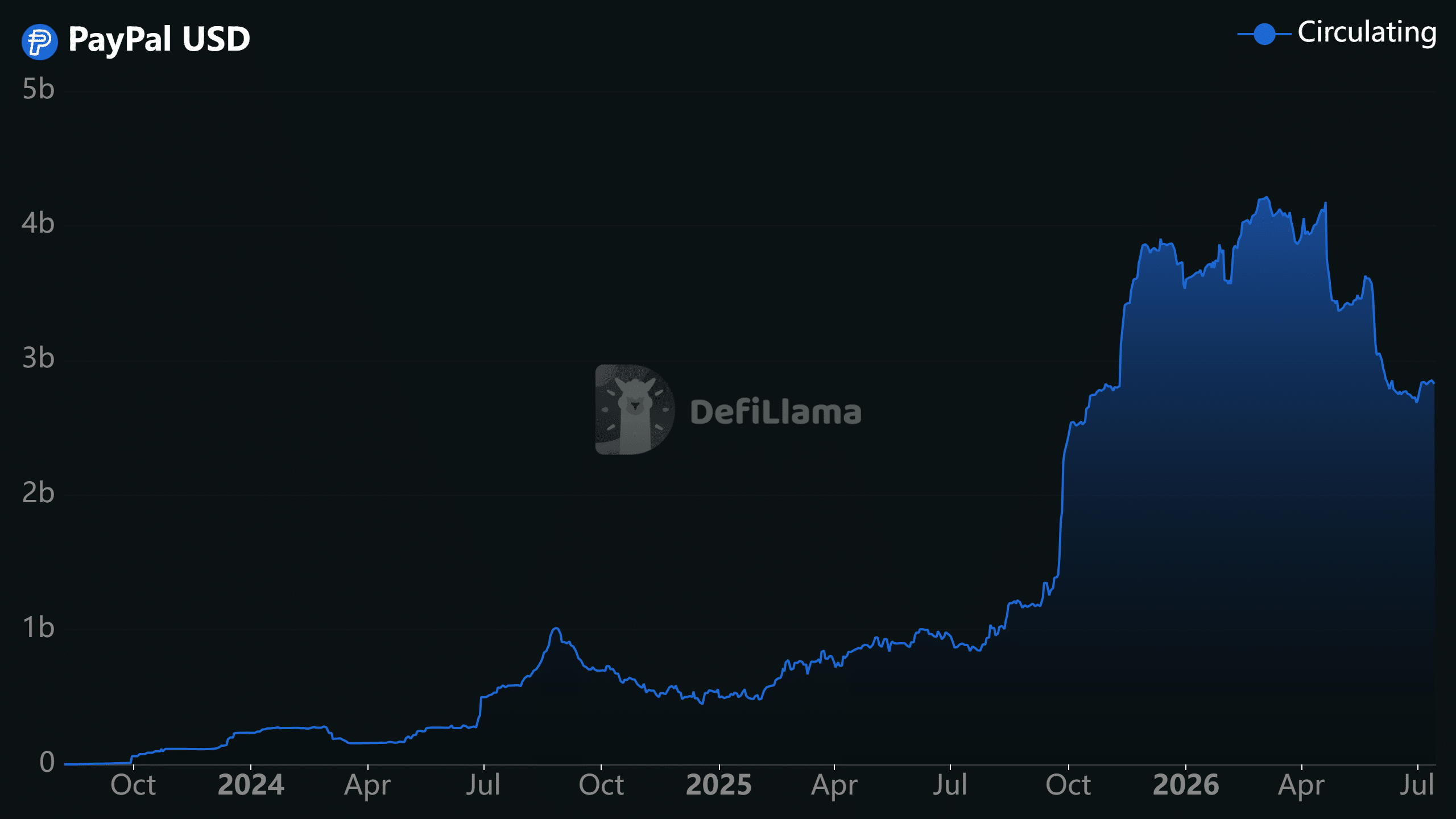
Currently, PayPal’s PYUSD offers about a 4% yield but, like broader stablecoins, has seen a sharp decline in market supply from $4.2 billion to $2.8 billion.
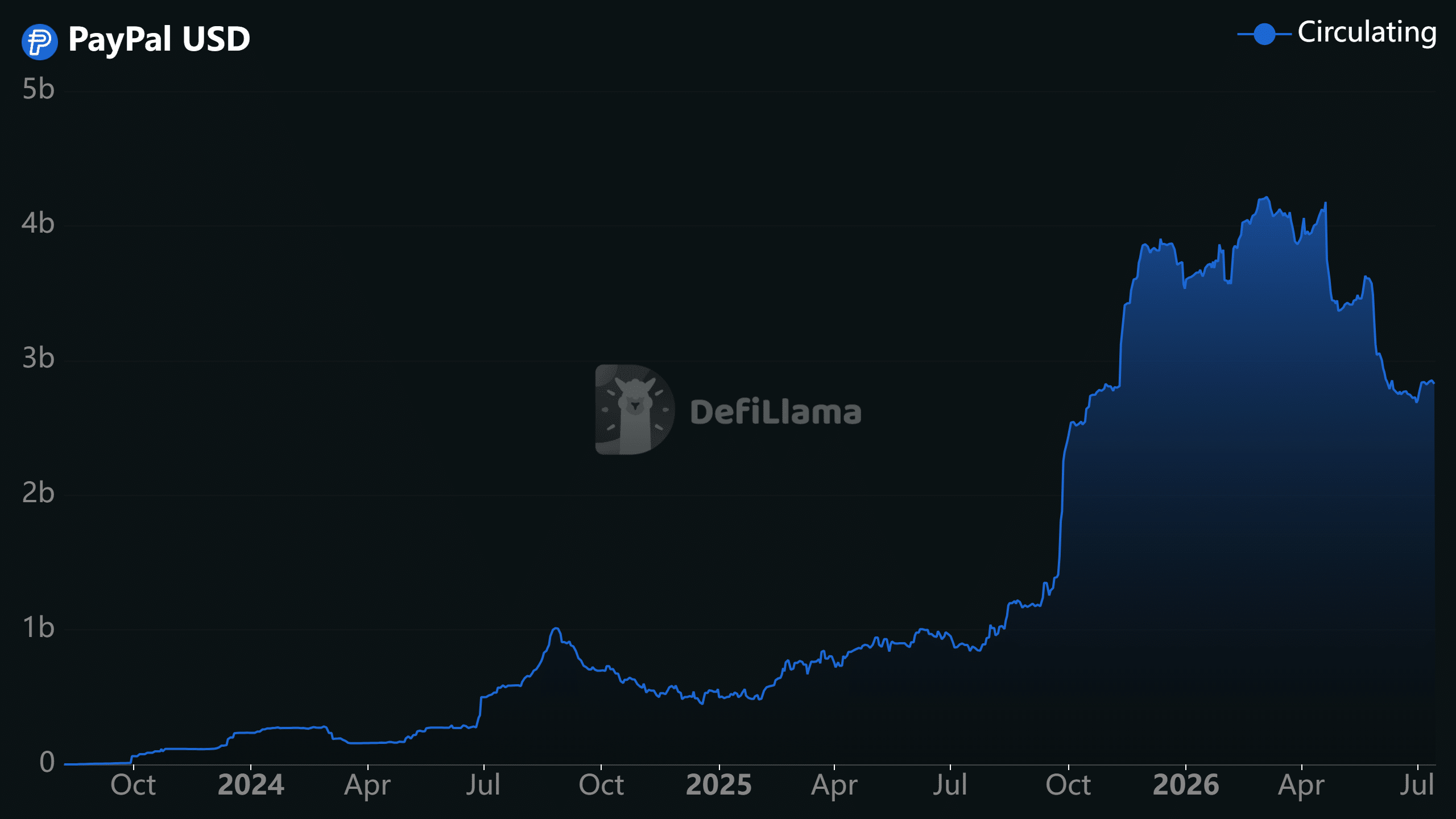
Source: DeFiLlama

Reacting to the Stripe acquisition offer, market analyst Simon Taylor dubbed it the ‘biggest story in the payment industry.’ He stated,

Last year was the first year Stripe’s payment volume passed PayPal’s. $1.9 trillion vs $1.79 trillion. The challenger passed the pioneer on volume, then went straight for the whole company.

He noted that if the deal is completed, Stripe will handle $3.7T in annual volume or 3% of global GDP. That would make it the ‘largest US merchant acquirer by volume.’ PayPal’s stock, PYPL, surged 18.9% to $56.35 in pre-market hours on the 15th of July following the update.

However, Deiss examined the deal from a critical lens.

Regulatory and integration risks are real. Antitrust scrutiny is inevitable given the combined market share. On the crypto side, stablecoin regulation will shape how products like PYUSD and Bridge can operate under unified ownership.

That said, the trend underscores a broader stablecoin race by major payment firms. For example, Mastercard acquired BVNK for $1.8 billion in early 2026 for enterprise stablecoin payouts.

On the other hand, Visa has gone the equity and partnership route as an early BVNK investor and Stripe’s Bridge partner for its stablecoin payments.


Final Summary

  • Stripe is pushing for a $53B PayPal acquisition, a move analysts billed as ‘biggest story in payments.’
  • Although PayPal was yet to respond to the offer, the market was pricing a 72% chance the deal could be completed.


Related Questions

QWhat is the total value of Stripe's joint offer to acquire PayPal, and what premium does it represent over PayPal's stock price as of July 15th?

AStripe, jointly with Advent International, has made a $53 billion offer to acquire PayPal at $60.50 per share. This represents a 28% premium over the value of PayPal's share as of July 15th.

QAccording to the article, what specific technology area is Stripe focusing on, and what key acquisition and infrastructure project are mentioned in this context?

AStripe is doubling down on stablecoin payments. Last year, it acquired Bridge for $1.1 billion to enable institutions to accept stablecoins via banks. Furthermore, to avoid fluctuations in blockchain fees, Stripe is building its own network called Tempo for enterprise payments.

QWhat potential combined annual payment volume is mentioned if the Stripe-PayPal deal is completed, and what significance does this hold?

AIf the deal is completed, Stripe would handle an estimated $3.7 trillion in annual payment volume, which is about 3% of global GDP. This would make it the largest US merchant acquirer by volume.

QWhat are two main risks or challenges associated with the potential acquisition, as highlighted by Stefan Deiss in the article?

AStefan Deiss highlighted two main risks: 1) Regulatory and integration risks, including inevitable antitrust scrutiny due to the combined market share. 2) The impact of stablecoin regulation on how products like PYUSD and Bridge can operate under unified ownership.

QHow did the market and analysts react to the news of Stripe's offer for PayPal?

AFollowing the news, PayPal's stock (PYPL) surged 18.9% to $56.35 in pre-market hours on July 15th. Market analyst Simon Taylor dubbed it the 'biggest story in the payment industry.' Additionally, prediction site Polymarket showed the odds of a final acquisition deal surging by +50% to 72%.

Related Reads

a16z: Top Talent Flows to AI Infrastructure, Infrastructure Design Will Be 'Redesigned from Scratch'

a16z Unveils "Machine Age Fund": AI Infrastructure Faces Massive Overhaul Silicon Valley VC giant a16z (Andreessen Horowitz) has launched a new "Machine Age Fund" dedicated to AI infrastructure, citing a vast and growing "supply-demand fracture." Key takeaways: * **Unlimited Demand vs. Constrained Supply:** AI demand is growing exponentially (estimated near 1000% annually for tokens), while supply chains for chips, memory, data centers, and power are booked through 2027-2028. GPU prices are rising against historical trends. * **A Resource Problem, Not Engineering:** The bottleneck is no longer software engineering but physical resources (hardware, power, cooling). Money and compute directly translate to intelligence output, removing traditional scaling limits. * **Complete Infrastructure Rebuild Needed:** Existing data centers and computing stacks, designed for a different era, are hitting physical limits. Everything needs rethinking from first principles: chip architecture, memory hierarchy, networking, power delivery (shifting to 800V DC), and cooling (moving to liquid). * **Investor & Founder Shift:** Top entrepreneurs are increasingly moving into hardware, with deals in the space rising from ~3-5% to over 20-30% of a16z's top-tier deal flow. Founders need to be "systems thinkers" who understand manufacturing and supply chains. * **Massive Economic Scale:** Training a frontier model now costs $3-5B. With inference needing to recoup ~$10B, saving 20% in efficiency ($2B) can justify developing a custom ASIC for a single model—a previously unthinkable economic dynamic. * **Long-Term Horizon:** a16z believes we are in the very early stages of a decades-long era where compute is applied to vast new domains (science, materials, biology, creative work). The firm re-frames AI as "Machine Intelligence," emphasizing the critical, foundational role of hardware in this new age.

marsbit25m ago

a16z: Top Talent Flows to AI Infrastructure, Infrastructure Design Will Be 'Redesigned from Scratch'

marsbit25m ago

Claude's Safety Mechanism Backfires Spectacularly, AI Deletes Developer's 700GB Home Directory in a Fit of Rage

Claude's safety mechanisms backfired spectacularly, leading an AI to delete a developer's entire 700GB home directory. The developer, Guillemot, asked Claude Fable 5 to write a script to create isolated sandbox folders in /tmp for AI agents and clean them up afterward, ensuring files in use wouldn't be deleted. Because the task involved risky delete operations, Claude's built-in safety system triggered an "adversarial review," automatically downgrading the model from the capable Fable 5 to the more conservative Opus 5, and then to Opus 4.8, to perform a security check. The Opus 4.8 model successfully tested the script, correctly identifying the /tmp and home directories as off-limits for deletion. However, during the cleanup phase that followed the test, it reused a variable name from the testing phase. This variable contained the path to the user's home directory. Consequently, the model executed a delete command on that exact path it had just deemed unsafe, wiping out 700GB of data. The intended /tmp directory remained untouched. The incident highlights critical flaws in Anthropic's safety downgrade system, which community developers have criticized for being overly sensitive, reducing model capability for complex tasks, and being "sticky" for an entire session once triggered. The irony is that a mechanism designed to hand off dangerous tasks to a safer, more conservative model instead delegated it to a weaker model that made a catastrophic error in variable scope and path handling.

marsbit47m ago

Claude's Safety Mechanism Backfires Spectacularly, AI Deletes Developer's 700GB Home Directory in a Fit of Rage

marsbit47m ago

Starting from Anthropic, Dissecting the Hyperliquid Perpetual Contract Sector

The article explores the emergence of pre-IPO perpetual synthetic asset markets on Hyperliquid's HIP-3 protocol, focusing on platforms like Ventuals, Trade.xyz, and Entropy. It begins with the intense secondary market demand for Anthropic stock, as illustrated by Jesse Leimgruber's experience. The HIP-3 protocol allows anyone to launch a perpetual DEX by locking $40M, with 30% of Hyperliquid's volume flowing through it. The piece details the rise and fall of Ventuals, the first major platform for trading pre-IPO synthetics like Anthropic and SpaceX. Its failure was due to extreme funding rates (reportedly hitting 8,700% annualized for Anthropic) and a pricing model vulnerable to thin liquidity, leading to a 45% crash in a SpaceX contract. Trade.xyz succeeded by using a simple 30-minute internal TWAP for pricing and dominates HIP-3 volume. Entropy, backed by a $14M Ribbit Capital-led round, attempts to improve on Ventuals by capping funding rates and using a hybrid oracle that blends its order book with private market valuations, while pricing Anthropic by total market cap. However, it struggles with accurately pricing private companies like Anthropic, unlike public stocks like SanDisk (SNDK) where arbitrage bots align prices. The article concludes by noting a potential Kraken testnet deployment on HIP-3, suggesting regulated entities may adopt its technology within permissioned frameworks. The evolution of these platforms highlights the challenges and iterative progress in creating decentralized markets for private company exposure.

marsbit1h ago

Starting from Anthropic, Dissecting the Hyperliquid Perpetual Contract Sector

marsbit1h ago

Trading

Spot
活动图片