U.S., U.K. unveil stablecoin roadmap as CLARITY Act stalls: ‘For their own political gain!’

ambcryptoPublished on 2026-07-15Last updated on 2026-07-15

Abstract

The U.S. and U.K. have jointly affirmed their commitment to fostering innovation in digital assets by outlining a cooperative roadmap for stablecoins and tokenized assets. Their 10-point statement emphasizes reducing regulatory friction, particularly by avoiding disproportionately burdensome reserve requirements for stablecoin issuers. This follows the Bank of England's softened stance on reserve rules, now more aligned with the U.S. GENIUS Act framework. However, a divergence in regulatory progress is emerging. The U.K. is advancing towards a comprehensive crypto regulatory framework set for 2027, which includes measures like deferring capital gains tax on crypto lending. In contrast, the U.S. faces significant political hurdles, with the key crypto market structure bill, the CLARITY Act, stalled and its chances of passage dropping to yearly lows. This political deadlock, marked by anti-tech rhetoric, risks leaving the U.S. behind in establishing a clear and frictionless framework for digital assets.

The U.S. and U.K. have reaffirmed their commitment to reducing regulatory friction for digital assets and the modernization of capital markets.

In a joint statement issued on the 14th of July, the two governments shared a 10-point view on stablecoins and tokenized assets, with innovation as the anchor pillar.

The UK and United States affirm that stablecoins are an important vehicle for innovation in digital money. The UK and United States intend to enable the use of stablecoins in cross-border finance.

AD

Some of the issues addressed include reserves, liquidity, and prudential requirements for stablecoin issuers to operate across the two markets.

In particular, the countries pledged to avoid ‘imposing burdensome’ reserve requirements for stablecoins.

Neither government intends to impose burdensome reserve requirements that are disproportionate to risk and that create unwarranted barriers to entry.

The above stance is noteworthy given the recent U.K. softer stance on stablecoin reserves. Initially, it pushed for a strict plan where only 60% of reserves would earn interest, while 40% would be non-yielding at the central bank. The industry pushed against this and called it anti-competitive.

In response, the Bank of England softened the proposal, allowing up to 70% in yield-bearing bonds and reducing cash requirements to 30%. This somewhat mirrored the U.S. GENIUS Act framework, which mandates reserves to be backed by highly liquid assets like U.S. Treasury bonds.

Additionally, it scrapped its caps on individual stablecoin holdings to match the U.S. open market. Still, the two countries have divergences on some aspects of crypto regulation.

The U.S.’s CLARITY Act stalls as the U.K. eyes clear rules by 2027

First, the U.K. will defer capital gains tax for crypto lending to avoid burden and double taxation. The rules will be live in 2027, alongside its broader crypto regulatory framework covering stablecoins, exchanges, staking, and market abuse, among others.

However, a similar U.S. crypto market structure bill, the CLARITY Act, has stalled and risks being deferred to the 2030s. With ethics provisions becoming a sticky issue, odds of CLARITY Act passage dropped to a record yearly low of 32% before briefly hitting 38%.

The bill has now become a political issue with increasing anti-tech rhetoric between Republicans and Democrats, according to Miles Jennings, legal chief at a16z VC firm.
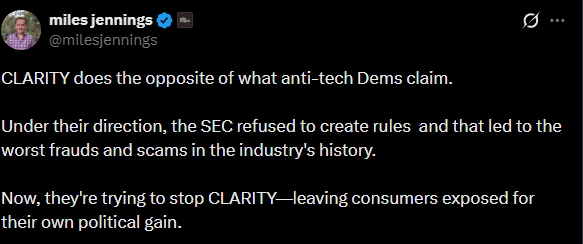
Source: X

The U.S. and the U.K. are pushing for a frictionless stablecoin and tokenization framework. But the U.S. risks falling behind amid uncertainty around the CLARITY Act.


Final Summary

  • The U.S. and U.K. vowed to reduce friction for stablecoin usage as part of driving innovation in capital markets.
  • But the U.S. could fall behind as CLARITY Act passage expectations have fallen to record lows.

Trending Cryptos

Related Questions

QWhat is the main topic announced by the U.S. and U.K. in their joint statement?

AThe U.S. and U.K. reaffirmed their commitment to reducing regulatory friction for digital assets and the modernization of capital markets. They shared a 10-point view focused on enabling stablecoins and tokenized assets, with innovation as a key pillar, and intend to allow the use of stablecoins in cross-border finance.

QWhat specific regulatory issue regarding stablecoin reserves did the U.S. and U.K. address?

ABoth governments pledged to avoid imposing burdensome reserve requirements that are disproportionate to risk and create unwarranted barriers to entry. This stance follows the U.K.'s softened position on reserves, moving from a stricter plan to allowing up to 70% in yield-bearing bonds and reducing cash requirements to 30%.

QHow does the progress of crypto regulation in the U.K. compare to that in the U.S., according to the article?

AThe U.K. is moving forward with clear crypto rules, including deferring capital gains tax for crypto lending, set to be live by 2027. In contrast, the U.S.'s key crypto market structure bill, the CLARITY Act, has stalled, with passage expectations dropping to as low as 32%, risking delay into the 2030s due to political issues.

QWhat is the CLARITY Act and why has it become a contentious issue in the U.S.?

AThe CLARITY Act is a U.S. crypto market structure bill that has stalled in Congress. It has become a political issue with increasing anti-tech rhetoric between Republicans and Democrats. According to Miles Jennings of a16z, ethics provisions have become a sticky point, causing the odds of its passage to drop significantly.

QWhat is the potential consequence for the U.S. if the CLARITY Act continues to stall?

AIf the CLARITY Act continues to stall, the U.S. risks falling behind in establishing a clear regulatory framework for stablecoins and tokenized assets, while the U.K. moves forward with its plans. This could impact innovation and the U.S.'s competitive position in the digital asset space.

Related Reads

China Monopolizes the Humanoid Market: The U.S. Is Forced to Defend Itself

China's Humanoid Robot Market Domination and US Response According to a report by Smart Analytics Global (SAG), Chinese manufacturers supplied over 97% of the global humanoid robot shipments (approximately 19,100 units) in the first half of 2026, a 272% year-on-year increase. Shanghai-based AGIBOT led with a 44% market share, followed by Unitree Robotics with 31%. Together, these two firms accounted for about 75% of global shipments. China itself represented over 85% of global demand for these devices, with industrial and commercial applications now comprising more than 70% of shipments. Key factors driving China's leadership include strong state support, abundant funding, expanding production capacity, IPO waves for developers, and a vast manufacturing ecosystem for rapid testing and deployment. Furthermore, over 90% of key components for humanoid robots are now sourced domestically. In response, the US Federal Communications Commission (FCC) banned federal agencies and subsidy recipients from purchasing or using foreign "advanced robotic devices," including humanoid and quadruped robots, citing national security concerns in July 2026. SAG forecasts global shipments to approach 60,000 units for full-year 2026, with industry revenue around $1.6 billion, projecting 500,000 units by 2030. The analysis notes potential challenges for Chinese expansion, such as reputational risks from alleged ties to China's defense sector and the precedent of trade disputes seen in solar panels and batteries, potentially triggered by the current low average robot price.

cryptonews.ru13m ago

China Monopolizes the Humanoid Market: The U.S. Is Forced to Defend Itself

cryptonews.ru13m ago

What's New in Ethereum's Roadmap: Privacy, Quantum Security, Native Rollup?

On August 10, 2024, Ethereum co-founder Vitalik Buterin revealed an updated technical roadmap, highlighting significant changes in priorities and new focus areas. Key new additions include: - **Strong Privacy Protection**: Elevated to a top-tier protocol concern. Proposals like EIP-8250 (keyed nonces for concurrency), EIP-8272 (recent roots for verification), and EIP-8182 (shared protocol-level privacy pools) aim to enable private transfers of ETH and ERC-20s, moving toward default private accounts. - **Quantum Resilience**: Priority increased. The plan addresses risks to ECDSA/BLS signatures, KZG commitments, and ZK systems, exploring solutions like leanSPHINCS signatures, STARK proofs (considered quantum-resistant), and streamlined verification processes. A full L1 upgrade is tentatively targeted for ~2029. - **Native Rollups**: A novel concept where rollups could reuse Ethereum's core validation infrastructure via a new EXECUTE precompile (EIP-8079 draft). This aims to reduce custom code and enhance security for certain L2s, while specialized chains will continue to exist. - **Protocol Simplification & Formal Verification**: Leveraging AI tools to make full-protocol formal verification feasible, aiming for more rigorous and machine-verifiable specifications. Other notable shifts: - State storage is evolving from Verkle trees to a Partitioned Binary Tree (PBT, EIP-8347 draft). - Some 2023 items like VDFs and certain EVM improvements were deprioritized. - Long-term discussions include blob/gas futures and non-EVM instruction sets (e.g., RISC-V). The "Strawmap" outlines potential upgrades through ~2029 but is a directional guide, not a firm timeline. Key milestones to watch include the Glamsterdam (Q4 2026) and Hegotá (2027) forks. Many proposals remain in draft or research phases.

marsbit35m ago

What's New in Ethereum's Roadmap: Privacy, Quantum Security, Native Rollup?

marsbit35m ago

Hyperliquid Trading Volume Soars, So Why Are Profits Falling?

Hyperliquid, a leading decentralized perpetuals trading platform, has seen its open interest surge to a record high above $11 billion, capturing roughly 9% of the global market share. Trading volume remains robust, nearing $178 billion over 30 days, driven largely by the explosive growth of third-party markets offering tokenized real-world assets (RWAs) like stocks and commodities. Despite this growth, the platform's protocol revenue has declined for four consecutive quarters, falling 43% from its Q3 2025 peak of $357 million to approximately $202 million in Q2 2026. This divergence is primarily attributed to the HIP-3 governance proposal, which allows external developers to launch their own markets and keep up to half of the generated fees. These third-party markets now account for nearly 50% of total volume. Consequently, the share of revenue redistributed to developers, market makers, and the treasury has tripled from 6% to 18% in a year. This directly reduces the funds allocated to the platform's buyback-and-burn mechanism for its native HYPE token, weakening a key price support. HYPE's price has fallen 28% from its all-time high. The platform's growth is also heavily concentrated, with a single entity, Trade.xyz, responsible for over 90% of HIP-3 open interest, introducing systemic risk. Additionally, the ecosystem lacks diversity beyond HYPE, faces ongoing token unlocks adding sell pressure, and is encountering increased regulatory scrutiny and new competition from platforms like Robinhood Chain. While still a major revenue generator in crypto, Hyperliquid's model of sharing fees to fuel expansion is currently compressing its own earnings and token economics.

marsbit35m ago

Hyperliquid Trading Volume Soars, So Why Are Profits Falling?

marsbit35m ago

Trading

Spot

Hot Articles

How to Buy GAIN

Welcome to HTX.com! We've made purchasing GriffinAI (GAIN) simple and convenient. Follow our step-by-step guide to embark on your crypto journey.Step 1: Create Your HTX AccountUse your email or phone number to sign up for a free account on HTX. Experience a hassle-free registration journey and unlock all features.Get My AccountStep 2: Go to Buy Crypto and Choose Your Payment MethodCredit/Debit Card: Use your Visa or Mastercard to buy GriffinAI (GAIN) instantly.Balance: Use funds from your HTX account balance to trade seamlessly.Third Parties: We've added popular payment methods such as Google Pay and Apple Pay to enhance convenience.P2P: Trade directly with other users on HTX.Over-the-Counter (OTC): We offer tailor-made services and competitive exchange rates for traders.Step 3: Store Your GriffinAI (GAIN)After purchasing your GriffinAI (GAIN), store it in your HTX account. Alternatively, you can send it elsewhere via blockchain transfer or use it to trade other cryptocurrencies.Step 4: Trade GriffinAI (GAIN)Easily trade GriffinAI (GAIN) on HTX's spot market. Simply access your account, select your trading pair, execute your trades, and monitor in real-time. We offer a user-friendly experience for both beginners and seasoned traders.

4.6k Total ViewsPublished 2025.09.24Updated 2026.06.02

How to Buy GAIN

Discussions

Welcome to the HTX Community. Here, you can stay informed about the latest platform developments and gain access to professional market insights. Users' opinions on the price of GAIN (GAIN) are presented below.

活动图片