Will Bittensor [TAO] hold $193 or sink to $186? Watch out for 2 signs!

ambcryptoPublished on 2026-07-15Last updated on 2026-07-15

Abstract

Despite a slight broader crypto market recovery, Bittensor (TAO) maintained its bearish trend, falling below the $200 support to a monthly low of $193. As of writing, TAO traded around $197 with declining volume. Key reasons for the drop include derivatives traders reducing exposure, evidenced by higher Futures Outflows ($90.81M) than Inflows ($78.64M), pushing Netflow negative and Open Interest lower. This indicates reduced speculative activity and short-term selling pressure. However, spot market data presents a contrasting signal. Spot Taker CVD remained positive for five days, suggesting buyer dominance, and persistent negative Spot Netflow implies more TAO is leaving exchanges than entering, potentially indicating accumulation, possibly by whales. Technically, the Directional Movement Index shows bearish momentum strengthening, with the RSI at 37. If selling continues, TAO could test support at $186. Conversely, stronger spot demand could help it reclaim $200, potentially targeting $216. The price is currently caught between bearish derivatives trends and signs of underlying spot accumulation.

Although the broader crypto market rebounded slightly, Bittensor [TAO] maintained its bearish structure. The altcoin breached the $200 support and dropped to a monthly low of $193.

As of writing, TAO traded at $197 after declining 2.13% over 24 hours. Trading volume also fell 16%, indicating weaker market participation.

Why is Bittensor declining?

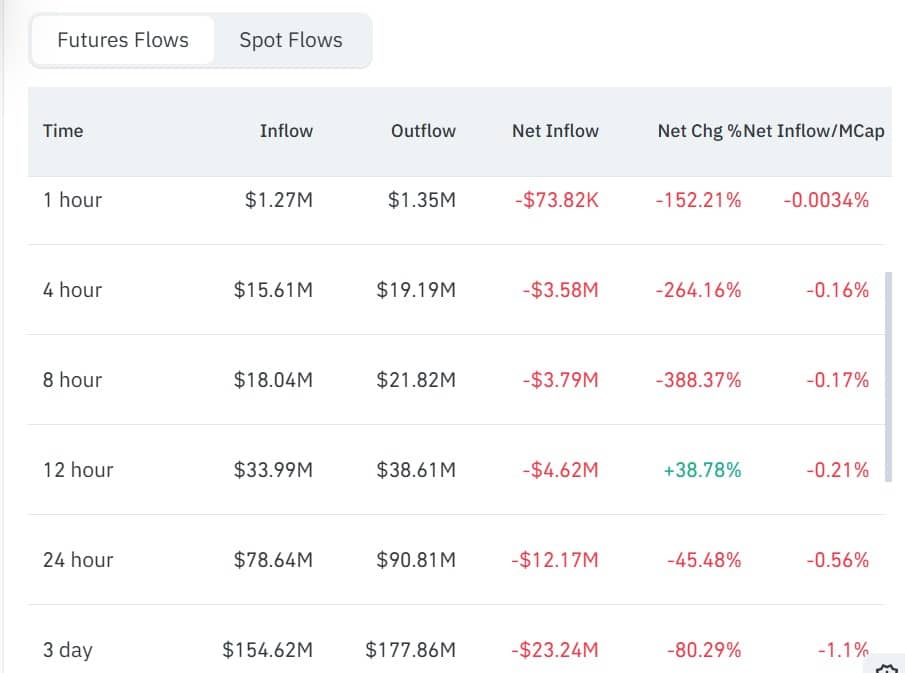
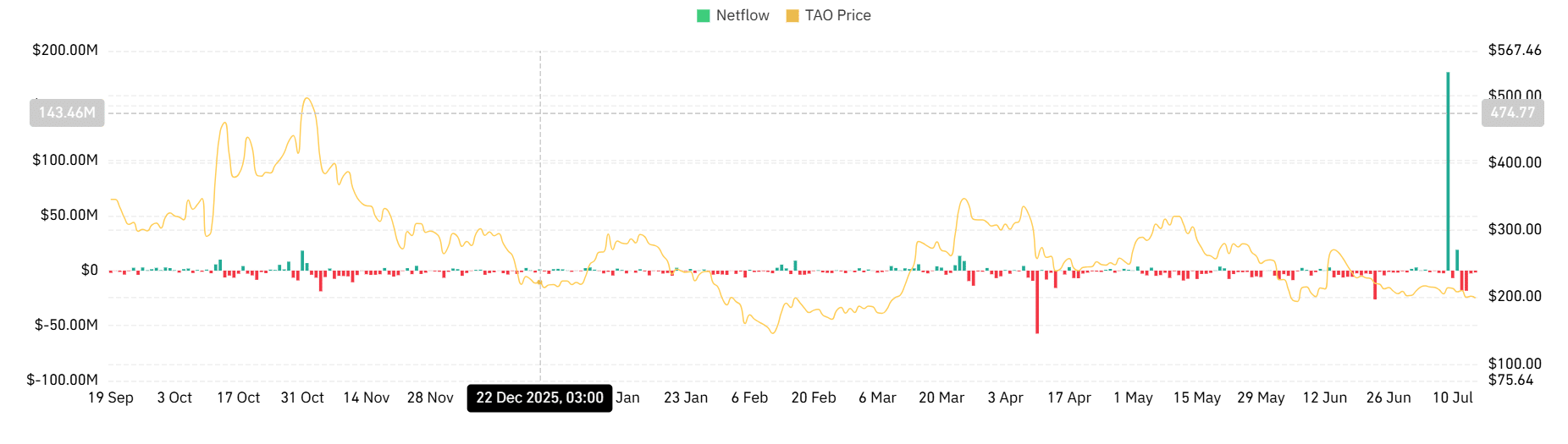
After TAO declined, derivatives traders reduced their exposure. Consequently, Futures Outflows exceeded Futures Inflows over the past 24 hours.

The altcoin recorded $90.81 million in Futures Outflows and $78.64 million in Futures Inflows.
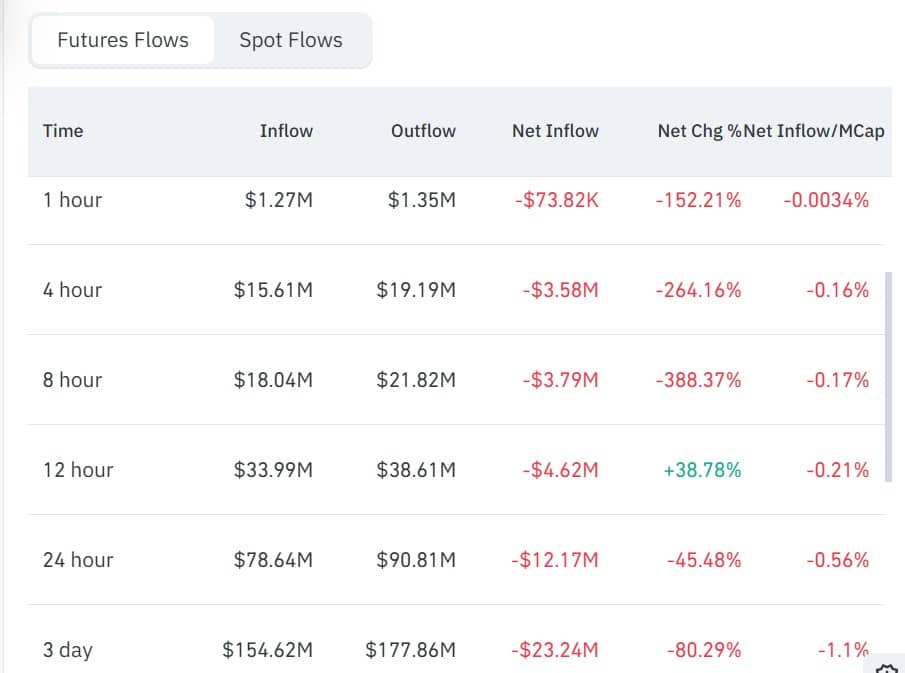
Source: CoinGlass

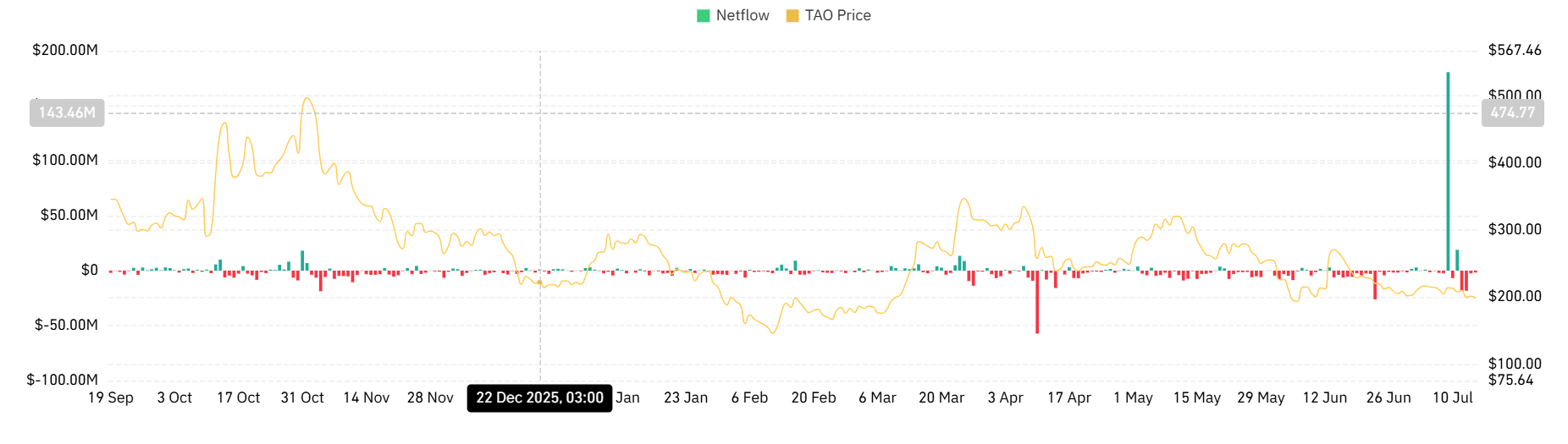
This pushed Futures Netflow down 45% to negative $12.17 million. The decline extended a three-day trend. At the same time, Open Interest fell 1.26% to $229 million.

Together, these readings suggested that traders closed positions as TAO weakened. Reduced speculative activity could keep short-term pressure on its price.

Are whales buying the dip?

Even as TAO declined, Spot market data suggested that whales remained active.

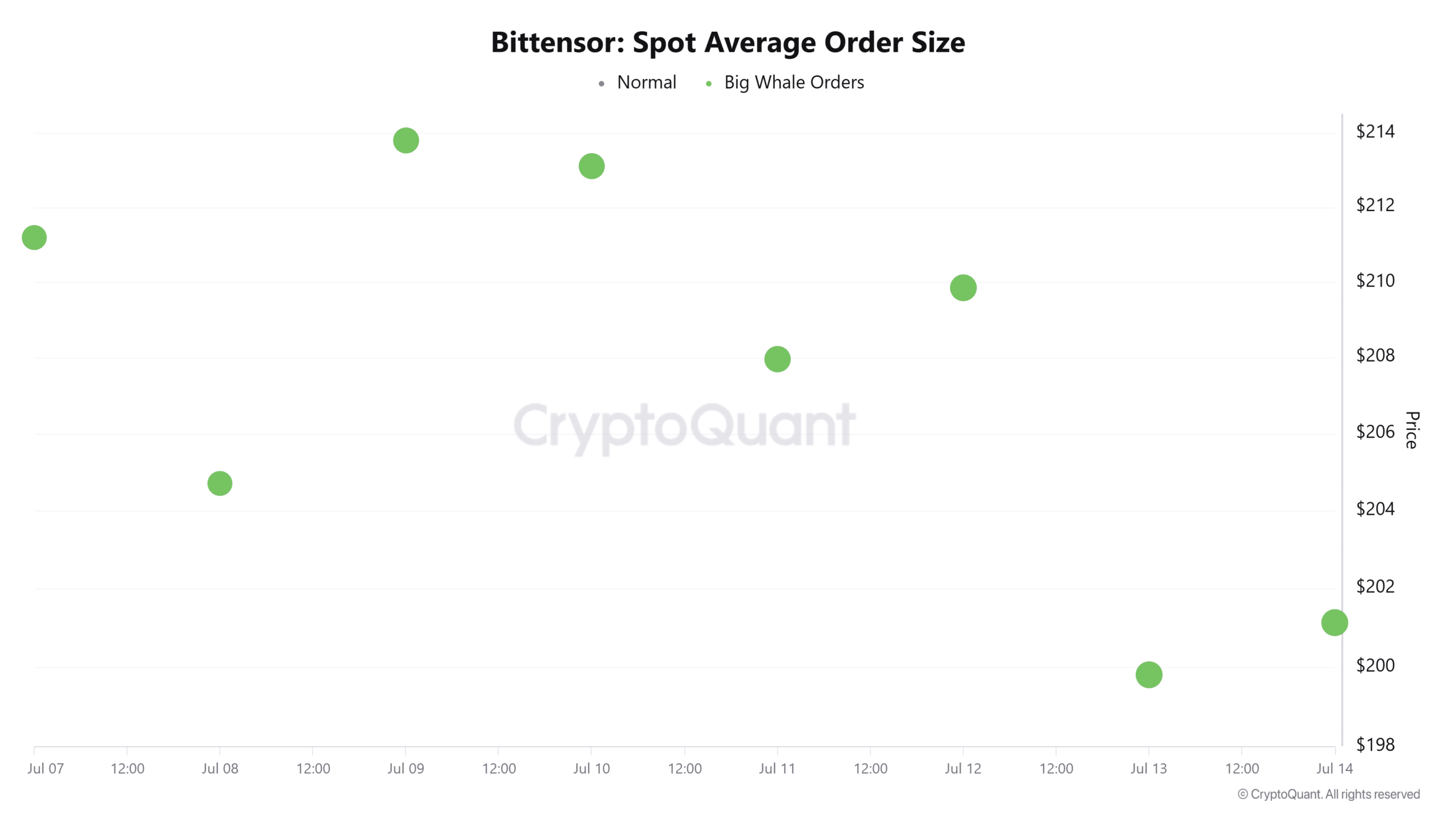
CryptoQuant’s Spot Average Order Size recorded large whale orders below $200. However, this metric alone could not confirm their direction.
Source: CryptoQuant

Spot Taker CVD provided clearer evidence. The metric remained positive for five days, suggesting that market buyers held the advantage.

On top of that, Bittensor’s Spot Netflow remained negative for four consecutive days. Spot Netflow stood at negative $1.68 million, compared with negative $2.5 million one day earlier.
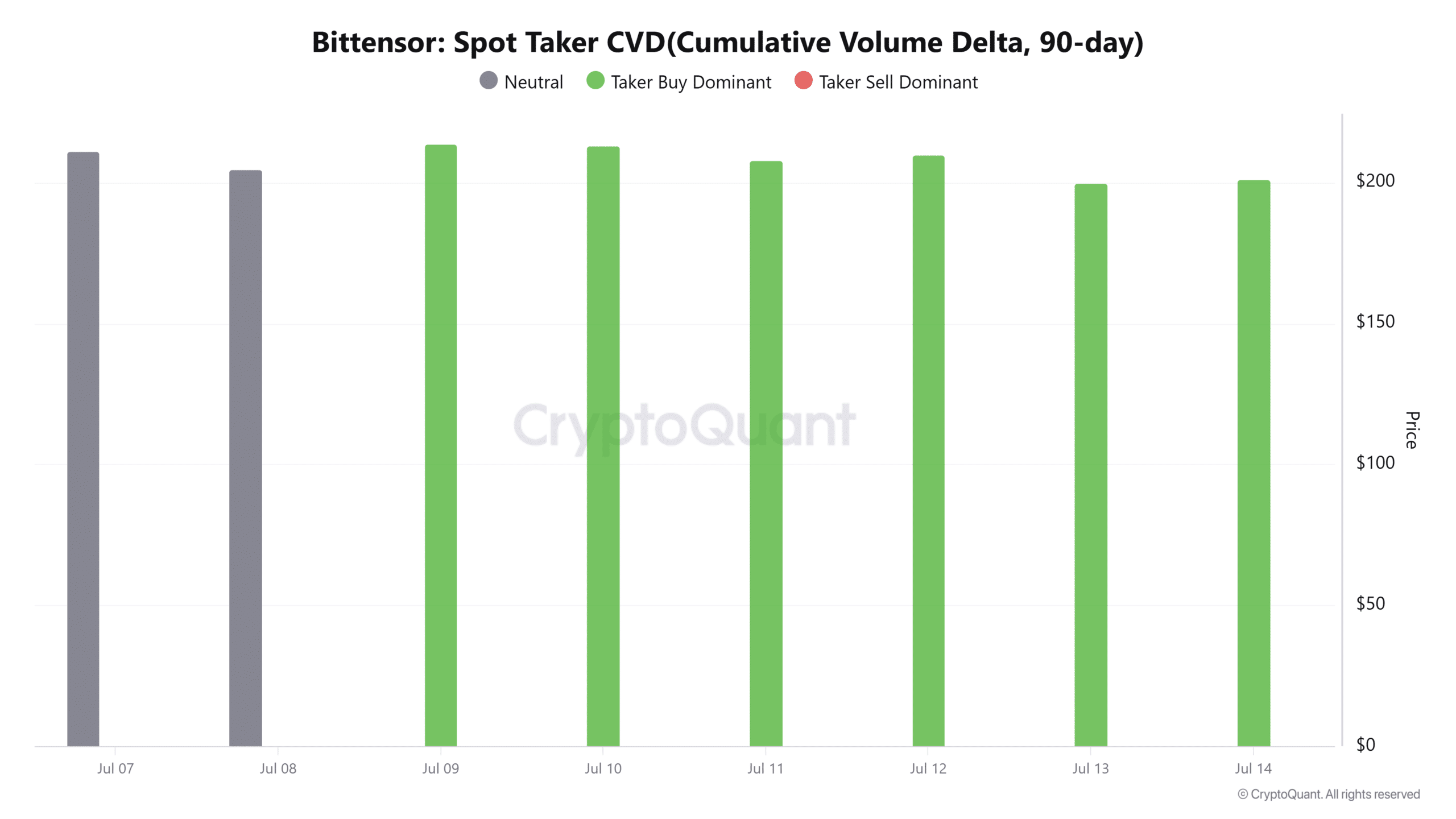
Source: CryptoQuant

Persistent negative Spot Netflow indicated that more TAO left exchanges than entered them. This trend could reflect accumulation or transfers into private custody.

Combined with positive Spot Taker CVD, the data strengthened the accumulation argument. However, it did not prove that whales caused every outflow.

Historically, stronger demand during market weakness has sometimes preceded price recoveries.
Source: CoinGlass

Can TAO reclaim $200?

Bittensor remained caught between bearish momentum and renewed Spot demand. For now, sellers appeared to retain control.

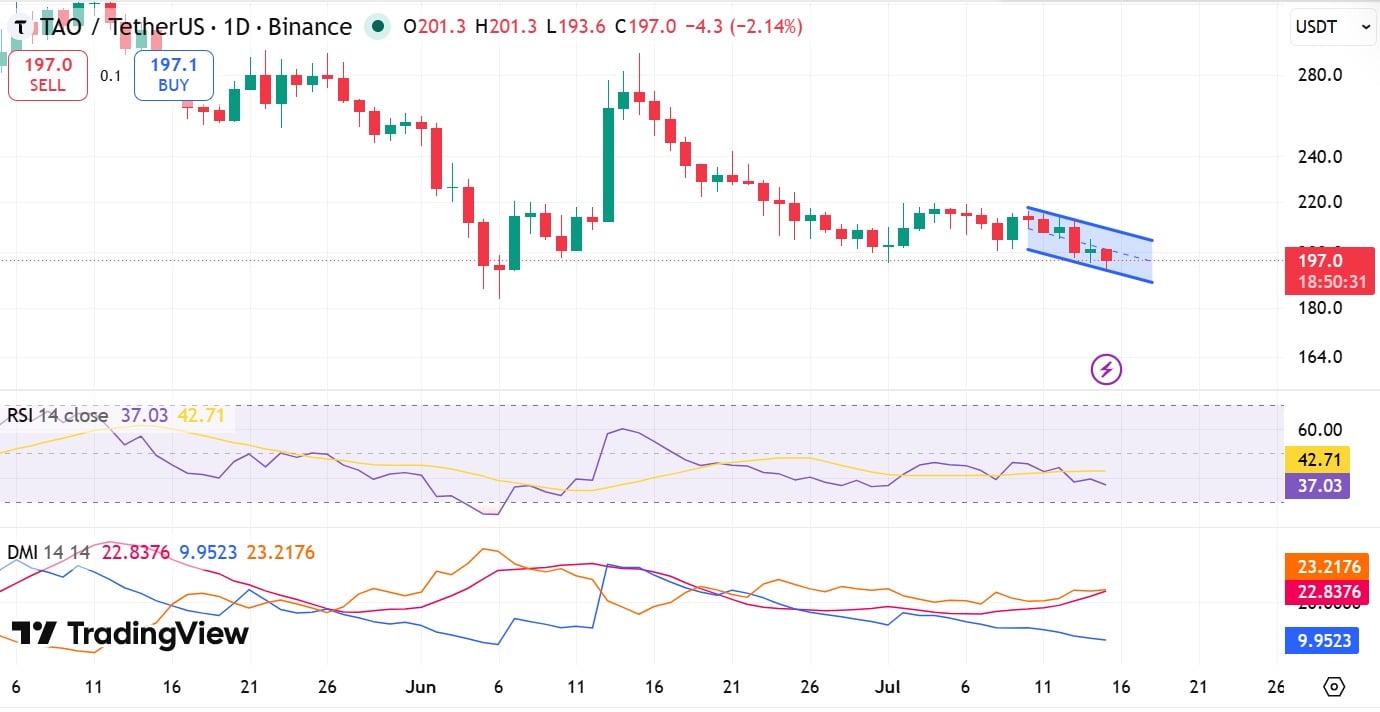
The Directional Movement Index [DMI] supported this view. The Positive Directional Indicator fell to 9.

Meanwhile, the Negative Directional Indicator rose to 22, while the Average Directional Index reached 23.
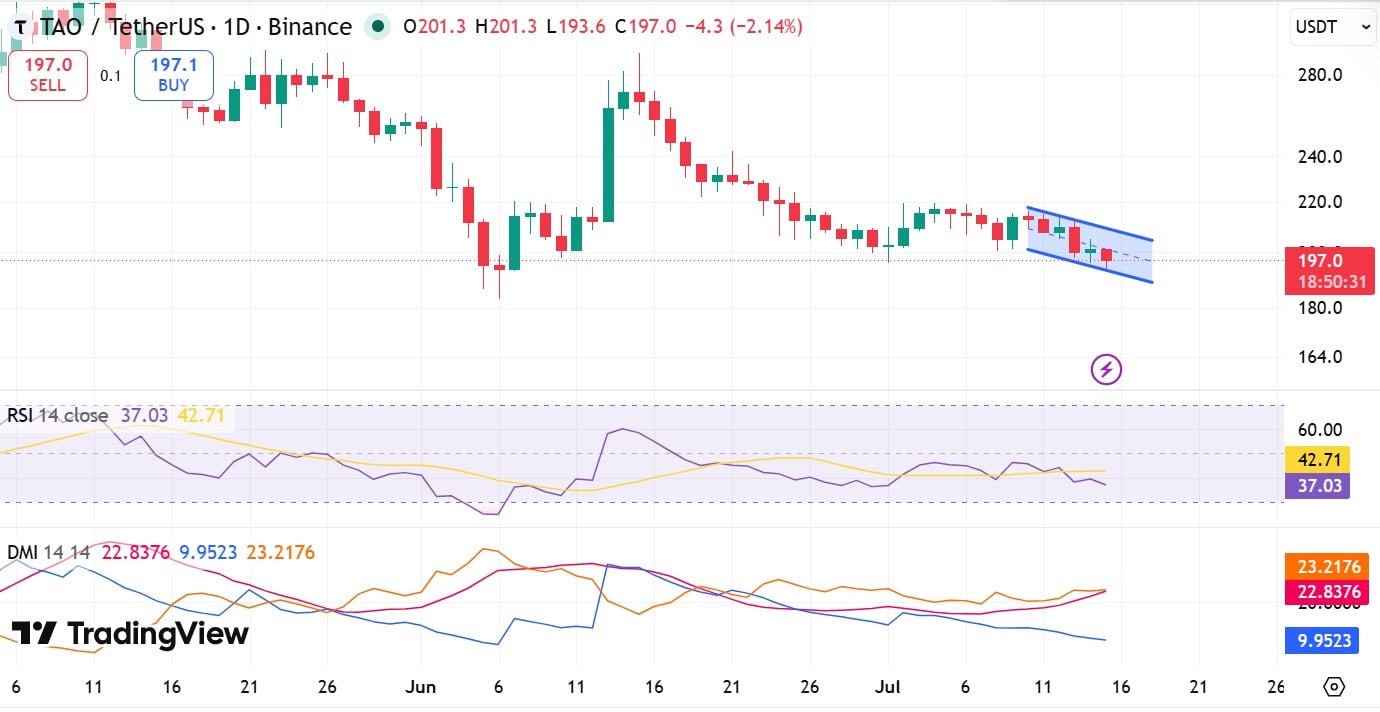
Source: TradingView

This setup suggested that bearish momentum was gaining strength. The Relative Strength Index also dropped to 37.

If selling continues, TAO could fall below $190 and test the $186 support. However, stronger Spot demand could help TAO reclaim $200. A sustained recovery may then place $216 back in focus.


Final Summary

  • TAO fell below $200 because Futures Outflows exceeded Inflows as Open Interest declined, suggesting that derivatives traders reduced exposure during the sell-off.
  • Positive Spot Taker CVD and exchange outflows suggested accumulation.

Related Questions

QWhat is the current trading price of Bittensor (TAO) according to the article, and what was the 24-hour change?

AAs of the writing of the article, TAO traded at $197 after declining 2.13% over the past 24 hours.

QWhat are the two key pieces of data from the Spot market that suggest potential accumulation of TAO by whales or buyers?

AThe two key pieces of data are: 1) A positive Spot Taker CVD for five consecutive days, indicating market buyers had an advantage. 2) A negative Spot Netflow for four consecutive days, meaning more TAO was leaving exchanges than entering, which can suggest accumulation or transfer to private custody.

QWhat does the negative Futures Netflow figure indicate about derivatives trader behavior?

AThe negative Futures Netflow of $12.17 million indicates that Futures Outflows ($90.81M) exceeded Futures Inflows ($78.64M) over the past 24 hours. This suggests derivatives traders were closing their positions and reducing their exposure as TAO's price weakened.

QBased on the technical indicators mentioned, what are the two possible price levels TAO could test next?

AThe article states that if selling continues, TAO could fall to test the $186 support level. Conversely, if stronger Spot demand emerges, it could help TAO reclaim the $200 level, with a potential further recovery target of $216.

QHow do the DMI (Directional Movement Index) readings support the author's view on market control?

AThe DMI readings show the Positive Directional Indicator falling to 9 and the Negative Directional Indicator rising to 22, with the Average Directional Index at 23. This setup suggests bearish momentum is gaining strength, leading the author to conclude that sellers appear to retain control of the market for now.

Related Reads

Token Buyback Volumes Continue to Rise, But Price Lows Keep Falling

The volume of token buybacks continues to grow, but the minimum price level is constantly declining, according to an internal memo by Bitwise CIO Matt Hogan. He argues that most crypto tokens, except Bitcoin, are undervalued as investors are unaware of the revenue now being returned to holders. He highlights the example of Hyperliquid, which has bought back and burned $1.3 billion worth of its $HYPE token. Hogan posits that tokens are beginning to trade based on revenue, similar to stocks and bonds, marking the end of an era where scaling networks provided little token utility. He links token valuation to strengthening protocol revenue, noting that Hyperliquid has earned over $800 million in the past year and spends nearly all fees on $HYPE buybacks. Following this model, protocols like Uniswap and Aave have implemented fee mechanisms to buy back and burn their own tokens. The trend has also affected base chains like Solana and Aptos, which have proposed or enacted higher fee burns. However, the memo acknowledges that reducing token supply has not reliably boosted prices. A Cryptopolitan report found many tokens with regular buybacks still underperformed the market. Even Hyperliquid's upward trend broke, and Pump.fun conducted significant buybacks near token lows. Hogan cautions that token buybacks differ from stock buybacks due to the lack of contractual claims on profits or assets, as governance rules can always be rewritten.

cryptonews.ru43m ago

Token Buyback Volumes Continue to Rise, But Price Lows Keep Falling

cryptonews.ru43m ago

NullReceiver abandons the recording address that made EtherHiding easy to detect

**Sonatype Research Labs has uncovered six malicious npm packages that retrieve command-and-control server addresses from an attacker's Ethereum wallet.** Three of the packages are legitimate, popular libraries that were compromised: `@kolbo/mcp`, `agentgui`, and `godot-kit`. The other three are purely malicious packages: `envpack-conf`, `postcss-initial-provider`, and `tailwindcss-motion-advanced`. All six deploy the same payload. The malware loader queries the Ethereum blockchain for the latest outgoing transaction from a specific wallet. It extracts bytes from the recipient field of that transaction, converts them into two IPv4 addresses, and uses these as primary and backup command-and-control servers. After connecting, it fetches, decodes, and executes a second-stage payload using `eval()` or by spawning a child process. This method, dubbed **"NullReceiver,"** is an evolution of the earlier "EtherHiding" technique. While EtherHiding hid data in transaction fields and sent funds to a fixed "burner" address (creating a monitoring point), NullReceiver sends no funds and generates unique, dynamic receiver addresses, making detection harder. OpenSourceMalware has linked this activity to the North Korean Lazarus group's "Contagious Interview" campaign. Sonatype advises developers to remove the affected package versions immediately and check their systems for signs of secondary payload execution.

cryptonews.ru45m ago

NullReceiver abandons the recording address that made EtherHiding easy to detect

cryptonews.ru45m ago

Trading

Spot
活动图片