Evaluating edgeX’s post-TGE crash: Can EDGE bulls defend $0.2950 support?

ambcryptoPublished on 2026-07-12Last updated on 2026-07-12

Abstract

EdgeX (EDGE) continues its post-Token Generation Event (TGE) price discovery, with the token price dropping 19.3% to $0.3756 amid a broader market decline in capitalization and trading volume. This reflects reduced trader activity rather than aggressive selling at lower prices. Despite the project's upgrade to the more independent StarkEx V2 infrastructure, market sentiment remains cautious. Derivatives data shows weakening conviction, with Open Interest falling 25.79% and the OI-Weighted Funding Rate nearing neutral levels. This indicates traders are closing leveraged positions instead of adding new exposure, reducing potential liquidation pressure but also signaling a lack of bullish momentum. Technically, EDGE retested support near $0.38, with $0.2950 as a critical level. A break below could target $0.2330, while reclaiming $0.50 is needed for a bullish shift. Indicators like the Parabolic SAR suggest the recovery structure is intact, but the MACD shows weakening buying strength. In summary, EDGE faces a consolidation phase with neutralized derivatives positioning and subdued participation. Sustained price recovery requires renewed demand and stabilized trader confidence.

edgeX [EDGE] remained under pressure as its post-TGE price discovery continued despite the project’s transition to the StarkEx V2 architecture. The token traded at $0.3756 at press time after falling 19.3% over the past 24 hours.

Market capitalization had also dropped 20.09% to $131.47 million, while trading volume had declined 51.79% to $31.74 million.

Those figures showed that traders reduced activity instead of chasing lower prices.

However, the ongoing infrastructure upgrade reflected a broader shift beyond a simple product update.

The move from StarkEx V1 positioned edgeX toward a more independent derivatives infrastructure with stronger self-custody and higher performance.

Even so, the market continued valuing the token cautiously as participants searched for a sustainable post-launch price.

Why did leveraged traders reduce exposure?

Derivatives traders reduced their exposure throughout the latest decline, reinforcing the weakening participation across the market.

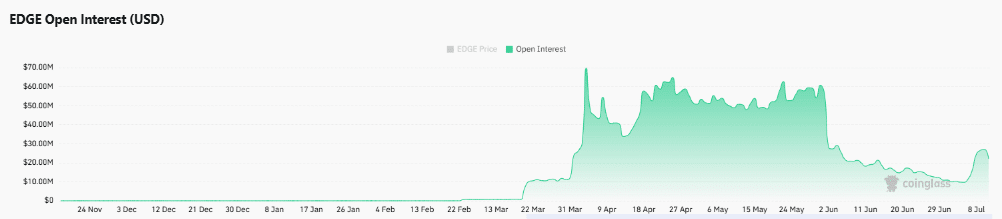
Open Interest dropped 25.79% to $20.96 million, indicating that traders closed positions instead of introducing fresh leverage during the sell-off. That behavior reflected declining speculative conviction rather than aggressive positioning in either direction.

Besides, the sharp fall in trading volume supported the same narrative because fewer participants actively entered new positions.

The combined contraction across spot activity and derivatives suggested that many traders preferred waiting for stronger confirmation before committing additional capital.

Although the decline reflected weaker confidence, it also showed that excessive leverage had gradually left the market, which could reduce liquidation pressure if buyers eventually return.
Source: CoinGlass

Can bulls defend the current support zone?

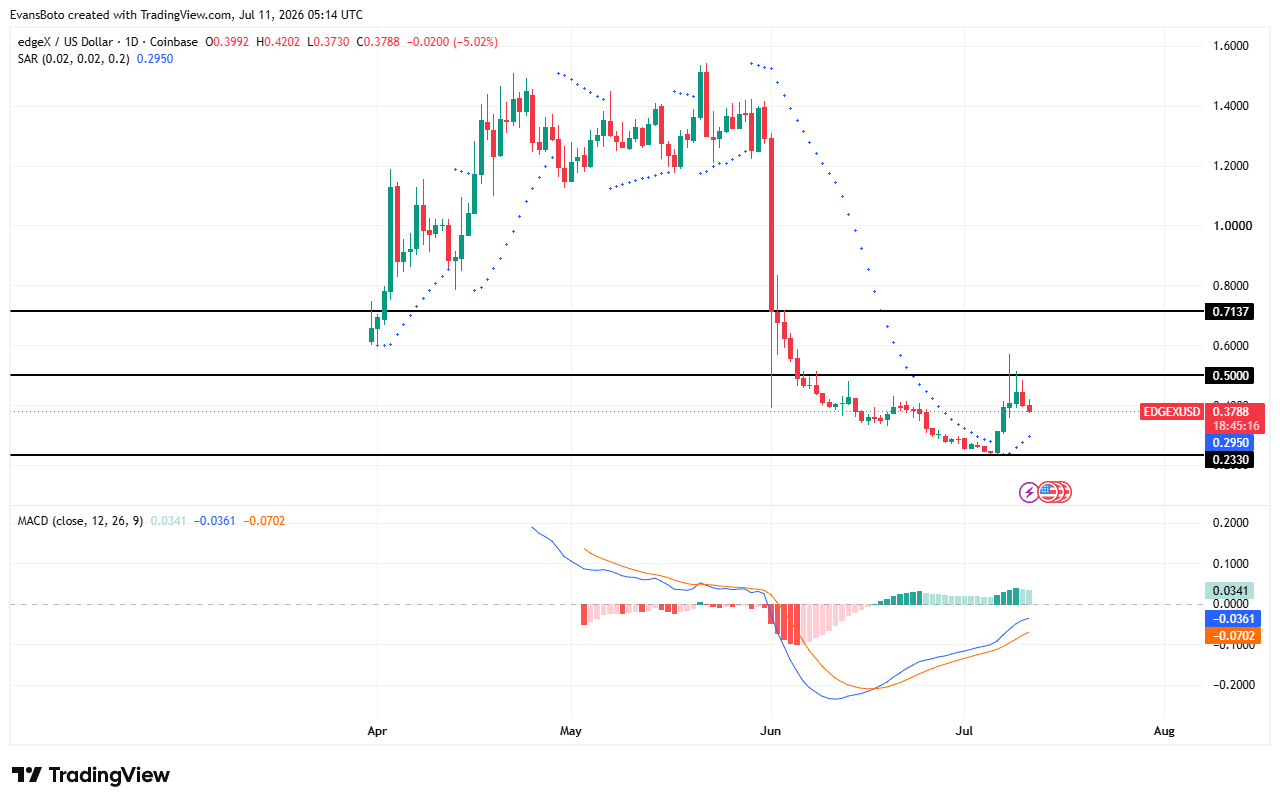
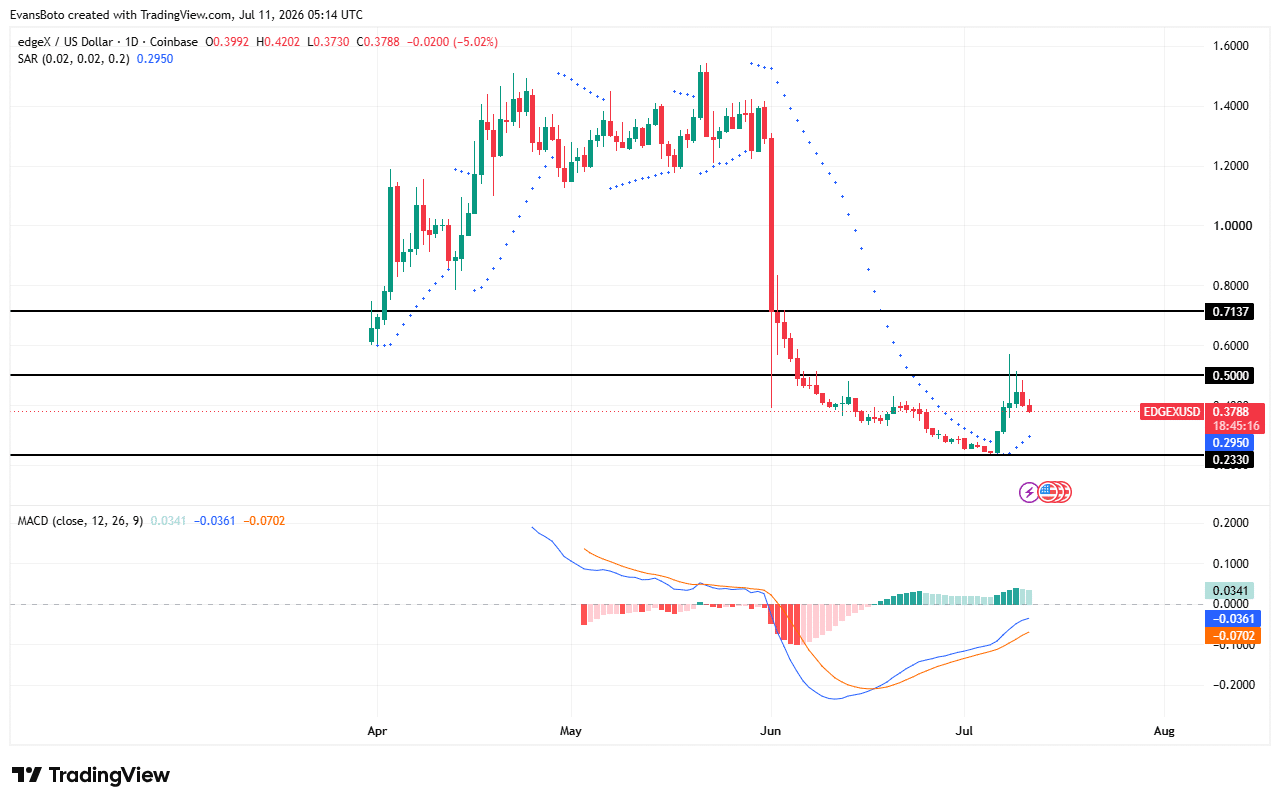
EDGE retested support after failing to sustain its recent rebound above $0.50, leaving buyers under renewed pressure.

Price pulled back toward $0.38, while $0.2950 continued serving as the nearest support level. A break beneath that area could expose $0.2330, whereas reclaiming $0.50 would place $0.7137 back into focus.

Despite the latest decline, the Parabolic SAR remained below the price, showing that the broader recovery structure had not fully broken down.

However, the MACD painted a more cautious picture. The MACD line stayed above the signal line, preserving its bullish crossover.

Even so, the histogram started shrinking while both lines flattened, indicating that buying strength had weakened following the rejection near resistance.

Accordingly, buyers needed renewed demand before the technical outlook could improve meaningfully.
Source: TradingView

Have EDGE funding rates already lost conviction?

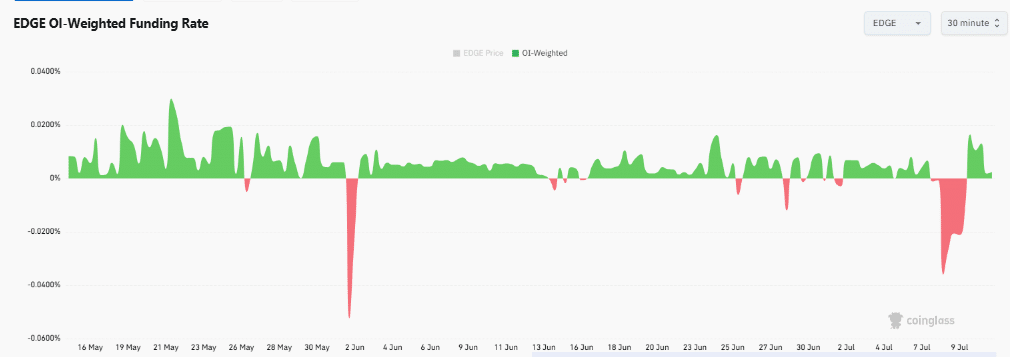
Perpetual market positioning also softened as funding conditions drifted toward neutral levels.

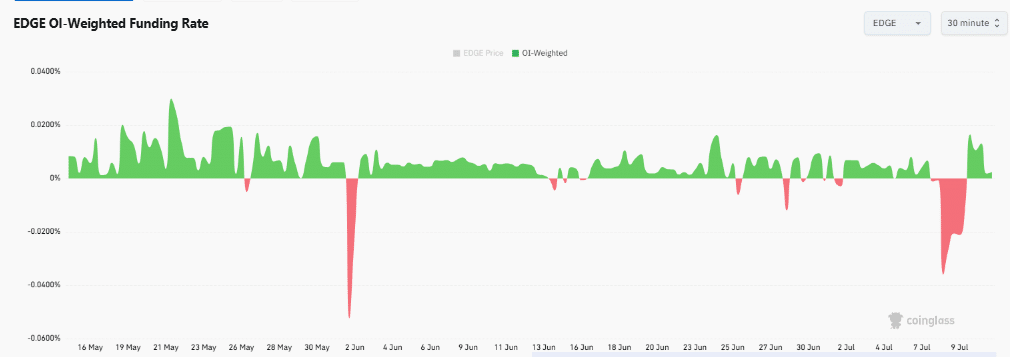
The OI-Weighted Funding Rate stood at approximately 0.0024%, showing that traders no longer paid a meaningful premium to maintain long positions.

Earlier positive readings gradually faded before reaching almost neutral territory, reflecting a balanced market instead of aggressive bullish positioning.

Additionally, the funding shift aligned with the decline in Open Interest, strengthening the view that leveraged traders reduced exposure rather than expanded it.

That combination highlighted a cooling derivatives environment after recent volatility.
Source: CoinGlass

If funding remains close to neutral while participation stabilizes, traders could regain confidence gradually.

Otherwise, another decline in participation would likely keep EDGE within its ongoing post-TGE price discovery phase.


Final Summary

  • edgeX remained in post-TGE price discovery despite continued progress toward StarkEx V2 infrastructure.
  • Falling Open Interest and neutral funding reflected weaker conviction across leveraged EDGE traders.


Trending Cryptos

Related Questions

QWhat was the percentage decline in EDGE's price over the past 24 hours according to the article?

AEDGE's price fell by 19.3% over the past 24 hours, trading at $0.3756 at press time.

QHow did Open Interest (OI) for EDGE change, and what does this indicate about trader behavior?

AOpen Interest dropped by 25.79% to $20.96 million, indicating that traders were closing positions rather than introducing new leverage during the sell-off, reflecting declining speculative conviction.

QWhat are the critical support and resistance levels mentioned for EDGE's price?

AThe nearest support level is $0.2950. A break below could expose $0.2330. Reclaiming $0.50 would place $0.7137 back into focus as a resistance level.

QWhat did the article state about the OI-Weighted Funding Rate and its implication?

AThe OI-Weighted Funding Rate stood at approximately 0.0024%, indicating traders no longer paid a meaningful premium for long positions, reflecting a more balanced and less aggressively bullish market.

QWhat broader infrastructure shift is the edgeX project undergoing, and what are its goals?

AedgeX is transitioning from StarkEx V1 to StarkEx V2 architecture. This move aims to position the project toward a more independent derivatives infrastructure with stronger self-custody and higher performance.

Related Reads

Nearly a Hundred Players Rush into Embodied Data: With 4.47 Billion Yuan in Financing in One Year, Who Can Really Make Money by 'Selling Data'?

The domestic embodied AI data industry has attracted nearly 100 players, with 70 focused on data collection and 27 on data infrastructure. In the past year, 15 independent embodied data service providers raised approximately 4.47 billion yuan. Despite this growth, the sector remains early-stage, fragmented, and faces significant challenges. Data collection methods are diverse, categorized into four main routes: teleoperation of real robots, human demonstration without a robot (using motion capture, exoskeletons, etc.), simulation synthesis, and distillation from internet videos. Most companies (43%) adopt hybrid approaches, combining multiple routes, as no single method can meet all training needs. Teleoperation alone is pursued by 31% of players, often by state-owned platforms and robot companies, while newer firms favor asset-light, no-hardware human demonstration. Independent data service providers now form the largest player group (40%), indicating the emergence of a distinct industry segment rather than just a subsidiary function for robot makers. Two-thirds of all players are "embodied-native" startups, while one-third are companies that pivoted from fields like AI data annotation, which are more prevalent in the data infrastructure layer. Current annual industry capacity is estimated at 1.6-1.8 million hours plus 70-80 million data points, with a short-term goal to increase this 15-20 fold within 1-3 years. Data collection factories are spread across 20 provinces in China, concentrated in the Yangtze River Delta, Beijing-Tianjin-Hebei, and Pearl River Delta regions. Financially, the 4.47 billion yuan raised in the past year pales compared to the 43.8 billion yuan raised by the broader embodied intelligence sector in just the first half of 2026, highlighting that data remains a less "sexy" bet for investors. The 15 funded independent providers show clear stratification: a top tier led by a unicorn (Lightwheel Intelligence, 3.1 billion yuan), a middle tier of 11 firms raising tens to hundreds of millions, and an early-stage tier of 3 companies. Sixty-nine investment institutions have participated, but none have made concentrated bets, reflecting uncertainty about viable business models. Over half of these funded companies are less than a year old, most are at pre-A or A rounds, and profitability remains largely unproven. In summary, the embodied data industry has become an independent track creating jobs and local economic activity. However, it is still nascent, with unformed consensus, unsolved problems, and unproven business models. The coming 1-2 years will be a critical validation window to see if companies can build sustainable, profitable businesses purely by "selling data."

marsbit35m ago

Nearly a Hundred Players Rush into Embodied Data: With 4.47 Billion Yuan in Financing in One Year, Who Can Really Make Money by 'Selling Data'?

marsbit35m ago

Dialogue with Multicoin Partner: The Crypto Market Has Bottomed Out, Favoring Three Cryptocurrencies in This Cycle

In a recent interview, Multicoin Capital managing partner Tushar Jain shared his views on the crypto market. He believes the market has bottomed and is at an inflection point, citing that negative news no longer causes significant price declines and application adoption continues to grow. Jain remains highly bullish on Solana, viewing it as the correct architectural choice for internet capital markets, particularly for spot and tokenized security trading. He is also positive on Hyperliquid, noting its leadership in decentralized derivatives trading. His investment approach focuses on concentrating capital in top convictions rather than equal allocation. A distinct opportunity he highlights is Zcash (ZEC), which he sees as a return to the industry's cypherpunk ethos and a potential top-five asset by market cap. For assets like Zcash without cash flows, his valuation framework is based on relative market cap ranking. Regarding investment strategy, Jain employs a "three-part" entry method to avoid timing pitfalls and emphasizes long-term "active management" over "active trading." He outlines four sources of investment edge: informational, analytical, behavioral/psychological, and structural. On portfolio management, the fund uses Bitcoin as its "cash," selling assets into Bitcoin during market euphoria to reduce beta risk and using Bitcoin to buy dips. Sales occur only if a better opportunity arises, the investment thesis breaks, or valuations become excessively overheated. While respectful of Ethereum's resilience, he questions its unclear scaling roadmap. Finally, Jain reaffirms his commitment to the thesis that blockchains will form the foundational architecture for future capital markets.

marsbit1h ago

Dialogue with Multicoin Partner: The Crypto Market Has Bottomed Out, Favoring Three Cryptocurrencies in This Cycle

marsbit1h ago

Trading

Spot

Hot Articles

Discussions

Welcome to the HTX Community. Here, you can stay informed about the latest platform developments and gain access to professional market insights. Users' opinions on the price of S (S) are presented below.

活动图片