CryptoQuant : le bitcoin pourrait chuter à 51 000 $ après avoir formé un sommet local

cryptonews.ruPublished on 2026-08-10Last updated on 2026-08-10

Abstract

Selon l'analyse de CryptoQuant, le Bitcoin pourrait approcher une formation de sommet local. La phase actuelle, interprétée comme une "quatrième vague" baissière, a atteint un premier objectif entre 62 541$ et 67 894$, avec une zone de résistance précise entre 66 317$ et 68 965$. Un scénario alternatif pourrait voir le prix monter jusqu'à 70 000$. Toutefois, après ces niveaux, le risque d'une nouvelle vague de vente est élevé, avec un objectif potentiel de baisse à environ 51 000$ (soit une baisse de 21% depuis les niveaux actuels). Les indicateurs techniques comme une divergence baissière du MACD et un RSI proche de la surachat soutiennent cette prudence. Parallèlement, les données on-chain montrent des signes potentiels de formation d'un plancher. L'activité du réseau, mesurée par la moyenne mobile exponentielle (EMA) sur 30 et 100 jours du nombre d'adresses actives, est revenue à des niveaux similaires à ceux de 2018-2019. Bien que ces indicateurs aient récemment rebondi, ils ne constituent pas en eux-mêmes un signal d'achat fort selon CryptoQuant. Des niveaux de résistance clés sont identifiés à 67 000$ et 72 000$, correspondant au prix de revient des détenteurs récents. Tant que le Bitcoin reste en dessous, la pression vendeuse persiste. La firme maintient donc une vision prudente et estime que des points d'entrée cycliques plus attractifs pourraient se présenter près des 51 000$. Le niveau de 58 535$ reste un support crucial, dont une rupture invaliderait l'hypothèse ...

Les analystes de CryptoQuant estiment que la première cryptomonnaie est en phase de formation d'un sommet local, après lequel le risque d'une nouvelle vente massive reste élevé. Parallèlement, l'activité sur le réseau est revenue aux niveaux de 2018-2019, ce qui pourrait correspondre à la structure de formation d'un plancher de marché, mais ne constitue pas un signal d'achat autonome.

Le bitcoin s'approche de la zone de sommet potentiel

Selon l'évaluation de CryptoQuant, le mouvement actuel du bitcoin pourrait être la « vague iv » dans le cadre d'une tendance baissière plus large. Elle se caractérise par un faible élan, des schémas de prix complexes et des mouvements prolongés, indique la déclaration.

Le premier objectif de cette vague, dans la fourchette de 62 541 $ à 67 894 $, a déjà été atteint. En même temps, les analystes mettent en évidence une zone plus précise de 66 317 $ à 68 965 $, où un sommet local pourrait se former. Un scénario alternatif avec une poursuite de la hausse jusqu'à 70 000 $ n'est pas exclu.

Après avoir atteint ces niveaux, le risque de passage à la prochaine vague de ventes augmentera. CryptoQuant cite comme signaux négatifs supplémentaires la divergence baissière entre le prix et le MACD, l'approche du RSI vers la zone de surachat et la contraction des volumes de négociation au cours du rallye de six semaines à partir du 1er juillet.

En cas de poursuite du mouvement baissier, l'objectif suivant pourrait être le niveau de 51 336 $, soit environ 21 % en dessous des valeurs actuelles. Si le bitcoin monte d'abord à 70 000 $, le potentiel de baisse est estimé à environ 26 %.

L'activité du réseau est revenue aux niveaux de 2018-2019

Parallèlement, les données on-chain montrent des signes de formation potentielle d'un plancher. La moyenne mobile exponentielle (MME) à 30 jours et à 100 jours du nombre d'adresses bitcoin actives est récemment tombée à des niveaux proches de ceux de 2018-2019, ont noté les experts.

Au 19 juillet, la MME à 30 jours était de 609 688 adresses contre 570 710 en juillet 2018. La MME à 100 jours a atteint 621 957 le 27 juillet contre 605 433 en janvier 2019.
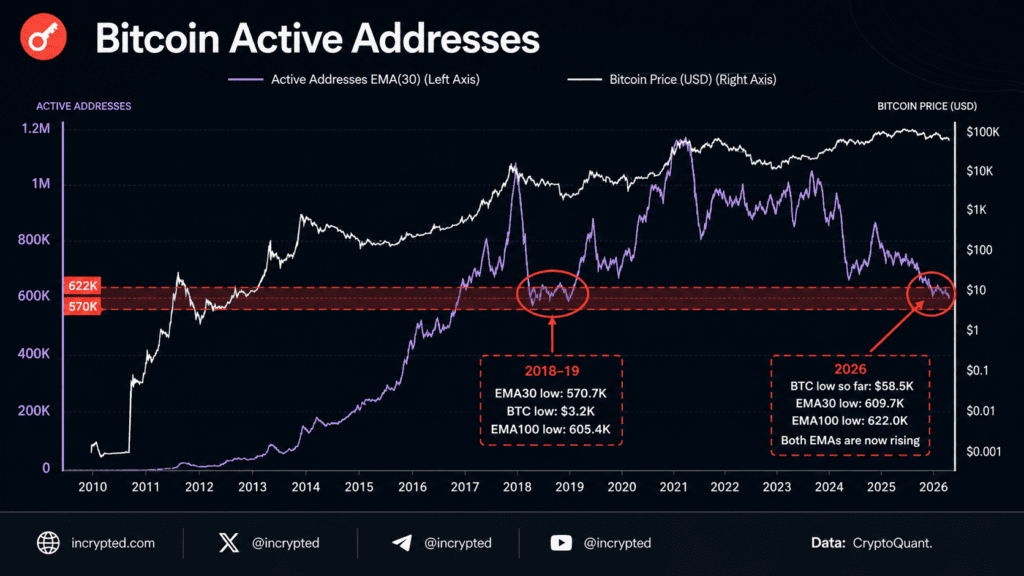
Activité sur le réseau Bitcoin. Infographie : Incrypted.

Cependant, les deux indicateurs se sont redressés après les minima de juillet. Au 8 août, ils s'établissaient respectivement à 664 764 et 640 603 adresses. Le bitcoin reste également au-dessus du creux de juin à 58 535 $, ont souligné les analystes.

Selon CryptoQuant, cela correspond à l'hypothèse de formation d'un plancher, mais les données historiques ne la confirment pas définitivement et ne permettent pas de déterminer le calendrier d'un éventuel retournement.

Les niveaux clés restent 609 688 et 621 957 pour les MME à 30 jours et 100 jours respectivement, ainsi que 58 535 $ pour le prix du bitcoin. Une négociation en dessous de ce dernier niveau invaliderait l'hypothèse actuelle de formation d'un plancher.

67 000 $ et 72 000 $ restent des résistances clés

Un facteur de pression supplémentaire est le prix de revient des pièces des acheteurs récents. Selon les bandes d'âge du prix réalisé UTXO, le prix réalisé des pièces âgées d'un à trois mois se situe autour de 67 000 $, et celui des pièces de trois à six mois autour de 72 000 $, indique le rapport.
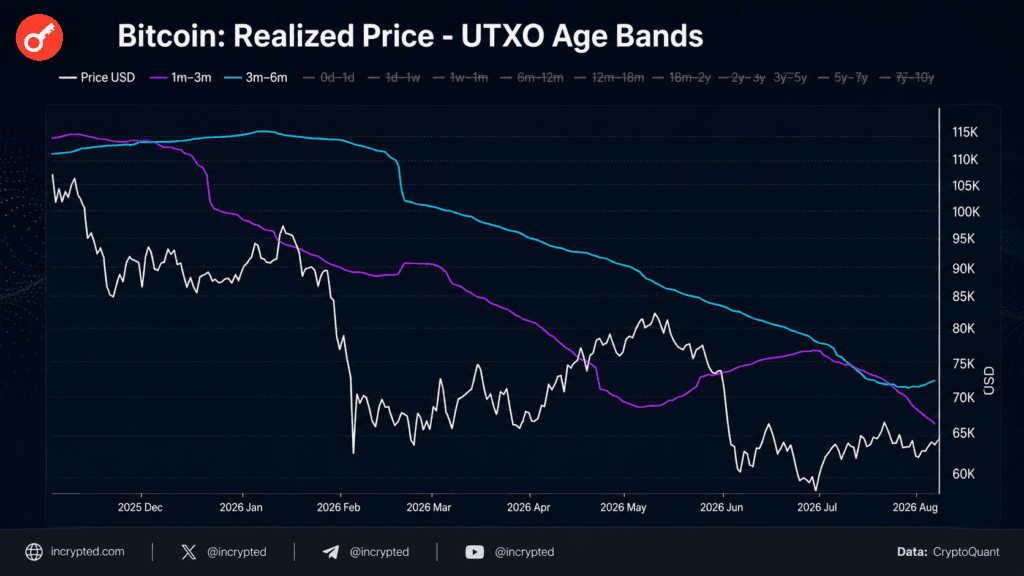
Prix réalisé des détenteurs de bitcoin âgés d'un à trois mois. Infographie : Incrypted.

Avec un prix actuel d'environ 65 000 $, les deux cohortes se trouvent dans la zone de pertes non réalisées. Par conséquent, le niveau de 67 000 $ pourrait constituer une première résistance : les détenteurs de pièces récemment acquises pourraient utiliser le retour au prix de revient pour réduire leurs positions.

Le niveau de 72 000 $ est le seuil suivant. Le dépassement de ce niveau signifierait que le marché absorbe l'offre potentielle des acheteurs récents et renforcerait le scénario de reprise.

Tant que le bitcoin reste en dessous de ces niveaux, CryptoQuant maintient un pronostic prudent et ne recommande pas de considérer la situation actuelle comme un signal d'achats importants. Les analystes voient des points d'entrée cycliques plus solides autour de 51 000 $.

Rappelons qu'auparavant, CryptoQuant avait désigné le niveau de 70 000 $ comme celui qui déterminerait l'avenir du bitcoin.

end-content

Trending Cryptos

Related Questions

QSelon CryptoQuant, quel est le principal niveau de support et pourquoi est-il crucial pour l'hypothèse de formation d'un plancher ?

ALe niveau de support clé est de 58 535 $. Bitcoin doit rester au-dessus de ce niveau pour valider l'hypothèse de formation d'un plancher. Si le cours chute en dessous, cette hypothèse serait annulée.

QQuels sont les deux niveaux de résistance clés identifiés par CryptoQuant et pourquoi sont-ils importants ?

ALes deux niveaux de résistance clés sont 67 000 $ et 72 000 $. Ils correspondent au prix de revient (prix réalisé) des détenteurs de bitcoins achetés il y a respectivement 1-3 mois et 3-6 mois. Ces niveaux pourraient inciter les détenteurs récents à vendre pour équilibrer leurs positions, créant ainsi une pression vendeuse.

QQuelle est l'analyse d'onde d'Elliott proposée par CryptoQuant pour le mouvement actuel du bitcoin et quelle est son implication ?

ACryptoQuant estime que le mouvement actuel du bitcoin pourrait être la 'vague iv' au sein d'une tendance baissière plus large. Cette phase est caractérisée par un faible élan, des schémas de prix complexes et des mouvements prolongés. Elle suggère qu'une correction (vague v) pourrait suivre, avec un objectif potentiel aux alentours de 51 336 $.

QQue révèlent les indicateurs on-chain sur l'activité du réseau Bitcoin selon l'article ?

ALes données on-chain montrent que la moyenne mobile exponentielle (EMA) sur 30 jours et 100 jours du nombre d'adresses Bitcoin actives est récemment revenue à des niveaux similaires à ceux de 2018-2019, ce qui pourrait indiquer une phase de consolidation ou de formation d'un plancher. Bien qu'ayant rebondi depuis, ces indicateurs ne sont pas considérés comme des signaux d'achat autonomes.

QPourquoi CryptoQuant adopte-t-il une position prudente et ne recommande-t-il pas de grands achats actuellement ?

ACryptoQuant reste prudent car le bitcoin évolue sous les résistances clés de 67 000 $ et 72 000 $. Plusieurs signaux techniques négatifs sont présents (divergence baissière, RSI proche de la surachat, volumes en baisse). L'analyse suggère que des points d'entrée cycliques plus solides pourraient se situer près du niveau des 51 000 $, si le scénario baissier se confirme.

Related Reads

Crypto.com and Trump Media "Break Up": $6.42 Billion Vault Plan Fails, CRO Loses Its Largest Backstop Buyer

Crypto.com, Trump Media (DJT), and Yorkville Acquisition Corp. have officially terminated their planned $64.2 billion merger to create the "Trump Media Group CRO Strategy," a publicly-listed CRO treasury company. Announced in August 2025 during the peak of Digital Asset Treasury (DAT) hype, the deal was promoted as a massive vote of confidence, with Crypto.com's CEO Kris Marszalek once stating the entity would "forever" buy CRO. The termination, citing changing market conditions and business priorities, also ends related plans for ETF services and integrating a prediction market into Truth Social. Following the news, CRO's price fell below $0.05, hitting its lowest point since October 2023. The token is down approximately 95% from its 2021 all-time high. The collapse of this high-profile deal raises critical questions about the DAT model, suggesting it creates artificial, unsustainable demand rather than being driven by genuine token utility or adoption. This sentiment is reinforced by recent reports that Strategy, the largest Bitcoin treasury company, has been selling BTC, breaking its "never sell" narrative. For CRO holders, the failed merger adds to existing concerns, including recent reductions in Crypto.com card benefits and executive departures, forcing a broader reassessment of the exchange's fundamentals beyond a single abandoned transaction.

marsbit3m ago

Crypto.com and Trump Media "Break Up": $6.42 Billion Vault Plan Fails, CRO Loses Its Largest Backstop Buyer

marsbit3m ago

Hash Global Research Report: Bitcoin Hasn't Risen Yet, Why Are We Starting to Think the Bear Market Might Be Over?

Hash Global Research Report: Why We Think the Bear Market Might Be Ending Even Before Bitcoin Rises Over the past six months, AI has dominated market attention, causing a significant shakeout in crypto. Bitcoin has tested the $58-60K support three times since February, with volatility hitting multi-year lows. Despite stagnant prices, key underlying dynamics are shifting. The forces that drove the market down are weakening: macro tightening fears are easing as US inflation and jobs data cool, the perceived systemic risk from large holders like MicroStrategy selling is diminishing as they shore up finances, and institutional outflows have stopped. Simultaneously, on-chain data shows a rare concentration of over 240,000 BTC (approx. 12% of supply) accumulated in the $61-65K range, forming a new, consolidated base reminiscent of historical bottoms. Meanwhile, the AI trade is cooling, potentially redirecting capital towards undervalued crypto assets, as seen in July's relative outperformance. The current phase, where AI money hesitates and crypto veterans await a final dip, creates a "no-man's-land" investment opportunity—a potential entry point before a new consensus forms. While a definitive upturn isn't guaranteed, the confluence of weakening bearish pressures, improved on-chain structure, and a possible capital rotation suggests the window for positioning for the next cycle is opening.

marsbit13m ago

Hash Global Research Report: Bitcoin Hasn't Risen Yet, Why Are We Starting to Think the Bear Market Might Be Over?

marsbit13m ago

Explosion in Deep Sea Robots, the Hardest Series A Round Emerges

Deep-sea robotics startup Deepsea Zhiren has secured over 5 billion yuan in its Series A funding, a landmark deal backed by prominent investors including GGV Capital, Dachen Capital, Genesis Capital, Everbright Capital, China Life Insurance Investment, CETC Investment, and the energy tech fund managed by Cathay Capital with TotalEnergies as the cornerstone LP. Existing investors also participated significantly. The company, founded by industry veteran Ma Yiming, specializes in developing heavy-duty work-class ROVs for extreme deep-sea environments up to 6,000 meters, used in oil and gas, offshore wind, and subsea cable operations. Its product line includes models like "Taurus" (1,000m), "Phoenix 600" (3,000m), and "Singularity" (6,000m). A key achievement is securing multi-million dollar orders from UAE's telecom giant Etisalat, marking a breakthrough for Chinese-made deep-sea robotics in the international market. Deepsea Zhiren differentiates itself through full-stack in-house R&D—from pressure-resistant structures to control systems and AI—and a modular hardware approach. It has built a comprehensive internal standard system aligned with top global offshore specifications. The company is now advancing its "Deep Matrix" initiative, an unmanned, AI-powered, multi-robot cluster system designed for permanent seabed operations. This system aims to drastically reduce reliance on support vessels and human operators, potentially cutting costs in offshore oil field operations by billions over their lifecycle. The funding round signals strong market confidence in the deep-sea tech sector, recently highlighted in China's national policy. With the global subsea services market valued at around 1.5 trillion yuan and growing over 20% annually, Deepsea Zhiren aims to redefine deep-sea development through integrated hardware and embodied AI systems, positioning itself as a global pioneer in ocean robotics.

marsbit41m ago

Explosion in Deep Sea Robots, the Hardest Series A Round Emerges

marsbit41m ago

Trading

Spot

Hot Articles

What is $BITCOIN

DIGITAL GOLD ($BITCOIN): A Comprehensive Analysis Introduction to DIGITAL GOLD ($BITCOIN) DIGITAL GOLD ($BITCOIN) is a blockchain-based project operating on the Solana network, which aims to combine the characteristics of traditional precious metals with the innovation of decentralized technologies. While it shares a name with Bitcoin, often referred to as “digital gold” due to its perception as a store of value, DIGITAL GOLD is a separate token designed to create a unique ecosystem within the Web3 landscape. Its goal is to position itself as a viable alternative digital asset, although specifics regarding its applications and functionalities are still developing. What is DIGITAL GOLD ($BITCOIN)? DIGITAL GOLD ($BITCOIN) is a cryptocurrency token explicitly designed for use on the Solana blockchain. In contrast to Bitcoin, which provides a widely recognized value storage role, this token appears to focus on broader applications and characteristics. Notable aspects include: Blockchain Infrastructure: The token is built on the Solana blockchain, known for its capacity to handle high-speed and low-cost transactions. Supply Dynamics: DIGITAL GOLD has a maximum supply capped at 100 quadrillion tokens (100P $BITCOIN), although details regarding its circulating supply are currently undisclosed. Utility: While precise functionalities are not explicitly outlined, there are indications that the token could be utilized for various applications, potentially involving decentralized applications (dApps) or asset tokenization strategies. Who is the Creator of DIGITAL GOLD ($BITCOIN)? At present, the identity of the creators and development team behind DIGITAL GOLD ($BITCOIN) remains unknown. This situation is typical among many innovative projects within the blockchain space, particularly those aligning with decentralized finance and meme coin phenomena. While such anonymity may foster a community-driven culture, it intensifies concerns about governance and accountability. Who are the Investors of DIGITAL GOLD ($BITCOIN)? The available information indicates that DIGITAL GOLD ($BITCOIN) does not have any known institutional backers or prominent venture capital investments. The project seems to operate on a peer-to-peer model focused on community support and adoption rather than traditional funding routes. Its activity and liquidity are primarily situated on decentralized exchanges (DEXs), such as PumpSwap, rather than established centralized trading platforms, further highlighting its grassroots approach. How DIGITAL GOLD ($BITCOIN) Works The operational mechanics of DIGITAL GOLD ($BITCOIN) can be elaborated on based on its blockchain design and network attributes: Consensus Mechanism: By leveraging Solana’s unique proof-of-history (PoH) combined with a proof-of-stake (PoS) model, the project ensures efficient transaction validation contributing to the network's high performance. Tokenomics: While specific deflationary mechanisms have not been extensively detailed, the vast maximum token supply implies that it may cater to microtransactions or niche use cases that are still to be defined. Interoperability: There exists the potential for integration with Solana’s broader ecosystem, including various decentralized finance (DeFi) platforms. However, the details regarding specific integrations remain unspecified. Timeline of Key Events Here is a timeline that highlights significant milestones concerning DIGITAL GOLD ($BITCOIN): 2023: The initial deployment of the token occurs on the Solana blockchain, marked by its contract address. 2024: DIGITAL GOLD gains visibility as it becomes available for trading on decentralized exchanges like PumpSwap, allowing users to trade it against SOL. 2025: The project witnesses sporadic trading activity and potential interest in community-led engagements, although no noteworthy partnerships or technical advancements have been documented as of yet. Critical Analysis Strengths Scalability: The underlying Solana infrastructure supports high transaction volumes, which could enhance the utility of $BITCOIN in various transaction scenarios. Accessibility: The potential low trading price per token could attract retail investors, facilitating wider participation due to fractional ownership opportunities. Risks Lack of Transparency: The absence of publicly known backers, developers, or an audit process may yield skepticism regarding the project's sustainability and trustworthiness. Market Volatility: The trading activity is heavily reliant on speculative behavior, which can result in significant price volatility and uncertainty for investors. Conclusion DIGITAL GOLD ($BITCOIN) emerges as an intriguing yet ambiguous project within the rapidly evolving Solana ecosystem. While it attempts to leverage the “digital gold” narrative, its departure from Bitcoin's established role as a store of value underscores the need for a clearer differentiation of its intended utility and governance structure. Future acceptance and adoption will likely depend on addressing the current opacity and defining its operational and economic strategies more explicitly. Note: This report encompasses synthesised information available as of October 2023, and developments may have transpired beyond the research period.

1.8k Total ViewsPublished 2025.05.13Updated 2025.05.13

What is $BITCOIN

Discussions

Welcome to the HTX Community. Here, you can stay informed about the latest platform developments and gain access to professional market insights. Users' opinions on the price of BTC (BTC) are presented below.

活动图片