S&P Welcomes Top Exchange’s Native Token To Five Key Crypto Indices

bitcoinistPublished on 2025-12-05Last updated on 2025-12-05

Abstract

European exchange WhiteBIT announced the inclusion of its native token in major digital asset benchmarks by leading global provider of...

Trusted Editorial content, reviewed by leading industry experts and seasoned editors. Ad Disclosure

European exchange WhiteBIT announced the inclusion of its native token in major digital asset benchmarks by leading global provider of financial market indices, S&P Dow Jones Indices, marking a significant step for the platform and the region’s crypto infrastructure sector.

WhiteBIT Included In Major Crypto Indices

On Thursday, top crypto exchange WhiteBIT announced that its token, WBT, has been added to the S&P Cryptocurrency Broad Digital Market (BDM) Index, curated by S&P Dow Jones Indices (DJI).

The S&P BDM Index is designed to track the performance of crypto assets that meet strict institutional criteria, including liquidity, market capitalization, governance, transparency, and risk controls, and are listed on recognized open digital exchanges.

This marks an important milestone for both WhiteBIT and the broader fintech landscape in Central and Eastern Europe, the exchange noted, as it reinforces “the platform’s growing role in the global crypto economy” and highlights the industry’s move toward regulated, infrastructure-level players.

In a statement, Volodymyr Nosov, CEO of WhiteBIT, affirmed that “being recognized by S&P DJI is more than an index inclusion — it signals that crypto infrastructure from our region has reached global institutional standards.”

The announcement also revealed that WBT was added to the other four S&P Dow Jones digital-asset indices, including the S&P Cryptocurrency Broad Digital Asset (BDA) Index, S&P Cryptocurrency Financials Index, S&P Cryptocurrency LargeCap Ex-MegaCap Index, and the S&P Cryptocurrency LargeCap Index.

Notably, index providers have been expanding coverage beyond protocol-layer tokens as the industry matures, acknowledging the systemic role of exchanges and financial infrastructure platforms, positioning these companies within the global map of institutional-grade digital asset providers.

The exchange underscored that the classifications require a remarkable record of liquidity stability, transparent price formation, and consistent market cap behavior. “This is a turning point not only for our company but also for the evolution of compliant crypto services worldwide,” Nosov continued.

WhiteBIT’s Expansion And WBT’s Momentum

The S&P index inclusions follow a strong market performance from WBT, which rallied around 50% over the last three months, despite recent market volatility that sent many leading tokens to multi-month lows in the past few weeks.

In mid-November, the altcoin reached an all-time high (ATH) of $62.96, fueled by last month’s positive developments. As reported by Bitcoinist, WhiteBIT unveiled its entry into the Argentine and Brazilian markets, building on its expansion to Australia, Croatia, Italy, and Kazakhstan.

The move is expected to integrate local fiat providers and add support for local currencies, aiming to further enhance accessibility and convenience for domestic users in the two largest countries in South America.

Moreover, the exchange signed a strategic cooperation agreement with Durrah AlFodah Holding, represented by His Royal Highness Prince Naif Bin Abdullah Bin Saud Bin Abdulaziz Al Saud, to drive the Kingdom’s development in blockchain technology, digital finance, and data infrastructure.

Under the strategic agreement, WhiteBIT is set to provide technological expertise and infrastructure design. Meanwhile, Durrah AlFodah will facilitate the exchange’s market entry, regulatory engagement, and partnership development across Saudi Arabia.

Now, being part of S&P’s indices offers WBT a clear benchmark, the announcement added, facilitating its use in future financial products and long-term investment strategies.

This expanded representation marks an important shift for WBT: from a utility token into a component integrated into global benchmark structures used by investment firms, ETF/ETN designers, and quantitative research platforms. Its presence in multiple institutional models means that WBT is now incorporated into the analytical frameworks that guide long-term allocation strategies, diversified exposure construction, and risk-adjusted portfolio modelling.

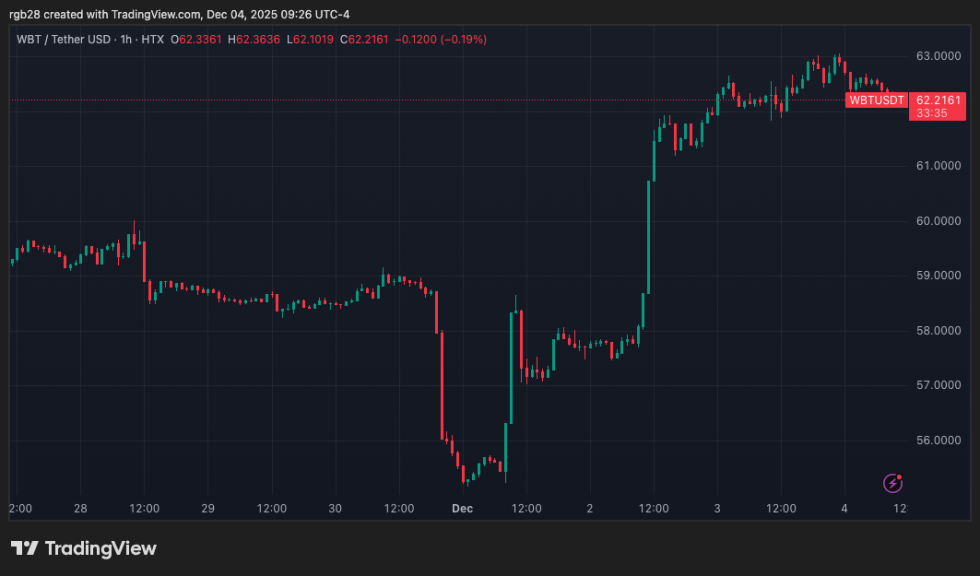
In the late hours of December 3, WBT rallied to a new ATH of $63.05 before stabilizing around the $62 mark, according to CoinGecko data. This represents a 14.5% increase from the recent lows and a 9% surge in the weekly timeframe.
crypto, WBT, WBTUSDT

WBT trades at $62.21 in the one-week chart. Source: WBTUSDT on TradingView
Featured Image from Unsplash.com, Chart from TradingView.com
Editorial Process for bitcoinist is centered on delivering thoroughly researched, accurate, and unbiased content. We uphold strict sourcing standards, and each page undergoes diligent review by our team of top technology experts and seasoned editors. This process ensures the integrity, relevance, and value of our content for our readers.

Rubmar is a crypto enthusiast who likes learning and improving constantly. She enjoys reporting on the latest news and developments in the crypto industry. Rubmar also enjoys scrapbooking, crafting, simulation games, and watching football.

Trending Cryptos

Related Reads

Apple Sues OpenAI Sparking Feud, Musk Slams Altman for Fraud, Altman Retorts with 'Space Data Center' Boast

Apple Sues OpenAI as Musk-Altman Feud Escalates The public feud between Elon Musk and OpenAI CEO Sam Altman intensified, coinciding with their respective AI companies launching flagship models in the same week, highlighting fierce competition. On July 11, Musk posted on X, accusing Altman of taking "fraud to the next level" regarding OpenAI's commercial practices. Altman fired back, sarcastically suggesting Musk was the one selling "short-term space datacenter" concepts to public market investors. Musk countered with allegations that Altman "stole an open-source AI charity" and, amid Apple's recent lawsuit, "stole all of Apple's phone tech." He mockingly referenced Altman needing a "parole officer's" approval to travel. This exchange occurred against the backdrop of a significant legal development: Apple filed a lawsuit against OpenAI in a California federal court, alleging the AI company deliberately solicited Apple employees to leak confidential information on unreleased products to aid its own hardware plans. Apple demands OpenAI cease this activity, destroy proprietary materials, and redesign upcoming products. OpenAI responded, stating it has no interest in other companies' trade secrets and remains focused on innovation. This lawsuit could profoundly impact their two-year partnership where OpenAI provides key tech for Apple Intelligence and Siri. The rivalry extended to product releases. OpenAI launched GPT-5.6, while Musk's SpaceXAI unveiled Grok 4.5. Both are positioned as AI agents capable of multi-step tasks. GPT-5.6 is noted for strengths in broad reasoning, business workflows, and cybersecurity. Grok 4.5 is highlighted for higher efficiency in autonomous programming and developer workflows, with lower usage costs than GPT-5.6, though OpenAI's model reportedly still leads in areas like abstract reasoning. The differing strengths offer distinct choices for enterprises and developers based on their specific needs.

marsbit2h ago

Apple Sues OpenAI Sparking Feud, Musk Slams Altman for Fraud, Altman Retorts with 'Space Data Center' Boast

marsbit2h ago

Robinhood Chain's Success Proves Ethereum is Not Dead

Robinhood Chain's success demonstrates that Ethereum's L1+L2 model is thriving, not dying. Traditional crypto projects often focused on token sales and chose infrastructure to maximize token value. However, real-world businesses building cash-based products make different, pragmatic choices. When launching its chain, Robinhood chose Ethereum as its base layer and built a custom L2 using Arbitrum technology. It uses Ethereum blobs for data availability, ETH for gas, and relies on Ethereum for security. This mirrors Coinbase's earlier decision to build Base as an Ethereum L2. These are not ideological choices but sound business decisions driven by needs for security, liquidity, control, and predictable economics. The shift in the industry is from "token-centric" models to "cash business" models. Real companies serving broad user bases prioritize risk reduction, product improvement, and profit. For them, blockchain is infrastructure. The Ethereum L1+L2 "barbell" structure is ideal: the highly decentralized, neutral, and liquid L1 for settlement and security, combined with customizable, high-performance L2s for execution. This trend is positive for Ethereum and ETH. As more real businesses build on it, ETH becomes more integrated, distributed, and useful, strengthening its network effects and monetary premium. Robinhood's path—starting on an existing L2 and graduating to a dedicated one—is likely to become a standard playbook, proving the enduring utility of Ethereum's layered architecture for serious commercial adoption.

Odaily星球日报2h ago

Robinhood Chain's Success Proves Ethereum is Not Dead

Odaily星球日报2h ago

Trading

Spot

Hot Articles

Discussions

Welcome to the HTX Community. Here, you can stay informed about the latest platform developments and gain access to professional market insights. Users' opinions on the price of S (S) are presented below.

活动图片