Inside Bonzo Lend’s $9M exploit – Why secure smart contracts couldn’t stop it

ambcryptoPublished on 2026-07-12Last updated on 2026-07-12

Abstract

Bonzo Lend, a lending protocol on the Hedera network, suffered a $9.05 million exploit due to a flaw in the external Supra oracle system. The attacker manipulated SAUCE token price feeds, enabling them to borrow assets far exceeding their collateral. Audits confirmed the protocol's own smart contracts and the Hedera core network were secure; the failure originated in the trusted oracle infrastructure. This incident highlights a recurring DeFi risk where correct protocol logic can still be weaponized via compromised external data. The attack impacted market sentiment, causing a drop in HBAR's price and Hedera's DeFi TVL, underscoring the need for stronger oracle safeguards and verification standards.

Bonzo Lend, a non-custodial lending and borrowing protocol built on the Hedera [HBAR] network, was recently exploited. The exploit happened after an oracle exploit enabled the attacker to borrow assets exceeding the posted collateral. As a result, Bonzo Lend suffered losses of $9.05 million.

Preliminary findings linked the breach to a flaw in Supra’s signature verification, enabling manipulation of SAUCE price feeds. The attacker then secured undercollateralized loans before the protocol halted activity.
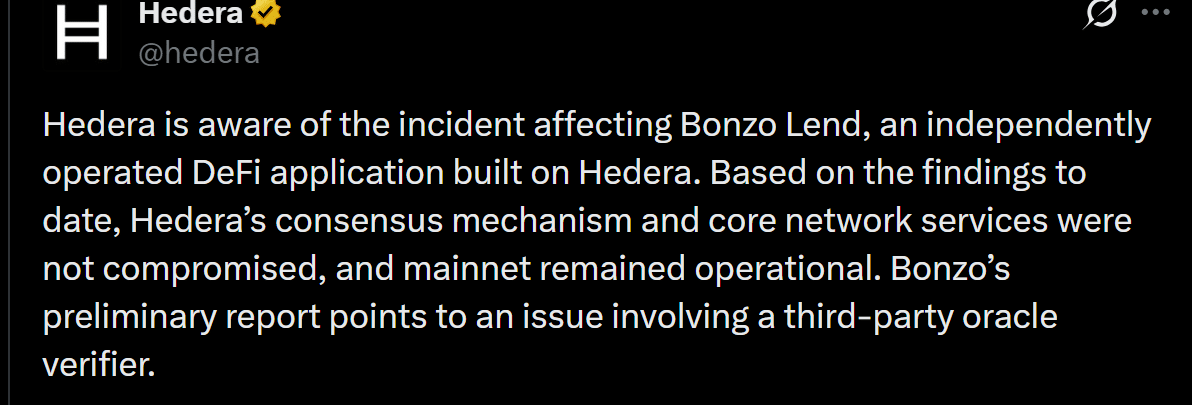
Source: Hedera on X

In a post on X, Hedera confirmed Bonzo Lend’s smart contracts and Hedera’s core network were not compromised. That discovery narrowed the failure to external oracle infrastructure rather than blockchain security.

Meanwhile, the exploit quickly spilled into market sentiment. At press time, HBAR fell to about $0.068, while Hedera’s DeFi TVL plunged 21.43% to $25.4 million. This drawdown reflected capital withdrawals despite the network itself remaining uncompromised.
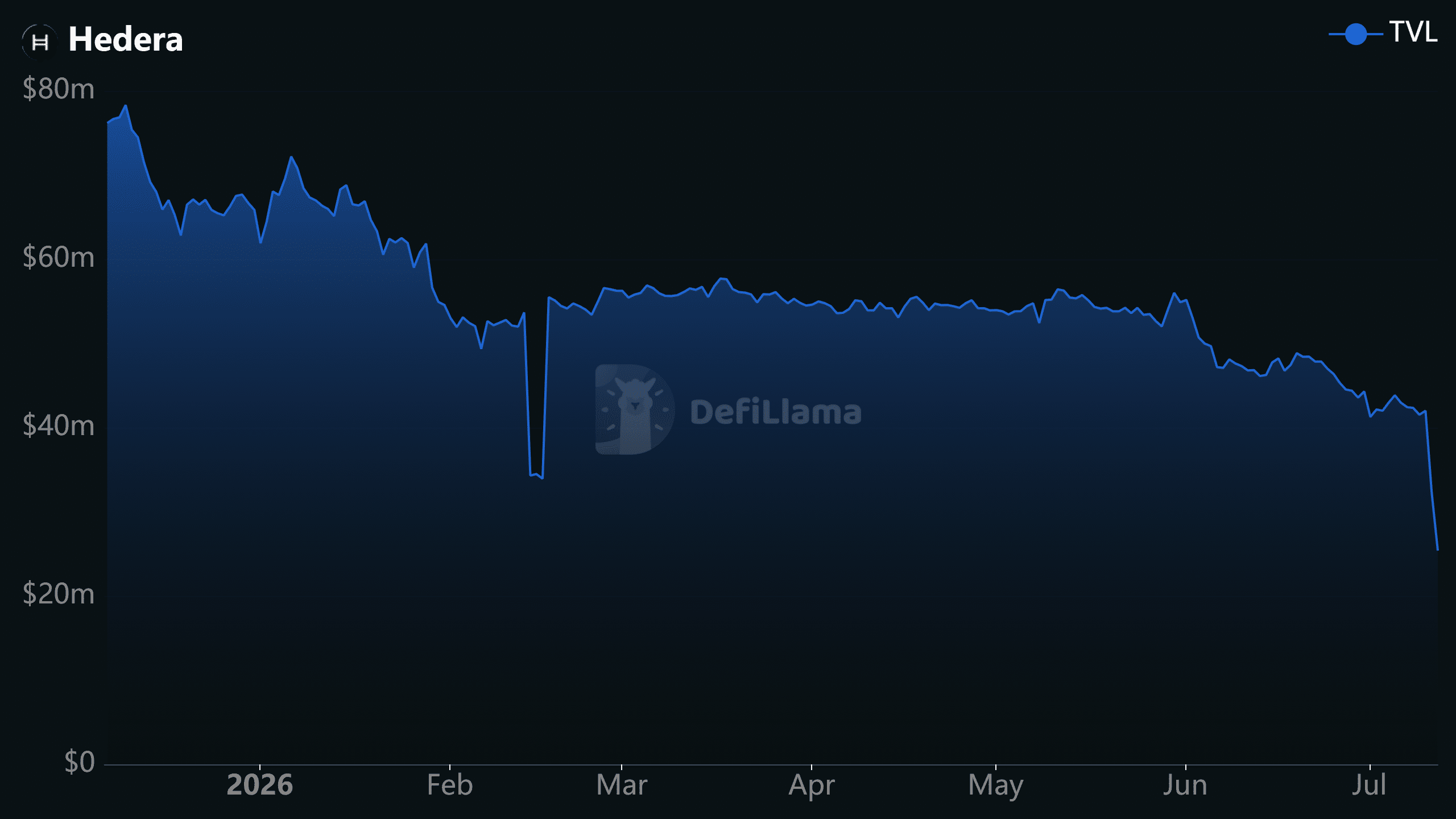
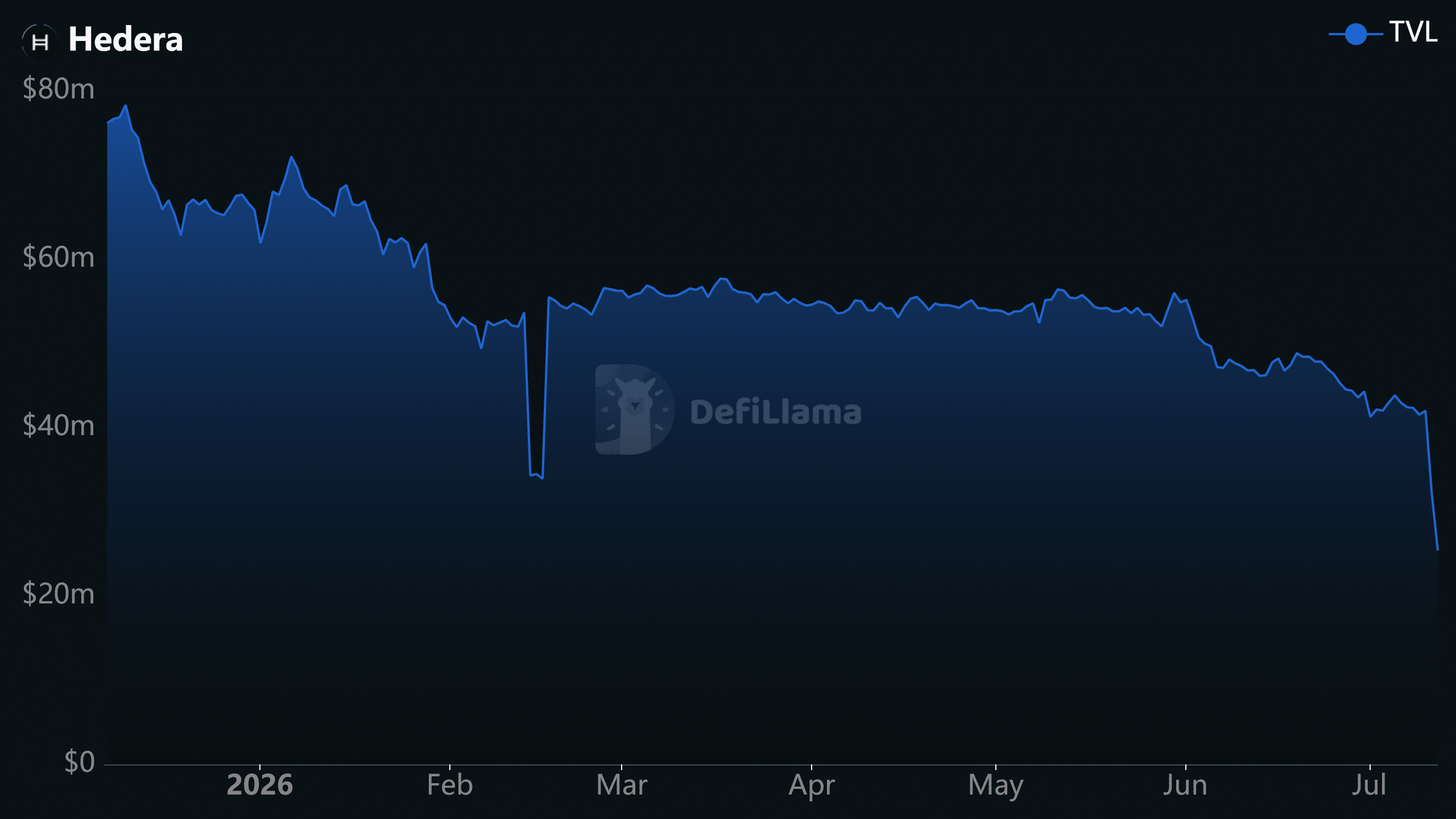
Source: DeFILlama

Nevertheless, the exploit exposed the growing importance of resilient price oracles. As recovery efforts continue, stronger oracle safeguards and verification standards will likely become essential for protecting DeFi lending protocols.

Oracle flaw exposes DeFi risk

The audit of Bonzo Lend’s smart contracts determined that there were no issues related to it. Still, it also identified how the attack was successful. Although the protocol had read a manipulated SAUCE price to calculate collateral exactly as defined by the protocol, it had done so precisely as designed.

Auditors eliminated flash loans and market manipulation based upon their observations of SAUCE trading volumes having peaked at only a couple of thousand dollars.

Instead of using those methods, the attacker exploited the protocol’s reliance on trusted oracle inputs. Although the code executes flawlessly, attackers can still weaponize protocol rules against users and protocol owners. That pattern reflects a recurring DeFi risk where the rules themselves become weaponized despite flawless code execution. Such protocol logic exploits remain a recurring category in DefiLlama’s hacks database.

Therefore, such a recurring pattern is driving protocols to adopt economic simulations, formal verification, and bug bounties, in addition to traditional smart contract audits.


Final Summary

  • Hedera oracle exploit exposed critical risks in trusted price feeds.
  • HBAR showed correct protocol logic can still enable multimillion-dollar exploits.

Trending Cryptos

Related Questions

QWhat was the primary cause of the $9.05 million exploit on Bonzo Lend?

AThe primary cause was a flaw in Supra's signature verification, which enabled manipulation of the SAUCE price feeds from the oracle. This allowed the attacker to borrow assets exceeding the value of their posted collateral.

QAccording to Hedera, were the Bonzo Lend smart contracts or the Hedera network itself compromised in the attack?

ANo, Hedera confirmed that Bonzo Lend's smart contracts and the Hedera core network were not compromised. The failure was isolated to external oracle infrastructure.

QHow did the attack affect Hedera's market metrics following the exploit?

AFollowing the exploit, HBAR's price fell to about $0.068, and Hedera's total value locked (TVL) in DeFi plunged by 21.43% to $25.4 million, reflecting capital withdrawals.

QWhy were methods like flash loans or market manipulation ruled out as the attack vector by auditors?

AAuditors ruled out flash loans and market manipulation because they observed that SAUCE trading volumes had peaked at only a couple of thousand dollars, which was insufficient for such methods.

QWhat recurring DeFi risk does the Bonzo Lend exploit exemplify, according to the article?

AIt exemplifies the recurring risk where protocol rules themselves can be weaponized by attackers, despite the smart contract code executing flawlessly. This highlights vulnerabilities in trusted oracle inputs and protocol logic.

Related Reads

From Speculation to Risk Management: Predictive Markets Are Filling the Gap in Commercial Insurance

From Speculation to Risk Management: Predictive Markets Filling the Commercial Insurance Gap The emergence of AI risk management tools like Blanket is exploring the potential of predictive markets as a genuine insurance tool for businesses. These markets, with their simple contract structure—paying $1 if an event occurs, $0 if not—allow the real-time market price to reflect collective probability assessments. Businesses can use them to hedge against operational risks (e.g., abnormal weather, energy price fluctuations) that are often not covered by traditional business interruption insurance, which typically requires physical damage. A key question is whether these markets are genuinely used for hedging or remain primarily speculative. Analysis of Kalshi markets from August 2025 to August 2026 compared weather contracts (a potential hedge instrument) against sports contracts (largely speculative) and traditional CME grain futures. Three behavioral metrics were examined: 1. **Daily Turnover Rate:** Weather contracts showed the lowest rate (0.210), lower than corn futures (0.266) and significantly lower than sports contracts (0.315), suggesting longer holding periods. 2. **Hold-to-Expiry Ratio:** Weather contracts had a much higher ratio (over 0.5) compared to near-zero ratios for sports contracts, indicating a stronger tendency to hold positions until settlement, consistent with hedging behavior. 3. **Position Buildup Timing:** Weather market positions reached 50% of their peak much earlier in their lifecycle than sports market positions, aligning with the early risk-locking behavior seen in traditional futures hedging markets. The data indicates that the Kalshi weather market exhibits transaction patterns distinct from pure speculation and more aligned with hedging markets, suggesting real hedging demand exists alongside speculative activity. Crucially, speculation provides the essential liquidity and pricing mechanism that enables the hedging function. The future growth of predictive markets as viable risk management infrastructure depends not on eliminating speculation, but on building real enterprise hedging demand atop this existing liquidity base.

marsbit5m ago

From Speculation to Risk Management: Predictive Markets Are Filling the Gap in Commercial Insurance

marsbit5m ago

Fields Medalist: AI Currently Mainly "Challenges" to Break Major Mathematical Conjectures

Fields Medalist Timothy Gowers observes that current AI breakthroughs in mathematics often come from a "contrarian" approach: actively searching for counterexamples to disprove major conjectures. Recent high-profile achievements—such as progress on the Erdős unit distance problem, the Jacobian conjecture, the existence of non-sofic groups, and multicolor Ramsey numbers—largely involve AI constructing specific counterexamples or novel objects that violate long-held assumptions. Gowers explains this tendency stems from AI's two key strengths: vast knowledge across mathematical domains, enabling unexpected cross-tool synthesis (e.g., applying algebraic number theory to a discrete geometry problem), and the ability to conduct low-cost, extensive trial-and-error searches in huge combinatorial spaces. Unlike human mathematicians who rely on intuition (a "nose") to prune unpromising paths, AI excels at breadth-first exploration—testing countless constructions until it finds a qualifying example. However, Gowers notes current limitations: AI often proposes superficially plausible but flawed approaches and may get stuck refining "more precise subproblems" without true progress. He envisions a future where AI not only solves problems but generates fundamentally new, elegant methods that inspire further human research—a sign it has evolved from a search tool into a genuine creative partner in mathematics.

marsbit5m ago

Fields Medalist: AI Currently Mainly "Challenges" to Break Major Mathematical Conjectures

marsbit5m ago

Hegotá EIP Comprehensive Overview: Where is Ethereum's Next Hard Fork Headed?

The article outlines Ethlabs' recommended priorities for the upcoming Ethereum Hegotá hard fork, following Glamsterdam. The core focus areas are: 1. **Stronger censorship resistance** via EIP-7805 FOCIL (already in SFI stage). 2. **A faster Ethereum** by shortening the slot time via EIP-8198 Quick Slots (S-tier recommendation). This aims to reduce transaction confirmation latency and improve cross-chain interoperability. 3. **Native account abstraction** through EIP-8141 Frame Transactions (A-tier). This enables passkey wallets, gas sponsorship, and batched transactions. Its flexibility allows for custom validation logic and future post-quantum security but presents ecosystem coordination challenges. 4. **Continued L1 scaling** by optimizing resource pricing with proposals like EIP-8131 & EIP-8279 (S-tier) to prepare for future gas limit increases. The article uses a tiered system (S, A, B, D) to rank proposed EIPs based on their value and implementation feasibility. It advises strictly controlling the scope of Execution Layer (EL) changes in Hegotá to reserve developer bandwidth for future large-scale upgrades like decoupled consensus. Other notable proposals include EIP-8363 for staking issuance changes (requiring broad community consensus), various post-quantum preparation EIPs, and zkEVM optimizations. Ethlabs emphasizes that Ethereum upgrades are complex, high-risk endeavors requiring coordination across the entire ecosystem.

marsbit24m ago

Hegotá EIP Comprehensive Overview: Where is Ethereum's Next Hard Fork Headed?

marsbit24m ago

Is the US Stock Market Rising Too Smoothly? BTIG Warns of Elevated Risk of Systematic Correction in August to October

U.S. Stocks at Risk of Systemic Pullback in August-October, Warns BTIG BTIG's chief technical market strategist warns that the market is entering the most dangerous seasonal window of midterm election years—August through October—trading at all-time highs with extremely low volatility. Historically, since 1990, the equal-weight S&P 500 (SPW) has experienced at least a 7% pullback in this period almost every midterm year, with 2006 being the lone exception. This pattern is often triggered by unforeseen external shocks. Multiple technical indicators flash warning signs. The maximum drawdown for the Invesco S&P 500 Equal Weight ETF (RSP) since March has not exceeded 2.25%, an unusually calm period signaling risk buildup. RSP currently trades about 11% above its 200-day moving average, a stretched level historically. Furthermore, the NYSE has recorded zero "80% downside volume days" in 2024, a record-long streak far below the annual average of 21, indicating a lack of selling pressure that may be overdue. Market complacency is evident with the CBOE put/call ratio near multi-year lows and the VIX at yearly lows, showing minimal demand for downside protection. A macroeconomic divergence adds to concerns: despite recent soft economic data, long-term Treasury yields remain near cycle highs, contradicting the equity market's optimistic pricing. BTIG suggests this is an attractive time to reduce risk or hedge broad equity exposure. For sector positioning, healthcare has historically shown resilience during midterm year pullbacks, while caution is advised on chasing energy's breakout and semiconductors are expected to continue seeking support near their 200-day average.

marsbit34m ago

Is the US Stock Market Rising Too Smoothly? BTIG Warns of Elevated Risk of Systematic Correction in August to October

marsbit34m ago

2026 Global Overview of Crypto Asset Taxation

Global Cryptocurrency Tax Overview for 2026 As cryptocurrencies integrate into the mainstream financial system, tax treatments across jurisdictions have moved from initial regulatory gaps towards institutionalization. The OECD's 2020 report, *Taxing Virtual Currencies*, was a key early comparative study. Since then, more jurisdictions have clarified tax rules through existing laws, specific regulations, or guidance, increasing the procedural and technical complexity of crypto taxation. Currently, crypto taxation is predominantly built upon traditional tax frameworks, typically applying income tax, capital gains tax, corporate tax, and indirect taxes based on asset nature and transaction activity. The maturity of rules varies: basic trading and mining are well-covered, while DeFi, NFTs, and other on-chain activities involve more complex asset exchanges and profit recognition, with corresponding tax rules remaining underdeveloped. Significant disparities exist in tax treatment and effective tax burdens across jurisdictions. Crypto assets can trigger direct taxes, indirect taxes, and property-related levies. Factors such as holding period, transaction type, income nature, and taxpayer status further influence the tax outcome. The global crypto tax landscape is thus evolving from the initial question of "whether to tax" towards more nuanced classification and treatment of different assets, transactions, and economic activities. The scope of crypto tax rules continues to expand. From 29 jurisdictions with guidance in 2021, the number grew to 43 by 2025. Existing rules are also becoming more detailed. However, rule coverage remains uneven—common activities like buying/selling are widely addressed, whereas staking, DeFi, and NFTs have significantly less guidance, as seen in jurisdictions like Germany and Australia. Tax liabilities are highly complex, determined by a combination of factors including taxpayer status, income classification, holding periods, and applicable deductions or exemptions. The concept of a "crypto-tax-friendly" jurisdiction is therefore relative and depends on specific user activities and circumstances.

marsbit37m ago

2026 Global Overview of Crypto Asset Taxation

marsbit37m ago

Trading

Spot

Hot Articles

How to Buy T

Welcome to HTX.com! We've made purchasing Threshold Network Token (T) simple and convenient. Follow our step-by-step guide to embark on your crypto journey.Step 1: Create Your HTX AccountUse your email or phone number to sign up for a free account on HTX. Experience a hassle-free registration journey and unlock all features.Get My AccountStep 2: Go to Buy Crypto and Choose Your Payment MethodCredit/Debit Card: Use your Visa or Mastercard to buy Threshold Network Token (T) instantly.Balance: Use funds from your HTX account balance to trade seamlessly.Third Parties: We've added popular payment methods such as Google Pay and Apple Pay to enhance convenience.P2P: Trade directly with other users on HTX.Over-the-Counter (OTC): We offer tailor-made services and competitive exchange rates for traders.Step 3: Store Your Threshold Network Token (T)After purchasing your Threshold Network Token (T), store it in your HTX account. Alternatively, you can send it elsewhere via blockchain transfer or use it to trade other cryptocurrencies.Step 4: Trade Threshold Network Token (T)Easily trade Threshold Network Token (T) on HTX's spot market. Simply access your account, select your trading pair, execute your trades, and monitor in real-time. We offer a user-friendly experience for both beginners and seasoned traders.

13.0k Total ViewsPublished 2024.03.29Updated 2026.06.02

How to Buy T

Discussions

Welcome to the HTX Community. Here, you can stay informed about the latest platform developments and gain access to professional market insights. Users' opinions on the price of T (T) are presented below.

活动图片