DATCo 2.0 诞生:当散户恐慌折价时,贝莱德正在悄悄入场

marsbitPublished on 2025-11-12Last updated on 2025-11-13

11 月 13 日,一个惊悚的数据点在加密市场内部流传开来。

比特币的巨鲸代理——Strategy (MSTR.US)——其公司股票的总市值(约 662.3 亿美元),已经跌破了它所持有的比特币的现货价值(约 664.9 亿美元)。
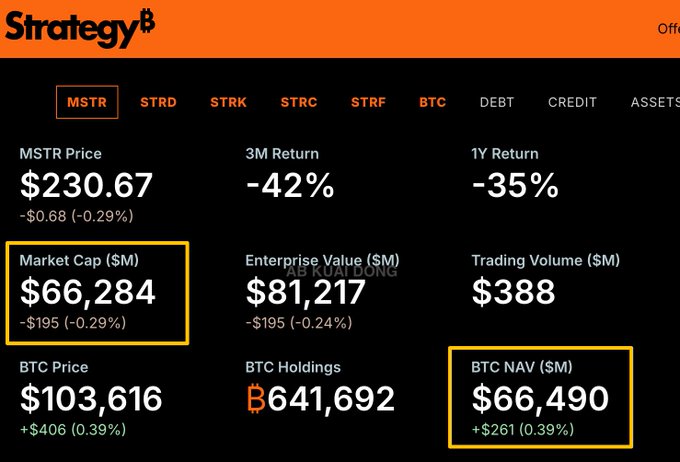
mNAV

这个数据释放的信号,远比比特币跌破 10 万美元更可怕。

它标志着 mNAV(市值与持有加密货币价值的比率)正式跌破 1.0。而 mNAV 大于 1.0 的溢价,正是 Strategy 创始人 Michael Saylor 过去四年来赖以生存的核心魔法 。

这也不是 Strategy 的个案。CoinGecko 在其最新的《2025 年 DATCo 报告》中证实,日本的小微策略 Metaplanet (3350.T),其 mNAV 也在 10 月中旬首次跌破 1.0。而 ETH 巨鲸 Bitmine Immersion Tech (BMNR.US) 的 mNAV 同样跌破了 1.0。

市场陷入了集体恐慌。因为 mNAV 跌破 1.0,意味着 DATCo 1.0(Digital Asset Treasury Companies) 时代——那个增发股票、融资买币、拉高溢价、继续增发的完美飞轮——已经解体了 。


正在上演的“死亡螺旋”

恐慌并非空穴来风。

CoinGecko 的报告证实了市场最深的恐惧:当 mNAV 跌破 1.0 时,它将“扼杀”(kneecap)DATCo 依赖 ATM(At-the-Market)股权发行来融资的能力 。

简而言之,当你的股价(市值)已经比你持有的币(净资产)还便宜时,你再增发股票去买币,就成了一个赔本买卖 。

这个死亡螺旋已经开始上演。

  1. Semler Scientific (SMLR) 的“贱卖”: 这家公司在 2024 年 5 月高调转型 BTC 财库 ,mNAV 一度高达 4.3 。但进入 2025 年,其股价崩溃,mNAV 在 4 月跌破 1.0 。融资能力枯竭后 ,它在 9 月被迫宣布与 Strive (ASST.US) 全股票合并 ——这无异于一次“贱卖”。
  2. Sequans Communications 的“断臂”: 这家美股上市半导体公司在 11 月初被迫出售 970 枚比特币,目的不是抄底,而是为了赎回 50% 的可转换债券,将其总债务减半。
  3. ETHZilla 的“绝望”: 这家 ETH 财库公司在 10 月 14 日,同样被迫抛售价值 4000 万美元的 ETH。讽刺的是,它抛售 ETH 不是为了偿还债务,而是为了回购公司股票,试图人为地将其 mNAV 拉回 1.0 之上。

CoinGecko 的报告冷酷地总结道:“DATCo 进一步抛售加密货币的阴影正笼罩着该行业” 。


惊天逆转:贝莱德和摩根大通的入场

就在市场因机构踩踏和死亡螺旋的恐惧而陷入绝望时,一个 Alpha 信号出现了。

BitMine Immersion (BMNR)——这家 mNAV 同样跌破 1.0 的 ETH 巨鲸——其主席 Tom Lee(华尔街知名策略师),转发了一条推文。
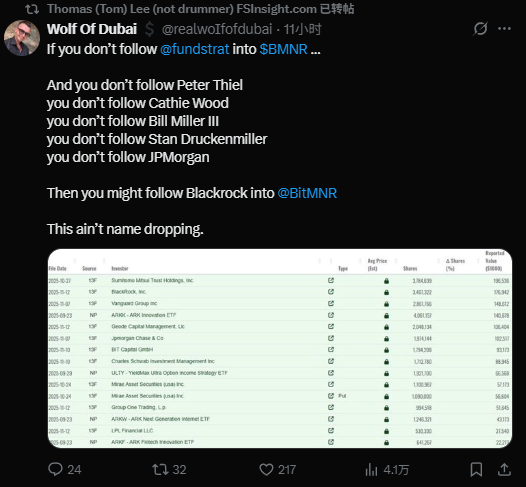
mNAV

推文内容显示:贝莱德 (BlackRock)、Vanguard 和摩根大通 (JP Morgan) 等一众 TradFi 巨头,赫然出现在 BitMine 的机构股东名单上。
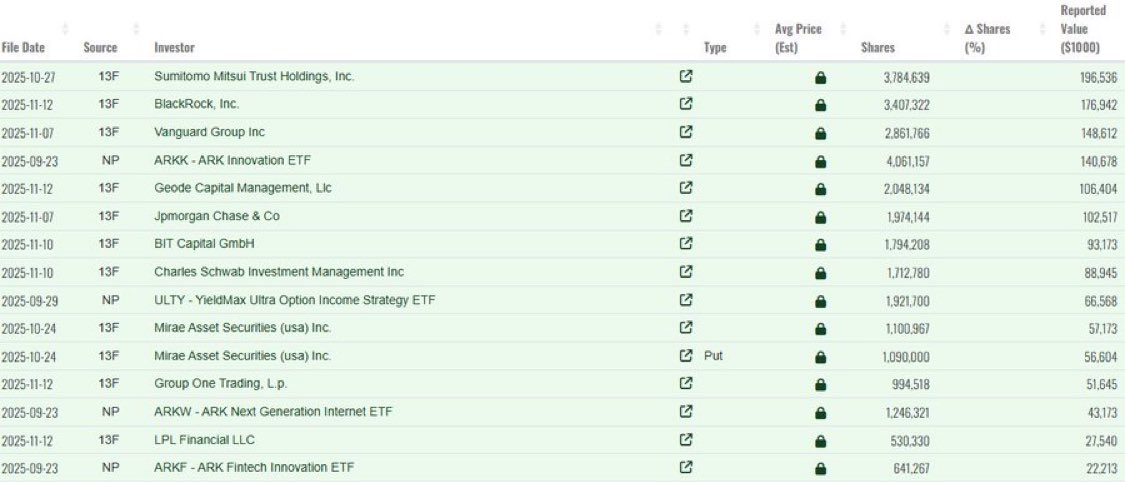
mNAV

这简直是魔幻现实。

为什么在散户和加密 OG 们因 mNAV < 1.0 而恐慌死亡螺旋时,贝莱德和摩根大通这些“旧钱”巨头,反而正在悄悄入场?

答案是:市场正在发生一场深刻的叙事反转。

散户和 TradFi 巨头,正在交易两个完全不同的 DATCo。


DATCo 1.0:Saylor 的“溢价飞轮”

散户恐慌的,是 DATCo 1.0 模式的死亡。

这个由 Michael Saylor 在 2020 年开创的模式 ,本质是一个 Beta 杠杆工具 。它允许没有合规渠道的投资者(主要是散户),通过购买 MSTR 的股票,来获得对 BTC 的杠杆敞口 。

这个模式成功的唯一前提,就是 mNAV > 1.0。

投资者愿意支付溢价,是因为他们买的是未来的预期 。MSTR 利用这个溢价,通过 ATM 增发股票 ,疯狂融资买币,MSTR 的 BTC 持仓量从 0 飙升至 64 万枚 。

但在 2024 年 1 月现货 ETF 获批后,这个模式的根基就已经动摇了。

当贝莱德的 IBIT 可以提供 1:1 追踪 BTC、且管理费极低的敞口时,投资者(尤其是机构)为什么还要去购买 MSTR 这个溢价高达 3.1 倍(2024 年 11 月高点) 的昂贵替代品?

因此,mNAV 跌破 1.0,不是危机,而是价值回归 。

“DATCo 2.0”:贝莱德的“折价 + 现金流”

贝莱德和摩根大通在 mNAV < 1.0 时入场,因为它们交易的是一个全新的物种:DATCo 2.0

TradFi 巨头是价值投资者,他们只买折价(mNAV < 1.0)。

而 DATCo 2.0 模式,正在解决 1.0 模式的两个致命弱点:

1. 弱点一:过分依赖“股权融资”

  • MSTR 2.0 的进化(转向债务): Saylor 已经意识到了这个问题。CoinGecko 报告(第 17 页)详细拆解了 MSTR 的新玩法:发行“永久优先股”(Perpetual Preference Shares)。
  • MSTR 正在从一个纯股权公司,进化为一个债务工具。它试图构建一个由 BTC 背书的收益率曲线,以吸引那些追求稳定股息的收入驱动型投资者 。这是 MSTR 摆脱“溢价飞轮”的第一步。

2. 弱点二:“没有可持续的现金流”

  • MSTR 的“阿喀琉斯之踵”: BTC 本身不产生原生收益 。这导致 MSTR 的“优先股”利息支付备受争议——报告指出,MSTR 支付股息的钱,居然还是来自于增发更多的普通股 。这属实有点“庞氏”了。
  • Altcoin 2.0 的“杀手锏”: 这就是为什么贝莱德们选择的是 BitMine (BMNR),一家 ETH 财库。
  • CoinGecko 报告(第 23 页)明确指出了 DATCo 2.0 的未来:它们正在寻找可持续的现金流 。BTC 财库做不到,但 Altcoin 财库可以 。它们正在探索原生质押(native staking)、再质押(restaking yield)或 DeFi 挖矿


结语:“折价”不是陷阱,是“邀请函”

现在,我们再回头看 Tom Lee 的那条推文,一切都清晰了。

贝莱德和摩根大通入股 BitMine (BMNR),不是在“赌”ETH 的价格(它们可以通过 ETF 获得更纯粹的敞口),而是在进行一次经典的华尔街“价值投资”:

它们正在购买一家现金流公司(通过 Staking 产生可持续收益),而这家公司的股票(mNAV 0.946),恰好正以折价的方式在交易。

这就是 DATCo 2.0 的真相。

市场正在发生一场深刻的换仓:

  • DATCo 1.0(MSTR 模式): 散户因溢价消失而恐慌性抛售 。
  • DATCo 2.0(BMNR / FORD 模式): 机构因折价出现 + 现金流诞生而悄悄入场。

CoinGecko 报告中那句“抛售的阴影正笼罩着该行业” 是对的,但那只是死亡螺旋的 A 面。而 B 面是,这场大逃杀将“进一步整合”市场 ,淘汰掉那些无法产生现金流的 1.0 玩家,最终将筹码(如 Semler Scientific) 集中到 Saylor 和 Tom Lee 这些 2.0 巨头手中。

mNAV 跌破 1.0,不是陷阱,而是 TradFi 巨头正式入场的“邀请函”。

Trending Cryptos

Related Reads

Claude Accused of Becoming Dumber by the Entire Internet, Anthropic Steps In to Reveal: It’s Not the Model That’s Tricking You

When users complained that Claude was "getting dumber," the root cause wasn't the AI model itself. In an official blog post, Anthropic clarified the critical difference between two key settings in Claude Code: Model and Effort. Model refers to the core "brain"—the fixed, trained weights of a specific AI (like Sonnet, Opus, or Fable). Changing the Model addresses *capability* ("can it do this?"), but its knowledge is static post-training. Effort, however, controls the AI's *approach and thoroughness* for a specific task. A higher Effort level instructs Claude to read more files, run tests, perform verification, and complete multi-step reasoning before responding, significantly increasing its "work output" for that job. Conversely, low Effort leads to quicker, less thorough replies. This distinction explains the March 2024 uproar where users experienced a sudden drop in Claude's performance. The cause was not a model change but Anthropic quietly lowering the *default* Effort setting from "high" to "medium" to reduce latency, which was later reverted. The key insight is that a smaller, capable model (like Sonnet) on high Effort can often outperform a larger, more powerful model (like Opus) on low Effort for many tasks. The article provides a practical troubleshooting framework: if Claude makes an error, first check the context and instructions. If it seems to skip necessary steps or validations, increase Effort. If it diligently attempts the task but fails conceptually or makes consistent factual errors despite good context, then consider switching to a more capable Model. The takeaway is a shift in focus: effective AI programming is less about always choosing the "strongest" model and more about intelligently *orchestrating* models and effort levels—acting like a project manager to assign the right "brain" with the right level of diligence for each job, optimizing both results and cost.

marsbit1h ago

Claude Accused of Becoming Dumber by the Entire Internet, Anthropic Steps In to Reveal: It’s Not the Model That’s Tricking You

marsbit1h ago

Will the Ethereum Foundation Evolve into a 'Mascot'? Diversified Organizations Are Fragmenting Its Functions

The Ethereum Foundation (EF) is undergoing significant internal turmoil and functional erosion. Following its largest-ever layoff of 54 staff (20% of its workforce) and a major organizational restructuring announced in June, its Protocol Support Team has been officially dissolved. This comes alongside the high-profile resignation of key figures like co-executive director Xiaowei Wang, bringing senior departures this year to at least eight. Criticism of EF's rigid structure, opaque decision-making, and perceived lack of a clear value narrative for ETH has intensified within the community. The layoffs have catalyzed the emergence of independent, non-profit organizations like Ethlabs and Ethereum Institutional, founded by former EF researchers and members. These entities are now taking on core functions such as protocol research/development and institutional adoption, effectively fragmenting the EF's traditional leadership role. Concurrently, EF's security team is adapting to technological change, deploying specialized AI agents to audit Ethereum's codebase, which successfully discovered a critical vulnerability (CVE-2026-34219). While EF states AI complements rather than replaces researchers, it signals a potential future shift in its operational model. Faced with these challenges—internal restructuring, talent drain, the rise of competing organizations, and AI integration—the Ethereum Foundation appears to be stepping back from a central commanding role. Analysts and community observers speculate it may increasingly transition towards a symbolic "ecosystem mascot" function, while decentralized initiatives drive Ethereum's future growth and institutional adoption.

marsbit2h ago

Will the Ethereum Foundation Evolve into a 'Mascot'? Diversified Organizations Are Fragmenting Its Functions

marsbit2h ago

Trading

Spot

Hot Articles

What is $BITCOIN

DIGITAL GOLD ($BITCOIN): A Comprehensive Analysis Introduction to DIGITAL GOLD ($BITCOIN) DIGITAL GOLD ($BITCOIN) is a blockchain-based project operating on the Solana network, which aims to combine the characteristics of traditional precious metals with the innovation of decentralized technologies. While it shares a name with Bitcoin, often referred to as “digital gold” due to its perception as a store of value, DIGITAL GOLD is a separate token designed to create a unique ecosystem within the Web3 landscape. Its goal is to position itself as a viable alternative digital asset, although specifics regarding its applications and functionalities are still developing. What is DIGITAL GOLD ($BITCOIN)? DIGITAL GOLD ($BITCOIN) is a cryptocurrency token explicitly designed for use on the Solana blockchain. In contrast to Bitcoin, which provides a widely recognized value storage role, this token appears to focus on broader applications and characteristics. Notable aspects include: Blockchain Infrastructure: The token is built on the Solana blockchain, known for its capacity to handle high-speed and low-cost transactions. Supply Dynamics: DIGITAL GOLD has a maximum supply capped at 100 quadrillion tokens (100P $BITCOIN), although details regarding its circulating supply are currently undisclosed. Utility: While precise functionalities are not explicitly outlined, there are indications that the token could be utilized for various applications, potentially involving decentralized applications (dApps) or asset tokenization strategies. Who is the Creator of DIGITAL GOLD ($BITCOIN)? At present, the identity of the creators and development team behind DIGITAL GOLD ($BITCOIN) remains unknown. This situation is typical among many innovative projects within the blockchain space, particularly those aligning with decentralized finance and meme coin phenomena. While such anonymity may foster a community-driven culture, it intensifies concerns about governance and accountability. Who are the Investors of DIGITAL GOLD ($BITCOIN)? The available information indicates that DIGITAL GOLD ($BITCOIN) does not have any known institutional backers or prominent venture capital investments. The project seems to operate on a peer-to-peer model focused on community support and adoption rather than traditional funding routes. Its activity and liquidity are primarily situated on decentralized exchanges (DEXs), such as PumpSwap, rather than established centralized trading platforms, further highlighting its grassroots approach. How DIGITAL GOLD ($BITCOIN) Works The operational mechanics of DIGITAL GOLD ($BITCOIN) can be elaborated on based on its blockchain design and network attributes: Consensus Mechanism: By leveraging Solana’s unique proof-of-history (PoH) combined with a proof-of-stake (PoS) model, the project ensures efficient transaction validation contributing to the network's high performance. Tokenomics: While specific deflationary mechanisms have not been extensively detailed, the vast maximum token supply implies that it may cater to microtransactions or niche use cases that are still to be defined. Interoperability: There exists the potential for integration with Solana’s broader ecosystem, including various decentralized finance (DeFi) platforms. However, the details regarding specific integrations remain unspecified. Timeline of Key Events Here is a timeline that highlights significant milestones concerning DIGITAL GOLD ($BITCOIN): 2023: The initial deployment of the token occurs on the Solana blockchain, marked by its contract address. 2024: DIGITAL GOLD gains visibility as it becomes available for trading on decentralized exchanges like PumpSwap, allowing users to trade it against SOL. 2025: The project witnesses sporadic trading activity and potential interest in community-led engagements, although no noteworthy partnerships or technical advancements have been documented as of yet. Critical Analysis Strengths Scalability: The underlying Solana infrastructure supports high transaction volumes, which could enhance the utility of $BITCOIN in various transaction scenarios. Accessibility: The potential low trading price per token could attract retail investors, facilitating wider participation due to fractional ownership opportunities. Risks Lack of Transparency: The absence of publicly known backers, developers, or an audit process may yield skepticism regarding the project's sustainability and trustworthiness. Market Volatility: The trading activity is heavily reliant on speculative behavior, which can result in significant price volatility and uncertainty for investors. Conclusion DIGITAL GOLD ($BITCOIN) emerges as an intriguing yet ambiguous project within the rapidly evolving Solana ecosystem. While it attempts to leverage the “digital gold” narrative, its departure from Bitcoin's established role as a store of value underscores the need for a clearer differentiation of its intended utility and governance structure. Future acceptance and adoption will likely depend on addressing the current opacity and defining its operational and economic strategies more explicitly. Note: This report encompasses synthesised information available as of October 2023, and developments may have transpired beyond the research period.

738 Total ViewsPublished 2025.05.13Updated 2025.05.13

What is $BITCOIN

Discussions

Welcome to the HTX Community. Here, you can stay informed about the latest platform developments and gain access to professional market insights. Users' opinions on the price of BTC (BTC) are presented below.

活动图片