浅析TRUMP如何引领政治Meme新风潮?

Odaily星球日报Published on 2025-01-22Last updated on 2025-01-22

Abstract

世界各国的领导人正逐渐对加密货币行业持积极态度。

浅析TRUMP如何引领政治Meme新风潮?

根据 Artemis 的数据, 2024 年 memecoin 领域席卷了整个行业,其价格表现超过 218% ,超过所有资产类别。

在如此惊人的表现背后,是各种著名的 memecoins,它们已经获得了独角兽的地位和广泛的社区支持,如 DOGE、POPCAT、VIRTUAL、PNUT、FARTCOIN 等。

Memecoin 的象征意义、文化、社区及其真正的去中心化性质吸引了许多用户轻松参与其中。虽然其中一些代表了特定的故事、动物、甚至对人工智能的信念等,但在 2025 年,它们与一个新兴的叙事相比已经黯然失色:即政治模因。

引领这一叙事增长的 memecoin 是 TRUMP,这是由第一位对加密货币采取友好态度的美国总统唐纳德·特朗普推出的 memecoin。

市场何以至此?

2025 年 1 月 17 日,唐纳德·特朗普在其社交账号上首次宣布推出“TRUMP”,三天后他将正式宣誓就任美国总统。推出后不到 24 小时,该代币的市值就飙升至 48 亿美元,完全稀释估值(FDV)为 243 亿美元。在 1 月 19 日达到顶峰时,代币价格为 75.35 美元,FDV 达到 753.5 亿美元,已经跻身前 20 大加密货币之列,甚至一度超过狗狗币,成为市值最大的 memecoin。 

$TRUMP 的迅速崛起有何意义?

与市场上其他类型的模因币不同,TRUMP 币是一个政治模因币的例子,象征着这位加密货币友好型总统所展现的勇气与活力。大家可能还记得他在竞选期间曾经历过一次刺杀未遂事件。除了担任总统,唐纳德·特朗普还是一位成功的商人,掌控着特朗普商业集团,该集团拥有数百个使用特朗普品牌的附属公司和子公司。如今,随着 TRUMP 币的推出,这标志着特朗普再次利用个人品牌进行尝试,该项目迅速取得了成功,跻身加密货币前 20 名。

TRUMP 币不仅是一个社区文化驱动的投机性资产,其未来表现还可能受到特朗普对加密行业的政治立场、金融政策及放松监管等多种因素的影响。

名人效应:从 NFT 到 memecoin

值得注意的是 Trump 之前也曾通过发行 NFT 等形式参与到行业中,但能吸引到的注意力和资金远无法和本次 memecoin 相比。背后的原因可能是多方面的,例如 NFT 的流动性无法和一般的同质化代币(FT)相比;而且当前能为 memecoin 提供的基础设施(交易平台、交易机器人等),也比 2021 年 NFT 热潮时更为完善。

Trump 可能会给整个行业带来一个“示范”效应, 2025 年可能会有更多的名人、明星、KOL 等选择用发行 memecoin 的形式来造势或募资。但正如一些分析所提到的,Trump 和他的妻子 Melania 之所以在正式就职前的周末来发币,可能也是为了规避利益冲突。未来如果有其他的名人、组织发币,也可能会有合规方面的顾忌。名人效应在 2025 究竟能发展到什么程度还有待进一步观察,但是个有趣的开始。

Trump 币背后的社区力量

此前整个行业里的 memecoin 热潮也为建立强大的社区基础奠定了基础。在 Trump 发布这个官方 Trump 币之前已经有了非常多的社区发布的 memecoins,例如 MAGA 等,体现了社区的积极参与。此外,Trump 这次选择在 Solana 平台上发布而并非以太坊或其他智能合约平台,也可以归因于 Solana 上充满活力和动态的 meme 社区。

从这些现象可以看出,由 memecoins 推动的“注意力经济”可能在不久的将来获得更多关注。尽管 memecoins 存在巨大的炒作和价格波动风险,但加密社区通过日益增加的 memecoins 展示出了自己的价值和力量。那些能够关注到社区价值、情绪和声音的项目团队比以往只关注在叙事的团队在未来更有可能获得成功。

潜在的风险

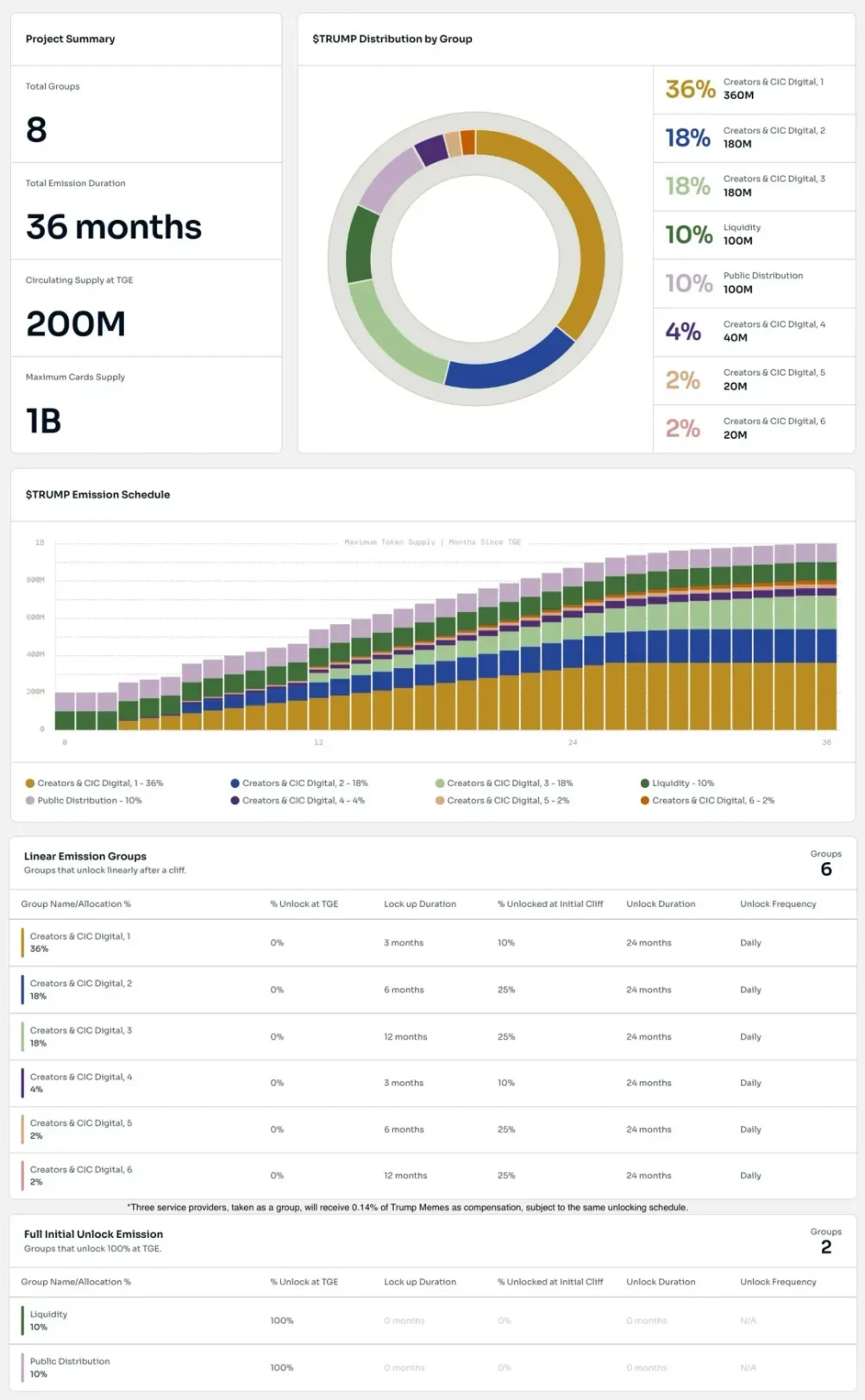
Memecoins 本质上是一种高度投机、波动性大的资产,TRUMP 也不例外。在推出后的数小时内,TRUMP 的交易量就超过了 DOGE,各种中心化和去中心化交易所紧随其后,宣布上线 TRUMP。截至撰写本文时,其 24 小时交易量达到 422 亿美元,超过了 XRP、SOL 和 DOGE 等蓝筹股。除了上述可能影响价格的因素外,值得注意的是,目前该代币的大部分尚未解锁。这带来了巨大的集中持仓风险,因为 80% 的代币由特朗普组织附属公司 CIC Digital LLC 和一家名为 Fight Fight Fight LLC 共同拥有的实体持有。代币投资者应注意即将到来的流动性解锁事件,这些事件在其解锁时间表上的体现,可能会加剧价格波动。
浅析TRUMP如何引领政治Meme新风潮?

来源:trumpmemes.com

展望

唐纳德·特朗普的成功上任,使其成为首位对加密货币持友好态度的美国总统,这标志着加密行业进入了一个新的发展阶段,因为他承诺将在上任后的几天内颁布与加密货币,尤其是比特币相关的行政命令。

由于众议院和参议院中支持加密货币的议员占多数,再加上众所周知支持加密货币创新的 Paul Atkins 被选为美国证券交易委员会(SEC)主席,我们可以预见监管将更加清晰,数字资产的主流应用环境将更加有利。

虽然 TRUMP 币的未来走向还有待观察,但它的推出不仅是一种投机资产,还表明了通过提高监管透明度和支持加密货币主流化的友好政策来支持加密货币行业的承诺。这也为其他国家的效仿铺平了道路,在美国的带动下,世界各国的领导人正逐渐对加密货币行业持积极态度。


Trending Cryptos

Related Reads

Nearly a Hundred Players Rush into Embodied Data: With 4.47 Billion Yuan in Financing in One Year, Who Can Really Make Money by 'Selling Data'?

The domestic embodied AI data industry has attracted nearly 100 players, with 70 focused on data collection and 27 on data infrastructure. In the past year, 15 independent embodied data service providers raised approximately 4.47 billion yuan. Despite this growth, the sector remains early-stage, fragmented, and faces significant challenges. Data collection methods are diverse, categorized into four main routes: teleoperation of real robots, human demonstration without a robot (using motion capture, exoskeletons, etc.), simulation synthesis, and distillation from internet videos. Most companies (43%) adopt hybrid approaches, combining multiple routes, as no single method can meet all training needs. Teleoperation alone is pursued by 31% of players, often by state-owned platforms and robot companies, while newer firms favor asset-light, no-hardware human demonstration. Independent data service providers now form the largest player group (40%), indicating the emergence of a distinct industry segment rather than just a subsidiary function for robot makers. Two-thirds of all players are "embodied-native" startups, while one-third are companies that pivoted from fields like AI data annotation, which are more prevalent in the data infrastructure layer. Current annual industry capacity is estimated at 1.6-1.8 million hours plus 70-80 million data points, with a short-term goal to increase this 15-20 fold within 1-3 years. Data collection factories are spread across 20 provinces in China, concentrated in the Yangtze River Delta, Beijing-Tianjin-Hebei, and Pearl River Delta regions. Financially, the 4.47 billion yuan raised in the past year pales compared to the 43.8 billion yuan raised by the broader embodied intelligence sector in just the first half of 2026, highlighting that data remains a less "sexy" bet for investors. The 15 funded independent providers show clear stratification: a top tier led by a unicorn (Lightwheel Intelligence, 3.1 billion yuan), a middle tier of 11 firms raising tens to hundreds of millions, and an early-stage tier of 3 companies. Sixty-nine investment institutions have participated, but none have made concentrated bets, reflecting uncertainty about viable business models. Over half of these funded companies are less than a year old, most are at pre-A or A rounds, and profitability remains largely unproven. In summary, the embodied data industry has become an independent track creating jobs and local economic activity. However, it is still nascent, with unformed consensus, unsolved problems, and unproven business models. The coming 1-2 years will be a critical validation window to see if companies can build sustainable, profitable businesses purely by "selling data."

marsbit33m ago

Nearly a Hundred Players Rush into Embodied Data: With 4.47 Billion Yuan in Financing in One Year, Who Can Really Make Money by 'Selling Data'?

marsbit33m ago

Dialogue with Multicoin Partner: The Crypto Market Has Bottomed Out, Favoring Three Cryptocurrencies in This Cycle

In a recent interview, Multicoin Capital managing partner Tushar Jain shared his views on the crypto market. He believes the market has bottomed and is at an inflection point, citing that negative news no longer causes significant price declines and application adoption continues to grow. Jain remains highly bullish on Solana, viewing it as the correct architectural choice for internet capital markets, particularly for spot and tokenized security trading. He is also positive on Hyperliquid, noting its leadership in decentralized derivatives trading. His investment approach focuses on concentrating capital in top convictions rather than equal allocation. A distinct opportunity he highlights is Zcash (ZEC), which he sees as a return to the industry's cypherpunk ethos and a potential top-five asset by market cap. For assets like Zcash without cash flows, his valuation framework is based on relative market cap ranking. Regarding investment strategy, Jain employs a "three-part" entry method to avoid timing pitfalls and emphasizes long-term "active management" over "active trading." He outlines four sources of investment edge: informational, analytical, behavioral/psychological, and structural. On portfolio management, the fund uses Bitcoin as its "cash," selling assets into Bitcoin during market euphoria to reduce beta risk and using Bitcoin to buy dips. Sales occur only if a better opportunity arises, the investment thesis breaks, or valuations become excessively overheated. While respectful of Ethereum's resilience, he questions its unclear scaling roadmap. Finally, Jain reaffirms his commitment to the thesis that blockchains will form the foundational architecture for future capital markets.

marsbit57m ago

Dialogue with Multicoin Partner: The Crypto Market Has Bottomed Out, Favoring Three Cryptocurrencies in This Cycle

marsbit57m ago

Behind Robinhood's Chain Launch and Tokenized Stocks: No Equity Rights, How Far Can This Packaging Game Go?

Robinhood is launching its own Layer 2 blockchain (Robinhood Chain) and "tokenized stocks," but these are not actual equity shares. The tokens are legally structured as debt securities or derivatives, offering economic exposure to a reference stock without granting voting rights or direct ownership. This move represents Robinhood's strategy to expand from a traditional brokerage into a "financial super app," building a user-friendly, programmable financial interface on top of complex, legally compliant, and jurisdiction-specific backend structures. The company's existing business remains strong, driven by options, event contracts, and stock trading. The new blockchain and tokenization efforts are an ambitious layer of infrastructure built atop this core, aiming to make financial products more portable and globally accessible via crypto rails. Key components include the Robinhood Wallet, Bitstamp acquisition (for institutional reach), the Lighter perpetual contracts platform, and Robinhood Earn (DeFi yield). The central challenge is the "brokerage chain paradox": maintaining a simple, intuitive user experience while the underlying assets are highly structured, regulated, and legally distinct from direct ownership. The success of this strategy depends on users, developers, and regulators accepting this model. If the complexity is misunderstood or deemed misleading, it could create product liability issues and stall expansion. The initiative is a significant infrastructure play, but its long-term viability hinges on navigating this fundamental tension between simplicity and legal reality.

marsbit2h ago

Behind Robinhood's Chain Launch and Tokenized Stocks: No Equity Rights, How Far Can This Packaging Game Go?

marsbit2h ago

Trading

Spot

Hot Articles

Discussions

Welcome to the HTX Community. Here, you can stay informed about the latest platform developments and gain access to professional market insights. Users' opinions on the price of MEME (MEME) are presented below.

活动图片