# Real Estate Articoli collegati

Il Centro Notizie HTX fornisce gli articoli più recenti e le analisi più approfondite su "Real Estate", coprendo tendenze di mercato, aggiornamenti sui progetti, sviluppi tecnologici e politiche normative nel settore crypto.

On-Chain Finance Finally Posts a Profitable Ledger: Figure's Quarterly Revenue Doubles, Net Profit Hits $87 Million

Blockchain finance firm Figure Technology Solutions reported a strong second-quarter earnings report, potentially serving as the first major proof of profitability for the sector. The company’s GAAP net revenue reached $226 million, up 113% year-over-year, while net profit surged 192% to $87.4 million, yielding a net profit margin of 38.8%. Its quarterly consumer loan origination volume hit $4.3 billion, marking 132% growth. Figure's business focuses on streamlining the U.S. Home Equity Line of Credit (HELOC) market by shifting the entire loan lifecycle—from origination to securitization—onto its proprietary Provenance blockchain. This backend infrastructure significantly reduces processing time and costs while remaining invisible to end borrowers, who simply benefit from faster, cheaper loans. A key growth driver is the Figure Connect platform, a blockchain-based marketplace connecting loan originators and institutional investors. It accounted for 65% ($2.8 billion) of the quarter's volume, demonstrating strong network effects with 489 partner firms. The company is building an integrated on-chain finance ecosystem that includes its SEC-approved yield-generating stablecoin, YLDS. Notably, Figure has achieved this scale and profitability without relying on token sales or speculative crypto economics, instead choosing a traditional IPO path. Its success suggests blockchain's most practical application in finance may be as an efficient, invisible infrastructure layer that solves specific real-world inefficiencies rather than attempting to overhaul the entire system.

marsbit2 giorni fa 04:55

On-Chain Finance Finally Posts a Profitable Ledger: Figure's Quarterly Revenue Doubles, Net Profit Hits $87 Million

marsbit2 giorni fa 04:55

Arthur Hayes' 10,000-Word New Article: When Will the AI Wave Peak? Will the Bubble Burst? Why Am I Frantically Buying ETH?

Arthur Hayes' latest article explores the intersection of AI investment, credit markets, and cryptocurrency. He argues that the massive capital expenditure (CAPEX) in AI infrastructure resembles a real estate-driven credit bubble, akin to the 2008 financial crisis, rather than a tech growth story. Hayes predicts that the AI bubble's peak will arrive in 2027, triggered not by failing AI profits but by a slowdown in the growth rate of data center construction and capex, revealing systemic over-leverage. He explains that banks, incentivized by government policy and steep yield curves, will continue lending to AI projects despite rising risks, expecting eventual government bailouts. Hayes further speculates that the US government might directly intervene by creating a sovereign wealth fund to buy AI equities, injecting permanent liquidity into the system. For crypto investors, this misallocation of capital is bullish. Hayes believes Bitcoin will bottom as AI capex growth decelerates but credit continues to flow, setting the stage for a major rally fueled by the inevitable large-scale monetary stimulus. He sets a rough year-end 2026 target of $5,000 for Ethereum, citing its potential role as a settlement layer for tokenized real-world assets (RWA) as a key narrative driver. The eventual government response to the AI credit bubble, he concludes, will unleash a cryptocurrency bull market unlike any seen since 2021.

marsbit08/05 06:42

Arthur Hayes' 10,000-Word New Article: When Will the AI Wave Peak? Will the Bubble Burst? Why Am I Frantically Buying ETH?

marsbit08/05 06:42

Exploring ChangXin Technology's Hefei Headquarters: The Rising Campus Ignites Changgang CBD, Grassroots Employees 'Witness' Wealth Creation Myth

"On-the-Ground Visit to CXMT's Hefei Headquarters: Campus Boom Ignites Changgang 'CBD,' While Rank-and-File Employees Watch Wealth Creation Myth from the Sidelines." Following CXMT's (ChangXin Memory Technologies Inc., 688825.SH) explosive stock market debut on July 27, where its share price surged over fivefold, a site visit to its Hefei headquarters reveals a stark contrast. While the company's市值 soared, making it A-share's most valuable firm,基层员工 indicate the wealth creation has largely bypassed them. Employees reveal that股权激励 is restricted to managerial levels (Grade 9科长 and above), with most普通员工 at Grades 11 or 12. Salaries, while considered high for Hefei at around 200,000 RMB annually, fall short of the millions speculated online. Work routines remain demanding, with long hours, phone confiscation in sensitive areas, and strict保密 protocols forbidding unauthorized external communication. Simultaneously, CXMT's expansion is visibly transforming the once-rural Changgang area. Ongoing construction includes multiple new phases, with an industrial chain of supporting companies集聚 around the campus. This growth has spurred local development: housing prices initially skyrocketed, and a vibrant commercial district dubbed "Changgang CBD" now thrives, catering to the潮汐效应 of shift workers. The area has evolved from construction sites to a bustling hub, though the company's stringent安保, including high-voltage perimeter fencing, underscores its sensitive nature. The report concludes that while CXMT's rise fuels regional economic activity, the immediate financial rewards of its上市 are not shared by its frontline workforce.

marsbit07/28 06:01

Exploring ChangXin Technology's Hefei Headquarters: The Rising Campus Ignites Changgang CBD, Grassroots Employees 'Witness' Wealth Creation Myth

marsbit07/28 06:01

ChangXin's Debut: The Missed 50 Billion Yuan by Country Garden, and the Handover of an Era

On July 27, 2026, Changxin Memory Technologies (CXMT) debuted on the STAR Market, its share price surging 471.59%. With a market cap exceeding ICBC, it became China’s most valuable A-share company, highlighting a dramatic technological and economic shift. In 2021, at the peak of China's real estate boom, developer Country Garden invested 2 billion yuan (20 billion) for a 1.56% stake in the fledgling chipmaker through its venture capital arm. The investment was strategic; CXMT represented a crucial "chain-blocker" in China's semiconductor supply chain. Country Garden’s unique "perpetual capital" model allowed for long-term bets on hard tech, from space rockets to memory chips. However, the property sector’s severe downturn forced Country Garden's hand. Facing immense liquidity pressure to fund construction and deliver pre-sold homes, it sold its entire CXMT stake back to Hefei's state-owned capital for the original 2 billion yuan in December 2024. By the IPO date, that stake was worth roughly 50 billion yuan, a 500 billion opportunity lost. This story encapsulates a pivotal transition. Money accumulated during the property boom was redirected to seed next-generation industries like semiconductors. Yet the old cycle collapsed faster than the new one could mature. While Country Garden accurately foresaw the strategic importance of chip manufacturing, it ultimately misjudged how long its own capital could wait, becoming a poignant symbol of an era's handover from bricks and mortar to silicon and innovation.

marsbit07/28 03:42

ChangXin's Debut: The Missed 50 Billion Yuan by Country Garden, and the Handover of an Era

marsbit07/28 03:42

Japan RWA, Stablecoin, and BNB Ecosystem Closed-Door Exchange Meeting Held in Tokyo

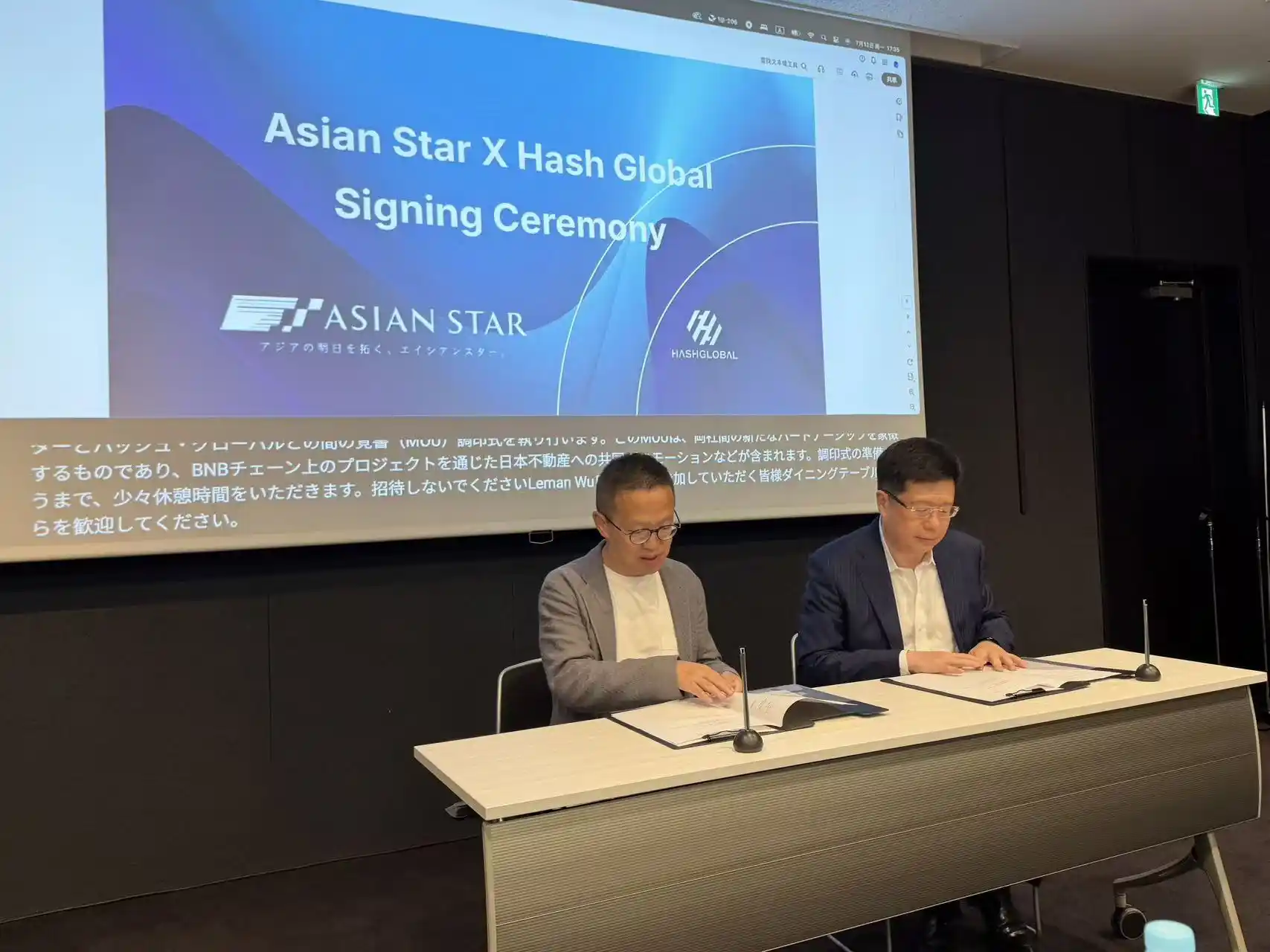
On July 13, 2026, during WebX, the "Japan RWA, Stablecoin, and BNB Ecosystem Closed-Door Exchange" was held in Tokyo. Organized by ASIAN STAR and co-hosted by Hash Global, with BNB Chain as the blockchain ecosystem partner, the event brought together Japanese traditional financial institutions, listed companies, real asset holders, stablecoin issuers, and Web3 infrastructure teams. Discussions centered on tokenizing real-world assets (RWA), stablecoin settlement, global distribution, and institutionalized on-chain finance. Speakers highlighted Japan's high-quality assets, such as real estate and REITs, and emphasized that RWA success depends on compliance, governance, valuation, and investor protection—not just tokenization. The industry is shifting from defining RWA to achieving scale, where tokenized assets must enable real financial activities like collateralization and lending. BNB Chain was presented as providing global distribution, stablecoin ecosystems, and on-chain liquidity infrastructure. A key synergy framework was proposed: combining Japanese asset quality and compliance with dollar/yen stablecoins and BNB Chain's global network. While Japan's security token market has seen issuance, greater connection to global Web3 liquidity is needed. Panels agreed that liquidity stems from trusted underlying assets, clear regulation, licensed partners, and robust distribution—not from tokenization alone. Compliance enables institutional capital entry. Stablecoins were identified as a crucial settlement layer for connecting Japanese assets to global capital, requiring trust, licensing, and reliable fiat channels. For initial RWA pilots, key elements include licensed partners, compliance tools, custody, investor suitability checks, stablecoin settlement, and real global distribution plans. The event concluded with ASIAN STAR and Hash Global signing a strategic MOU to collaborate on a Japanese real estate fund project within the BNB Chain ecosystem, exploring compliant issuance, on-chain settlement, and liquidity. The discussion marks a step towards building institutional-grade financial infrastructure for Japanese assets in the global Web3 space.

marsbit07/15 06:29
Japan RWA, Stablecoin, and BNB Ecosystem Closed-Door Exchange Meeting Held in Tokyo

marsbit07/15 06:29

活动图片