On July 13, 2026, during WebX, the "Japan RWA, Stablecoin, and BNB Ecosystem Closed-Door Exchange Meeting" was held at Toranomon Alcea Tower Conference in Tokyo. The event was hosted by ASIAN STAR and co-organized by Hash Global, with BNB Chain serving as the blockchain ecosystem partner. It brought together traditional Japanese financial institutions, listed companies, real-world asset holders, stablecoin issuers, and Web3 infrastructure teams for in-depth discussions on tokenizing real-world assets (RWA), stablecoin settlement, global distribution, and the institutionalization of on-chain finance.
From "Asset Tokenization" to Institutional Financial Infrastructure
In his opening remarks, Wu Wenwei, Chairman of ASIAN STAR, stated that Japan possesses high-quality real-world assets such as real estate, real estate trusts, fund equity, and REIT-related assets with stable cash flow and credit foundations. ASIAN STAR understands RWA as the digitization and global distribution of assets under compliance, not just simple token issuance; governance, valuation, information disclosure, KYC/AML, and investor suitability management are essential foundations for connecting Japanese assets to the global on-chain financial system.
During the keynote speech session, Sean Wu discussed the liquidity potential of Japan's approximately 300 trillion yen real estate market. He introduced ASIAN STAR's approach of using structures like Japanese GK-TK to advance asset isolation, tax efficiency, and compliance management. Combined with BNB Chain's low-cost settlement, institutional-grade custody, and DeFi protocols, this aims to further equip real estate and trust equity with capabilities for automated profit distribution, collateralized financing, and reinvestment. Relevant market size and yield data were shared on-site.
Zach, a representative of BNB Chain, pointed out that the RWA industry is shifting from explaining "what RWA is" to solving "how to achieve scale." Tokenized assets with genuine financial value should not remain merely digital certificates in wallets but should be able to enter real financial scenarios such as collateralization, lending, payment, and settlement. BNB Chain hopes to provide more efficient distribution and application infrastructure for Japanese assets through its global user network, stablecoin ecosystem, and on-chain liquidity.
KK, Founder of Hash Global, proposed a synergistic framework of "Japanese high-quality assets + USD/JPY stablecoins + BNB Chain global liquidity": the Japanese market is responsible for asset authenticity, compliance, and investor protection, while the public chain ecosystem provides international distribution, settlement efficiency, and subsequent liquidity. He also defined BNB as a "value-utility token" that captures value while having practical uses, suggesting it is gradually becoming the most core foundational asset in an open financial system.
Kimio Mikazuki, Representative Director and CEO of Osaka Digital Exchange, shared the current development status of Japan's Security Token market. According to his on-site introduction, the cumulative issuance scale of Security Tokens in Japan is approximately 350 billion yen, primarily composed of real estate beneficiary securities and corporate bonds; meanwhile, the market is still dominated by private chains and traditional broker distribution, leaving significant room for expansion in connecting with global Web3 users, public chain ecosystems, and on-chain secondary liquidity.
Liquidity Begins with Trust, Compliance, and Quality Assets
The first panel discussion, "Tokenization of Real-World Assets and Compliance Boundaries," was moderated by Zhou Ruoyun, Head of Antalpha Japan, with participants including Kimio Mikazuki, Henry (Founder and Group CEO of DigiFT), Kunaal (Head of Institutional Business for Asia Pacific, Middle East, and North Africa at Ondo Finance), and Bridget (CEO of Asseto). The consensus formed by the panelists was: "tokenizing" assets is not the end goal; liquidity first stems from credible underlying assets and genuine two-way trading demand, and relies on clear regulation, licensed partners, institutional custody, information disclosure, cross-market distribution, and market-making mechanisms.
Participants also pointed out that compliance is not just a cost or restriction but forms the infrastructure for institutional capital entry, asset security, and accountability tracing. For RWA projects, the focus should first be on verifying asset quality, product-market fit, and global distribution capabilities before choosing a suitable tokenization structure, avoiding "tokenization for tokenization's sake."
Stablecoins Become the Key Settlement Layer Connecting Japanese Assets and Global Capital
The second panel, "Stablecoins, On-Chain Settlement, and Global Liquidity," was moderated by KK, with participants including Seihaku Yoshida (Founder and CEO of HashPort), Jong (representative of BNB Chain), and Athena Yu (CEO of United Stables). The discussion focused on how Japanese Yen stablecoins can evolve from domestic payment tools into channels for cross-border settlement and global distribution of Japanese assets.
Panelists believed that the primary foundation for stablecoins is trust, encompassing brand, licenses, AML systems, reserve management, and predictable minting and redemption mechanisms. On this basis, issuers also need to build reliable fiat on-ramp/off-ramp channels, cross-currency liquidity pools, and partner distribution networks. As the supply and usage scenarios of Japanese Yen stablecoins gradually expand, they are expected to form more efficient on-chain settlement loops with assets like Japanese real estate, listed stocks, and money market funds.
align="justify">Regarding the implementation conditions for Japanese RWA pilot projects, attendees suggested that the initial projects need to simultaneously possess clear licensed partners, compliance and privacy tools, institutional custody, investor suitability management, stablecoin settlement, fiat channels, as well as genuine global distribution and secondary liquidity solutions. High-quality assets, credible institutions, and a relatively clear regulatory foundation are the core advantages of the Japanese market; connecting with global on-chain capital and users is the key issue to be addressed in the next phase.Signing Strategic Cooperation MOU to Jointly Advance Japanese Real Estate Fund Project
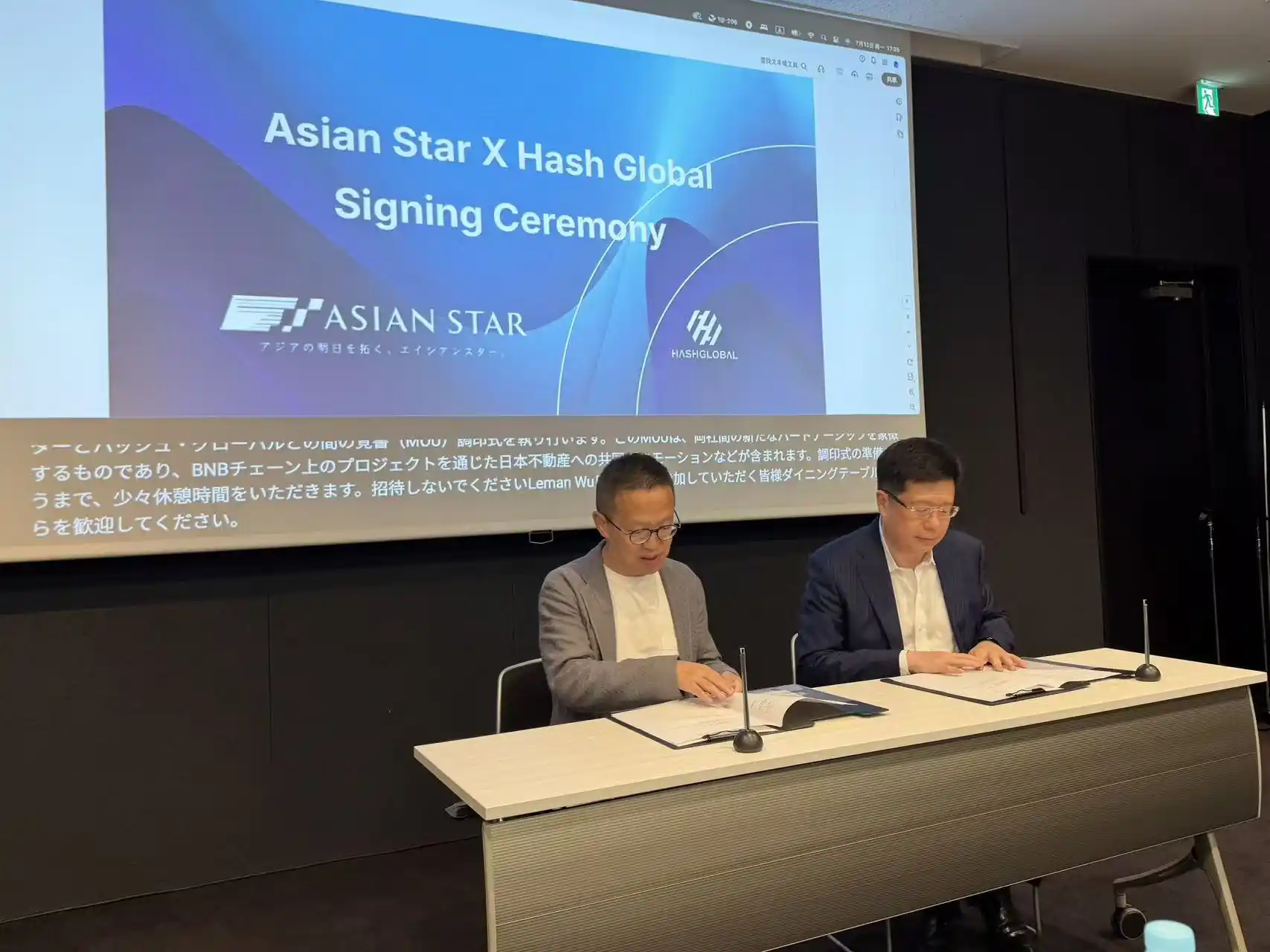
At the end of the event, ASIAN STAR and Hash Global held a strategic cooperation MOU signing ceremony. Chairman Wu Wenwei and KK represented both parties in signing and exchanging documents. According to information announced on-site, the two parties will collaborate on the development of Japanese real estate fund projects within the BNB Chain ecosystem, further exploring synergistic pathways for compliant asset issuance, on-chain settlement, global distribution, and liquidity construction.
This closed-door exchange meeting continued discussions following the previous BNB Institutional Forum in Hong Kong and established more concrete cooperative dialogue among Japanese traditional financial institutions, asset holders, stablecoin issuers, and the public chain ecosystem. As regulation, institutional participation, and on-chain infrastructure gradually mature, the opportunity for RWA in Japan is no longer limited to "digitizing assets" but extends to building institutional financial infrastructure covering issuance, settlement, distribution, trading, collateralization, and asset management. ASIAN STAR, Hash Global, and BNB Chain ecosystem partners will continue to promote the connection between high-quality Japanese assets and global Web3 capital, facilitating the broader on-chain application of real-world assets.