Kalshi's Daily Stock Open Interest Hits Record High of $17.98 Million

cryptonews.ruPubblicato 2026-08-14Pubblicato ultima volta 2026-08-14

Introduzione

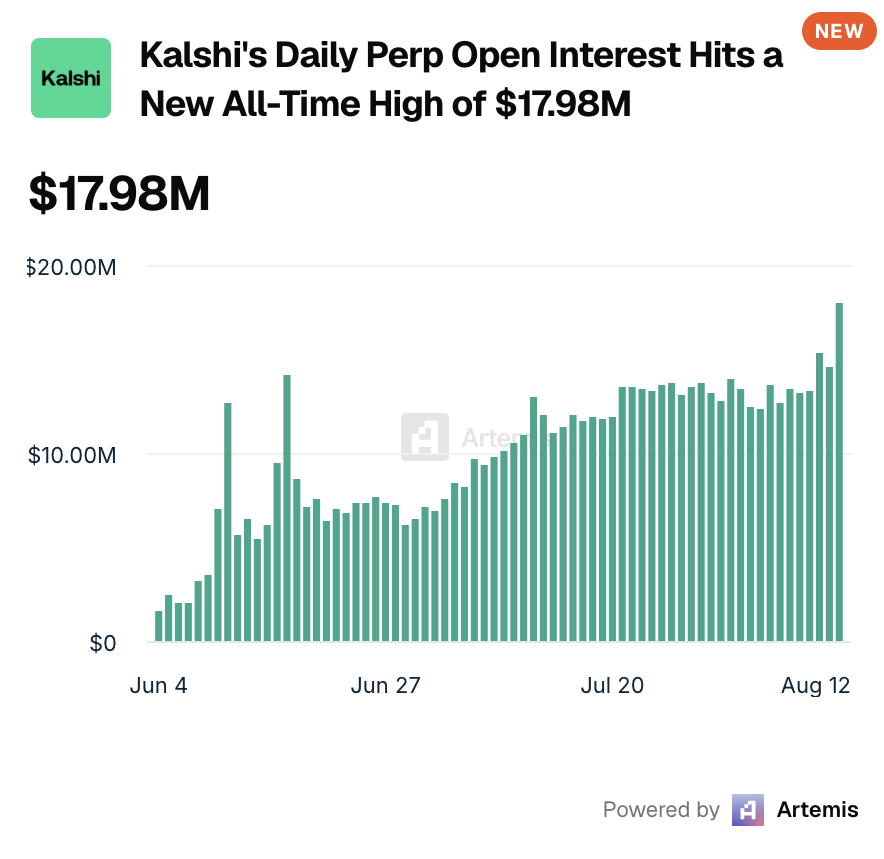
Kalshi's daily open interest for its perpetual futures product hit a record $17.98 million on August 12th, just over two months after its launch. The CFTC-approved platform, which began with Bitcoin and Ethereum contracts in early June, now lists 13 crypto assets. Open interest remained below $5 million initially, saw mid-June spikes to $13-14 million, stabilized around $6-7 million, and has steadily climbed since July, consistently holding above $12 million in recent weeks. This growth indicates sustained trader engagement on a platform that recently offered only short-term binary contracts. Despite this rapid growth, Kalshi's total crypto perpetuals portfolio is small in scale, representing about 0.15% of rival Hyperliquid's $11.7 billion daily open interest. The comparison is structurally limited: each Kalshi contract requires federal regulatory pre-approval, resulting in a small list, whereas permissionless platforms like Hyperliquid support hundreds of pairs. The concentrated open interest on Kalshi's few approved contracts signals strong demand within its specific niche. Analysts suggest Kalshi is not cannibalizing existing decentralized exchange volume but is tapping a previously underserved pool of U.S.-based traders who lacked a legal, leveraged crypto platform. The true size of this new user pool remains unknown. While a market downturn could disrupt the trend, the open interest chart has so far shown consistent upward momentum.

Kalshi's perpetual futures product launched on June 3rd, with BTCPERP becoming the first perpetual contract approved by the CFTC for traders from the US. Ether launched on June 4th, XRP on June 10th, and now the list covers 13 crypto assets. This week, on August 12th, daily open interest for perpetual futures closed at $17.98 million, a historic high for a product that didn't exist three months ago.
Source: Artemis

Open interest was under $5 million during the first week of June, with two peaks reaching $13 and $14 million mid-month, then dropped to the $6-7 million range where it stayed until the end of June. The following month, specifically in the second week of July, there was a jump as daily bars closed above $10 million, holding in the $12-14 million range for the last three weeks.

Interest Rate Hike More Important Than Election Results

A single large option on the new platform typically indicates several large positions that could have been closed over a few days. However, the chart doesn't show this. The lower bound of the range continues to rise, meaning traders are holding risk on a platform that just ten weeks ago only offered short-term binary contracts.

There is certainly demand for Kalshi's services, and another telling sign is sales volume. The notional value of Kalshi's services surpassed $1 billion within a week of launch. Compared to contracts on the events the platform built its reputation on, it took 40 months to reach that figure.

$17.98 Million Next to $11.7 Billion

Despite Kalshi Perps' impressive performance since launch, it's important to keep perspective. According to DefiLlama, Hyperliquid's 24-hour open interest is $11.7 billion with a daily trading volume of $7.17 billion. Kalshi's entire Perps portfolio is roughly 0.15% of that amount. Individual large players on Hyperliquid have positions exceeding Kalshi's total open interest across all its crypto markets combined.

The difference isn't just size. CoinGecko states Hyperliquid offers 377 perpetual trading pairs. Its HIP-3 segment, covering non-crypto markets created by a single developer, has over $4 billion in open interest. This is just one segment of one developer's markets and is more than 200 times larger than Kalshi's total markets.

Every New Stock Listing on Kalshi Starts with an Application

Kalshi's small contract list is for structural reasons. Every contract it lists must be vetted by a federal regulator before a single trade can be made. Hyperliquid deploys markets permissionlessly, so it can support 377 pairs and add new ones at a user's whim.

This is also a fair assessment of the $17.98 million figure. This number isn't low due to lack of demand. It's low because there's almost nothing to trade, and what there is took months of work with regulators to get on the exchange. Concentrating this much open interest on so few contracts is a very different signal than spreading it across hundreds.

In any case, the comparison everyone makes is wrong. Kalshi isn't taking flow from Hyperliquid. It's taking flow from US traders who previously had no legal venue at all to use crypto leverage, and who were either offshore, using a VPN, or just sitting on the sidelines. This pool is separate, and no one knows how large it is.

A period of stagnant or falling prices through the end of August could disrupt this trend. So far, the chart hasn't shown it.

end-content

Crypto di tendenza

Domande pertinenti

QWhat is the significance of Kalshi's daily open interest reaching $17.98 million according to the article?

AThe $17.98 million daily open interest for Kalshi's perpetual futures is a historical high for a product that didn't exist three months prior. It signifies strong initial growth and sustained trader interest in the regulated platform.

QHow does Kalshi's open interest and volume compare to a platform like Hyperliquid?

AKalshi's entire perpetuals portfolio of approximately $17.98 million in open interest is about 0.15% of Hyperliquid's $11.7 billion 24-hour open interest. Individual large positions on Hyperliquid can exceed Kalshi's total crypto open interest.

QWhat key structural difference between Kalshi and platforms like Hyperliquid limits Kalshi's number of contracts?

AEach contract on Kalshi must be approved by federal regulators (CFTC) before trading can begin. In contrast, platforms like Hyperliquid deploy markets permissionlessly, allowing them to support hundreds of trading pairs.

QAccording to the article, where is Kalshi primarily drawing its trading volume from?

AKalshi is drawing volume primarily from US-based traders who previously had no legally compliant platform to use leverage for crypto trading. These traders were either trading overseas, using VPNs, or not trading at all.

QWhat does the article suggest about the nature of the open interest growth on Kalshi, based on the chart data?

AThe chart shows that the lower bound of the open interest range has been consistently rising. This indicates traders are maintaining risk positions over time, rather than the growth being driven by a few large, short-term option positions.

Letture associate

Staking Inflation Reforms Trap Ethereum and Solana

The article discusses the "Morton's Fork" dilemma facing both Ethereum and Solana, where both blockchains must choose between two paths that lead to the same outcome: increased centralization of their validator networks. Ethereum researchers have proposed EIP-8363, a "Progressive Issuance Burn" plan. It would gradually increase the proportion of validator rewards burned as the total staked ETH rises, aiming to reduce new token issuance. If staking reaches 50% of the supply, rewards would drop to zero. This proposal has faced strong opposition from major staking service providers and DeFi platforms (e.g., Aave, ether.fi), as staking yields form a crucial base rate for DeFi leverage strategies. Critics argue slashing rewards would first hurt small, individual node operators due to fixed operational costs, accelerating centralization. Solana faces a similar challenge. Its validators have fixed costs but rely heavily on token issuance for rewards (only ~13% of validator income comes from fees). Two current proposals, SIMD-0550 and SIMD-0553, aim to accelerate the reduction of its inflation rate and increase fee burns, respectively. A vote concludes on August 18th. The core conflict is between large token holders (whose assets are diluted by issuance) and the concentrated staking industry that depends on high yields. While reducing issuance could curb the influx of capital into centralized staking services, it could also force out smaller validators first. The article concludes that as blockchains grow into large financial systems, underlying economic forces—yields, leverage, and operational costs—ultimately constrain their original design visions and push them toward centralization, regardless of the specific policy path chosen.

marsbit1 h fa

Staking Inflation Reforms Trap Ethereum and Solana

marsbit1 h fa

Trading

Spot

Articoli Popolari

Come comprare T

Benvenuto in HTX.com! Abbiamo reso l'acquisto di Threshold Network Token (T) semplice e conveniente. Segui la nostra guida passo passo per intraprendere il tuo viaggio nel mondo delle criptovalute.Step 1: Crea il tuo Account HTXUsa la tua email o numero di telefono per registrarti il tuo account gratuito su HTX. Vivi un'esperienza facile e sblocca tutte le funzionalità,Crea il mio accountStep 2: Vai in Acquista crypto e seleziona il tuo metodo di pagamentoCarta di credito/debito: utilizza la tua Visa o Mastercard per acquistare immediatamente Threshold Network TokenT.Bilancio: Usa i fondi dal bilancio del tuo account HTX per fare trading senza problemi.Terze parti: abbiamo aggiunto metodi di pagamento molto utilizzati come Google Pay e Apple Pay per maggiore comodità.P2P: Fai trading direttamente con altri utenti HTX.Over-the-Counter (OTC): Offriamo servizi su misura e tassi di cambio competitivi per i trader.Step 3: Conserva Threshold Network Token (T)Dopo aver acquistato Threshold Network Token (T), conserva nel tuo account HTX. In alternativa, puoi inviare tramite trasferimento blockchain o scambiare per altre criptovalute.Step 4: Scambia Threshold Network Token (T)Scambia facilmente Threshold Network Token (T) nel mercato spot di HTX. Accedi al tuo account, seleziona la tua coppia di trading, esegui le tue operazioni e monitora in tempo reale. Offriamo un'esperienza user-friendly sia per chi ha appena iniziato che per i trader più esperti.

604 Totale visualizzazioniPubblicato il 2024.12.10Aggiornato il 2026.06.02

Come comprare T

Discussioni

Benvenuto nella Community HTX. Qui puoi rimanere informato sugli ultimi sviluppi della piattaforma e accedere ad approfondimenti esperti sul mercato. Le opinioni degli utenti sul prezzo di T T sono presentate come di seguito.

活动图片