Hidden Landmines Beneath the AI Boom: Hints of the Next 'Subprime' Crisis

marsbitPubblicato 2026-08-10Pubblicato ultima volta 2026-08-10

Introduzione

The article warns of a potential "AI subprime" crisis brewing beneath the rapid growth of AI infrastructure. Unlike the dot-com bubble fueled by equity, the current AI boom is largely debt-financed, resembling a real estate development cycle. Tech giants like OpenAI sign massive, multi-year "take-or-pay" contracts for computing power, which cloud providers then use as collateral to secure debt for building data centers. This creates a fragile chain reliant on continuous refinancing, as many AI labs are not yet profitable. The structure is dangerously similar to the 2008 financial crisis: long-term commitments ("shadow loans") are packaged into asset-backed securities, while underlying cash flows depend on unproven, future AI demand. Key players like Amazon and Google have seen free cash flow turn negative, shifting them toward debt-dependent financing models. The core risk is a mismatch: AI's rapid technological obsolescence and uncertain profitability are combined with the high leverage and cyclical risks of real estate. A slowdown in the growth *rate* (a negative second derivative) of AI demand could trigger a debt crisis, as lenders pull back when refinancing becomes unsustainable. The article concludes that while AI's long-term promise remains, its medium-term danger is a debt bubble inflated by capital expenditure outpacing genuine revenue.

The AI industry is still primarily driven by large-scale infrastructure build-out, funded largely by debt. This is a key difference from the Internet bubble era, which relied mainly on equity financing.

The bursting of the Internet bubble in 2000 triggered a stock market crisis. If a future AI bubble bursts, the initial shock would likely occur in the bond market. However, this doesn't mean the stock market would be immune, as the 2008 financial crisis was ignited by the subprime mortgage crisis.

The difference lies in the speed of the collapse.

The 2000 dot-com bust involved a valuation collapse—a linear process with massive daily trading volume, allowing investors to sell at any time. A bear market could last years. Equity is patient capital; investors can hold on, waiting for companies to recover.

In contrast, debt exhibits negative convexity. No matter how well a company performs, creditors only receive fixed interest payments. But if performance deteriorates, they face potentially unlimited losses. Therefore, debt covenants have binary, hard triggers—it's either 0 or 1, with no middle ground. Either a company can successfully refinance, appearing as if nothing is wrong, or it can quickly face asset seizures, with bond prices plummeting to zero in days.

A simple example: the accounting figure "Remaining Performance Obligations" (RPO). An equity investor might treat it as future revenue and assign some valuation. But a debt investor would scrutinize who will fulfill these future orders and how.

The current debt chain in AI infrastructure roughly follows this pattern:

Leading AI labs like OpenAI sign contracts with Microsoft, committing to pay hundreds of billions over several years for computing power. However, OpenAI lacks sufficient cash, so this is essentially a "financed order," similar to an airline's aircraft leasing financing.

The major cloud providers, data centers, and computing leasing companies then use these contracts as collateral to borrow from private institutions, raising funds for data center construction and GPU procurement.

Stripping away the AI hype, AI infrastructure is essentially a chain of credit leverage. Financial institutions advance capital for buildings full of chips, with data centers as collateral and AI lab contract payments as debt service. This structure functions only if the AI labs at the order's origin can continuously fund these payments.

But for an unprofitable company, where revenue (ARR) is less than expenditure (orders), it must rely on constant fundraising to survive.

If you were a bond analyst, seeing a company losing tens of billions annually, surviving only through continuous refinancing, these "remaining performance obligations" are essentially subprime commitments used to justify massive, not-yet-depreciated capital expenditures.

Naturally, this brings to mind the subprime mortgage crisis that triggered the 2008 financial crash.

In just a few years, OpenAI has committed to unprecedented computing costs, with total debt potentially reaching trillions—unprecedented in corporate history. Roughly half of the approximately $2.1 trillion in backlogged contracts held by the top five cloud platforms are commitments from OpenAI and Anthropic, an unprecedented level of concentration.
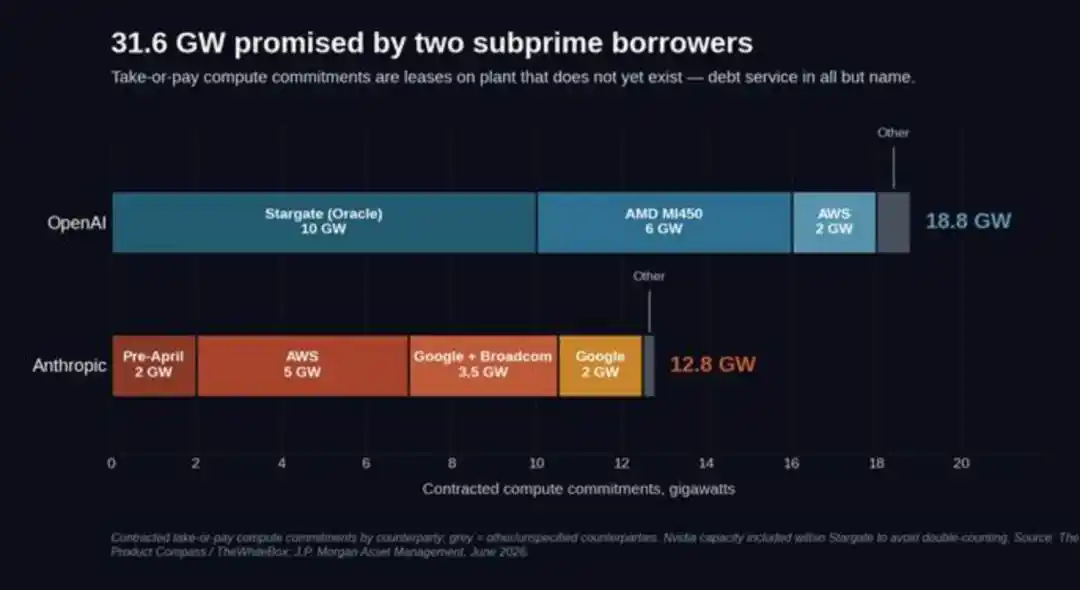
Corresponding to this debt is an operational business with unpredictable profitability. While its revenue is real, large, and growing rapidly, its only hope for success is continuously finding explosive growth avenues like coding. This is a century-spanning gamble dragging even tech giants into the fray.

Thus, the true root of this potential crisis is that AI, as a technological revolution, is being funded through a very traditional, credit-driven real estate finance model.

Yes, AI infrastructure is essentially real estate. That's why, after studying the 2000 dot-com bust in the previous piece "The Last 120 Days of the Tech Bubble," we now examine 2008.

2/4

The Real Estate Core of the AI Industry

Technological revolutions and real estate cycles should be worlds apart.

Tech revolutions are driven by innovation and adoption rates, high-risk with high potential rewards upon success, making them most suitable for equity financing like venture capital.

Real estate cycles are mechanical, value determined by land and space, with fixed profits. Future income can be locked in via commercial leases or pre-sales. Long investment horizons and massive capital requirements make them most suitable for debt financing.

But scrutinizing AI infrastructure reveals its every characteristic mirrors real estate development:

Building data centers on approved land requires massive upfront investment, necessitating debt financing from the start—akin to a development loan.

Then, signing "take-or-pay" contracts with large clients and using these contracts as collateral for more funding—akin to later-stage project financing.

"Take-or-pay" contracts: e.g., an AI company commits to buying $100 million in computing power annually for 5 years. Even if model training demand is lower or user growth lags, payment is mandatory. This is because data center investment is huge; builders need predictable future cash flow. It's similar to office towers or malls securing anchor tenants before applying for bank loans.

It doesn't end there. After purchasing and installing GPU racks, cloud providers mortgage them for GPU financing to support operations—akin to commercial real estate operational loans.

But the financing value isn't fully extracted. The final step for cloud providers and data centers is issuing "Asset-Backed Securities" (ABS), packaging future cash flows to sell to insurers, pension funds, and other conservative investors—somewhat similar to real estate REITs.

ABS-packaged assets were precisely what allowed subprime mortgage risks to spread from real estate to the entire financial system.

This is essentially the universal playbook for all capital-intensive industries: using layered collateral, packaging future cash flows, and completing construction with leveraged funds. It has nothing to do with being a tech company or a technological revolution.

But applying this to cutting-edge tech like AI creates problems.

Both real estate and tech experience bubbles, but their causes are entirely different.

Tech bubbles stem from new technologies being too far ahead of their time or lacking large-scale real demand, causing their value to plummet.

Real estate bubbles result from cyclical mismatches. Investment peaks typically occur during economic booms, with financing amounts based on linear extrapolations of boom-time cash flows. Long construction cycles mean projects often become operational when the market is already oversupplied, generating insufficient cash flow to service debt, triggering a crisis.

The associated risks are also completely different:

The primary risk in tech investment is product failure. High upfront R&D costs, but high barriers if successful.

The risk in real estate investment lies on the balance sheet—leverage risk. Land value depends on location, fluctuating but rarely disappearing entirely, with slow depreciation. The key is that leverage doesn't break before the next cycle arrives.

Therefore, "AI + infrastructure" is even more dangerous, combining the inherent technology risk of tech investment with the leverage risk of real estate. Its data centers are specialized assets with limited alternative uses. The mortgaged GPU clusters face rapid technological obsolescence, potentially losing significant value in just two years. ABS assets packaged from AI operating income are based on theoretical future revenue.

Moreover, amid the "arms race" of capital expenditure, the current financing pace mirrors real estate bubble dynamics. Assuming AI computing demand grows 50% annually, financing is also based on this cash flow projection.

This is similar to land auctions in recent years: with nearby二手房 (secondary housing) at 100,000 per square meter, developers dared bid 120,000 for land, believing prices would rise to 120,000 by project completion.

Cloud providers are increasingly becoming real estate companies in the computing business, at least in their financial structure, rather than traditional internet firms.

Of course, this risky financing game persists mainly because the top five cloud providers are among the world's highest-valued companies, each with a core business generating massive cash flow. Investors don't believe these tech giants could face a debt crisis.

But consider: why was China Vanke long considered a premium blue-chip stock in the A-share market? Because real estate's primary risk stems from debt, even off-balance-sheet debt. They rarely raise equity and compensate shareholders with high dividends (essentially a small compensation for high leverage). Their risk is non-linear: as long as debt doesn't blow up, they remain premium blue-chips; once debt implodes, they become worthless overnight.

We must understand that debt accumulation is a linearly increasing mathematical process. Greater strength only means a longer pre-crisis period. Technological revolution is a non-linear process, potentially accelerating suddenly or stalling abruptly. Expecting the latter to solve the former's problems is like assuming the hare, prone to naps, will always win the race against the tortoise.

Bond investors are the world's most pessimistic group. They become alert when the second derivative of growth declines, never waiting for the hare to fall asleep.

3/4

Why the Second Derivative Matters More

Conventionally, the 2008 subprime crisis is attributed to lax lending standards, falling home prices causing borrowers to become underwater, subsequent defaults, and the eventual blow-up of ABS securities based on these loans.

In reality, default rates began rising while home prices were still increasing, just at a slower pace. This is positive first-derivative growth, but a declining second derivative (rate of growth).

This relates to the mechanics of subprime mortgages. Borrowers enjoyed extremely low "teaser" rates for the first three years, making payments affordable. After three years, if home prices had risen, borrowers could refinance based on the increased equity, securing a new low teaser rate and restarting the cycle. Nearly four-fifths of subprime hybrid adjustable-rate mortgages issued in 2003 were refinanced by late 2006.

But this game required one premise: home prices must perpetually rise, ensuring loans never reached the interest rate reset point, or borrowers couldn't afford the payments.

By 2006, home prices were still rising, but the growth rate had slowed compared to previous years. This meant prices had stagnated in some areas. Some households couldn't refinance and couldn't afford the reset rates. Subprime loan delinquency rates began rising precisely then.
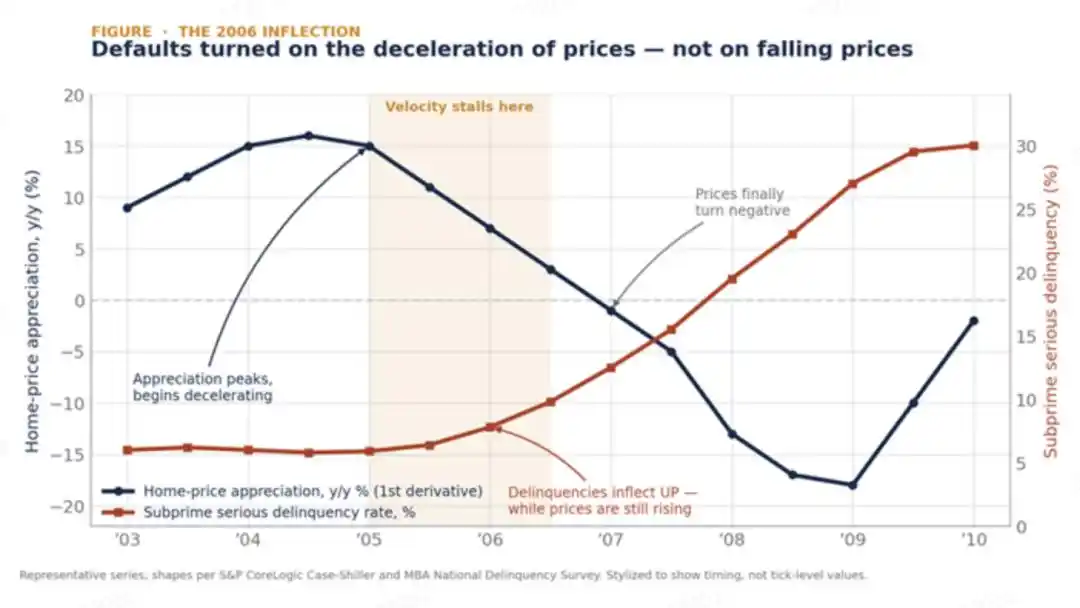
There exists a "borrowed time window" between the decline of the second derivative and the first derivative turning negative. During this window, everything appears rosy—revenue at record highs, growth still positive. Yet, a future crisis has already become inevitable.

Here, we can introduce Hyman Minsky's financial instability hypothesis. Minsky argued that "stability is destabilizing." Long periods of economic prosperity foster overly optimistic expectations, gradually shifting financing structures from robust to highly leveraged, refinance-dependent models, ultimately triggering a "Minsky Moment."

Based on a firm's debt-servicing ability, Minsky categorized financing into three regimes:

1. **Hedge financing:** Operating cash flow is sufficient to cover both principal and interest payments.

2. **Speculative financing:** Cash flow covers only interest, not principal. The firm must continuously roll over debt.

3. **Ponzi financing:** Operating cash flow is insufficient to cover even interest payments.

A decline in the second derivative of demand growth corresponds to a shift from Regime 1 to Regime 2. The first derivative turning negative signifies a full transition to Regime 2, making it difficult for the firm to return to Regime 1 through its own efforts.

Examining the top five cloud providers' Q2 reports reveals three categories:

Google and Amazon's free cash flow has turned negative, meaning AI capex growth has temporarily outpaced core business cash flow growth. They have just entered Regime 2 this quarter.

Microsoft and Meta remain in Regime 1, but risk entering Regime 2 soon if capex isn't controlled.

Oracle has long been a Regime 2 firm. Its debt service coverage ratio (present value of debt principal & interest / operating cash flow) is only 48%, resembling a capital-intensive real estate company more than a high-tech firm.

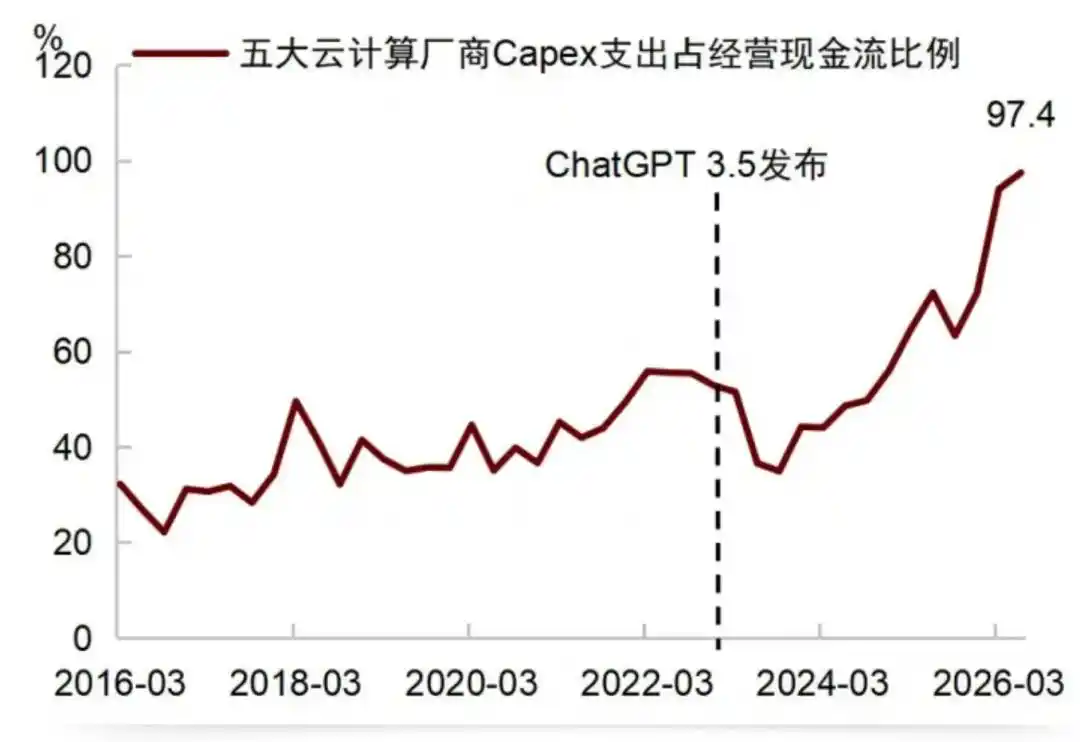
The conclusion is stark: when capital expenditure exceeds 100% of operating cash flow, further accelerated expansion means borrowing more money at an even faster pace each quarter. Over the next year, hyperscale cloud providers must dramatically increase debt issuance. The entire AI infrastructure build-out will become entirely dependent on the bond market for marginal funding.

The situation might be worse than these numbers suggest. AI infrastructure shares another trait with real estate: much of its debt is hidden off-balance-sheet as "shadow loans."

4/4

Shadow Loans

A report from the Bank for International Settlements notes that large cloud providers are rapidly increasing their use of "shadow loans" to finance AI data centers.

"Shadow lending" often occurs via private credit. For instance, a large cloud provider might first establish a Special Purpose Vehicle (SPV) or joint venture with a consortium to acquire or build data center assets, holding only a minority stake. The cloud provider commits to long-term operating leases or computing power purchase agreements and provides credit guarantees. Debt is serviced by lease cash flows.

This risk mirrors off-balance-sheet project financing by real estate companies. If, upon completion, AI computing demand is insufficient to cover long-term lease costs, the guaranteed contingent liabilities will surface, creating new debt.

Some institutions estimate this implicit debt at approximately $1.65 trillion. While these cloud providers emphasize that their cloud service backlogs remain ample and, if fulfilled as planned, should cover related lease liabilities, we have already analyzed what "unfulfilled orders" represent.
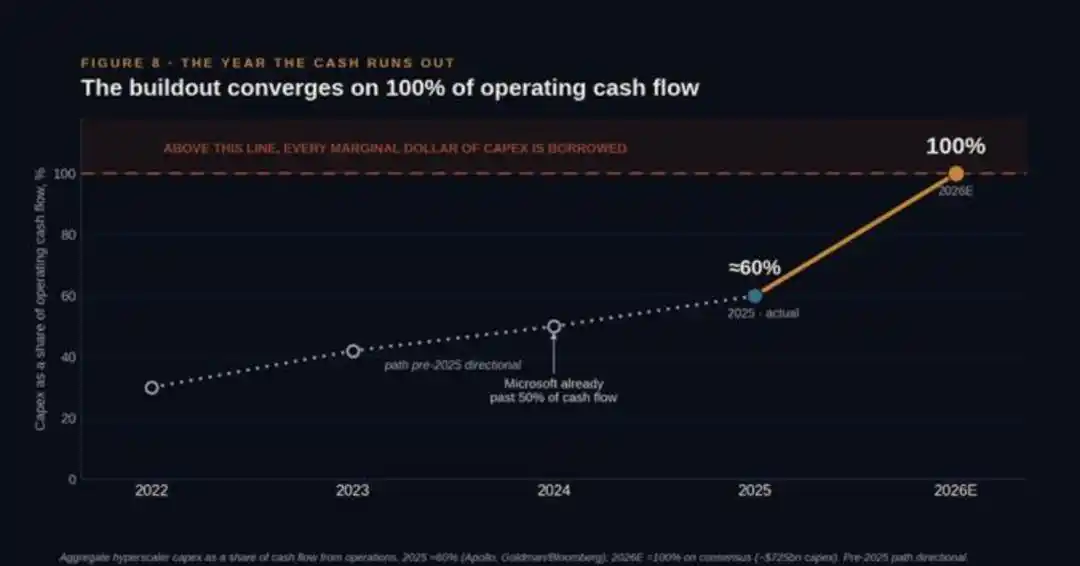
In summary, starting this year, with continued AI capex expansion, the financing structure of the top five cloud providers is shifting. Their financing mode is transitioning from internal to external funding, marking a metamorphosis from tech companies to real estate entities. They now possess "the capital intensity of real estate" and "the rapid depreciation of semiconductors," yet are still valued as tech stocks.

The Minsky Moment hasn't arrived, but a "financing migration" in the Minsky sense has begun. Most problems trace back to the two leading AI labs at the source. The next explosive demand will undoubtedly emerge, but the crucial factor is timing.

Finally, we return to the opening premise: don't conflate stock and bond risks.

Equity investors consider: Does AI have technological value? What future revenue and profits can it generate?

Creditors consider: Can the future cash flows from AI's massive fixed asset investments cover their capital costs?

AI's long-term risk is insufficient demand, but the mid-to-short-term accumulating risk is that the pace of capital expenditure is outstripping the pace of genuine cash flow generation.

In the next piece, I will analyze which of the two top AI labs is more vulnerable to crisis and identify the five most fragile moments when a debt crisis could emerge.

This article is from the WeChat public account "lig0624" (ID: sxgy9999), author: Thought Seal.

Crypto di tendenza

Domande pertinenti

QWhat is the core argument about the funding structure of the AI industry presented in the article?

AThe core argument is that the current AI industry, particularly its infrastructure build-out (like data centers and compute power), is primarily funded by debt rather than equity. This structure resembles traditional real estate or heavy asset financing, where future cash flow promises (like AI service contracts) are leveraged through layered debt instruments. This creates a significant systemic risk similar to the 2008 subprime mortgage crisis, as the entire chain depends on continuous financing and the ability of AI labs (like OpenAI) to generate future revenue to pay for their massive commitments.

QHow does the financing structure of the current AI boom differ from that of the 2000 dot-com bubble?

ADuring the 2000 dot-com bubble, the primary source of funding was equity financing (venture capital and stock market investments). In contrast, the current AI infrastructure boom is largely driven by debt financing. The article argues this difference is crucial: a bubble burst in an equity-driven market leads to a linear decline in stock valuations, while a crisis in a debt-driven structure could trigger a sudden, non-linear collapse in bond markets due to the negative convexity and hard contractual triggers inherent in debt instruments.

QAccording to the article, why is the 'second derivative' (acceleration of growth) critically important in assessing the AI debt risk?

AThe article uses the concept of the 'second derivative' (the rate of change of the growth rate) to explain the early warning signs of a debt crisis. It draws a parallel to the 2008 subprime crisis, where mortgage defaults began rising not when housing prices fell, but when their rate of price *increase* slowed down (positive first derivative, negative second derivative). Similarly, for AI infrastructure debt, a slowdown in the *acceleration* of AI demand or cash flow growth could be the first sign of trouble. This is because the financing model often depends on constant refinancing based on the expectation of perpetually accelerating growth to cover obligations. A decline in the second derivative signals that this refinancing mechanism is becoming vulnerable, creating a 'borrowed time window' before a potential crisis.

QWhat does the article mean by stating that 'AI infrastructure is essentially real estate'?

AThe article asserts that AI infrastructure financing shares the fundamental characteristics of real estate development, not traditional tech venture financing. The process involves: securing capital (like development loans) to build specialized physical assets (data centers), signing long-term 'take-or-pay' contracts with tenants (AI labs/companies) to guarantee future cash flow, using those contracts as collateral for further loans, and potentially securitizing the future cash flows into asset-backed securities (ABS). This entire structure is capital-intensive, relies on long-term debt, and depends on predictable rental-like income. The risk, therefore, combines the technological uncertainty of AI with the high-leverage, cyclical risks typical of real estate.

QWhat is the role of 'shadow lending' in the AI infrastructure financing landscape described in the article?

A'Shadow lending' refers to off-balance-sheet financing methods used by major cloud providers to fund AI data centers. This often involves setting up Special Purpose Vehicles (SPVs) or joint ventures with investment consortia. The cloud provider holds a minority stake but provides credit guarantees and signs long-term leasing or compute purchase agreements. The debt is held by the SPV and repaid by the lease cash flows. This hides significant leverage from the cloud provider's main balance sheet. The risk is that if future AI demand doesn't materialize to cover these lease costs, the guaranteed liabilities will surface, potentially causing a sudden debt crisis similar to the off-balance-sheet risks that plagued some real estate companies.

Letture associate

Chip Design: The 'Cash Flow Restructuring' and 'Capability Leap Window' of 'Institutional Rents'

Chip Design: The "Cash Flow Reconstruction" and "Capability Leap Window" of Institutional Rents The first half of 2026 saw extreme divergence in China's chip design sector. While companies like Jiangbolong and GigaDevice reported massive profit surges, others like StarPower saw sharp declines. This disparity stems not from market cycles, but from a fundamental "institutional rent" transfer—profits were systematically shifted from downstream manufacturers (the payers) to upstream design firms (the recipients) due to supply constraints and policy-driven "domestic substitution" mandates. For decades, China's chip design industry was trapped in a vicious cycle: no revenue without customers, no R&D without revenue, and no competitive products without sustained R&D, leading to perpetual cash flow crises. Crucially, this institutional rent, though distorting short-term competition, has inadvertently broken this deadlock. It has created a "cash flow reconstruction," funneling steady, policy-backed income to design houses for the first time. This generates a critical "capability leap window"—a structural, long-term opportunity (potentially lasting over five years due to prolonged chip shortages and tightening export controls) for companies to invest rents into long-cycle R&D (e.g., automotive-grade, AI chips) rather than short-term speculation. Policy is also evolving from simple procurement subsidies to "ecosystem binding," forcing adoption and integration of domestic chips. Conversely, rent-paying downstream firms face a painful but necessary "market clearing," forced into genuine competition and efficiency drives, which may spur deeper industry collaboration. Importantly, companies like Montage Technology and Fudan Microelectronics show growth based on real technological breakthroughs and market demand, not just policy rents, signaling the potential for independent capability growth. The conclusion is that institutional rent is not an end but a means. The core investment thesis shifts from betting on rent persistence to identifying companies that successfully transform this reconstructed cash flow into proprietary technology and autonomous market viability. While a shakeout is imminent as certain mechanisms reverse, a new generation of technologically independent firms is quietly emerging under the cover of this rent-fueled window.

marsbit35 min fa

Chip Design: The 'Cash Flow Restructuring' and 'Capability Leap Window' of 'Institutional Rents'

marsbit35 min fa

Karpathy Says It Will Take Another Decade, But This Road Is Already Packed

The article discusses the intensifying focus on **Continual (or Lifelong) Learning** for large language models (LLMs), a capability seen as crucial for developing truly useful "AI colleagues." It references Andrej Karpathy's 2025 assessment that overcoming LLMs' lack of persistent memory and learning might take a decade. The core challenge is **catastrophic forgetting**, where learning new information erases previously acquired skills. Current research diverges into several technical paths: 1. **External Memory Systems:** Storing new knowledge in external databases (e.g., MemGPT, Letta's approach, Karpathy's "LLM Wiki"), akin to enhanced RAG. This is safe but doesn't "internalize" knowledge. 2. **Context Engineering:** Evolving the input context itself into a growing "playbook," as seen in ACE (Agentic Context Engineering), which uses execution feedback to refine instructions without weight updates. 3. **Continual Post-Training:** Carefully updating model weights (e.g., via LoRA) to internalize knowledge, using techniques like Self-Distillation Fine-Tuning (SDFT) to mitigate forgetting. 4. **Continual Pre-training:** Updating the base model with new corpus data, which is compute-intensive and prone to forgetting. 5. **Novel Paradigms:** More radical approaches redefining learning itself. These include models that generate their own training data and update instructions (e.g., SEAL), architectures with nested, multi-timescale learning (e.g., Google's Nested Learning/Hope), and the vision of an "Era of Experience" where AI learns from self-generated interaction data. The article suggests a pragmatic, hybrid future is likely: short-term, mutable knowledge handled by external memory/context, while long-term, solidified capabilities are encoded into model parameters via fine-tuning. While catastrophic forgetting remains unsolved, the field has evolved from a theoretical gap into an active arena with multiple competing approaches and emerging commercial products, all racing to bridge the gap to practical, continually learning AI agents.

marsbit40 min fa

Karpathy Says It Will Take Another Decade, But This Road Is Already Packed

marsbit40 min fa

U.S. Stocks Trend (August 10): Nonfarm Payrolls Drop by 23K, Inflation Takes Over to Test New Highs

US Stock Market Weekly Review (August 10th): Nonfarm Payrolls Drop by 23K, Inflation Takes Over Testing New Highs Last week, US stocks closed with their strongest weekly gains since mid-April, led by a tech rebound and adjusted rate expectations. The S&P 500 and Dow hit new record closing highs. Weekend developments centered on Strait of Hormuz negotiations, Berkshire Hathaway's capital deployment, and US government funding. The core focus this week shifts to whether incoming inflation data can justify current market pricing for interest rates. The July Nonfarm Payrolls report showed a loss of 23,000 jobs, missing expectations and leading to a decline in September rate hike probabilities. This eased pressure on tech valuations. However, discussions between Iran and Oman on Strait of Hormuz navigation are pending execution, and renewed attacks on energy facilities kept oil prices volatile, with potential implications for inflation. Berkshire Hathaway reported strong earnings and shifted its capital allocation strategy, ending a long streak of net stock sales and making significant new investments, including in Alphabet. The US Senate passed a stopgap funding bill, reducing near-term government shutdown risks. This week's calendar is dominated by key inflation readings (July CPI & PPI), retail sales data, and earnings from AI and tech infrastructure companies like CoreWeave, Lumentum, Cisco, and Applied Materials. The market expects CPI to show a moderation. If inflation data is benign, supporting stable or lower Treasury yields, and corporate earnings remain solid, indices may find further upside. Conversely, a resurgence in inflation or rising oil prices could trigger a swift reversal in interest rate expectations, testing the market's record highs.

marsbit41 min fa

U.S. Stocks Trend (August 10): Nonfarm Payrolls Drop by 23K, Inflation Takes Over to Test New Highs

marsbit41 min fa

Trading

Spot

Articoli Popolari

Cosa è GROK AI

Grok AI: Rivoluzionare la Tecnologia Conversazionale nell'Era Web3 Introduzione Nel panorama in rapida evoluzione dell'intelligenza artificiale, Grok AI si distingue come un progetto notevole che collega i domini della tecnologia avanzata e dell'interazione con l'utente. Sviluppato da xAI, un'azienda guidata dal rinomato imprenditore Elon Musk, Grok AI cerca di ridefinire il modo in cui interagiamo con l'intelligenza artificiale. Mentre il movimento Web3 continua a prosperare, Grok AI mira a sfruttare il potere dell'IA conversazionale per rispondere a query complesse, offrendo agli utenti un'esperienza che è non solo informativa ma anche divertente. Cos'è Grok AI? Grok AI è un sofisticato chatbot di intelligenza artificiale conversazionale progettato per interagire dinamicamente con gli utenti. A differenza di molti sistemi di intelligenza artificiale tradizionali, Grok AI abbraccia un'ampia gamma di domande, comprese quelle tipicamente considerate inappropriate o al di fuori delle risposte standard. Gli obiettivi principali del progetto includono: Ragionamento Affidabile: Grok AI enfatizza il ragionamento di buon senso per fornire risposte logiche basate sulla comprensione contestuale. Supervisione Scalabile: L'integrazione dell'assistenza degli strumenti garantisce che le interazioni degli utenti siano sia monitorate che ottimizzate per la qualità. Verifica Formale: La sicurezza è fondamentale; Grok AI incorpora metodi di verifica formale per migliorare l'affidabilità delle sue uscite. Comprensione del Lungo Contesto: Il modello di IA eccelle nel trattenere e richiamare una vasta storia di conversazione, facilitando discussioni significative e consapevoli del contesto. Robustezza Adversariale: Concentrandosi sul miglioramento delle sue difese contro input manipolati o malevoli, Grok AI mira a mantenere l'integrità delle interazioni degli utenti. In sostanza, Grok AI non è solo un dispositivo di recupero informazioni; è un partner conversazionale immersivo che incoraggia un dialogo dinamico. Creatore di Grok AI Il cervello dietro Grok AI non è altri che Elon Musk, un individuo sinonimo di innovazione in vari campi, tra cui automotive, viaggi spaziali e tecnologia. Sotto l'egida di xAI, un'azienda focalizzata sull'avanzamento della tecnologia AI in modi benefici, la visione di Musk mira a rimodellare la comprensione delle interazioni con l'IA. La leadership e l'etica fondamentale sono profondamente influenzate dall'impegno di Musk nel superare i confini tecnologici. Investitori di Grok AI Sebbene i dettagli specifici riguardanti gli investitori che sostengono Grok AI rimangano limitati, è pubblicamente riconosciuto che xAI, l'incubatore del progetto, è fondato e supportato principalmente dallo stesso Elon Musk. Le precedenti imprese e partecipazioni di Musk forniscono un robusto sostegno, rafforzando ulteriormente la credibilità e il potenziale di crescita di Grok AI. Tuttavia, al momento, le informazioni riguardanti ulteriori fondazioni di investimento o organizzazioni che supportano Grok AI non sono facilmente accessibili, segnando un'area per potenziali esplorazioni future. Come Funziona Grok AI? Le meccaniche operative di Grok AI sono innovative quanto il suo framework concettuale. Il progetto integra diverse tecnologie all'avanguardia che facilitano le sue funzionalità uniche: Infrastruttura Robusta: Grok AI è costruito utilizzando Kubernetes per l'orchestrazione dei container, Rust per prestazioni e sicurezza, e JAX per il calcolo numerico ad alte prestazioni. Questo trio garantisce che il chatbot operi in modo efficiente, si scaldi efficacemente e serva gli utenti prontamente. Accesso alla Conoscenza in Tempo Reale: Una delle caratteristiche distintive di Grok AI è la sua capacità di attingere a dati in tempo reale attraverso la piattaforma X—precedentemente nota come Twitter. Questa capacità consente all'IA di accedere alle informazioni più recenti, permettendole di fornire risposte e raccomandazioni tempestive che altri modelli di IA potrebbero perdere. Due Modalità di Interazione: Grok AI offre agli utenti la scelta tra “Modalità Divertente” e “Modalità Normale”. La Modalità Divertente consente uno stile di interazione più giocoso e umoristico, mentre la Modalità Normale si concentra sulla fornitura di risposte precise e accurate. Questa versatilità garantisce un'esperienza su misura che soddisfa varie preferenze degli utenti. In sostanza, Grok AI sposa prestazioni con coinvolgimento, creando un'esperienza che è sia arricchente che divertente. Cronologia di Grok AI Il viaggio di Grok AI è segnato da traguardi fondamentali che riflettono le sue fasi di sviluppo e distribuzione: Sviluppo Iniziale: La fase fondamentale di Grok AI si è svolta in circa due mesi, durante i quali sono stati condotti l'addestramento iniziale e il perfezionamento del modello. Rilascio Beta di Grok-2: In un significativo avanzamento, è stata annunciata la beta di Grok-2. Questo rilascio ha introdotto due versioni del chatbot—Grok-2 e Grok-2 mini—ognuna dotata delle capacità per chattare, programmare e ragionare. Accesso Pubblico: Dopo lo sviluppo beta, Grok AI è diventato disponibile per gli utenti della piattaforma X. Coloro che hanno account verificati tramite un numero di telefono e attivi per almeno sette giorni possono accedere a una versione limitata, rendendo la tecnologia disponibile a un pubblico più ampio. Questa cronologia racchiude la crescita sistematica di Grok AI dall'inizio all'impegno pubblico, enfatizzando il suo impegno per il miglioramento continuo e l'interazione con gli utenti. Caratteristiche Chiave di Grok AI Grok AI comprende diverse caratteristiche chiave che contribuiscono alla sua identità innovativa: Integrazione della Conoscenza in Tempo Reale: L'accesso a informazioni attuali e rilevanti differenzia Grok AI da molti modelli statici, consentendo un'esperienza utente coinvolgente e accurata. Stili di Interazione Versatili: Offrendo modalità di interazione distinte, Grok AI soddisfa varie preferenze degli utenti, invitando alla creatività e alla personalizzazione nella conversazione con l'IA. Avanzata Struttura Tecnologica: L'utilizzo di Kubernetes, Rust e JAX fornisce al progetto un solido framework per garantire affidabilità e prestazioni ottimali. Considerazione del Discorso Etico: L'inclusione di una funzione di generazione di immagini mette in mostra lo spirito innovativo del progetto. Tuttavia, solleva anche considerazioni etiche riguardanti il copyright e la rappresentazione rispettosa di figure riconoscibili—una discussione in corso all'interno della comunità AI. Conclusione Come entità pionieristica nel campo dell'IA conversazionale, Grok AI incarna il potenziale per esperienze utente trasformative nell'era digitale. Sviluppato da xAI e guidato dall'approccio visionario di Elon Musk, Grok AI integra conoscenze in tempo reale con capacità di interazione avanzate. Si sforza di spingere i confini di ciò che l'intelligenza artificiale può realizzare, mantenendo un focus su considerazioni etiche e sicurezza degli utenti. Grok AI non solo incarna il progresso tecnologico, ma rappresenta anche un nuovo paradigma conversazionale nel panorama Web3, promettendo di coinvolgere gli utenti con sia conoscenze esperte che interazioni giocose. Man mano che il progetto continua a evolversi, si erge come testimonianza di ciò che l'incrocio tra tecnologia, creatività e interazione simile a quella umana può realizzare.

624 Totale visualizzazioniPubblicato il 2024.12.26Aggiornato il 2024.12.26

Cosa è GROK AI

Cosa è ERC AI

Euruka Tech: Una Panoramica di $erc ai e delle sue Ambizioni in Web3 Introduzione Nel panorama in rapida evoluzione della tecnologia blockchain e delle applicazioni decentralizzate, nuovi progetti emergono frequentemente, ciascuno con obiettivi e metodologie uniche. Uno di questi progetti è Euruka Tech, che opera nel vasto dominio delle criptovalute e del Web3. L'obiettivo principale di Euruka Tech, in particolare del suo token $erc ai, è presentare soluzioni innovative progettate per sfruttare le crescenti capacità della tecnologia decentralizzata. Questo articolo si propone di fornire una panoramica completa di Euruka Tech, un'esplorazione dei suoi obiettivi, della funzionalità, dell'identità del suo creatore, dei potenziali investitori e della sua importanza nel contesto più ampio del Web3. Cos'è Euruka Tech, $erc ai? Euruka Tech è caratterizzato come un progetto che sfrutta gli strumenti e le funzionalità offerte dall'ambiente Web3, concentrandosi sull'integrazione dell'intelligenza artificiale nelle sue operazioni. Sebbene i dettagli specifici sul framework del progetto siano piuttosto sfuggenti, è progettato per migliorare l'engagement degli utenti e automatizzare i processi nello spazio crypto. Il progetto mira a creare un ecosistema decentralizzato che non solo faciliti le transazioni, ma incorpori anche funzionalità predittive attraverso l'intelligenza artificiale, da cui il nome del suo token, $erc ai. L'obiettivo è fornire una piattaforma intuitiva che faciliti interazioni più intelligenti e un'elaborazione delle transazioni più efficiente all'interno della crescente sfera del Web3. Chi è il Creatore di Euruka Tech, $erc ai? Attualmente, le informazioni riguardanti il creatore o il team fondatore di Euruka Tech rimangono non specificate e piuttosto opache. Questa assenza di dati solleva preoccupazioni, poiché la conoscenza del background del team è spesso essenziale per stabilire credibilità nel settore blockchain. Pertanto, abbiamo classificato queste informazioni come sconosciute fino a quando dettagli concreti non saranno resi disponibili nel dominio pubblico. Chi sono gli Investitori di Euruka Tech, $erc ai? Allo stesso modo, l'identificazione degli investitori o delle organizzazioni di supporto per il progetto Euruka Tech non è prontamente fornita attraverso la ricerca disponibile. Un aspetto cruciale per i potenziali stakeholder o utenti che considerano di impegnarsi con Euruka Tech è la garanzia che deriva da partnership finanziarie consolidate o dal supporto di società di investimento rispettabili. Senza divulgazioni sulle affiliazioni di investimento, è difficile trarre conclusioni complete sulla sicurezza finanziaria o sulla longevità del progetto. In linea con le informazioni trovate, anche questa sezione rimane allo stato di sconosciuto. Come funziona Euruka Tech, $erc ai? Nonostante la mancanza di specifiche tecniche dettagliate per Euruka Tech, è essenziale considerare le sue ambizioni innovative. Il progetto cerca di sfruttare la potenza computazionale dell'intelligenza artificiale per automatizzare e migliorare l'esperienza dell'utente all'interno dell'ambiente delle criptovalute. Integrando l'IA con la tecnologia blockchain, Euruka Tech mira a fornire funzionalità come operazioni automatizzate, valutazioni del rischio e interfacce utente personalizzate. L'essenza innovativa di Euruka Tech risiede nel suo obiettivo di creare una connessione fluida tra gli utenti e le vaste possibilità presentate dalle reti decentralizzate. Attraverso l'utilizzo di algoritmi di apprendimento automatico e IA, mira a ridurre le sfide degli utenti alle prime armi e semplificare le esperienze transazionali all'interno del framework Web3. Questa simbiosi tra IA e blockchain sottolinea l'importanza del token $erc ai, fungendo da ponte tra le interfacce utente tradizionali e le avanzate capacità delle tecnologie decentralizzate. Cronologia di Euruka Tech, $erc ai Sfortunatamente, a causa delle limitate informazioni disponibili riguardo a Euruka Tech, non siamo in grado di presentare una cronologia dettagliata dei principali sviluppi o traguardi nel percorso del progetto. Questa cronologia, tipicamente preziosa per tracciare l'evoluzione di un progetto e comprendere la sua traiettoria di crescita, non è attualmente disponibile. Man mano che le informazioni su eventi notevoli, partnership o aggiunte funzionali diventano evidenti, gli aggiornamenti miglioreranno sicuramente la visibilità di Euruka Tech nella sfera crypto. Chiarimento su Altri Progetti “Eureka” È importante sottolineare che più progetti e aziende condividono una nomenclatura simile con “Eureka.” La ricerca ha identificato iniziative come un agente IA della NVIDIA Research, che si concentra sull'insegnamento ai robot di compiti complessi utilizzando metodi generativi, così come Eureka Labs ed Eureka AI, che migliorano l'esperienza utente nell'istruzione e nell'analisi del servizio clienti, rispettivamente. Tuttavia, questi progetti sono distinti da Euruka Tech e non dovrebbero essere confusi con i suoi obiettivi o funzionalità. Conclusione Euruka Tech, insieme al suo token $erc ai, rappresenta un attore promettente ma attualmente oscuro nel panorama del Web3. Sebbene i dettagli sul suo creatore e sugli investitori rimangano non divulgati, l'ambizione centrale di combinare intelligenza artificiale e tecnologia blockchain si erge come un punto focale di interesse. Gli approcci unici del progetto nel promuovere l'engagement degli utenti attraverso l'automazione avanzata potrebbero distinguerlo mentre l'ecosistema Web3 progredisce. Con l'evoluzione continua del mercato crypto, gli stakeholder dovrebbero tenere d'occhio gli sviluppi riguardanti Euruka Tech, poiché lo sviluppo di innovazioni documentate, partnership o una roadmap definita potrebbe presentare opportunità significative nel prossimo futuro. Così com'è, attendiamo ulteriori approfondimenti sostanziali che potrebbero svelare il potenziale di Euruka Tech e la sua posizione nel competitivo panorama crypto.

660 Totale visualizzazioniPubblicato il 2025.01.02Aggiornato il 2025.01.02

Cosa è ERC AI

Cosa è DUOLINGO AI

DUOLINGO AI: Integrare l'apprendimento delle lingue con Web3 e innovazione AI In un'era in cui la tecnologia rimodella l'istruzione, l'integrazione dell'intelligenza artificiale (AI) e delle reti blockchain annuncia una nuova frontiera per l'apprendimento delle lingue. Entra in scena DUOLINGO AI e la sua criptovaluta associata, $DUOLINGO AI. Questo progetto aspira a fondere la potenza educativa delle principali piattaforme di apprendimento delle lingue con i benefici della tecnologia decentralizzata Web3. Questo articolo esplora gli aspetti chiave di DUOLINGO AI, esaminando i suoi obiettivi, il framework tecnologico, lo sviluppo storico e il potenziale futuro, mantenendo chiarezza tra la risorsa educativa originale e questa iniziativa indipendente di criptovaluta. Panoramica di DUOLINGO AI Alla sua base, DUOLINGO AI cerca di stabilire un ambiente decentralizzato in cui gli studenti possono guadagnare ricompense crittografiche per il raggiungimento di traguardi educativi nella competenza linguistica. Applicando smart contracts, il progetto mira ad automatizzare i processi di verifica delle competenze e le allocazioni di token, aderendo ai principi di Web3 che enfatizzano la trasparenza e la proprietà da parte degli utenti. Il modello si discosta dagli approcci tradizionali all'acquisizione linguistica, facendo forte affidamento su una struttura di governance guidata dalla comunità, che consente ai detentori di token di suggerire miglioramenti ai contenuti dei corsi e alle distribuzioni delle ricompense. Alcuni degli obiettivi notevoli di DUOLINGO AI includono: Apprendimento Gamificato: Il progetto integra traguardi blockchain e token non fungibili (NFT) per rappresentare i livelli di competenza linguistica, promuovendo la motivazione attraverso ricompense digitali coinvolgenti. Creazione di Contenuti Decentralizzati: Apre opportunità per educatori e appassionati di lingue di contribuire con i propri corsi, facilitando un modello di condivisione dei ricavi che beneficia tutti i collaboratori. Personalizzazione Guidata dall'AI: Utilizzando modelli avanzati di machine learning, DUOLINGO AI personalizza le lezioni per adattarsi ai progressi individuali, simile alle funzionalità adattive presenti nelle piattaforme consolidate. Creatori del Progetto e Governance A partire da aprile 2025, il team dietro $DUOLINGO AI rimane pseudonimo, una pratica comune nel panorama decentralizzato delle criptovalute. Questa anonimato è inteso a promuovere la crescita collettiva e il coinvolgimento degli stakeholder piuttosto che concentrarsi su sviluppatori individuali. Lo smart contract distribuito sulla blockchain di Solana annota l'indirizzo del wallet dello sviluppatore, che segna l'impegno verso la trasparenza riguardo alle transazioni, nonostante l'identità dei creatori sia sconosciuta. Secondo la sua roadmap, DUOLINGO AI mira a evolversi in un'Organizzazione Autonoma Decentralizzata (DAO). Questa struttura di governance consente ai detentori di token di votare su questioni critiche come l'implementazione di funzionalità e le allocazioni del tesoro. Questo modello si allinea con l'etica dell'empowerment della comunità presente in varie applicazioni decentralizzate, enfatizzando l'importanza del processo decisionale collettivo. Investitori e Partnership Strategiche Attualmente, non ci sono investitori istituzionali o capitalisti di rischio identificabili pubblicamente legati a $DUOLINGO AI. Invece, la liquidità del progetto proviene principalmente da scambi decentralizzati (DEX), segnando un netto contrasto con le strategie di finanziamento delle aziende tradizionali di tecnologia educativa. Questo modello di base indica un approccio guidato dalla comunità, riflettendo l'impegno del progetto verso la decentralizzazione. Nel suo whitepaper, DUOLINGO AI menziona la formazione di collaborazioni con “piattaforme educative blockchain” non specificate, mirate ad arricchire la sua offerta di corsi. Sebbene partnership specifiche non siano ancora state divulgate, questi sforzi collaborativi suggeriscono una strategia per mescolare innovazione blockchain con iniziative educative, ampliando l'accesso e il coinvolgimento degli utenti attraverso diverse vie di apprendimento. Architettura Tecnologica Integrazione AI DUOLINGO AI incorpora due componenti principali guidate dall'AI per migliorare la sua offerta educativa: Motore di Apprendimento Adattivo: Questo sofisticato motore apprende dalle interazioni degli utenti, simile ai modelli proprietari delle principali piattaforme educative. Regola dinamicamente la difficoltà delle lezioni per affrontare le sfide specifiche degli studenti, rinforzando le aree deboli attraverso esercizi mirati. Agenti Conversazionali: Utilizzando chatbot alimentati da GPT-4, DUOLINGO AI offre una piattaforma per gli utenti per impegnarsi in conversazioni simulate, promuovendo un'esperienza di apprendimento linguistico più interattiva e pratica. Infrastruttura Blockchain Costruito sulla blockchain di Solana, $DUOLINGO AI utilizza un framework tecnologico completo che include: Smart Contracts per la Verifica delle Competenze: Questa funzionalità assegna automaticamente token agli utenti che superano con successo i test di competenza, rinforzando la struttura di incentivi per risultati di apprendimento genuini. Badge NFT: Questi token digitali significano vari traguardi che gli studenti raggiungono, come completare una sezione del loro corso o padroneggiare competenze specifiche, consentendo loro di scambiare o mostrare digitalmente i loro successi. Governance DAO: I membri della comunità dotati di token possono partecipare alla governance votando su proposte chiave, facilitando una cultura partecipativa che incoraggia l'innovazione nell'offerta di corsi e nelle funzionalità della piattaforma. Cronologia Storica 2022–2023: Concettualizzazione I lavori per DUOLINGO AI iniziano con la creazione di un whitepaper, evidenziando la sinergia tra i progressi dell'AI nell'apprendimento delle lingue e il potenziale decentralizzato della tecnologia blockchain. 2024: Lancio Beta Un lancio beta limitato introduce offerte in lingue popolari, premiando i primi utenti con incentivi in token come parte della strategia di coinvolgimento della comunità del progetto. 2025: Transizione DAO Ad aprile, avviene un lancio completo della mainnet con la circolazione di token, stimolando discussioni nella comunità riguardo a possibili espansioni nelle lingue asiatiche e ad altri sviluppi dei corsi. Sfide e Direzioni Future Ostacoli Tecnici Nonostante i suoi obiettivi ambiziosi, DUOLINGO AI affronta sfide significative. La scalabilità rimane una preoccupazione costante, in particolare nel bilanciare i costi associati all'elaborazione dell'AI e nel mantenere una rete decentralizzata reattiva. Inoltre, garantire la creazione e la moderazione di contenuti di qualità in un'offerta decentralizzata presenta complessità nel mantenere standard educativi. Opportunità Strategiche Guardando al futuro, DUOLINGO AI ha il potenziale per sfruttare partnership di micro-credentialing con istituzioni accademiche, fornendo validazioni verificate dalla blockchain delle competenze linguistiche. Inoltre, l'espansione cross-chain potrebbe consentire al progetto di attingere a basi utenti più ampie e a ulteriori ecosistemi blockchain, migliorando la sua interoperabilità e portata. Conclusione DUOLINGO AI rappresenta una fusione innovativa di intelligenza artificiale e tecnologia blockchain, presentando un'alternativa focalizzata sulla comunità ai sistemi tradizionali di apprendimento delle lingue. Sebbene il suo sviluppo pseudonimo e il modello economico emergente comportino alcuni rischi, l'impegno del progetto verso l'apprendimento gamificato, l'istruzione personalizzata e la governance decentralizzata illumina un percorso per la tecnologia educativa nel regno di Web3. Man mano che l'AI continua a progredire e l'ecosistema blockchain evolve, iniziative come DUOLINGO AI potrebbero ridefinire il modo in cui gli utenti interagiscono con l'istruzione linguistica, potenziando le comunità e premiando il coinvolgimento attraverso meccanismi di apprendimento innovativi.

610 Totale visualizzazioniPubblicato il 2025.04.11Aggiornato il 2025.04.11

Cosa è DUOLINGO AI

Discussioni

Benvenuto nella Community HTX. Qui puoi rimanere informato sugli ultimi sviluppi della piattaforma e accedere ad approfondimenti esperti sul mercato. Le opinioni degli utenti sul prezzo di AI AI sono presentate come di seguito.

活动图片