TON Enters the Telegram Era: The On-Chain Experiment of Super Apps is Unfolding

marsbitDipublikasikan tanggal 2026-05-08Terakhir diperbarui pada 2026-05-08

Abstrak

The TON token recently surged nearly 120% in 4 days, approaching $3. This rally is primarily driven by Telegram founder Pavel Durov's announcement that Telegram will become the core driver of the TON network, replacing the TON Foundation and serving as its largest validator. This move signals a fundamental shift: Telegram is no longer just supporting TON from a distance but is formally taking over its governance and operations. This changes TON's valuation narrative from being a crypto project with Telegram's user base to becoming the foundational blockchain infrastructure for Telegram's future commercial ecosystem—transitioning from a crypto narrative to an internet-platform-level story. TON's recent technical upgrades focus on 10x faster speeds, 6x lower fees, and near-instant confirmations. These optimizations target Telegram's internal high-frequency, micro-transaction scenarios like tipping, bot services, and Mini App purchases. The goal is to enable seamless, near-zero-cost transactions for its nearly 1 billion users, making blockchain usage almost invisible—akin to platforms like WeChat Pay. TON's path is unique: it already has a massive user base and is building the blockchain system to serve it, aiming to onboard users into Web3 without them realizing it. The vision is to integrate wallet, payment, bot, and Mini App functionalities into a closed loop within Telegram, positioning TON as the value-exchange infrastructure for a super-app. In essence, this surge refl...

Author: Climber, CryptoPulse Labs

Recently, the TON token has experienced consecutive increases, rising approximately 120% over 4 days and approaching the $3 mark. The primary reason behind this surge is the public endorsement by Pavel Durov, the founder of Telegram.

He stated that Telegram will replace the TON Foundation, becoming the core driving force behind TON, and will serve as the largest validator for the TON network. Meanwhile, the TON network has also been continuously advancing technical upgrades, such as announcing a 10x increase in network speed performance and a 6x reduction in transaction fees.

On the surface, this appears to be a round of technical upgrades and narrative revival for TON. However, what the market is truly reassessing is not TON itself, but the fact that Telegram has begun, for the first time, to fully embark on a comprehensive on-chain transformation in a real sense.

I. Telegram Takes the Helm: TON's Valuation Logic Begins to Shift

Over the past few years, TON has occupied a very unique position. It is deeply intertwined with Telegram, yet the two have always maintained a certain distance.

The reason is quite simple. Early on, Telegram launched the Gram fundraising plan, which ultimately faced regulatory intervention from the U.S. SEC, forcing the project to be terminated. The community subsequently took over the project, gradually evolving into the current TON ecosystem.

Therefore, for a long time, although Telegram continued to support TON—including gradually integrating its wallet, bots, mini-apps, and advertising system with TON—it never truly assumed the role of the official driver of TON publicly.
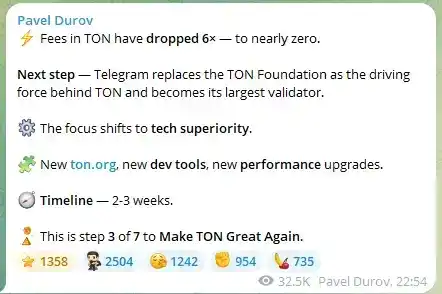
Pavel Durov's recent statements fundamentally alter market expectations. Particularly, the key points of Telegram replacing the TON Foundation and becoming the largest validator directly clarify that Telegram is now beginning to participate directly in the underlying governance and network operation of TON.

This is no longer just ecosystem support; it signifies Telegram formally reclaiming dominant control over TON's roadmap.

This shift is crucial because, in the past, the biggest question the market had about TON was not its technical capability but whether Telegram would truly go all-in on TON. Now, this question has a clear answer.

Simultaneously, this also means TON's valuation logic is changing. Previously, the market priced TON essentially as a public chain with Telegram's traffic support. But now, the market is beginning to reassess TON, as it is likely becoming the on-chain infrastructure within Telegram's future commercial ecosystem.

The difference between the two is significant. The former still belongs to the Crypto narrative, while the latter is beginning to enter the narrative of an internet-platform scale. This is also why TON's recent rise is not merely driven by sentiment but resembles a round of long-term expectation restructuring.

II. TON Reconstructs the Internet Payment Structure

Examining TON's recent rounds of upgrades closely reveals that its optimization direction is actually very clear: faster speed, lower fees, shorter confirmation times, and transaction fees approaching zero.

On the surface, these upgrades are optimizing chain performance, but what they are truly serving is not traditional DeFi but the large-scale payment application scenarios within Telegram.

Because Telegram itself has nearly 1 billion users, it inherently generates a vast amount of high-frequency, small-value transaction demand. Examples include content tipping, bot services, mini-app purchases, cross-border transfers, and digital goods consumption, among others.

These scenarios share a common need: users require extremely low costs and prioritize high speed.

If a payment takes tens of seconds to wait or incurs fees of several dollars, the entire user experience deteriorates significantly. Traditional blockchains have been particularly ill-suited for this type of scenario in the past.
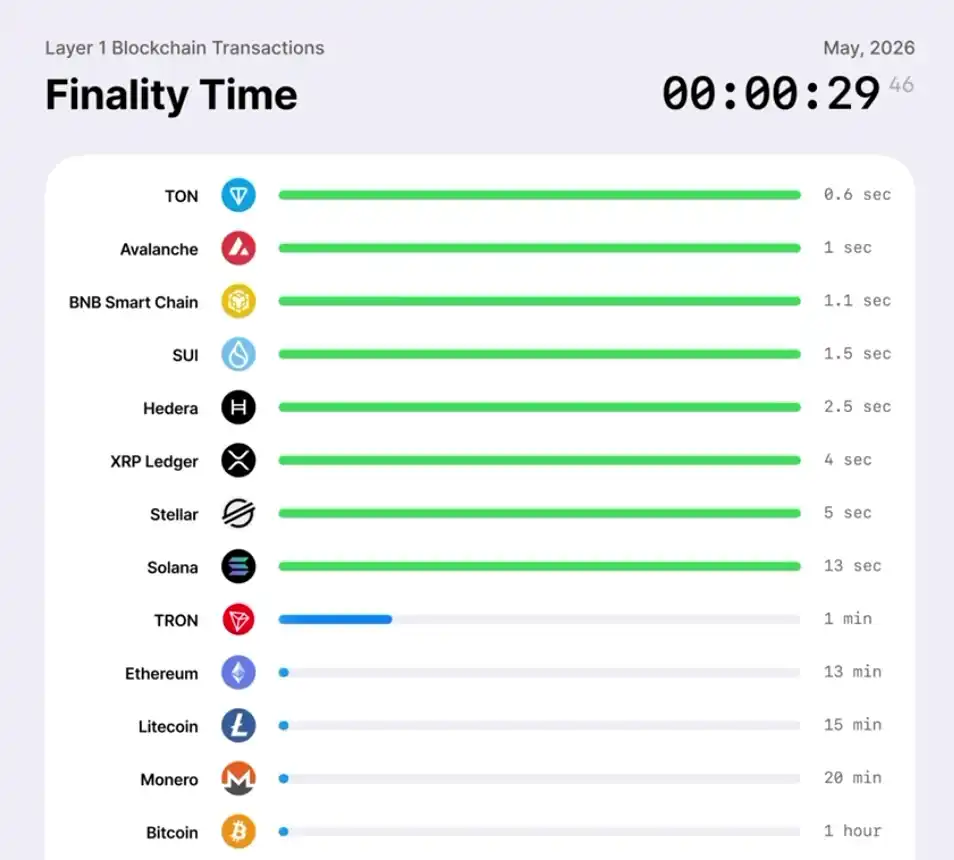
Therefore, TON's recent emphasis on fixed low fees and sub-second confirmations essentially revolves around redesigning blockchain for internet product experience. In other words, TON is attempting to solve a problem that Crypto has long failed to address: how to enable ordinary users to utilize on-chain systems almost imperceptibly.

This shift in logic is actually increasingly approaching the model of WeChat Pay.

Users don't need to understand blockchain, nor do they need to understand wallets, gas, or validation mechanisms. They only need to complete tipping, payments, purchases, transfers, and subscriptions, with all underlying settlements handled by TON.

This suggests that what TON truly aims to achieve may not be competition in the traditional L1 sense. What it is genuinely competing for is the global internet payment gateway.

Additionally, there is another crucial change. The logic of many public chains in the past has been: first build the infrastructure, then find users. But TON is the complete opposite. It first possesses a massive user base and then begins constructing the on-chain system.

Therefore, TON's challenge has never been how to get users into Web3, but rather how to enable users to complete on-chain actions without even realizing they are entering Web3. This represents a completely different development path.

III. TON's Future Blueprint: The On-Chain Transformation of Super Apps

Looking at all of TON's recent actions together, it becomes apparent that Telegram is gradually forming a complete closed loop. Functions that were originally separate—such as wallet, payments, bots, mini-apps, and on-chain settlements—are now gradually being integrated by TON.
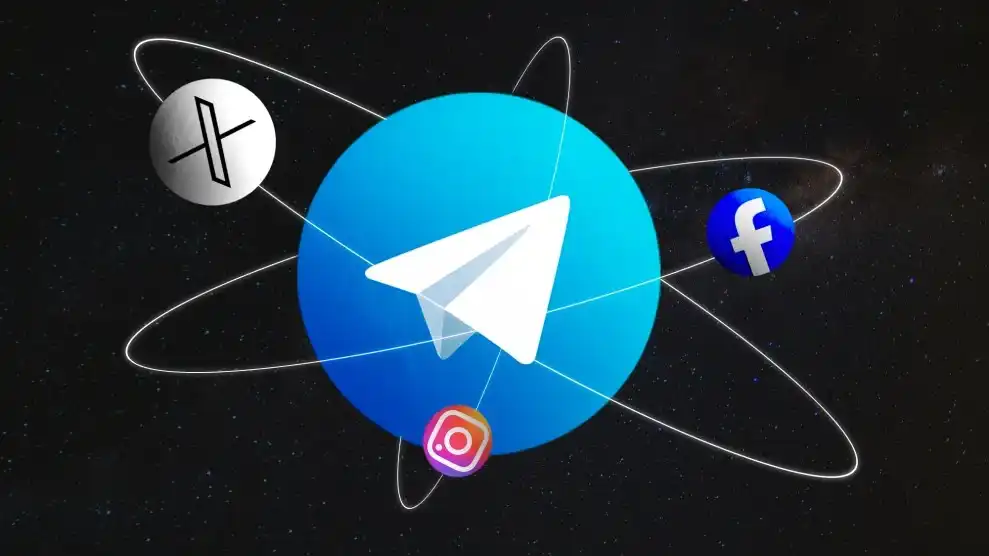
This also signifies that TON is no longer just an independent public chain; it is becoming the infrastructure for value circulation within Telegram. The true significance of this lies in the fact that, for the first time, the crypto industry is approaching the on-chain transformation of super applications.

Because over the past decade, the crypto industry has always lacked a genuine mass-market entry point. Most public chains have been striving to attract users into the crypto world, but Telegram itself already possesses global-scale traffic.

Especially in markets like the Middle East, Russia, Eastern Europe, Southeast Asia, and Latin America, Telegram often functions not merely as a messaging tool but also as a community platform, commercial platform, payment tool, and more.

Therefore, TON's true strategic focus is not DeFi but rather global digital commercial scenarios.

Areas such as low-cost cross-border payments, the creator economy, on-chain micro-payments, and similar directions are likely the true sources of large-scale growth for TON in the future.

Of course, this path is not easy. TON's ecosystem remains in its early stages, with many applications still lingering in phases like mini-games, airdrops, and short-term traffic acquisition. Additionally, after Telegram's renewed deep involvement with TON, it may once again face regulatory pressure in the future.

Nevertheless, the market has now begun to realize one thing: TON's competitors may never have been traditional L1s, but rather the global internet payment systems.

Conclusion

This round of TON's rise is not essentially the market speculating on a simple upgrade. What truly drives the repricing of capital is the growing awareness that the world's first on-chain ecosystem with a genuine super-app entry point may have already begun to take shape.

And this time, Pavel Durov is no longer just an observer. Telegram is finally preparing to take the field itself.

Pertanyaan Terkait

QAccording to the article, what was the main reason for the recent significant price surge of the TON token?

AThe primary reason for TON's recent price surge was Telegram founder Pavel Durov's public announcement that Telegram will become the core driver behind the TON network, replacing the TON Foundation and becoming its largest validator.

QHow has Pavel Durov's statement fundamentally changed the market's perception of TON's valuation logic?

AHis statement shifted TON's valuation logic from being a crypto-native public chain with Telegram's traffic support to potentially becoming the on-chain infrastructure for Telegram's future commercial ecosystem, moving from a crypto narrative to an internet platform-level narrative.

QWhat specific user needs is TON's recent technical optimization targeting, and what payment system is this approach compared to?

ATON's recent optimizations (faster speeds, lower fees, sub-second confirmation, near-zero costs) target the need for low-cost, high-speed, small-value transactions within Telegram (e.g., tipping, Bot services). This approach is compared to systems like WeChat Pay, aiming for users to use the on-chain system almost without awareness.

QWhat key advantage does TON possess compared to many other public blockchains regarding its development path?

AUnlike other blockchains that build infrastructure first and then seek users, TON already possesses a massive user base (Telegram's near 1 billion users) first, and is now building the on-chain system around that existing traffic.

QWhat does the article suggest is the true long-term competitor for TON, and what is its ultimate envisioned role?

AThe article suggests TON's true competitor is not traditional Layer 1 blockchains, but the global internet payment system. Its ultimate envisioned role is to become the on-chain value circulation infrastructure for the Telegram super-app, enabling global digital commercial scenarios like low-cost cross-border payments and the creator economy.

Bacaan Terkait

GensynAI : Jangan Biarkan AI Mengulangi Kesalahan Internet

Beberapa bulan terakhir, banyak talenta dari industri kripto beralih ke AI karena pesatnya perkembangan industri kecerdasan buatan. Para peneliti yang bergerak di kedua bidang ini terus mengeksplorasi satu pertanyaan yang belum terjawab: **Bisakah blockchain menjadi bagian dari infrastruktur AI?** Proyek yang menggabungkan AI dan Crypto, seperti AI Agent, on-chain reasoning, pasar data, dan penyewaan daya komputasi, telah banyak bermunculan. Namun, sebagian besar masih berada di "lapisan aplikasi AI" dan belum membentuk closed-loop bisnis yang nyata. Berbeda dengan itu, **Gensyn** justru menyasar lapisan paling inti dan mahal dalam industri AI: **pelatihan model**. Gensyn bertujuan untuk mengorganisir sumber daya GPU yang tersebar secara global menjadi jaringan pelatihan AI terbuka. Pengembang dapat mengirimkan tugas pelatihan, node menyediakan daya komputasi, dan jaringan bertugas memverifikasi hasil pelatihan serta mendistribusikan insentif. Nilai utama di balik ini bukan semata-mata "desentralisasi", melainkan solusi atas masalah mendesak dalam industri AI: **sumber daya komputasi (GPU) yang semakin terkonsentrasi di tangan segelintir raksasa teknologi.** Kelangkaan pasokan H100, kenaikan harga layanan cloud, dan persaingan ketat untuk mengunci sumber daya komputasi menunjukkan bahwa kepemilikan GPU kini menjadi penentu kecepatan pengembangan AI, terutama di era model besar (large models). **Mengapa Gensyn Menarik Perhatian?** 1. **Menyasar Lapisan Infrastruktur Inti AI:** Gensyn langsung masuk ke dalam proses pelatihan model, bagian yang paling menantang secara teknis dan paling banyak mengonsumsi sumber daya. Ini adalah lapisan yang mudah membentuk hambatan platform (platform壁垒). Jika jaringan pelatihannya mencapai skala, ia berpotensi menjadi pintu masuk penting bagi pengembangan AI di masa depan. 2. **Menawarkan Model Kolaborasi Komputasi yang Lebih Terbuka:** Berbeda dengan ketergantungan pada platform cloud terpusat yang biayanya terus naik, Gensyn mengusung model yang memanfaatkan GPU menganggur dan menjadwalkan sumber daya komputasi secara dinamis. Ini dapat meningkatkan efisiensi penggunaan daya komputasi secara keseluruhan dan mengurangi hambatan inovasi bagi tim AI kecil-menengah. 3. **Tingkat Kesulitan Teknis sebagai Keunggulan:** Tantangan sebenarnya bukan sekadar menghubungkan GPU, tetapi **cara memverifikasi hasil pelatihan, memastikan kejujuran node, dan menjaga keandalan pelatihan di lingkungan terdistribusi.** Gensyn fokus pada solusi teknis ini (seperti mekanisme verifikasi probabilistik, model distribusi tugas), menjadikannya lebih mirip perusahaan infrastruktur teknologi mendalam (deep tech). 4. **Memiliki Closed-Loop Bisnis Nyata:** Kebutuhan akan pelatihan AI adalah pasar nyata yang terus berkembang, dengan celah pasokan GPU yang berkelanjutan. Gensyn tidak sekadar menambahkan blockchain untuk kepentingannya sendiri, tetapi menjawab kebutuhan industri akan sistem penjadwalan sumber daya yang lebih fleksibel dan terbuka. Singkatnya, batas antara Crypto (sistem finansial) dan AI (sistem teknologi) semakin kabur. AI membutuhkan koordinasi sumber daya, mekanisme insentif, dan kolaborasi global—hal-hal yang menjadi keahlian Crypto. Gensyn mewakili upaya untuk membuka akses kemampuan pelatihan, yang selama ini dikuasai sedikit perusahaan besar, menjadi sistem yang lebih terbuka dan dapat dikolaborasikan. Inisiatif ini tidak lagi sekadar cerita konsep, tetapi berkembang menuju infrastruktur AI nyata, di mana perusahaan paling bernilai di era AI sering kali lahir dari lapisan infrastruktur.

marsbit5j yang lalu

GensynAI : Jangan Biarkan AI Mengulangi Kesalahan Internet

marsbit5j yang lalu

Mengapa AI China Berkembang Begitu Cepat? Jawabannya Tersembunyi di Dalam Laboratorium

Pengarang mencatat bahwa laboratorium AI China telah menjadi kekuatan yang semakin sulit diabaikan dalam kompetisi model besar global. Keunggulannya tidak hanya terletak pada banyaknya talenta, kemampuan rekayasa yang kuat, dan iterasi cepat, tetapi juga berasal dari cara organisasi yang sangat realistis: lebih banyak fokus pada pembuatan model daripada konsep, lebih menekankan eksekusi tim daripada individu bintang, dan lebih memilih menguasai tumpukan teknologi inti sendiri daripada bergantung pada layanan eksternal. Dari kunjungan ke sejumlah laboratorium AI terkemuka China, penulis menemukan ekosistem AI China tidak sepenuhnya sama dengan AS. AS lebih menekankan orisinalitas, investasi modal, dan pengaruh ilmuwan puncak, sedangkan China lebih mahir dalam mengejar cepat arah yang sudah ada. Melalui sumber terbuka, optimasi rekayasa, dan kontribusi banyak peneliti muda, China mendorong kemampuan model ke garis depan dengan cepat. Yang paling menarik untuk diperhatikan bukanlah apakah AI China telah melampaui AS, melainkan dua jalur pengembangan berbeda yang terbentuk: AS lebih seperti kompetisi garis depan yang digerakkan modal dan laboratorium bintang, sedangkan China lebih seperti kompetisi industri yang didorong oleh kemampuan rekayasa, ekosistem sumber terbuka, dan kesadaran penguasaan teknologi mandiri. Ini berarti kompetisi AI di masa depan tidak hanya soal peringkat model, tetapi juga kemampuan organisasi, ekosistem pengembang, dan eksekusi industri. Perubahan nyata AI China terletak pada cara mereka berpartisipasi dalam garis depan global dengan caranya sendiri, bukan hanya meniru Silicon Valley. Penulis juga menyoroti beberapa perbedaan utama dalam ekosistem AI China: permintaan AI domestik mulai muncul, banyak pengembang terpengaruh Claude, perusahaan memiliki mentalitas kepemilikan teknologi, ada dukungan pemerintah meski skalanya belum jelas, industri data kurang berkembang dibanding Barat, dan ada kebutuhan kuat akan chip NVIDIA lebih banyak. Penutupnya menekankan pentingnya ekosistem global yang terbuka dan kolaboratif untuk menciptakan AI yang lebih aman, mudah diakses, dan bermanfaat bagi dunia.

marsbit6j yang lalu

Mengapa AI China Berkembang Begitu Cepat? Jawabannya Tersembunyi di Dalam Laboratorium

marsbit6j yang lalu

3 Tahun 5 Kali Lipat, Pabrik Kaca Berusia Satu Abad Dibangkitkan Kembali

Menurut CRU, permintaan serat optik untuk pusat data AI meningkat 75.9% per tahun, dan kesenjangan pasokan-meningkat dari 6% menjadi 15%. Harga serat optik melonjak lebih dari 3 kali lipat dalam beberapa bulan, dan kapasitas produksi tidak dapat mengimbangi. Inilah alasan NVIDIA berinvestasi di Corning dan mempercepat ekspansi kapasitas serat optik, dengan total investasi $45 miliar dalam tiga perusahaan di seluruh rantai optik. Corning, perusahaan kaca berusia 175 tahun dari New York, melihat sahamnya naik 316.81% dalam setahun terakhir, mencapai kapitalisasi pasar $160 miliar. NVIDIA memilih Corning karena keahliannya dalam serat optik khusus berkinerja tinggi yang penting untuk pusat data AI, seperti serat dengan kehilangan sinyal ultra-rendah (0.15 dB/km), kepadatan tinggi, dan ketahanan tekuk yang baik. Penghasilan Corning dari segmen komunikasi optik untuk perusahaan (Enterprise) melonjak dari $1.3 miliar pada 2023 menjadi lebih dari $3 miliar pada 2025. Perusahaan telah mengamankan kontrak pasokan jangka panjang bernilai miliaran dolar dari klien seperti Meta dan NVIDIA. Meskipun bukan produsen serat optik terbesar secara global, keunggulan teknis Corning di pasar serat canggih untuk AI, ditambah dengan investasi R&D tahunan sebesar $1 miliar, memberinya posisi unik. Percepatan adopsi teknologi **CPO (Co-Packaged Optics)** oleh NVIDIA, yang dijadwalkan mulai produksi massal pada paruh kedua 2026, menjadi katalis penting bagi permintaan serat optik premium Corning. Namun, valuasi sahamnya yang telah melonjak pesat dan potensi keterlambatan dalam eksekusi pesanan menjadi faktor risiko yang perlu diperhatikan.

marsbit7j yang lalu

3 Tahun 5 Kali Lipat, Pabrik Kaca Berusia Satu Abad Dibangkitkan Kembali

marsbit7j yang lalu

Trading

Spot
Futures

Artikel Populer

Cara Membeli TON

Selamat datang di HTX.com! Kami telah membuat pembelian The Open Network (TON) menjadi mudah dan nyaman. Ikuti panduan langkah demi langkah kami untuk memulai perjalanan kripto Anda.Langkah 1: Buat Akun HTX AndaGunakan alamat email atau nomor ponsel Anda untuk mendaftar akun gratis di HTX. Rasakan perjalanan pendaftaran yang mudah dan buka semua fitur.Dapatkan Akun SayaLangkah 2: Buka Beli Kripto, lalu Pilih Metode Pembayaran AndaKartu Kredit/Debit: Gunakan Visa atau Mastercard Anda untuk membeli The Open Network (TON) secara instan.Saldo: Gunakan dana dari saldo akun HTX Anda untuk melakukan trading dengan lancar.Pihak Ketiga: Kami telah menambahkan metode pembayaran populer seperti Google Pay dan Apple Pay untuk meningkatkan kenyamanan.P2P: Lakukan trading langsung dengan pengguna lain di HTX.Over-the-Counter (OTC): Kami menawarkan layanan yang dibuat khusus dan kurs yang kompetitif bagi para trader.Langkah 3: Simpan The Open Network (TON) AndaSetelah melakukan pembelian, simpan The Open Network (TON) di akun HTX Anda. Selain itu, Anda dapat mengirimkannya ke tempat lain melalui transfer blockchain atau menggunakannya untuk memperdagangkan mata uang kripto lainnya.Langkah 4: Lakukan trading The Open Network (TON)Lakukan trading The Open Network (TON) dengan mudah di pasar spot HTX. Cukup akses akun Anda, pilih pasangan perdagangan, jalankan trading, lalu pantau secara real-time. Kami menawarkan pengalaman yang ramah pengguna baik untuk pemula maupun trader berpengalaman.

996 Total TayanganDipublikasikan pada 2024.12.10Diperbarui pada 2025.03.21

Cara Membeli TON

Diskusi

Selamat datang di Komunitas HTX. Di sini, Anda bisa terus mendapatkan informasi terbaru tentang perkembangan platform terkini dan mendapatkan akses ke wawasan pasar profesional. Pendapat pengguna mengenai harga TON (TON) disajikan di bawah ini.

活动图片