Accumulation Across the Entire Market, BTC May Challenge the $86,000 Resistance Zone?

marsbitDipublikasikan tanggal 2026-08-27Terakhir diperbarui pada 2026-08-27

Abstrak

Record-breaking short liquidations ignited a roughly 26% rebound in Bitcoin from the August lows. Unlike previous leverage-driven squeezes, this rally is supported by substantial buy-side demand. U.S. spot ETFs recorded their strongest weekly inflows of the year, with $2.23 billion, while bitcoin continued to flow out of exchanges. On-chain data shows all wallet cohorts are simultaneously accumulating coins, confirming broad-based buying. Leverage has been effectively cleared post-squeeze, with bitcoin-denominated futures open interest contracting. The funding rate has hovered around neutral, indicating the move was driven more by short covering than new speculative longs. A key challenge lies ahead: a significant supply wall in the $81k to $86k range. This zone is defined by the cost basis of long-term holders, concentrated sell-side order book liquidity, and pending short liquidation clusters. Market structure appears top-heavy, with large-cap assets outperforming smaller ones, a pattern typical of early-cycle rallies. Bitcoin has also decoupled from equities during this move. Cycle indicators have risen from a prolonged "cool" phase, positioning the market in an early stage, far from historical top readings. The path forward hinges on whether this overhead supply can be absorbed. A sustained close above ~$83.3k with continued ETF inflows would signal strength. Conversely, a break below the ~$70k short-term holder cost basis, and ultimately the ~$62k-$65k support floor, ...

Author: Glassnode

Compilation: AididiaoJP, Foresight News

Core Summary

  • Record short liquidations triggered a rebound; Bitcoin faces a test in the $81,000 to $86,000 supply concentration zone.
  • ETFs recorded a weekly net inflow of $2.23 billion; all market cohorts are accumulating synchronously, providing clear capital support.
  • Leverage unwound as the market churns; the $81,000-$86,000 range becomes the key resistance band overhead.

Introduction

A historically large short liquidation event ignited a rebound of approximately 26% from the mid-August low. Unlike past short-term squeezes driven solely by leverage, this rally has been backed by substantial buying pressure: U.S. spot ETFs recorded their strongest weekly inflows of the year, Bitcoin continued to flow out of exchanges, and all wallet size cohorts on-chain showed synchronized accumulation. At present, whether the rebound can extend to the January high depends crucially on whether the supply-concentrated zone between $81,000 and $86,000 can be effectively breached.

The Liquidation Storm: History's Largest Short Squeeze Ignites the Rebound

Record Single-Day Short Liquidations

In dollar terms, August 19, 2026, saw the largest single-day short liquidation volume since data began in 2019. During the entire squeeze window, short liquidations accounted for 85% of total liquidations. It should be noted that our data covers major centralized exchanges but excludes Hyperliquid, so the actual total liquidation value is higher than our statistics.

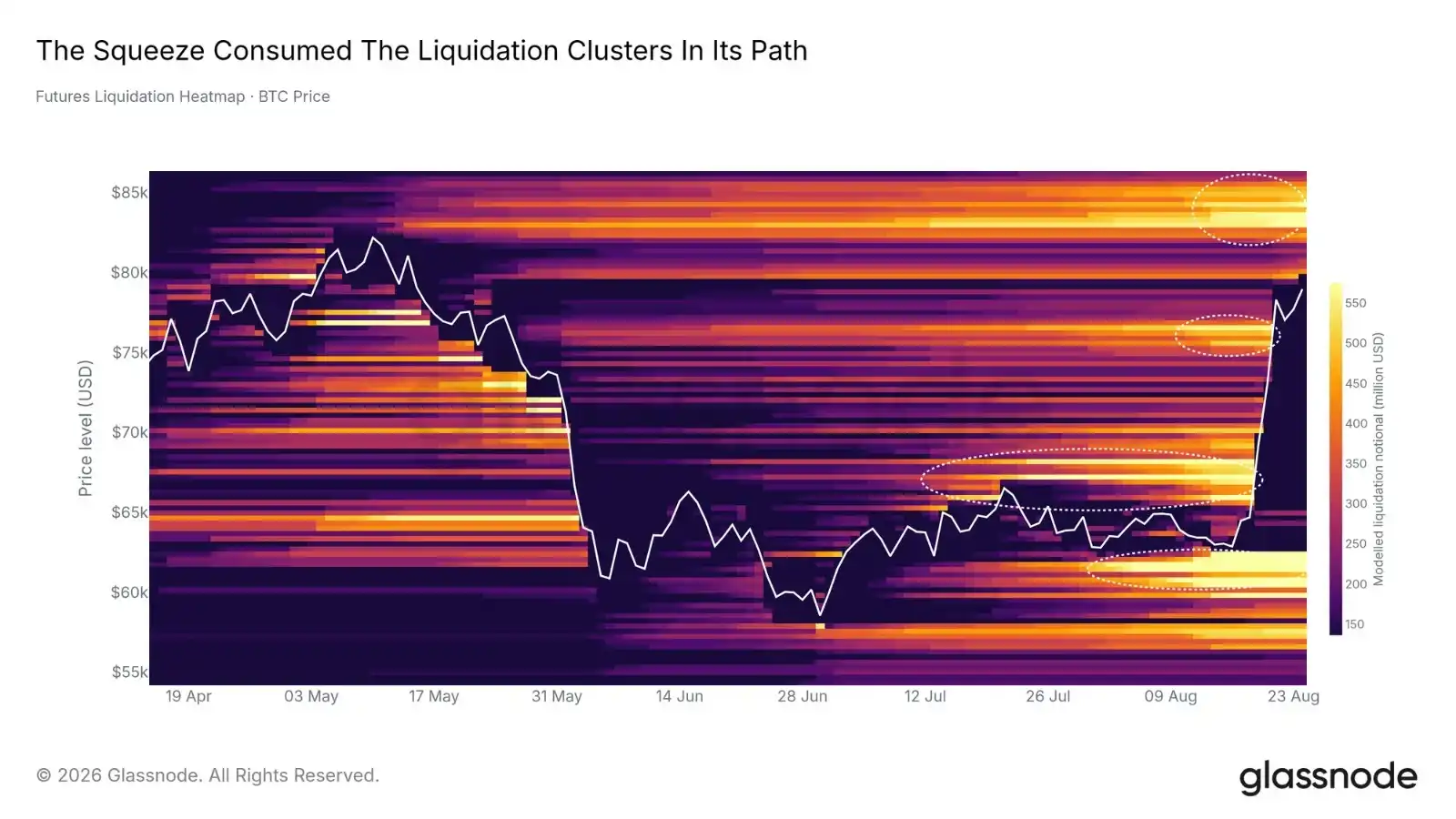
The liquidation heatmap clearly shows how price action consumed this "fuel." Clusters of simulated liquidation levels along the price path were triggered one by one during the rebound, digesting roughly 86% of the liquidation orders along the way. The remaining orders are distributed at both ends: a dense cluster of short liquidation orders sits above in the $82,000-$86,000 range, while residual long liquidation orders linger below in the $60,500-$62,400 area.
Significant Leverage Unwinding

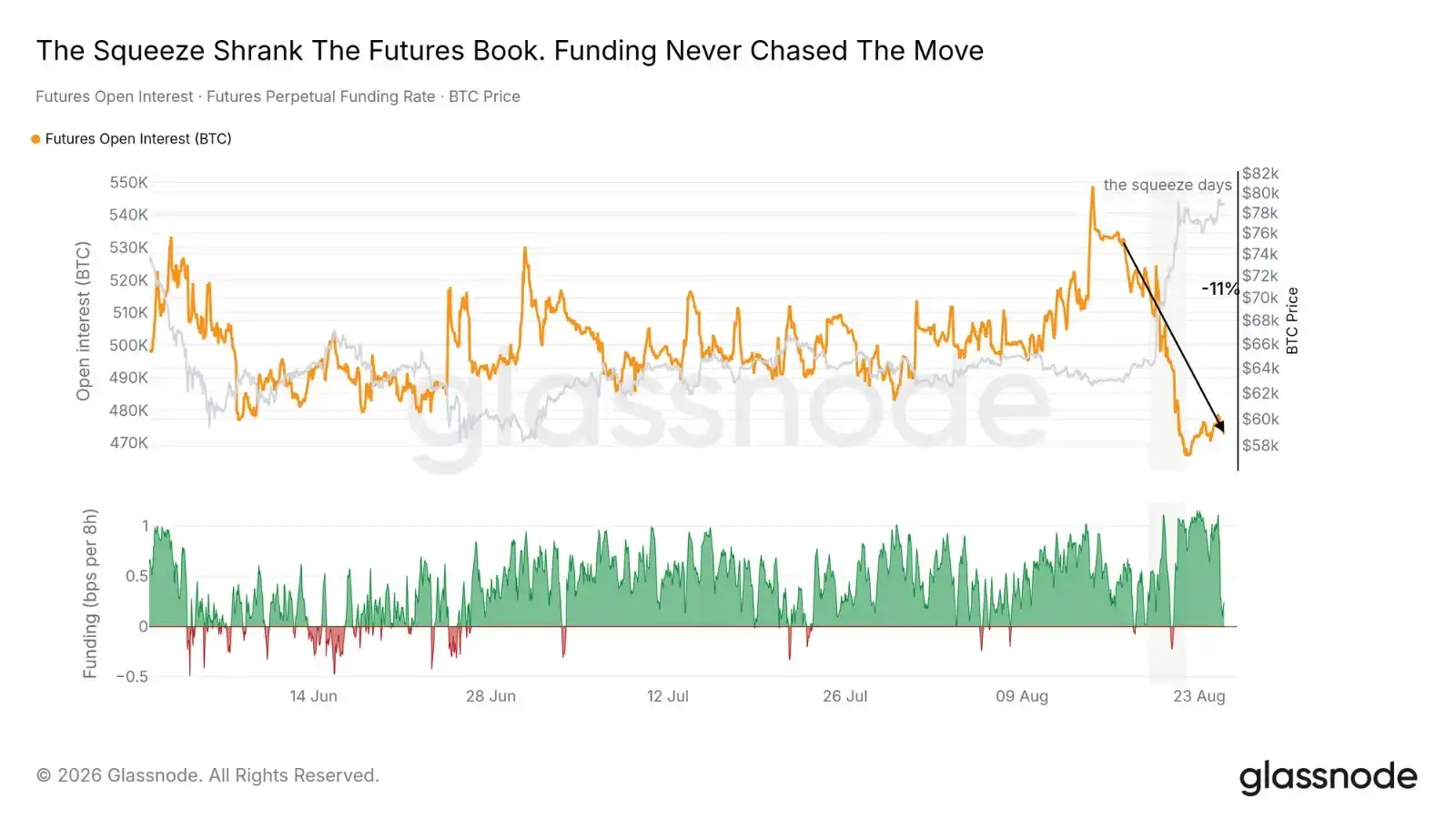
This squeeze effectively cleared leverage from the market it passed through. Measured in Bitcoin terms, futures open interest contracted by 11% during the window. The expansion in dollar-denominated nominal size was entirely due to price appreciation—meaning the liquidated short positions were not quickly replaced by new contracts.

Perpetual swap funding rates also confirm this. Throughout the rebound, funding rates fluctuated mostly around the neutral baseline, occasionally turning negative. This indicates the rally was not driven by new long speculation but rather a passive unwinding triggered by concentrated stop-loss executions. If Bitcoin-denominated open interest begins to expand again alongside rising funding rates, it would be the first warning sign of renewed leverage influx.
Capital Flow Validation: Real Money Backs the Rebound

ETF Channel Reactivated

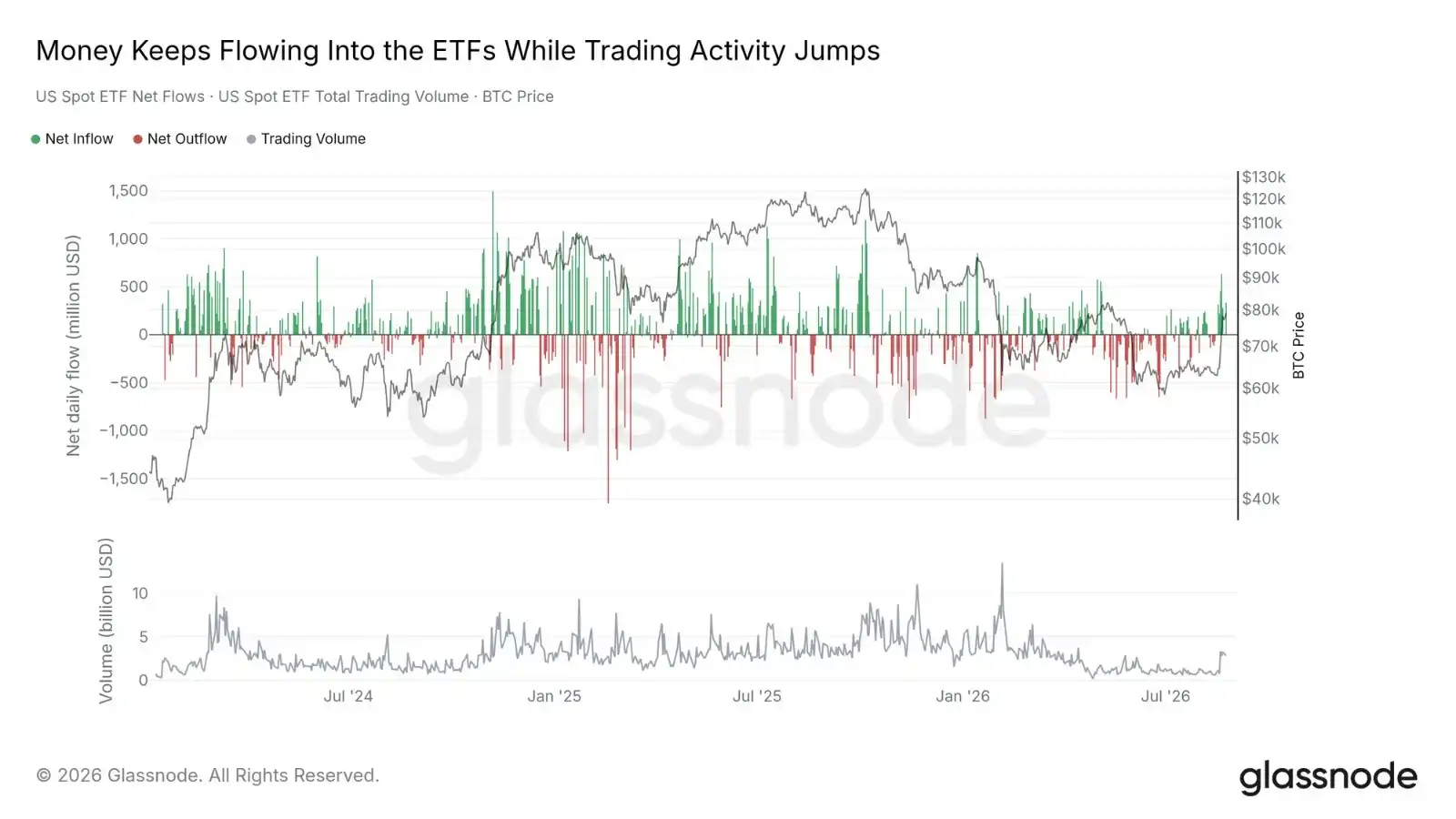
U.S. spot Bitcoin ETFs achieved net inflows of $2.23 billion during the squeeze window, with not a single day of outflows, marking the strongest weekly net absorption record for the year. The largest single-day subscription size during this period was the highest since January 14, 2026. The price also reclaimed the short-term holder cost basis during the rebound.

Trading activity recovered somewhat but remains far from historical peaks: the average daily ETF trading volume during the squeeze week was approximately $2.4 billion, roughly half the levels seen during the January-February peak period and about one-third lower than last August.
On-Chain Supply Shifts Up the Size Ladder

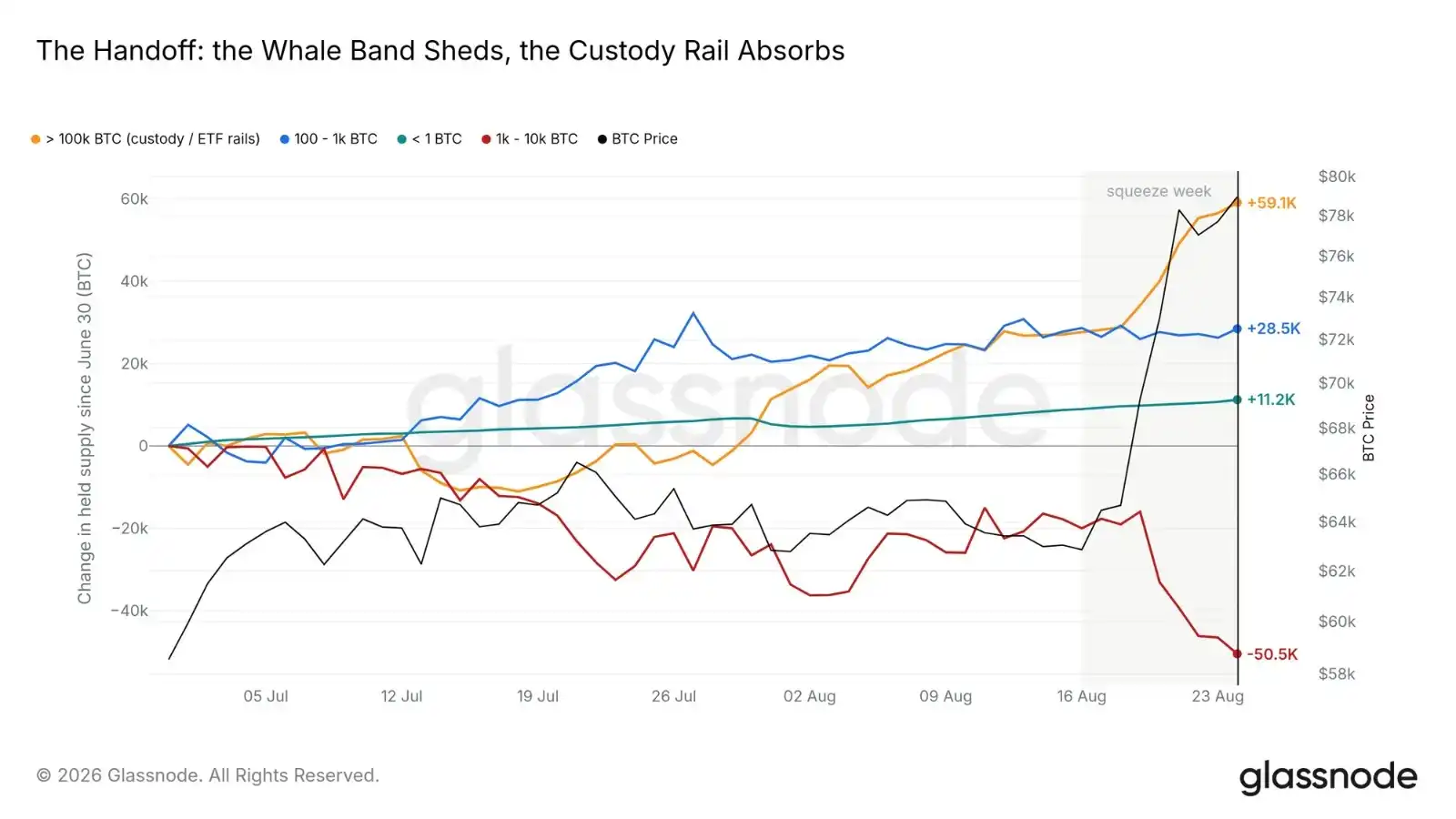
Since the low on June 30, 2026, entities holding 1,000-10,000 BTC have cumulatively reduced their holdings by approximately 50,500 BTC. Meanwhile, the largest cohort (holding over 100,000 BTC, primarily comprising exchanges, custodians, and ETF wrapper products) absorbed about 59,100 BTC during the same period. Capital is flowing up the size ladder from mid-sized and smaller whales toward large custodial institutions.

This trend intensified during the squeeze week: the custodial cohort increased holdings by approximately 31,500 BTC within the window, a magnitude comparable to the weekly ETF net subscriptions (though not a direct coin-for-coin match). BTC flowing from distressed whale wallets is appearing on institutional custodial channels in similar size.
Synchronized Accumulation Across All Market Cohorts

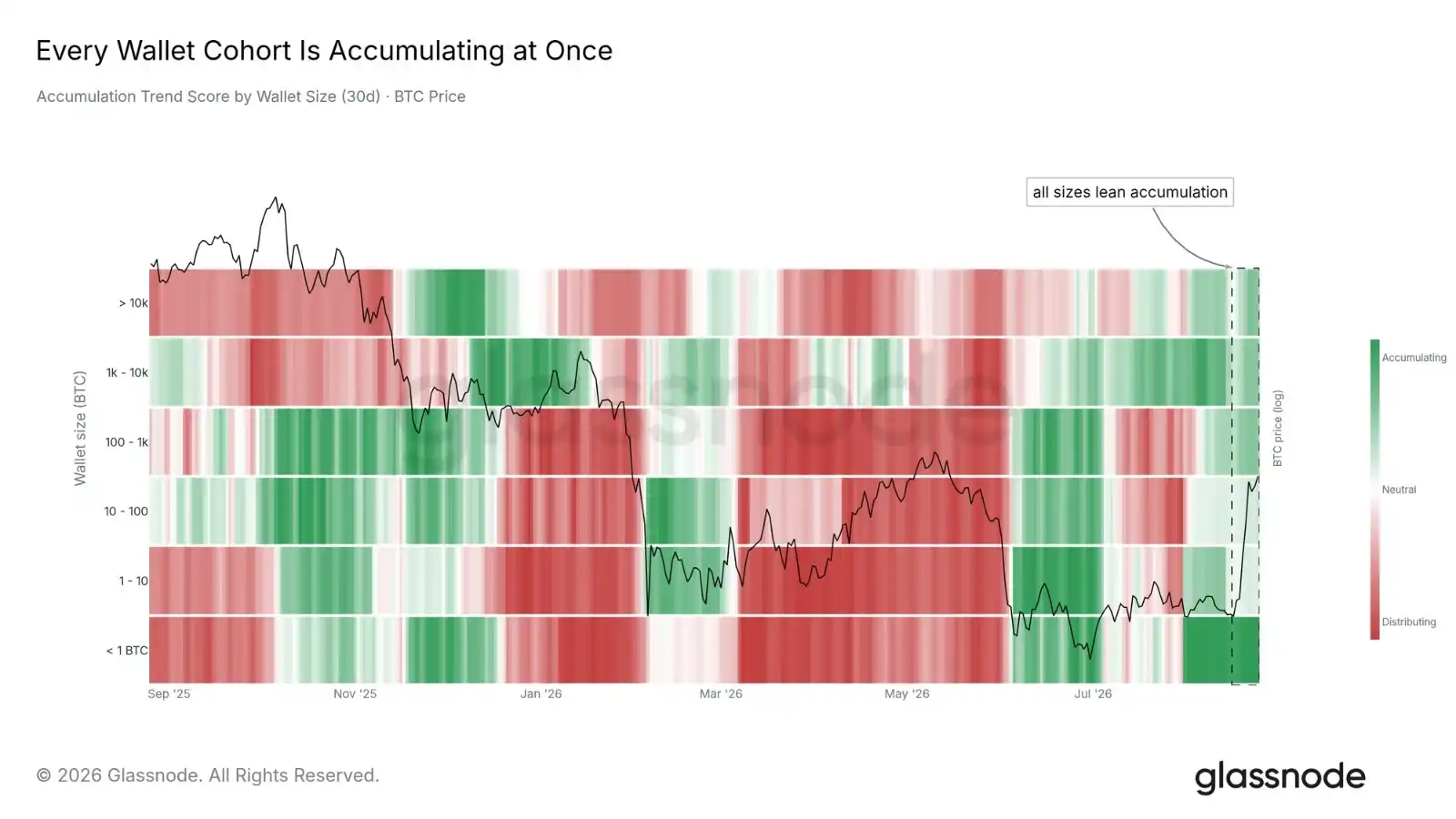
The breadth of buying behavior confirms the authenticity of capital inflows. The 30-day accumulation trend score shows that all six wallet size cohorts are at or above the 0.5 neutral threshold. This state has persisted for 20 days since August 5, marking the longest period of synchronized accumulation across all cohorts since the 22-day record in late 2024.

The squeeze day itself was primarily driven by large wallet accumulation, while smaller cohorts had been gradually building positions throughout August. If the score for any cohort falls back below 0.5, it would be the first signal of a crack in market breadth, indicating that the buying pressure supporting this rebound is narrowing.
Rebound Structure: Cycle Positioning and Cross-Asset Performance

Cycle Indicators Exit the Cooling Zone

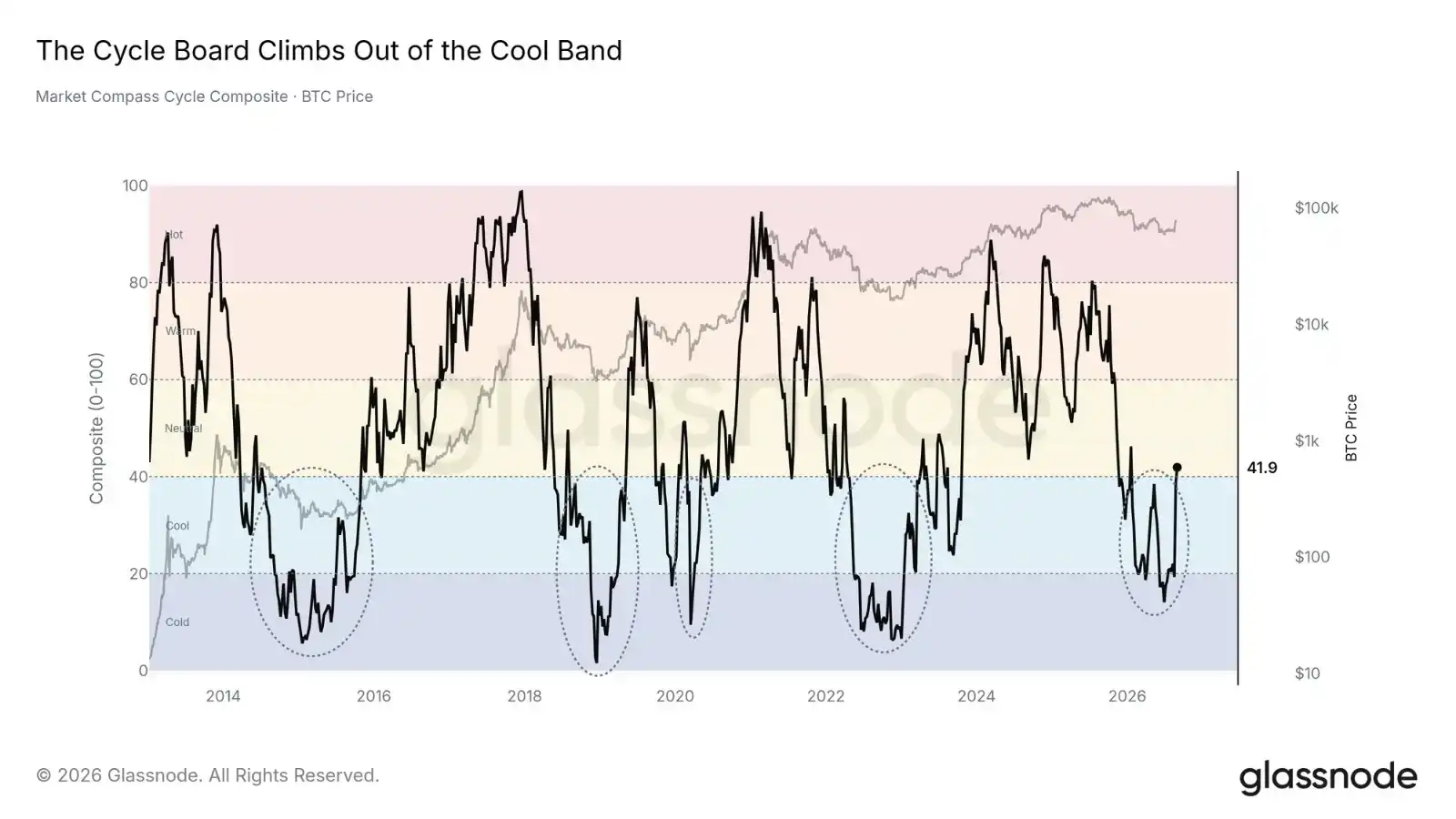
The Cycle Composite Indicator (the median of 45 on-chain cycle metrics) has rebounded to the 40 neutral boundary, after spending a prolonged seven months in the "Cold" to "Cool" range.

The five rings on the chart mark similar extended periods of low readings in history: 2014-2015, 2018-2019, 2020, 2022-2023, and the current cycle. Each corresponded to the low regions of their respective cycles. This indicator does not predict the speed of the rebound but positions the current market action in the early stages of a cycle, far from the readings seen in past top regions.
Rebound Structure Shows "Top-Heavy" Characteristic

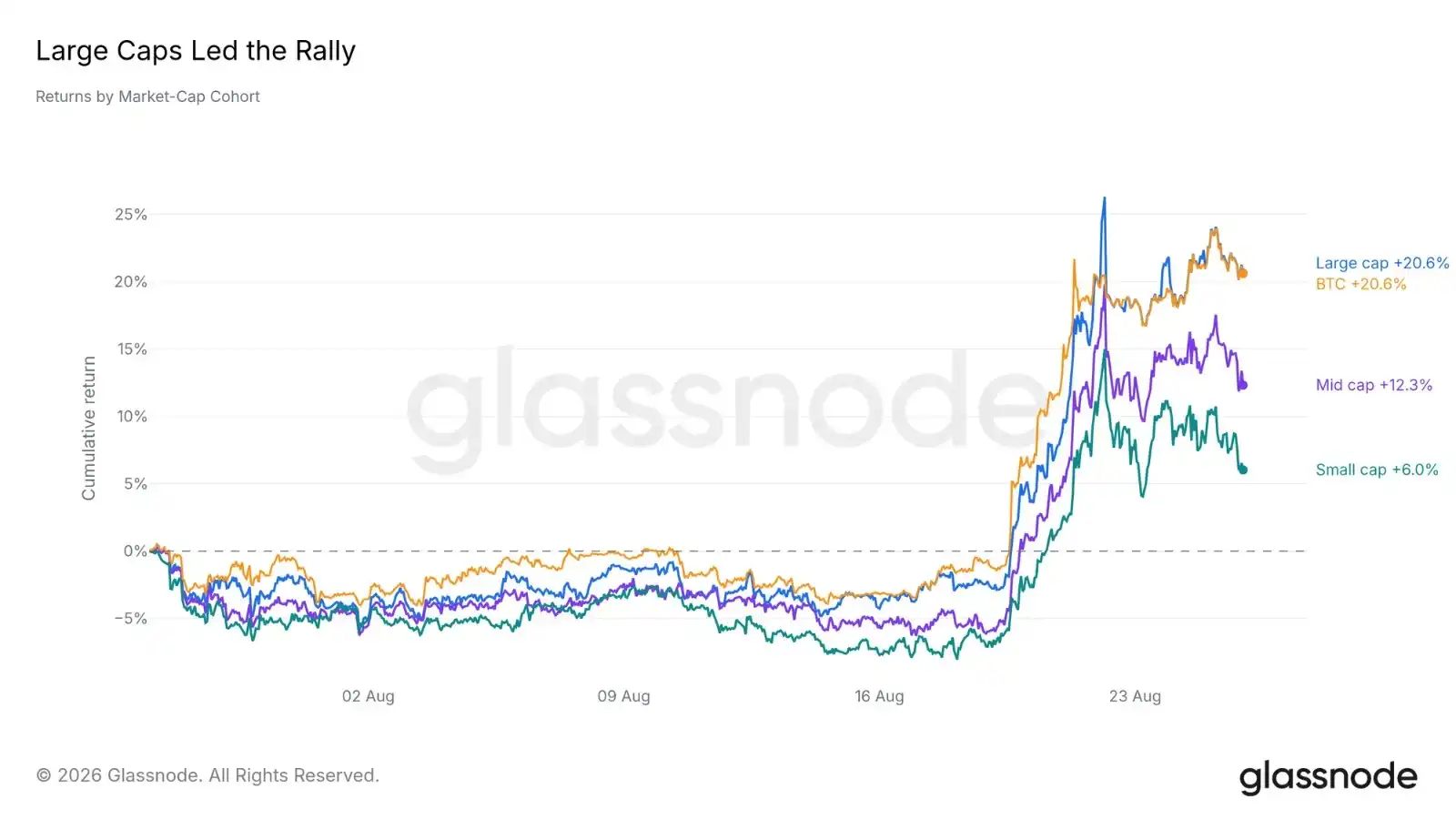
Looking across assets, the breadth of the rally is relatively narrow. Over the past month, the large-cap cohort averaged returns of about 20.6%, roughly in line with Bitcoin; while the small-cap cohort gained only about 6.0%. The smaller the market capitalization, the less capital inflow it received.

This is a typical structure for an early-stage rebound—the most liquid assets get allocated first. If smaller and mid-cap cohorts can catch up later, the rally will diffuse to a broader range; until then, this remains a market led by large-cap coins, with Bitcoin at the forefront.
Significant Decoupling from U.S. Stocks

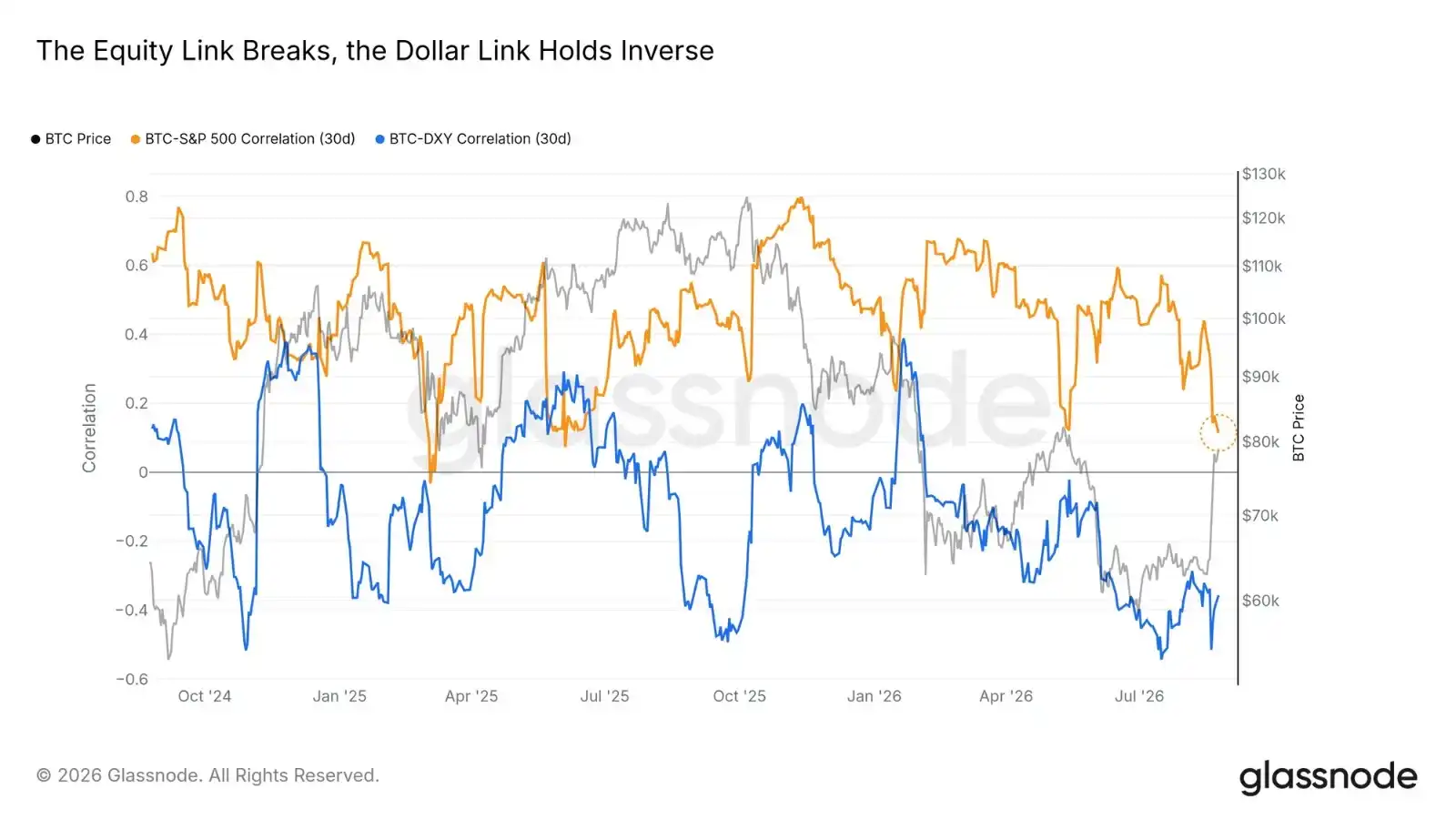
This rebound has diverged from macro trends. During the squeeze window, Bitcoin rose about 25%, while the S&P 500 index fell 1.7%. Their one-month rolling return correlation plunged to near zero. The negative correlation with the U.S. dollar remained intact.

Similar rapid decouplings in 2025 reverted to the mean within weeks on two occasions, so a structural shift cannot yet be asserted—the quarterly-window correlation has only just begun to turn downward. However, a rebound completed against a backdrop of stock market weakness is clearly not a "stock beta" play; its true driving force is capital flowing into the crypto market itself.
Overhead Resistance: The $81,000-$86,000 Supply-Concentrated Zone

Cost Basis: A Floor and Ceiling Coexist

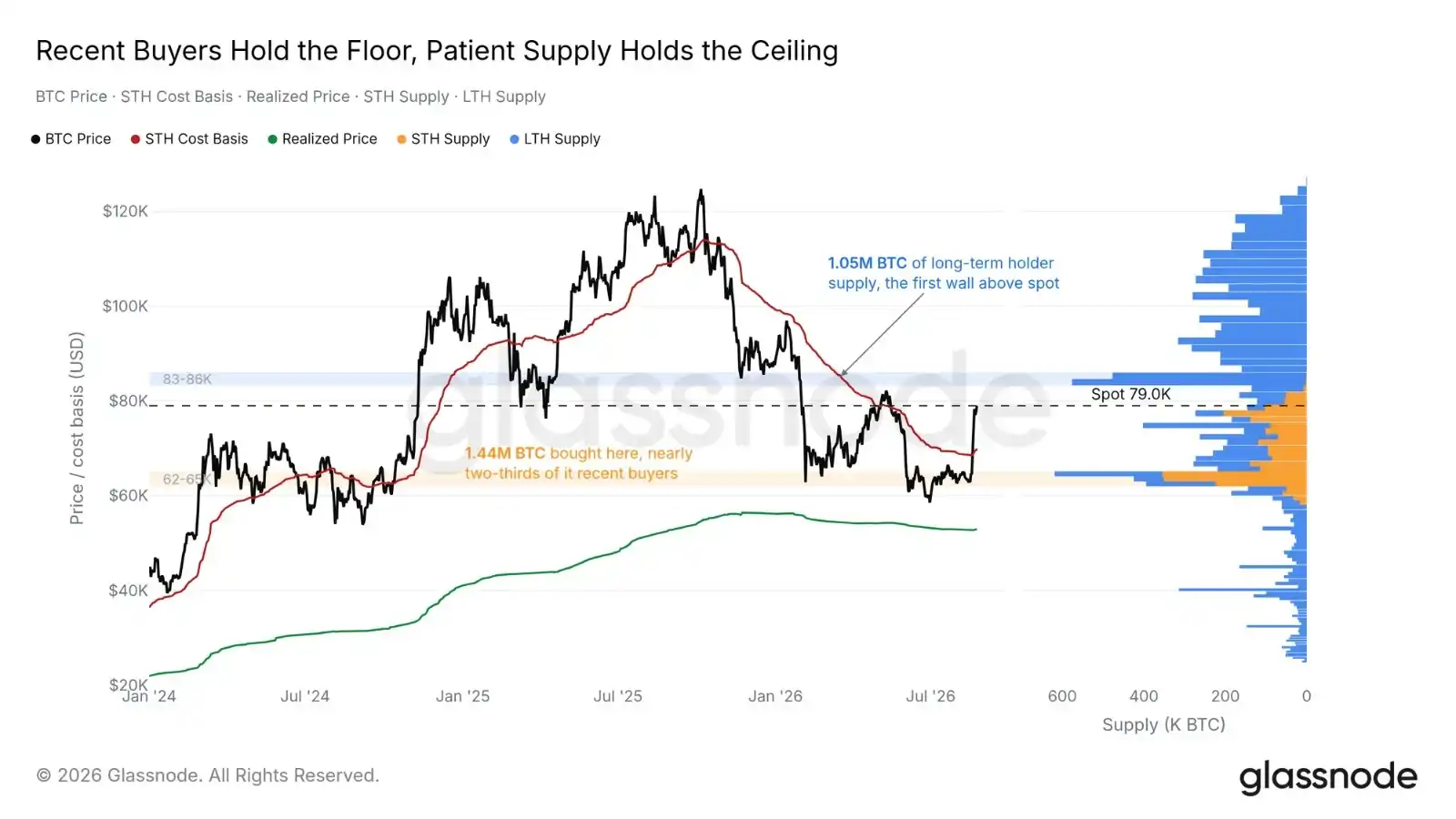
On-chain cost distribution now sandwiches the price. Below, buyers who entered during the June-August bottom hold a cost basis in the $62,000-$65,000 range, with nearly two-thirds belonging to short-term holders—recent buyers inclined to defend their cost line. Above, the first major supply structure sits between $83,000 and $86,000, almost entirely comprised of long-term holders who experienced the full decline.

The current spot price resides in the gap between. The short-term holder cost basis has recovered to around $70,000 (below the price). An assault on the $83,000-$86,000 zone would test whether long-term holders choose to sell near their break-even point.
Sell-Side Orders Regroup Overhead

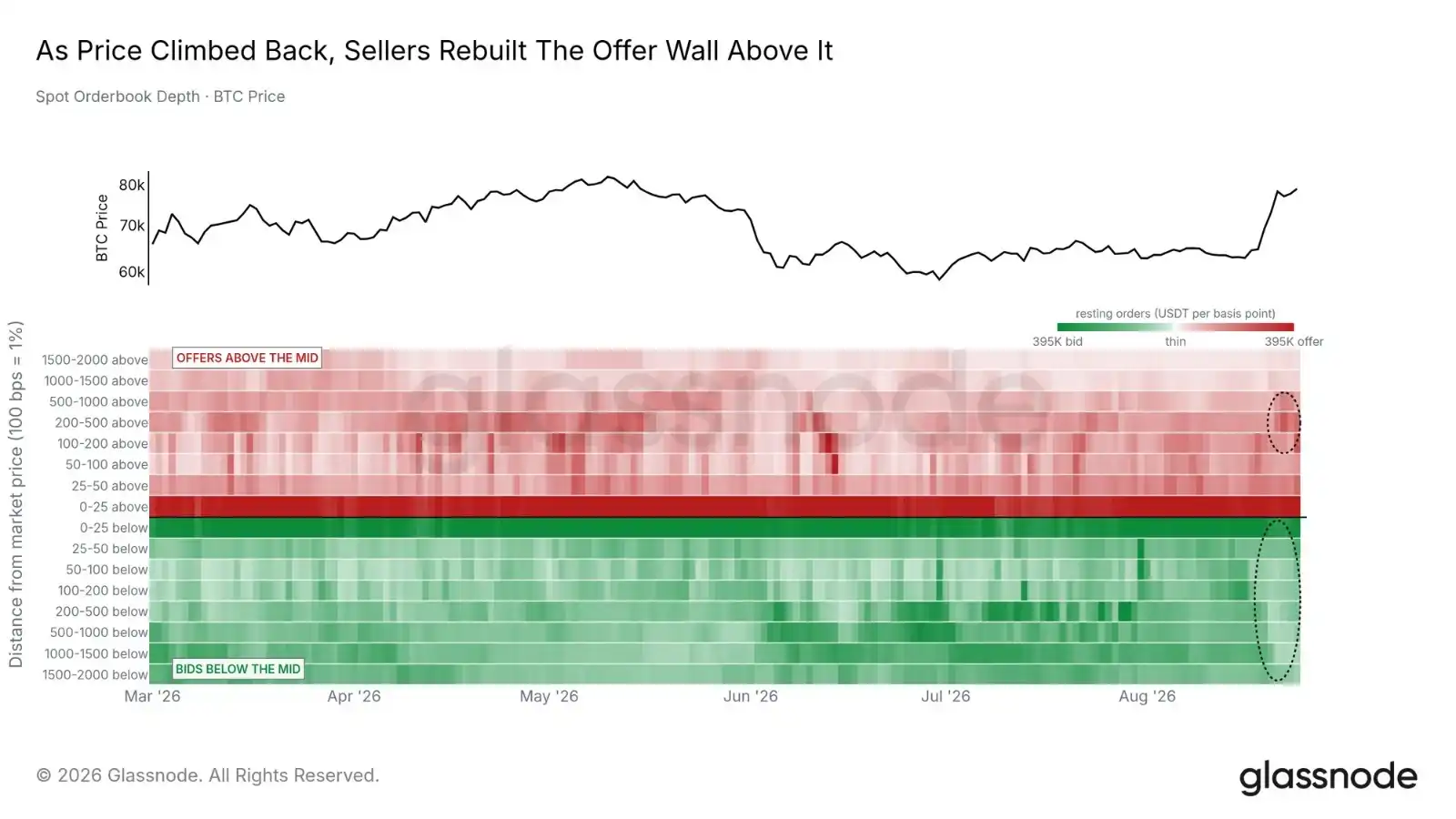
As prices rose, sell orders reappeared on the order books above. Static sell orders in the +100 to +1000 basis point range above the mid-price grew by about 41% in the last five days of the window. Meanwhile, buy-side depth across the visible order book thinned by approximately 32% in the last seven days. Static orders can be canceled instantly, so the order book reflects zones of seller willingness—currently, sellers prefer to place orders above.

This regrouping of sell orders points to the same zone as several independent metrics: the first self-custodied cost basis plateau begins at $80,800, market maker gamma turns negative at $82,300, existing liquidation orders extend to $86,000, and a wall of patient supply fills the $83,000-$86,000 range. All overhead structures we track are currently concentrated between $81,000 and $86,000—this is the true test for the rebound's sustainability.
Options Market Pricing: Stability Expected

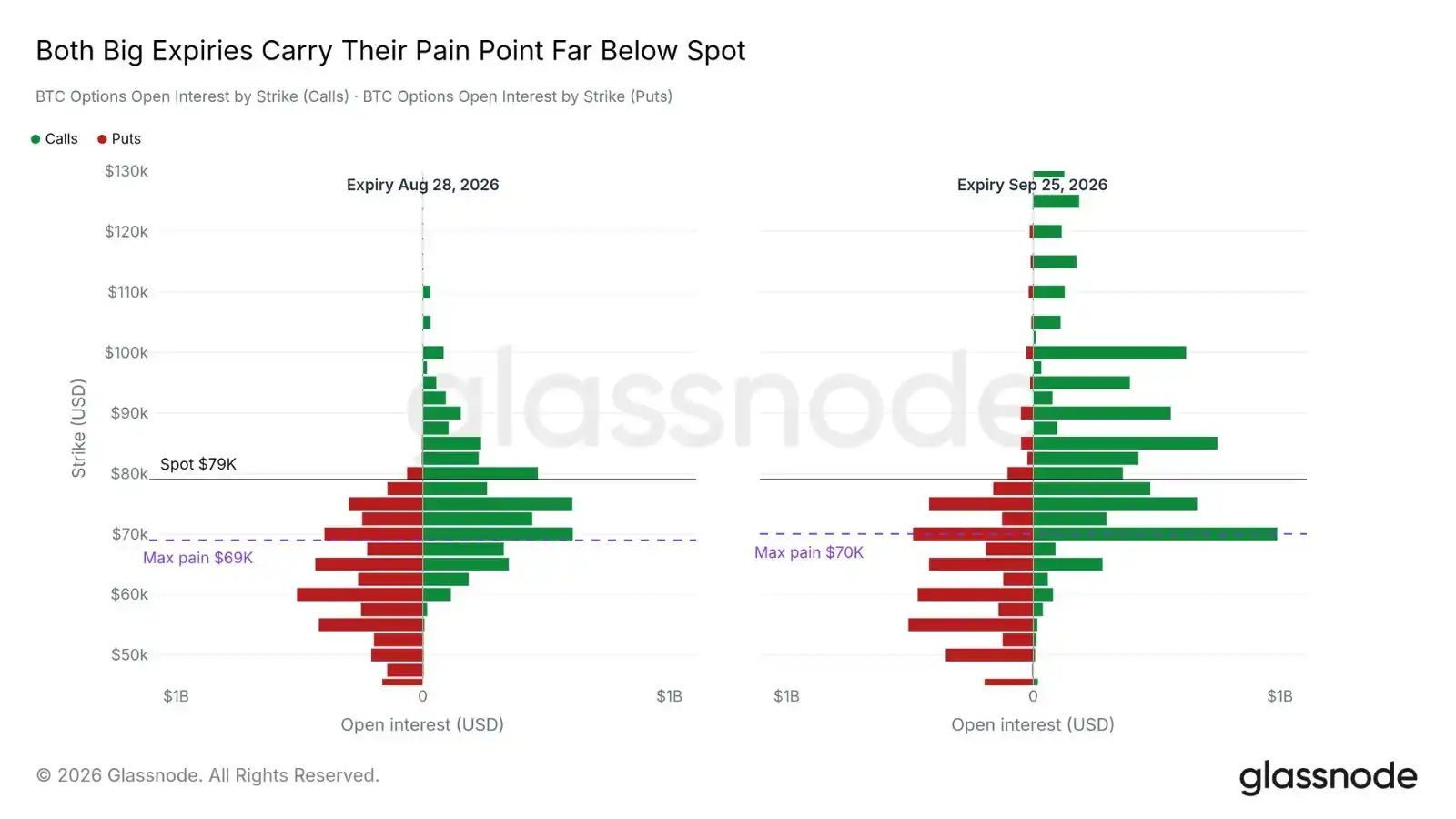
The options market indicates patient expectations. The two most concentrated upcoming monthly expiries—this Friday with about $10.4 billion in notional value and the September quarterly expiry with about $13.7 billion—have their respective max pain points significantly below the spot price. Max pain (the strike price where the largest number of options expire worthless) is at $69,000 and $70,000, respectively, while spot is around $79,000. Below lies a concentration of puts, above a concentration of calls.

The forward distribution is relatively flat. For expiries up to September 25, 2026, about 70% of the strike prices imply outcomes within the $69,000 to $89,700 range, with the median only a few hundred dollars above spot. The options market's base-case scenario prices in stability within the current supply wall: neither expecting a breakout above the $86,000 zone, nor a retreat back to the floor below.
Conclusion

The largest short liquidation event in our data records initiated this rebound; sustained ETF subscriptions, active on-chain buying, and net exchange outflows provided the capital needed for continuation; cycle indicators still position the market in an early stage. This is a typical profile for a phased rally.

Confirmation signals would come from above: a sustained close above $83,300, coupled with continuing ETF inflows, would indicate the supply wall is being absorbed rather than respected. Weakness signals would first manifest with a loss of the $70,000 short-term holder cost basis, followed by the $62,000-$65,000 floor zone defended by recent buyers. A return to the $62,900 squeeze starting point would completely erase the entire move.


Kripto yang Sedang Tren

Pertanyaan Terkait

QWhat triggered the recent Bitcoin rally according to the article?

AThe rally was triggered by an unprecedented, record-breaking short squeeze event, where a massive amount of short positions were liquidated, sparking a 26% rebound from the mid-August lows.

QWhat key price zone is identified as the major supply and resistance area for Bitcoin's upward movement?

AThe key resistance and supply-dense zone is identified as the $81,000 to $86,000 range. A successful and sustained break above this area is crucial for the rally to continue towards the January highs.

QHow did US spot Bitcoin ETFs perform during the short squeeze window, and why is it significant?

AUS spot Bitcoin ETFs recorded net inflows of $2.23 billion during the short squeeze window, with no single day of outflows. This marked the strongest weekly inflow of the year and provided substantial, real capital backing for the rally, confirming genuine institutional buying interest.

QWhat does the 'Accumulation Trend Score' data reveal about market breadth during this rally?

AThe 30-day Accumulation Trend Score data shows that all six wallet size cohorts were at or above the neutral threshold of 0.5, indicating a synchronized accumulation of Bitcoin across all market participant groups—from small to large holders. This widespread buying confirms the breadth and authenticity of the market's strength.

QAccording to the article, what are the key signals for confirming a continuation of the rally versus a potential failure?

AA bullish confirmation signal would be a sustained close above $83,300 combined with continued ETF inflows, showing the supply wall is being absorbed. A bearish failure signal would be a loss of the $70,000 support (Short-Term Holder cost basis), followed by a break below the $62,000-$65,000 floor defended by recent buyers. A drop back to the $62,900 squeeze starting point would invalidate the entire rally.

Bacaan Terkait

Trading

Spot

Artikel Populer

Apa Itu BITCOIN

Memahami HarryPotterObamaSonic10Inu (ERC-20) dan Posisinya dalam Ruang Crypto Dalam beberapa tahun terakhir, pasar cryptocurrency telah menyaksikan peningkatan popularitas koin meme, menarik minat tidak hanya dari para pedagang, tetapi juga mereka yang mencari keterlibatan komunitas dan nilai hiburan. Di antara token unik ini adalah HarryPotterObamaSonic10Inu (ERC-20), sebuah proyek menarik yang memadukan referensi budaya ke dalam dunia cryptocurrency. Artikel ini membahas aspek-aspek kunci dari HarryPotterObamaSonic10Inu, menjelajahi mekanismenya, etos yang digerakkan oleh komunitas, dan keterlibatannya dengan lanskap crypto yang lebih luas. Apa itu HarryPotterObamaSonic10Inu (ERC-20)? Seperti namanya, HarryPotterObamaSonic10Inu adalah koin meme yang dibangun di atas blockchain Ethereum, diklasifikasikan di bawah standar ERC-20. Berbeda dengan cryptocurrency tradisional yang mungkin menekankan utilitas praktis atau potensi investasi, token ini berkembang berdasarkan nilai hiburan dan kekuatan komunitasnya. Proyek ini bertujuan untuk menciptakan lingkungan di mana pengguna yang terlibat dapat berkumpul, berbagi ide, dan berpartisipasi dalam aktivitas yang terinspirasi oleh berbagai fenomena budaya. Salah satu fitur mencolok dari HarryPotterObamaSonic10Inu adalah nol pajak pada transaksi. Elemen menarik ini bertujuan untuk mendorong perdagangan dan keterlibatan komunitas, tanpa biaya tambahan yang dapat menghalangi pedagang berskala kecil. Total pasokan koin ditetapkan pada satu miliar token, sebuah angka yang menandakan niatnya untuk menjaga sirkulasi yang substansial di dalam komunitas. Pencipta HarryPotterObamaSonic10Inu (ERC-20) Asal usul HarryPotterObamaSonic10Inu agak diselimuti misteri; rincian tentang penciptanya tetap tidak diketahui. Pengembangan token ini tidak memiliki tim yang teridentifikasi atau cetak biru yang jelas, yang bukan hal yang aneh dalam sektor koin meme. Sebaliknya, proyek ini muncul secara organik, dengan kemajuannya sangat bergantung pada antusiasme dan partisipasi komunitasnya. Investor HarryPotterObamaSonic10Inu (ERC-20) Terkait investasi eksternal dan dukungan, HarryPotterObamaSonic10Inu juga tetap ambigu. Token ini tidak mencantumkan yayasan investasi atau dukungan organisasi yang signifikan. Sebaliknya, denyut nadi proyek ini adalah komunitas akar rumputnya, yang menginformasikan pertumbuhannya dan keberlanjutan melalui aksi kolektif dan keterlibatan di ruang crypto. Bagaimana HarryPotterObamaSonic10Inu (ERC-20) Bekerja? Sebagai koin meme, HarryPotterObamaSonic10Inu beroperasi terutama di luar kerangka tradisional yang sering mengatur nilai aset. Ada beberapa aspek khas yang mendefinisikan cara kerja proyek ini: Transaksi Tanpa Pajak: Dengan tidak ada biaya pajak pada transaksi, pengguna dapat membeli dan menjual token tanpa khawatir akan biaya tersembunyi. Keterlibatan Komunitas: Proyek ini berkembang melalui interaksi komunitas, memanfaatkan platform media sosial untuk menciptakan buzz dan memfasilitasi keterlibatan. Diskusi, berbagi konten, dan keterlibatan adalah elemen penting yang membantu memperluas jangkauannya dan membangun loyalitas di antara para pendukung. Tidak Ada Utilitas Praktis: Perlu dicatat bahwa HarryPotterObamaSonic10Inu tidak menawarkan utilitas konkret dalam ekosistem finansial. Sebaliknya, ia diklasifikasikan sebagai token yang terutama untuk hiburan dan aktivitas komunitas. Referensi Budaya: Token ini dengan cerdik menggabungkan elemen dari budaya populer untuk menarik minat, terhubung dengan penggemar meme dan pengikut crypto. HarryPotterObamaSonic10Inu menunjukkan bagaimana koin meme beroperasi berbeda dari proyek cryptocurrency yang lebih tradisional, memasuki pasar sebagai konstruksi sosial yang inovatif daripada aset utilitarian. Garis Waktu HarryPotterObamaSonic10Inu (ERC-20) Sejarah HarryPotterObamaSonic10Inu ditandai oleh beberapa tonggak yang patut dicatat: Penciptaan: Token ini muncul dari meme viral, menangkap imajinasi banyak penggemar crypto. Tanggal penciptaan spesifik tidak tersedia, menekankan kebangkitannya yang organik. Pendaftaran di Bursa: HarryPotterObamaSonic10Inu telah muncul di berbagai bursa, memungkinkan akses dan perdagangan yang lebih mudah oleh komunitas. Inisiatif Keterlibatan Komunitas: Kegiatan yang sedang berlangsung bertujuan untuk meningkatkan interaksi komunitas, termasuk kontes, kampanye media sosial, dan generasi konten dari penggemar dan pendukung. Rencana Ekspansi Masa Depan: Peta jalan proyek ini mencakup peluncuran koleksi NFT, merchandise, dan situs eCommerce yang terkait dengan tema budayanya, lebih lanjut melibatkan komunitas dan berusaha menambahkan lebih banyak dimensi ke ekosistemnya. Poin Kunci Tentang HarryPotterObamaSonic10Inu (ERC-20) Sifat yang Diggerakkan oleh Komunitas: Proyek ini memprioritaskan masukan dan kreativitas kolektif, memastikan bahwa keterlibatan pengguna berada di garis depan pengembangannya. Klasifikasi Koin Meme: Ini mewakili puncak cryptocurrency berbasis hiburan, terpisah dari kendaraan investasi tradisional. Tidak Ada Afiliasi Langsung dengan Bitcoin: Meskipun ada kesamaan dalam nama ticker, HarryPotterObamaSonic10Inu berbeda dan tidak memiliki hubungan dengan Bitcoin atau cryptocurrency lain yang mapan. Fokus pada Kolaborasi: HarryPotterObamaSonic10Inu dirancang untuk menciptakan ruang untuk kolaborasi dan berbagi cerita di antara para pemegangnya, memberikan saluran untuk kreativitas dan ikatan komunitas. Prospek Masa Depan: Ambisi untuk berkembang melampaui premis awalnya ke dalam NFT dan merchandise menggambarkan jalur bagi proyek ini untuk berpotensi memasuki lebih banyak saluran arus utama dalam budaya digital. Seiring dengan terus meningkatnya daya tarik koin meme di komunitas cryptocurrency, HarryPotterObamaSonic10Inu (ERC-20) menonjol karena keterikatan budayanya dan pendekatan yang berorientasi pada komunitas. Meskipun mungkin tidak sesuai dengan pola tipikal token berbasis utilitas, esensinya terletak pada kegembiraan dan persahabatan yang ditegakkan di antara para pendukungnya, menyoroti sifat cryptocurrency yang terus berkembang dalam era digital yang semakin meningkat. Saat proyek ini terus berkembang, akan penting untuk mengamati bagaimana dinamika komunitas mempengaruhi trajektori dalam lanskap teknologi blockchain yang selalu berubah.

3.1k Total TayanganDipublikasikan pada 2024.04.01Diperbarui pada 2024.12.03

Apa Itu BITCOIN

Cara Membeli BTC

Selamat datang di HTX.com! Kami telah membuat pembelian Bitcoin (BTC) menjadi mudah dan nyaman. Ikuti panduan langkah demi langkah kami untuk memulai perjalanan kripto Anda.Langkah 1: Buat Akun HTX AndaGunakan alamat email atau nomor ponsel Anda untuk mendaftar akun gratis di HTX. Rasakan perjalanan pendaftaran yang mudah dan buka semua fitur.Dapatkan Akun SayaLangkah 2: Buka Beli Kripto, lalu Pilih Metode Pembayaran AndaKartu Kredit/Debit: Gunakan Visa atau Mastercard Anda untuk membeli Bitcoin (BTC) secara instan.Saldo: Gunakan dana dari saldo akun HTX Anda untuk melakukan trading dengan lancar.Pihak Ketiga: Kami telah menambahkan metode pembayaran populer seperti Google Pay dan Apple Pay untuk meningkatkan kenyamanan.P2P: Lakukan trading langsung dengan pengguna lain di HTX.Over-the-Counter (OTC): Kami menawarkan layanan yang dibuat khusus dan kurs yang kompetitif bagi para trader.Langkah 3: Simpan Bitcoin (BTC) AndaSetelah melakukan pembelian, simpan Bitcoin (BTC) di akun HTX Anda. Selain itu, Anda dapat mengirimkannya ke tempat lain melalui transfer blockchain atau menggunakannya untuk memperdagangkan mata uang kripto lainnya.Langkah 4: Lakukan trading Bitcoin (BTC)Lakukan trading Bitcoin (BTC) dengan mudah di pasar spot HTX. Cukup akses akun Anda, pilih pasangan perdagangan, jalankan trading, lalu pantau secara real-time. Kami menawarkan pengalaman yang ramah pengguna baik untuk pemula maupun trader berpengalaman.

11.3k Total TayanganDipublikasikan pada 2024.12.12Diperbarui pada 2026.06.02

Cara Membeli BTC

Apa Itu $BITCOIN

EMAS DIGITAL ($BITCOIN): Analisis Komprehensif Pengenalan EMAS DIGITAL ($BITCOIN) EMAS DIGITAL ($BITCOIN) adalah proyek berbasis blockchain yang beroperasi di jaringan Solana, yang bertujuan untuk menggabungkan karakteristik logam mulia tradisional dengan inovasi teknologi terdesentralisasi. Meskipun berbagi nama dengan Bitcoin, yang sering disebut sebagai “emas digital” karena persepsinya sebagai penyimpan nilai, EMAS DIGITAL adalah token terpisah yang dirancang untuk menciptakan ekosistem unik dalam lanskap Web3. Tujuannya adalah untuk memposisikan diri sebagai aset digital alternatif yang layak, meskipun rincian mengenai aplikasi dan fungsionalitasnya masih dalam pengembangan. Apa itu EMAS DIGITAL ($BITCOIN)? EMAS DIGITAL ($BITCOIN) adalah token cryptocurrency yang dirancang secara eksplisit untuk digunakan di blockchain Solana. Berbeda dengan Bitcoin, yang menyediakan peran penyimpanan nilai yang diakui secara luas, token ini tampaknya lebih fokus pada aplikasi dan karakteristik yang lebih luas. Aspek-aspek penting meliputi: Infrastruktur Blockchain: Token ini dibangun di atas blockchain Solana, yang dikenal karena kemampuannya menangani transaksi berkecepatan tinggi dan biaya rendah. Dinamika Pasokan: EMAS DIGITAL memiliki pasokan maksimum yang dibatasi pada 100 kuadriliun token (100P $BITCOIN), meskipun rincian mengenai pasokan yang beredar saat ini belum diungkapkan. Utilitas: Meskipun fungsionalitas yang tepat tidak dijelaskan secara eksplisit, ada indikasi bahwa token ini dapat digunakan untuk berbagai aplikasi, yang mungkin melibatkan aplikasi terdesentralisasi (dApps) atau strategi tokenisasi aset. Siapa Pencipta EMAS DIGITAL ($BITCOIN)? Saat ini, identitas pencipta dan tim pengembang di balik EMAS DIGITAL ($BITCOIN) tetap tidak diketahui. Situasi ini umum terjadi di antara banyak proyek inovatif dalam ruang blockchain, terutama yang sejalan dengan keuangan terdesentralisasi dan fenomena koin meme. Meskipun anonimitas semacam ini dapat mendorong budaya yang dipimpin komunitas, hal ini juga meningkatkan kekhawatiran tentang tata kelola dan akuntabilitas. Siapa Investor EMAS DIGITAL ($BITCOIN)? Informasi yang tersedia menunjukkan bahwa EMAS DIGITAL ($BITCOIN) tidak memiliki pendukung institusional yang dikenal atau investasi modal ventura yang menonjol. Proyek ini tampaknya beroperasi dengan model peer-to-peer yang berfokus pada dukungan dan adopsi komunitas daripada jalur pendanaan tradisional. Aktivitas dan likuiditasnya terutama terletak di bursa terdesentralisasi (DEX), seperti PumpSwap, daripada platform perdagangan terpusat yang mapan, lebih menyoroti pendekatan akar rumputnya. Bagaimana EMAS DIGITAL ($BITCOIN) Bekerja Mekanisme operasional EMAS DIGITAL ($BITCOIN) dapat dijelaskan berdasarkan desain blockchain dan atribut jaringannya: Mekanisme Konsensus: Dengan memanfaatkan bukti sejarah (PoH) unik dari Solana yang dipadukan dengan model bukti kepemilikan (PoS), proyek ini memastikan validasi transaksi yang efisien yang berkontribusi pada kinerja tinggi jaringan. Tokenomik: Meskipun mekanisme deflasi tertentu belum dijelaskan secara mendetail, pasokan token maksimum yang besar menunjukkan bahwa ini mungkin ditujukan untuk mikrotransaksi atau kasus penggunaan niche yang masih perlu didefinisikan. Interoperabilitas: Ada potensi untuk integrasi dengan ekosistem lebih luas Solana, termasuk berbagai platform keuangan terdesentralisasi (DeFi). Namun, rincian mengenai integrasi spesifik tetap tidak ditentukan. Garis Waktu Peristiwa Kunci Berikut adalah garis waktu yang menyoroti tonggak penting terkait EMAS DIGITAL ($BITCOIN): 2023: Penempatan awal token terjadi di blockchain Solana, ditandai dengan alamat kontraknya. 2024: EMAS DIGITAL mendapatkan visibilitas saat tersedia untuk diperdagangkan di bursa terdesentralisasi seperti PumpSwap, memungkinkan pengguna untuk memperdagangkannya melawan SOL. 2025: Proyek ini menyaksikan aktivitas perdagangan sporadis dan potensi minat dalam keterlibatan yang dipimpin komunitas, meskipun belum ada kemitraan atau kemajuan teknis yang signifikan yang didokumentasikan hingga saat ini. Analisis Kritis Kekuatan Skalabilitas: Infrastruktur Solana yang mendasari mendukung volume transaksi yang tinggi, yang dapat meningkatkan utilitas $BITCOIN dalam berbagai skenario transaksi. Aksesibilitas: Potensi harga perdagangan yang rendah per token dapat menarik investor ritel, memfasilitasi partisipasi yang lebih luas karena peluang kepemilikan fraksional. Risiko Kurangnya Transparansi: Ketidakhadiran pendukung, pengembang, atau proses audit yang dikenal publik dapat menimbulkan skeptisisme mengenai keberlanjutan dan keandalan proyek. Volatilitas Pasar: Aktivitas perdagangan sangat bergantung pada perilaku spekulatif, yang dapat mengakibatkan volatilitas harga yang signifikan dan ketidakpastian bagi investor. Kesimpulan EMAS DIGITAL ($BITCOIN) muncul sebagai proyek yang menarik namun ambigu dalam ekosistem Solana yang berkembang pesat. Meskipun berusaha memanfaatkan narasi “emas digital”, perbedaannya dari peran Bitcoin yang sudah mapan sebagai penyimpan nilai menyoroti perlunya diferensiasi yang lebih jelas mengenai utilitas dan struktur tata kelolanya. Penerimaan dan adopsi di masa depan kemungkinan akan bergantung pada penanganan ketidakjelasan saat ini dan mendefinisikan strategi operasional dan ekonominya dengan lebih eksplisit. Catatan: Laporan ini mencakup informasi yang disintesis yang tersedia hingga Oktober 2023, dan perkembangan mungkin telah terjadi di luar periode penelitian.

568 Total TayanganDipublikasikan pada 2025.05.13Diperbarui pada 2025.05.13

Apa Itu $BITCOIN

Diskusi

Selamat datang di Komunitas HTX. Di sini, Anda bisa terus mendapatkan informasi terbaru tentang perkembangan platform terkini dan mendapatkan akses ke wawasan pasar profesional. Pendapat pengguna mengenai harga BTC (BTC) disajikan di bawah ini.

活动图片