Price Cut Just 20%, Bill Drops 80%: GPT-5.6 Steps into Claude's Turf to Recalculate the Programming Bill

marsbitDipublikasikan tanggal 2026-08-28Terakhir diperbarui pada 2026-08-28

Abstrak

While the official price for GPT-5.6 Terra only dropped by 20%, developer costs for successful coding tasks have reportedly been slashed by 82% when using the model within AWS's Kiro platform. This dramatic reduction stems not from model price cuts alone, but from significant efficiency gains within the integrated "agent + model" system. By optimizing the workflow—reducing unnecessary tokens, tool calls, and failed attempts—the collaboration between OpenAI and AWS has minimized costly computational detours. Key to this efficiency is Kiro's "spec-driven" approach, which refines vague user requests into clear technical specifications before the model begins coding, preventing expensive misunderstandings and rewrites. Benchmark results highlight that the choice of AI agent framework significantly impacts cost, with different frameworks yielding vastly different bills for similar performance scores. The integration marks OpenAI's entry into Kiro, a platform previously dominated by Anthropic's Claude. AWS now offers developers a choice between GPT-5.6 models (Sol, Terra, Luna) and Claude, fostering direct competition. This shift reframes the model selection question from "cost per million tokens" to "total cost to complete the task," emphasizing end-to-end efficiency over raw benchmark scores.

For the same model, the official price is reduced by only 20%, but your bill shrinks by eighty percent.
On August 24th, OpenAI announced test results conducted jointly with AWS:

On Terminal-Bench 2.1, the cost for GPT-5.6 Terra to successfully complete a task in Kiro was reduced by approximately 82%.

Kiro is AWS's intelligent software developer agent platform, covering IDE, CLI, and Web.

The three siblings of the GPT-5.6 family—Sol, Terra, and Luna—have been running inside for over a month.

This 82% reduction is not the official price cut.

Terra's last price adjustment was on July 30th, by 20%.
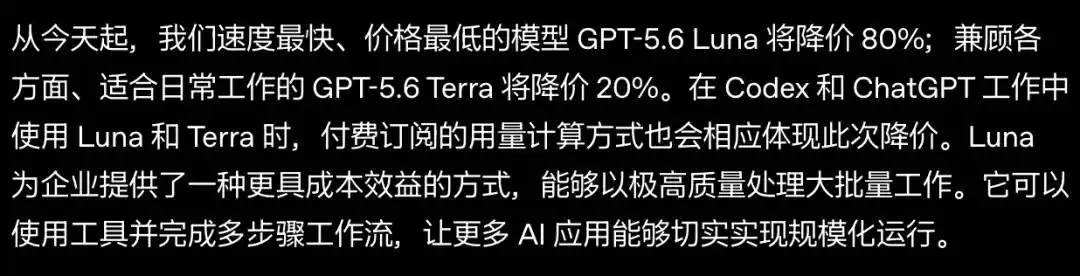
OpenAI price adjustment announcement on July 30th, Terra lowered by 20%.

The unit price dropped only 20%, but the bill could be slashed by eighty percent.

The source of the remaining sixty percentage points saved in the middle is what truly deserves our attention.

GPT-5.6 landed on Kiro in July this year.

First, on the 13th, AWS announced that GPT-5.6 Sol, Terra, and Luna were officially available on Amazon Bedrock.

The very next day, Kiro published a blog post announcing the availability of the three models on IDE, CLI, and Web.
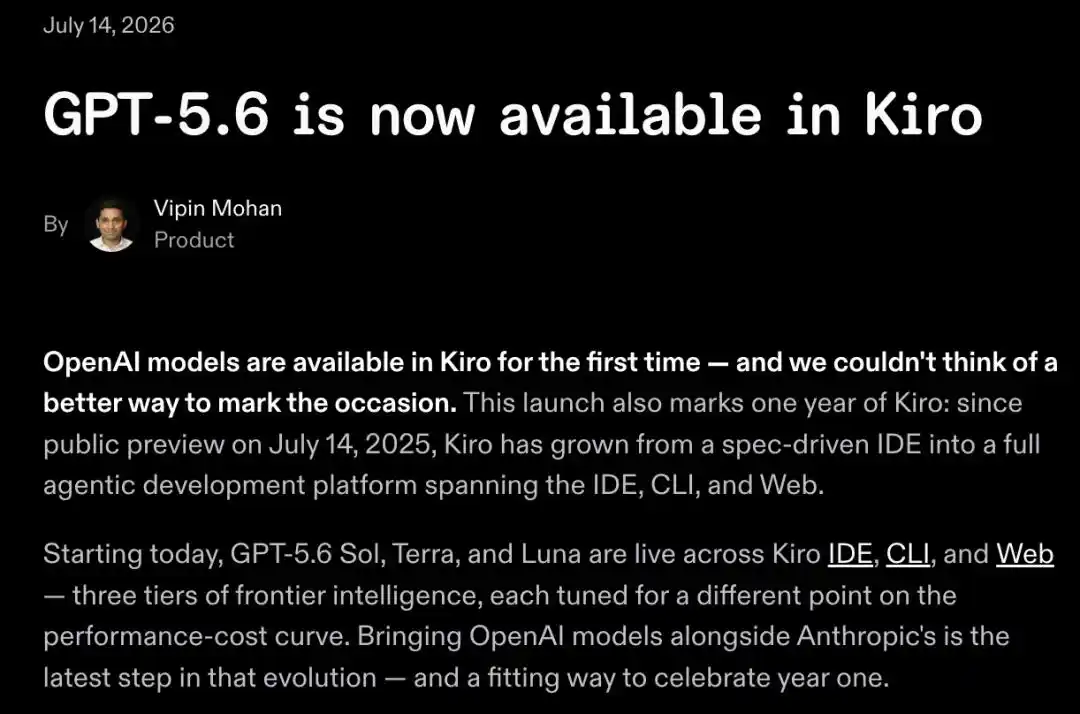
This marked the first time OpenAI models entered Kiro, coinciding with Kiro's one-year public preview anniversary.

First, put the models on the shelf, then put them to work. Over a month later, OpenAI came back with its homework:

The two companies jointly tuned the Kiro environment and OpenAI models, reducing the cost for Terra to complete a successful task by about 82%.

What's Saved

Is the Money Spent on Detours

During the price adjustment on July 30th, Terra was reduced by 20%, but in Kiro's tests, the cost per task dropped by 82%.

Where did the extra sixty percent savings come from?

The directions are limited:

The model generated fewer tokens, the number of back-and-forth tool calls decreased, and there were fewer retries and detours after failures.

Therefore, the large chunk saved is not the cost per call, but the cost of those calls that would have been wasted.

The logic is simple: if an AI agent fails a task once, the bill is still charged. If it chooses the wrong path, goes off-track three times, and then circles back, those tokens are also billed.

In real development, money often leaks out this way.

OpenAI has pointed out the same logic in its official blog: efficiency comes from three layers:

The agent framework that initiates requests and organizes context, the orchestration system that schedules requests in the middle, and finally the model itself running on GPUs.
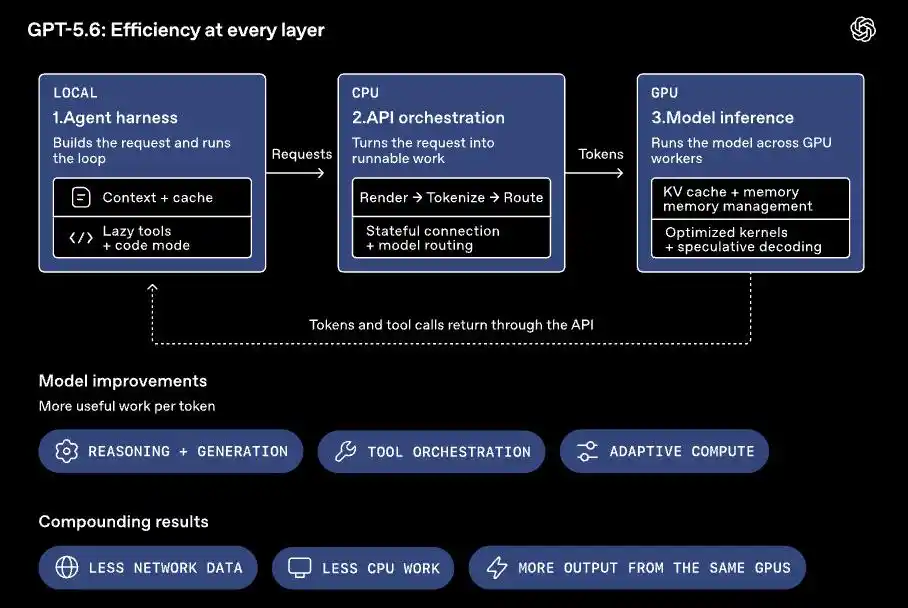
OpenAI breaks down the sources of GPT-5.6's efficiency: requests start from the agent framework, are scheduled by the orchestration system, and finally run the model on GPU, saving at every layer.

Savings can also come from model specialization.

OpenAI also gave an example of usage: a coding workflow can first use Sol to think through the problem and define the plan, then switch to Luna to implement the well-defined changes, write tests, and run evaluations.

Same pipeline, different levels of intelligence allocated to different stages.

The Model Accounts for Only Half the Bill

Change the Framework, Change the Price

The Terminal-Bench 2.1 benchmark doesn't ask the model to answer questions alone.

It places the model in a terminal environment with a vague objective, letting it plan its own path, call tools, write scripts, handle errors, and iterate repeatedly.

So the resulting score is the performance of the "agent + model" combination.
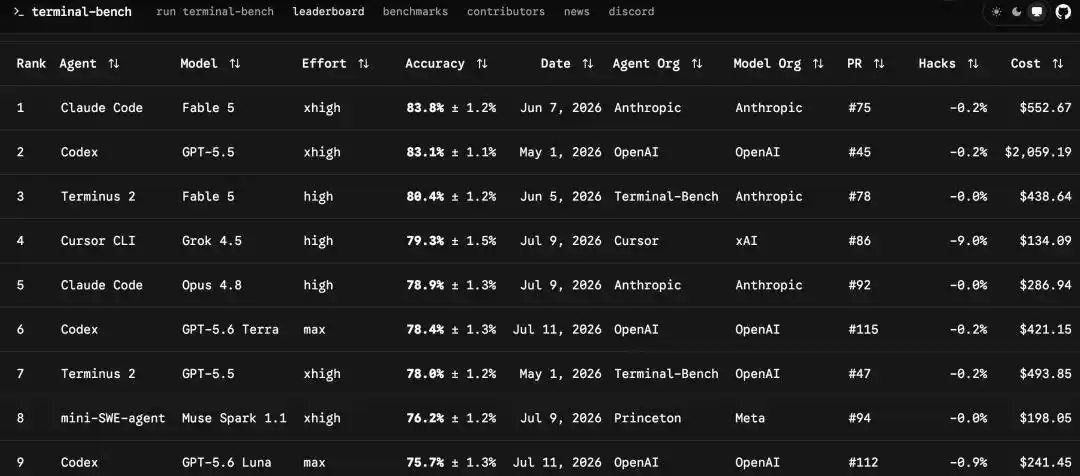
The public Terminal-Bench 2.1 leaderboard, with cost added to the right of accuracy. (Source: Terminal-Bench)

The four lines of numbers in the leaderboard illustrate the point best:

Claude Code with Fable 5, 83.8%, $552.67;

Codex with GPT-5.5, 83.1%, $2059.19;

Codex with GPT-5.6 Terra, 78.4%, $421.15;

Codex with GPT-5.6 Luna, 75.7%, $241.45.

The scores in the first two rows differ by only 0.7 percentage points, but the bills differ by nearly 4 times.

The same model, placed into different frameworks with different context organization and tool strategies, results in completely different prices.

According to data provided by Kiro, Terra scored 77.4 on the Coding Agent Index, only slightly higher than Claude Fable 5's 77.2.

Its selling point isn't the score, but the price corresponding to that score.

This is also where Kiro's spec-driven focus lies. The core approach is simple: don't start writing code immediately.

It first breaks down the user's vague goal into a formal requirements document, technical design, and executable task list before handing it over to the model.

Thus, the model receives not a vague statement, but a well-defined job.

Those familiar with Agents will immediately realize that this step saves the most expensive part of the expenditure.

Models going off-track, reworking, and starting over often burn more tokens than doing the actual work.

Kiro also includes two checkpoints in the process: pause for human review before code is actually modified; and automatically run a round of tests after the work is done to verify correctness.

Each rework stopped by these two checkpoints saves real money.

Claude in Amazon's Territory

GPT Takes Half

A year ago, Kiro was just a spec-driven IDE, and the model selector was Anthropic's domain.

A year later, AWS placed three tiers of OpenAI models into its own developer agent platform at once.

Sol, Terra, Luna listed alongside Claude in the same dropdown menu—a scene hard to imagine a year ago.

Although GPT-5.6 is "fully deployed" this time, it's not "fully open."

The three models are released progressively and experimentally, targeting Pro, Pro+, Pro Max, and Power users. Availability is limited to two regions: US North Virginia and Europe Frankfurt, supporting cross-region inference.

There's also a point many find hard to adjust to: these models in Kiro operate with a hidden chain-of-thought; you can't see its reasoning steps, only the final result.

Those accustomed to watching the Agent reason step-by-step feel like throwing work into an opaque box.

The official statement is that this is expected behavior and doesn't affect output quality.

The three model tiers are clearly priced in Kiro.

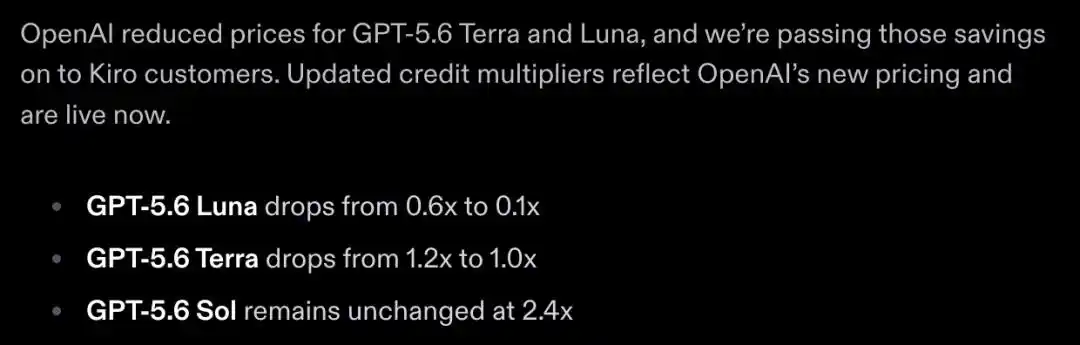
When they first launched on July 14th, the same task cost 2.4x for Sol, 1.2x for Terra, and 0.6x for Luna.

After OpenAI's price reduction on July 30th took effect, Kiro followed the next day: Luna was slashed from 0.6x all the way to 0.1x, Terra reduced from 1.2x to 1.0x, with only Sol unchanged.
AWS's stance is clear: a development platform cannot be tied to just one model.

In the same selector, two cutting-edge models are beginning to undercut each other on price.

The evaluation criteria for models is also changing: a higher score no longer guarantees a win; spending less can also win.

For developers, the question used to be "How much per million tokens for this model?" Now it must be "How much will it actually cost me to get this thing done?"

References:

https://x.com/OpenAIDevs/status/2091966982015103068

https://openai.com/index/gpt-5-6-in-kiro/

This article is from WeChat Official Account "AI_era" (ID: AI_era), author: ASI Revelation, editor: Yuanyu


Kripto yang Sedang Tren

Pertanyaan Terkait

QAccording to the article, the cost of completing a successful task with GPT-5.6 Terra in Kiro decreased by 82%, but the official price reduction was only 20%. Where did the additional 60% cost saving come from?

AThe additional 60% cost saving primarily came from optimizations that reduced wasted token usage. These savings were achieved by minimizing the number of tokens generated, reducing unnecessary tool calls, and decreasing the frequency of failed attempts and inefficient detours. Essentially, the savings came from avoiding the costs associated with the AI agent making mistakes, choosing wrong paths, or having to backtrack, all of which would have incurred charges.

QWhat is the primary difference in how Kiro approaches coding tasks compared to a traditional AI agent, and how does this contribute to cost savings?

AKiro uses a spec-driven approach. Instead of letting the AI write code immediately from a vague user instruction, it first breaks down the instruction into a formal requirements document, technical design, and a list of executable tasks. This provides the model with a clear and structured job description upfront. This method saves costs by significantly reducing the expensive overhead of the model going off-track, needing rework, or starting over, which consumes a large number of tokens.

QWhat was a notable change in the Kiro platform's model offerings one year after its public preview, and what does this signify?

AA notable change was the introduction of three OpenAI GPT-5.6 models (Sol, Terra, Luna) into Kiro's model selector, where previously Anthropic's Claude models were dominant. This signifies a strategic move by AWS to avoid being tied to a single model provider on its development platform. It creates direct competition between leading models, which can drive performance improvements and price reductions for developers.

QHow does the article explain the layered efficiency improvements for AI agents like GPT-5.6 in platforms such as Kiro?

AThe article explains that efficiency gains come from three layers: 1) The agent framework that initiates requests and organizes context. 2) The orchestration system that schedules and dispatches these requests. 3) The model itself running on the GPU. Cost savings are achieved through optimizations at every one of these layers, not just the model's raw processing cost.

QAccording to the Terminal-Bench 2.1 data cited, why might a developer's choice of agent framework be as important as the choice of model itself for overall cost?

AThe Terminal-Bench 2.1 data shows that different frameworks paired with the same or similar models can result in vastly different costs. For example, Claude Code with Fable 5 achieved 83.8% accuracy at a cost of $552.67, while Codex with GPT-5.5 achieved 83.1% accuracy but at a much higher cost of $2059.19. This demonstrates that the framework's context organization, tool strategies, and workflow efficiency have a massive impact on the final bill, making the framework choice critically important.

Bacaan Terkait

Ketua Fed Warsh "Terlihat Hawkish", Goldman Tetap Tak Percaya "Kenaikan Suku Bunga September", JPMorgan Bilang "Tetap Harus Lihat Data NFP dan CPI Agustus"

Ketua Fed Kevin Warsh memberikan sinyal lebih hawkish dalam pidato Jackson Hole-nya, menekankan inflasi sebagai "perhatian utama" dan menyatakan pekerjaan belum selesai jika tren inflasi inti tidak turun cukup cepat ke target 2%. Pasar merespons dengan kenaikan imbal hasil obligasi AS 2-tahunan dan probabilitas kenaikan suku bunga September melonjak dari sekitar 30% menjadi di atas 50%. Namun, dua bank Wall Street besar, Goldman Sachs dan J.P. Morgan, tidak mengubah prediksi dasar mereka. J.P. Morgan mempertahankan prediksi kenaikan suku bunga pada Desember, dengan ekonom Michael Feroli menekankan bahwa laporan data non-farm payrolls dan CPI Agustus yang akan datang akan menjadi penentu lebih penting untuk keputusan rapat September. Goldman Sachs memperkirakan kenaikan bulanan inti CPI dan inti PCE Agustus sekitar 0,2%, dan menurutnya, dengan jalur seperti itu, FOMC cenderung tidak akan bergerak. Warsh membahas panjang lebar tentang inflasi, meragukan perbaikan substansial dalam tren dasar meski ada data yang lebih baik, dan mengutip tingginya proporsi item dalam keranjang PCE yang naik lebih dari 3%. Dia juga mengklarifikasi dua pernyataan kontroversial dari Juli, menegaskan kembali komitmen pada target inflasi 2% dan bahwa suku bunga jangka pendek adalah alat kebijakan utama. Mengenai ekonomi, Warsh menilai kondisi "mengesankan" dan sulit menggambarkan kondisi keuangan saat ini sebagai ketat. Goldman Sachs dan J.P. Morgan sepakat bahwa kenaikan suku bunga September bukan skenario dasar mereka, dengan Goldman menyatakan hal itu hanya mungkin jika data CPI dan PPI Agustus jauh lebih kuat dari perkiraan.

marsbit8m yang lalu

Ketua Fed Warsh "Terlihat Hawkish", Goldman Tetap Tak Percaya "Kenaikan Suku Bunga September", JPMorgan Bilang "Tetap Harus Lihat Data NFP dan CPI Agustus"

marsbit8m yang lalu

Pilihan Editor Mingguan (0822-0828)

Pilihan Editor Mingguan (22-28 Agustus) Aliran informasi terlalu cepat, artikel analisis mendalam mudah tenggelam dalam sorotan panas. Rubrik "Pilihan Editor Mingguan" ini menyaring konten bernilai dari banjir informasi, membantu Anda menyaring kebisingan, menyisakan wawasan, dan membawa inspirasi. **Situasi Makro** Wall Street berspekulasi tentang langkah selanjutnya Menteri Keuangan AS untuk "menyelamatkan obligasi Treasury". Beberapa memperkirakan sinyal peningkatan pinjaman melalui T-Bills dan penerbitan obligasi jangka pendek pada November, dengan memperluas program buyback untuk meredam tekanan pada imbal hasil jangka panjang. Opsi pemotongan penerbitan obligasi jangka panjang juga mungkin muncul. Emas tembus $4.600/ons didorong oleh pembelian bank sentral, ETF, dan resonansi dana opsi. Goldman Sachs mempertahankan target akhir 2026 sebesar $4.900, dengan potensi kenaikan lebih lanjut. Mereka mencatat pembelian simultan oleh dana makro China dan Barat. **Investasi & Kewirausahaan** Dalam wawancara ekstensif, Arthur Hayes melihat ETH mencapai $30.000 dan yakin FLOP bisa melampaui ETH. Ia melihat kripto sebagai "katup pelepas" untuk pencetakan uang bank sentral. Menurutnya, risiko terbesar adalah perang. Ia juga memperkenalkan Flop Network. Saham kripto meroket: MSTR adalah "obligasi Bitcoin dengan leverage", COIN menawarkan pertumbuhan industri dan manfaat regulasi, sementara HOOD mungkin paling tahan turun. Perusahaan penambangan memiliki leverage tertinggi dan paling rapuh. Lonjakan 17% Circle dalam dua hari terkait pertumbuhan USDC dan prospek jaringan pembayaran serta blockchain Arc-nya. Masa depan valuasinya bergantung pada adopsi Arc. Pasar altcoin bangkit kembali, dengan 92% token naik dan kapitalisasi pasar kembali ke $1 triliun. Uang mengalir ke proyek-proyek top, dengan pergerakan yang semakin didorong fundamental. ZEC mencapai tertinggi baru didorong oleh proses konversi Grayscale Trust menjadi ETF. Skrip serupa sedang berjalan untuk TAO, namun kurang mendapat perhatian. Hyperliquid mengaktifkan mesin buyback kedua melalui mekanisme AQAv2, berpotensi menambah dana buyback $150-200 juta per tahun. Ethena Foundation membeli kembali token investor seed dan membatalkan semua unlock VC bulanan di masa depan, secara efektif menghilangkan tekanan pasokan rutin. **AI & Penyimpanan** Laba Nvidia mendekati $100 miliar per kuartal, dengan pertumbuhan 70% diperkirakan tahun depan. Permintaan tenaga AI meluas ke lebih banyak model dan perusahaan. Pasokan kini menjadi pembatas. Analisis teknis SK Hynix: meski turun, rencana buyback 40 triliun KRW menjadi variabel fundamental penting. Investor perlu memperhatikan risiko persaingan, negosiasi upah, dan volatilitas tinggi. **CeFi & DeFi** Proyek DeFi dengan pendapatan tinggi seperti UNI, JUP, AAVE, ETHFI, LDO disebutkan sebagai opsi untuk dipertimbangkan. Galaxy Digital meluncurkan fasilitas kredit dengan jaminan portofolio kripto (BTC, ETH, SOL), memungkinkan pinjaman dolar/USDC dengan suku bunga 8,99% tanpa perlu menjual aset. **Airdrop & Panduan Interaksi** Disebutkan beberapa proyek yang masih bisa diikuti terkait ekosistem PerpDEX dan HYPE. **Meme** Panduan "pump and dump" terkait rumor koin Trump di Robinhood Chain. **Ethereum & Skalabilitas** Diskusi tentang BitMine yang akan memegang 5% pasokan ETH: apakah risiko atau keuntungan? Tidak memberikan kontrol langsung, tetapi konsentrasi kepemilikan patut diperhatikan. Tom Lee mewawancarai pendiri BitMine, yang melihat target ETH $10.000 dan kemungkinan terus membeli melebihi 5%. **Keamanan** Kasus penipuan yang melibatkan selebritas internet Tionghoa "Dishi" dan "Xiongdi" selama 8 tahun, dengan kerugian puluhan juta. **Sorotan Mingguan Singkat** BTC kembali ke $80.000; rumor Trump terbitkan token baru dibantah anaknya; Standard Chartered perkirakan BTC bisa uji $126.000; Vitalik terbitkan penelitian kriptografi "local mixing"; kapitalisasi altcoin melonjak $215 miliar dalam 3 hari; Glassnode tunjukkan 85% altcoin ada dalam fase optimis.

marsbit16m yang lalu

Pilihan Editor Mingguan (0822-0828)

marsbit16m yang lalu

Eksekutif Strive: Memahami Ulang Roda Terbang Harga Bitcoin

Eksekutif Strive menjelaskan bahwa meskipun harga Bitcoin selama ini mengikuti pola "power law" (hukum pangkat) dengan keuntungan yang menurun seiring waktu, hal ini mungkin hanya tahap menuju fase selanjutnya. Mereka mengibaratkannya dengan teori retak logam: fase pertama adalah penemuan (volatilitas tinggi), fase kedua adalah pematangan (volatilitas dan keuntungan menurun mengikuti pola power law), dan fase ketiga adalah monetisasi yang didorong sistem keuangan. Dalam fase pematangan saat ini, volatilitas Bitcoin telah turun signifikan (dari 147% menjadi sekitar 44%), dan drawdown terburuknya juga berkurang. Hal ini meningkatkan rasio Sharpe, memungkinkan investor mengalokasikan modal lebih besar, dan yang terpenting, membuat Bitcoin menjadi jaminan (collateral) yang lebih menarik dan aman bagi pemberi pinjaman. Dengan volatilitas yang lebih rendah, risiko kredit turun, sehingga jumlah pinjaman yang dapat didukung oleh Bitcoin sebagai jaminan bisa jauh lebih besar. Harga yang naik juga akan semakin memperbesar kapasitas pinjaman ini. Ini menciptakan siklus umpan balik: volatilitas turun -> kualitas jaminan naik -> pinjaman lebih murah dan melimpah -> lebih banyak dolar (modal sendiri dan kredit) digunakan untuk membeli Bitcoin yang pasokannya tetap -> harga naik -> nilai jaminan naik -> kapasitas pinjaman bertambah lagi. Pada akhirnya, ketika modal dan kredit yang mengejar pasokan Bitcoin yang terbatas mencapai skala kritis, harga Bitcoin dalam dolar mungkin akan berakselerasi kembali dan keluar dari tren power law fase pematangan, memasuki fase monetisasi penuh yang didorong oleh sistem keuangan.

marsbit35m yang lalu

Eksekutif Strive: Memahami Ulang Roda Terbang Harga Bitcoin

marsbit35m yang lalu

Trading

Spot

Artikel Populer

Cara Membeli BILL

Selamat datang di HTX.com! Kami telah membuat pembelian Billions Network (BILL) menjadi mudah dan nyaman. Ikuti panduan langkah demi langkah kami untuk memulai perjalanan kripto Anda.Langkah 1: Buat Akun HTX AndaGunakan alamat email atau nomor ponsel Anda untuk mendaftar akun gratis di HTX. Rasakan perjalanan pendaftaran yang mudah dan buka semua fitur.Dapatkan Akun SayaLangkah 2: Buka Beli Kripto, lalu Pilih Metode Pembayaran AndaKartu Kredit/Debit: Gunakan Visa atau Mastercard Anda untuk membeli Billions Network (BILL) secara instan.Saldo: Gunakan dana dari saldo akun HTX Anda untuk melakukan trading dengan lancar.Pihak Ketiga: Kami telah menambahkan metode pembayaran populer seperti Google Pay dan Apple Pay untuk meningkatkan kenyamanan.P2P: Lakukan trading langsung dengan pengguna lain di HTX.Over-the-Counter (OTC): Kami menawarkan layanan yang dibuat khusus dan kurs yang kompetitif bagi para trader.Langkah 3: Simpan Billions Network (BILL) AndaSetelah melakukan pembelian, simpan Billions Network (BILL) di akun HTX Anda. Selain itu, Anda dapat mengirimkannya ke tempat lain melalui transfer blockchain atau menggunakannya untuk memperdagangkan mata uang kripto lainnya.Langkah 4: Lakukan trading Billions Network (BILL)Lakukan trading Billions Network (BILL) dengan mudah di pasar spot HTX. Cukup akses akun Anda, pilih pasangan perdagangan, jalankan trading, lalu pantau secara real-time. Kami menawarkan pengalaman yang ramah pengguna baik untuk pemula maupun trader berpengalaman.

546 Total TayanganDipublikasikan pada 2026.05.07Diperbarui pada 2026.06.02

Cara Membeli BILL

Diskusi

Selamat datang di Komunitas HTX. Di sini, Anda bisa terus mendapatkan informasi terbaru tentang perkembangan platform terkini dan mendapatkan akses ke wawasan pasar profesional. Pendapat pengguna mengenai harga BILL (BILL) disajikan di bawah ini.

活动图片