Bill Gates' Latest Long-Form Article: The Real Trouble with AI is That We Aren't Ready

marsbitDipublikasikan tanggal 2026-08-28Terakhir diperbarui pada 2026-08-28

Abstrak

Bill Gates' latest essay, "The turbulent AI era is here. The choices we make now are critical," warns that society is unprepared for the profound social and economic transition AI will bring. While optimistic about AI's long-term potential in healthcare, education, and other fields, Gates focuses on the "transition period" over the next 10-20 years. He argues this transition differs from past technological shifts like the Industrial Revolution because AI automates cognitive labor itself, potentially reducing the total number of future jobs. Risks like enhanced cyber-attacks and social disruption are already emerging, not distant future threats. A key concern is "low-cost intelligence substitution," where AI performs defined tasks cheaper than humans, gradually thinning workforces. Gates introduces the concept of "Human Reserved" jobs—roles like nursing or delivering serious medical news—where human judgment and empathy should remain central, even if AI is technically capable. To manage the transition, he calls for new governance, stronger social safety nets, retraining, and international cooperation, especially between the US and China. Crucially, he proposes taxing AI usage and robots to slow displacement and fund social programs. The core dilemma Gates presents is that AI could become humanity's "greatest equalizer" or its "worst source of injustice," depending on whether its immense productivity gains are broadly shared or concentrate wealth and power. The fundamental c...

By | Deng Ding Kexuan

On August 26, Bill Gates published a long-form article about AI on Gates Notes:

The turbulent AI era is here. The choices we make now are critical.(The Turbulent AI Era Has Arrived, The Choices We Make Now Are Critical)

Original article on Bill Gates' Gates Notes:
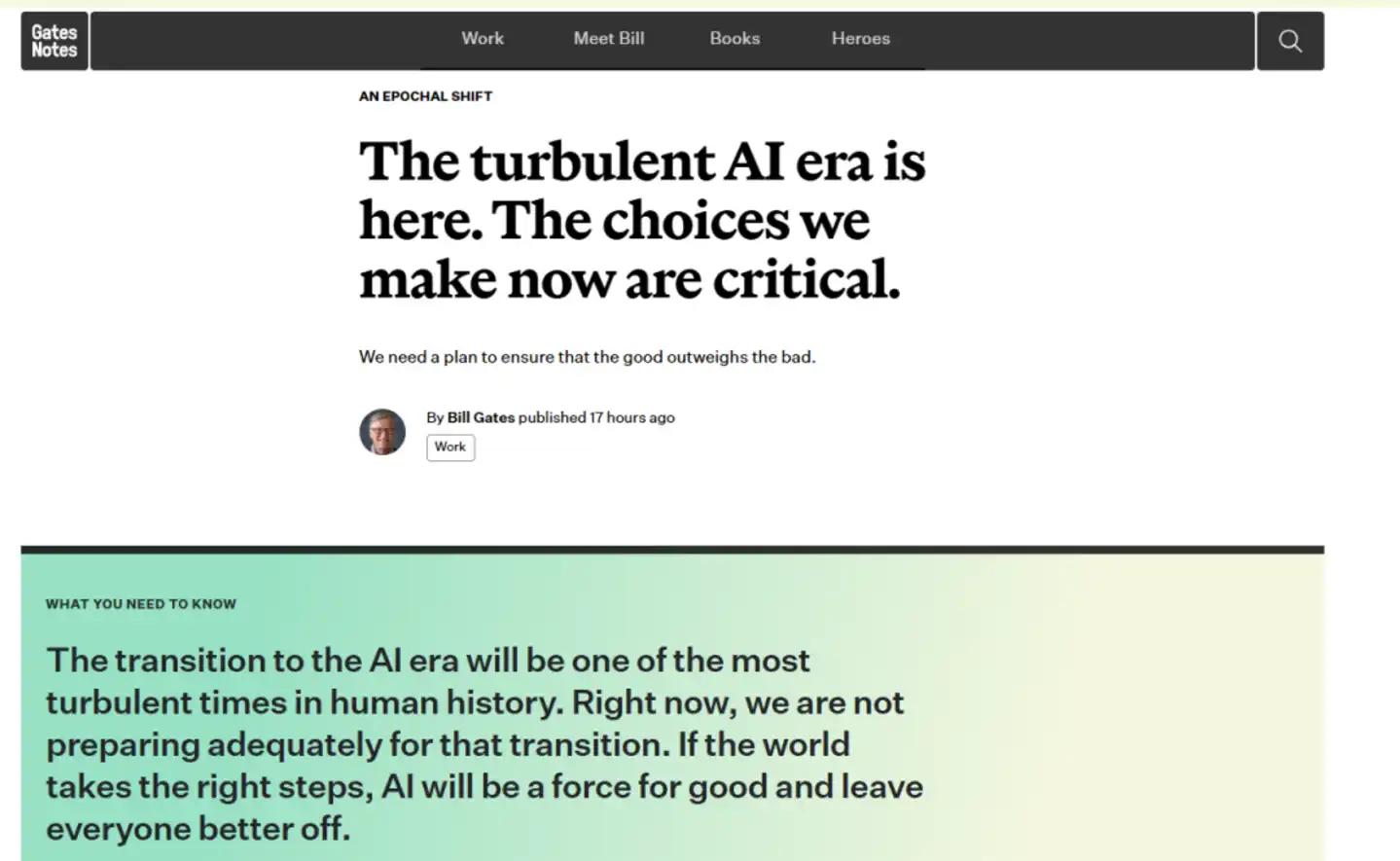
Core gist of the original article: AI could become the most powerful tool for equality, or a major source of inequality. Gates believes we need to start planning for this transition now.

This article is highly readable. Gates has not become an AI pessimist, nor does he deny AI's long-term value. He still believes AI will drive significant progress in fields like healthcare, education, agriculture, energy, and scientific research.

But his focus has changed.

In recent years, he talked more about what AI could ultimately create. This time, he spends considerable space discussing another question:

What will happen on the path from today to that future?

If the entire article were condensed into one sentence, it would probably be:

AI's long-term benefits could be enormous. But the 'transition period' between now and that future could become one of the most dramatic social transformations in human history. And we have barely established institutions for it.

Gates still believes in AI's long-term value. What worries him now is: how we get through the next decade or so in the middle.

He writes directly in the original text: "Unfortunately, we are not preparing for it now."

First Level: Gates believes this time cannot be simply compared to the Industrial Revolution

This is a point I consider very important and easily missed by news headlines.

Faced with the question 'Will AI take jobs?' in the past, a standard answer was: The steam engine eliminated some jobs but created new ones; the internet did the same, so AI will ultimately create new jobs too.

Gates now expresses clear skepticism about this analogy. Previous technologies primarily replaced physical labor or specific capabilities. New jobs ultimately still required human cognition.

The special thing about AI is: it is itself replacing cognitive labor.

The default cycle of the past two hundred years

Old jobs disappear → New jobs appear → Humans transition to them

Gates directly mentions law, customer service, healthcare, software, and manufacturing in the original text, later listing jobs like sales, software engineering, paralegal, loan approval, data analysis, and patient triage.

His assessment is: New jobs will still emerge, but without appropriate policies, the number of future positions may be far fewer than today's.

This assessment considers a deeper issue than the usual 'AI taking jobs'. For the past two hundred years, we assumed technological progress would ultimately create more, more complex jobs that also required human cognition.

But what if what's being scaled and made cheaper is 'cognitive capability' itself? The validity of this historical experience then becomes uncertain.

The biggest impact of AI on employment might not be a sudden wave of mass unemployment. A more likely change is that the same company, the same business, will need far fewer people in the future.

One person plus a few Agents can complete work that previously required a small team.

Jobs won't vanish overnight, but new job creation will slow, teams will thin out, and companies will become increasingly unwilling to pay the previous price for 'cognitive labor that can be done by AI'.

Second Level: The risk is no longer a post-AGI problem, it's happening now

Another important context for Gates's shift in stance this time.

He explained to MIT Technology Review why he is speaking out now specifically.

He believes several previously discussed 'danger thresholds' are actually starting to be crossed, including: biological capabilities, cyber attack capabilities, psychological and social influence, job market disruption, and AI controllability.

Especially Coding. Advances in Claude Code, long context, and Agentic Coding made him realize AI is crossing more than just a programming capability threshold.

An Agent capable of writing code at scale could also become a powerful tool for cyber attacks.

The stronger AI's capabilities, the better defenders become at finding vulnerabilities and patching systems. But the cost for attackers to find vulnerabilities and launch attacks using the same capabilities is also falling.

Gates also mentions this issue in the original text. The new capabilities attackers are gaining are rapidly increasing, while defenders cannot patch all weaknesses simultaneously.

Capabilities are crossing lines, governance remains stuck in the discussion stage.

Third Level: His biggest worry isn't just unemployment, but 'low-cost intelligent substitution'

There's one line from the MIT interview I find even more intriguing than the main text:

For well-defined jobs, AI will be cheaper and will do them better.

The examples he gives are very ordinary: telemarketing, customer service, finance departments, month-end closing, discount judgment, etc. A large number of white-collar jobs with clear processes, defined rules, and describable digitally will increasingly be easily done by low-cost AI.

The most crucial word here might not be 'substitution', but: cheaper.

The reality likely won't be a sudden switch where AI = 1, human = 0. It might be a department that previously needed 10 people now only needing 6.

The information processing required for entry-level positions is first handled mostly by Agents. A person's work hours used to dictate the speed of business expansion; now software can process vast numbers of tasks in parallel.

The core of the change is the marginal cost of labor and intelligence.

Following this line of thought further, Gates proposes an idea rarely heard from him: For some jobs, even if AI can do them, society may still want to leave them to people.

Fourth Level: A very interesting new concept – Human Reserved

Can be translated as: 'Human Reserved Domains.' Gates uses a vivid analogy: nature reserves.

Of course, roads and buildings could be built in nature reserves. We choose not to because the cost of losing them is too high. Human Reserved follows similar logic: even if AI can do it, we still decide to have humans do it.

This idea comes from his father's later years.

Gates's father had Alzheimer's disease. In his final years, a group of caregivers looked after him around the clock. Sometimes, his father could no longer express that he was hungry, but the caregivers could still understand him.

Gates writes there is something 'irreplaceably human' in this kind of care. Education and mental health might adopt a 'human + AI' approach, with humans bearing final responsibility and AI extending human capabilities.

Another example in healthcare: Technically, a robot could certainly tell a person 'You have an incurable disease.' Gates believes it should not.

The meaning of 'human work' in the future may no longer be determined solely by efficiency.

Fifth Level: Therefore, taxes and social security must be redesigned

If AI and robots continuously reduce labor demand, existing systems will encounter a very practical problem.

The current tax base

People work → Companies pay wages → Wages are taxed

If more and more work becomes: AI / robots work → Companies gain productivity benefits, the original tax base could be affected.

Therefore, Gates again raises the idea of a robot tax, and states it very directly:

"I believe we should tax AI tokens and robots."

"I believe we should tax AI tokens and robots."

When a company hires a person, it must pay payroll tax based on the salary. Purchasing a robot can often be immediately written off as a business expense.

Gates believes the current tax system actually incentivizes companies to replace humans with machines faster.

Taxation could, on one hand, slightly slow the pace at which companies move away from human labor, and on the other hand, raise funds for retraining and a stronger social safety net.

This touches on the flip side of the issue I previously considered when writing 'The Bill for AI Won't Just Be Paid by Tech Companies'.

If these investments ultimately do create huge productivity gains, who will the gains flow to?

Sixth Level: AI could simultaneously become 'the greatest equalizer' and 'the worst source of injustice'

This is the overarching thesis of the article.

"AI will either be the greatest equalizer ever invented, or the worst source of injustice."

AI will either be the greatest tool for equality ever invented by humanity, or the most severe source of injustice.

If the marginal cost of AI healthcare, AI education, AI agriculture, and AI research is low enough, capabilities previously available only to affluent regions have the opportunity to reach more ordinary people.

The same technology could also amplify existing disparities.

AI ownership is concentrated in a few companies.

Capital captures the main productivity gains.

The value of ordinary people's labor declines.

Affluent regions gain AI benefits first.

Low-income groups bear the brunt of job impacts first.

So the question is no longer just: 'Can AI create wealth?', but also: 'Who ultimately gets the wealth AI creates?'

Finally, the three categories of action he suggests

First, establish a new AI transition governance system.

Existing government agencies were not designed for a technology that spans employment, national security, education, healthcare, taxation, energy, finance, and cybersecurity.

Second, proactively manage job market impacts.

Including strengthening the social safety net, vocational retraining, adjusting tax systems, and unconventional solutions like Human Reserved.

Third, international coordination is needed; the US and China cannot be absent.

Cybersecurity, biological risks, and model proliferation all cross borders. Gates explicitly writes that a certain degree of cooperation between the US and China is needed.

The most hotly debated view in this article is his prediction about the future

Gates is discussing an AI transition period problem:

The endpoint of AI may be abundance, but there is no automatically smooth path between the 'abundant society' and the present.

An abundant society is at least a decade away. The entire transition process could last the next 10–20 years.

Sam Altman, Dario Amodei, and others often describe where AI can ultimately push productivity. Gates is discussing another period this time:

What exactly will happen between now and that abundant society?

This question is more realistic for ordinary people than 'When will AGI arrive?': Companies stop hiring so many new people. A department starts using Agents to do the work of several. Certain professional services become very cheap.

New productivity gains flow more to those who own the models, compute, and capital. But tax, education, social security, and employment systems still operate in the old way.

These changes don't need to wait for AGI to appear; some have already begun. The hardest part of AI may not just be making models powerful enough.

Once technology enters society, there is a slower, harder problem:

Do we have the capacity to make society adapt to it?

  • References:Bill Gates / Gates Notes; MIT Technology Review Interview; Anthropic Claude Code materials.


Kripto yang Sedang Tren

Pertanyaan Terkait

QAccording to Bill Gates, what is the main concern regarding AI's future development?

AAccording to Bill Gates, the main concern is not AI's ultimate potential but the "transition period" leading up to that future. This period could be one of the most dramatic social transformations in human history, and he believes we are largely unprepared for the institutional changes required to manage issues like employment disruption and inequality during this time.

QWhy does Bill Gates argue that the AI transition is not a simple repeat of the Industrial Revolution?

ABill Gates argues that past technological revolutions, like those driven by steam engines or the internet, primarily replaced physical labor or specific tasks, eventually creating new jobs that still required human cognition. AI is different because it is replacing cognitive labor itself, the very foundation upon which new jobs have historically been created. This calls into question whether the historical pattern of 'old jobs disappear → new jobs appear' will hold true.

QWhat is the concept of "Human Reserved" that Bill Gates introduces?

A"Human Reserved" refers to certain jobs or domains that society should purposefully reserve for humans, even if AI becomes technically capable of performing them. Gates uses the analogy of a nature preserve. Examples include certain aspects of caregiving (like for his father with Alzheimer's), education, and delivering serious medical news. The idea is that the human element in these roles provides an irreplaceable value that should be protected for social, not just efficiency, reasons.

QWhat specific policy recommendation does Bill Gates make to address potential economic disruptions from AI?

ABill Gates recommends implementing a "robot tax" or a tax on AI tokens. He argues that current tax systems, which tax human labor through payroll taxes but often allow immediate write-offs for capital investments in robots/AI, incentivize the rapid replacement of human workers. Taxing AI and robots could slow this transition and generate revenue to fund retraining programs and strengthen social safety nets for those affected by job displacement.

QWhat are the two potential, opposing outcomes that Bill Gates sees for AI's impact on society?

ABill Gates states that AI will either become "the greatest equalizer ever invented" or "the worst source of injustice." It could be an equalizer by drastically lowering the cost of access to high-quality services like healthcare and education, making them available to more people globally. Conversely, it could exacerbate inequality if the ownership and productivity gains from AI are concentrated among a few companies and capital owners, while the labor value of the majority declines and lower-income groups bear the brunt of job losses.

Bacaan Terkait

Meskipun Bitcoin Baru Saja Naik, Satu Analis Tetap Berhati-hati: 'Saya Belum Melihat Apa yang Saya Inginkan'

Meskipun harga Bitcoin baru-baru ini pulih di pasar kripto dan menumbuhkan ekspektasi bullish, analis João Wedson, pendiri Alphractal, tetap menyuarakan kehati-hatian. Analisisnya berdasarkan data blockchain, terutama indikator MVRV Z-Score, menunjukkan bahwa titik terendah harga Bitcoin dalam siklus saat ini mungkin belum tercapai. Wedson membandingkan struktur pasar saat ini dengan siklus 2017-2018. Pada 2017, indikator MVRV Z-Score membentuk tiga puncak signifikan sebelum Bitcoin mencapai rekor tertinggi, kemudian membentuk dasar setelah penurunan. Namun, pasar mengalami penurunan tajam lagi di November 2018. Pola serupa terlihat pada 2024-2025, di mana indikator juga mencapai tiga puncak, meskipun antusiasme lebih terbatas. Risiko utama yang disorot adalah indikator MVRV Z-Score belum memasuki zona negatif, yang secara historis dikaitkan dengan titik terendah utama siklus Bitcoin. Wedson mempertanyakan apakah harga akan mengikuti jika indikator ini turun lebih jauh. Menurutnya, data blockchain saat ini belum memberikan sinyal kuat bahwa penurunan harga terkini adalah titik terendah akhir. Berdasarkan analisisnya, Wedson menyatakan bahwa untuk memenuhi kondisi yang ia amati, harga Bitcoin mungkin perlu turun setidaknya ke level $53.000 atau bahkan lebih rendah. Ia menekankan bahwa ini adalah tantangan terhadap data, bukan terhadap sentimen bullish pasar saat ini, dan mengingatkan bahwa pada 2018 pun, banyak pelaku pasar tidak mengantisipasi penurunan tajam berikutnya. Secara keseluruhan, indikator on-chain menunjukkan bahwa risiko penurunan harga belum sepenuhnya hilang, dan tidak secara jelas menandakan bahwa "harga dasar telah tercapai" untuk Bitcoin.

cryptonews.ru25m yang lalu

Meskipun Bitcoin Baru Saja Naik, Satu Analis Tetap Berhati-hati: 'Saya Belum Melihat Apa yang Saya Inginkan'

cryptonews.ru25m yang lalu

Ketua Fed Warsh "Terlihat Hawkish", Goldman Tetap Tak Percaya "Kenaikan Suku Bunga September", JPMorgan Bilang "Tetap Harus Lihat Data NFP dan CPI Agustus"

Ketua Fed Kevin Warsh memberikan sinyal lebih hawkish dalam pidato Jackson Hole-nya, menekankan inflasi sebagai "perhatian utama" dan menyatakan pekerjaan belum selesai jika tren inflasi inti tidak turun cukup cepat ke target 2%. Pasar merespons dengan kenaikan imbal hasil obligasi AS 2-tahunan dan probabilitas kenaikan suku bunga September melonjak dari sekitar 30% menjadi di atas 50%. Namun, dua bank Wall Street besar, Goldman Sachs dan J.P. Morgan, tidak mengubah prediksi dasar mereka. J.P. Morgan mempertahankan prediksi kenaikan suku bunga pada Desember, dengan ekonom Michael Feroli menekankan bahwa laporan data non-farm payrolls dan CPI Agustus yang akan datang akan menjadi penentu lebih penting untuk keputusan rapat September. Goldman Sachs memperkirakan kenaikan bulanan inti CPI dan inti PCE Agustus sekitar 0,2%, dan menurutnya, dengan jalur seperti itu, FOMC cenderung tidak akan bergerak. Warsh membahas panjang lebar tentang inflasi, meragukan perbaikan substansial dalam tren dasar meski ada data yang lebih baik, dan mengutip tingginya proporsi item dalam keranjang PCE yang naik lebih dari 3%. Dia juga mengklarifikasi dua pernyataan kontroversial dari Juli, menegaskan kembali komitmen pada target inflasi 2% dan bahwa suku bunga jangka pendek adalah alat kebijakan utama. Mengenai ekonomi, Warsh menilai kondisi "mengesankan" dan sulit menggambarkan kondisi keuangan saat ini sebagai ketat. Goldman Sachs dan J.P. Morgan sepakat bahwa kenaikan suku bunga September bukan skenario dasar mereka, dengan Goldman menyatakan hal itu hanya mungkin jika data CPI dan PPI Agustus jauh lebih kuat dari perkiraan.

marsbit1j yang lalu

Ketua Fed Warsh "Terlihat Hawkish", Goldman Tetap Tak Percaya "Kenaikan Suku Bunga September", JPMorgan Bilang "Tetap Harus Lihat Data NFP dan CPI Agustus"

marsbit1j yang lalu

Pilihan Editor Mingguan (0822-0828)

Pilihan Editor Mingguan (22-28 Agustus) Aliran informasi terlalu cepat, artikel analisis mendalam mudah tenggelam dalam sorotan panas. Rubrik "Pilihan Editor Mingguan" ini menyaring konten bernilai dari banjir informasi, membantu Anda menyaring kebisingan, menyisakan wawasan, dan membawa inspirasi. **Situasi Makro** Wall Street berspekulasi tentang langkah selanjutnya Menteri Keuangan AS untuk "menyelamatkan obligasi Treasury". Beberapa memperkirakan sinyal peningkatan pinjaman melalui T-Bills dan penerbitan obligasi jangka pendek pada November, dengan memperluas program buyback untuk meredam tekanan pada imbal hasil jangka panjang. Opsi pemotongan penerbitan obligasi jangka panjang juga mungkin muncul. Emas tembus $4.600/ons didorong oleh pembelian bank sentral, ETF, dan resonansi dana opsi. Goldman Sachs mempertahankan target akhir 2026 sebesar $4.900, dengan potensi kenaikan lebih lanjut. Mereka mencatat pembelian simultan oleh dana makro China dan Barat. **Investasi & Kewirausahaan** Dalam wawancara ekstensif, Arthur Hayes melihat ETH mencapai $30.000 dan yakin FLOP bisa melampaui ETH. Ia melihat kripto sebagai "katup pelepas" untuk pencetakan uang bank sentral. Menurutnya, risiko terbesar adalah perang. Ia juga memperkenalkan Flop Network. Saham kripto meroket: MSTR adalah "obligasi Bitcoin dengan leverage", COIN menawarkan pertumbuhan industri dan manfaat regulasi, sementara HOOD mungkin paling tahan turun. Perusahaan penambangan memiliki leverage tertinggi dan paling rapuh. Lonjakan 17% Circle dalam dua hari terkait pertumbuhan USDC dan prospek jaringan pembayaran serta blockchain Arc-nya. Masa depan valuasinya bergantung pada adopsi Arc. Pasar altcoin bangkit kembali, dengan 92% token naik dan kapitalisasi pasar kembali ke $1 triliun. Uang mengalir ke proyek-proyek top, dengan pergerakan yang semakin didorong fundamental. ZEC mencapai tertinggi baru didorong oleh proses konversi Grayscale Trust menjadi ETF. Skrip serupa sedang berjalan untuk TAO, namun kurang mendapat perhatian. Hyperliquid mengaktifkan mesin buyback kedua melalui mekanisme AQAv2, berpotensi menambah dana buyback $150-200 juta per tahun. Ethena Foundation membeli kembali token investor seed dan membatalkan semua unlock VC bulanan di masa depan, secara efektif menghilangkan tekanan pasokan rutin. **AI & Penyimpanan** Laba Nvidia mendekati $100 miliar per kuartal, dengan pertumbuhan 70% diperkirakan tahun depan. Permintaan tenaga AI meluas ke lebih banyak model dan perusahaan. Pasokan kini menjadi pembatas. Analisis teknis SK Hynix: meski turun, rencana buyback 40 triliun KRW menjadi variabel fundamental penting. Investor perlu memperhatikan risiko persaingan, negosiasi upah, dan volatilitas tinggi. **CeFi & DeFi** Proyek DeFi dengan pendapatan tinggi seperti UNI, JUP, AAVE, ETHFI, LDO disebutkan sebagai opsi untuk dipertimbangkan. Galaxy Digital meluncurkan fasilitas kredit dengan jaminan portofolio kripto (BTC, ETH, SOL), memungkinkan pinjaman dolar/USDC dengan suku bunga 8,99% tanpa perlu menjual aset. **Airdrop & Panduan Interaksi** Disebutkan beberapa proyek yang masih bisa diikuti terkait ekosistem PerpDEX dan HYPE. **Meme** Panduan "pump and dump" terkait rumor koin Trump di Robinhood Chain. **Ethereum & Skalabilitas** Diskusi tentang BitMine yang akan memegang 5% pasokan ETH: apakah risiko atau keuntungan? Tidak memberikan kontrol langsung, tetapi konsentrasi kepemilikan patut diperhatikan. Tom Lee mewawancarai pendiri BitMine, yang melihat target ETH $10.000 dan kemungkinan terus membeli melebihi 5%. **Keamanan** Kasus penipuan yang melibatkan selebritas internet Tionghoa "Dishi" dan "Xiongdi" selama 8 tahun, dengan kerugian puluhan juta. **Sorotan Mingguan Singkat** BTC kembali ke $80.000; rumor Trump terbitkan token baru dibantah anaknya; Standard Chartered perkirakan BTC bisa uji $126.000; Vitalik terbitkan penelitian kriptografi "local mixing"; kapitalisasi altcoin melonjak $215 miliar dalam 3 hari; Glassnode tunjukkan 85% altcoin ada dalam fase optimis.

marsbit1j yang lalu

Pilihan Editor Mingguan (0822-0828)

marsbit1j yang lalu

Eksekutif Strive: Memahami Ulang Roda Terbang Harga Bitcoin

Eksekutif Strive menjelaskan bahwa meskipun harga Bitcoin selama ini mengikuti pola "power law" (hukum pangkat) dengan keuntungan yang menurun seiring waktu, hal ini mungkin hanya tahap menuju fase selanjutnya. Mereka mengibaratkannya dengan teori retak logam: fase pertama adalah penemuan (volatilitas tinggi), fase kedua adalah pematangan (volatilitas dan keuntungan menurun mengikuti pola power law), dan fase ketiga adalah monetisasi yang didorong sistem keuangan. Dalam fase pematangan saat ini, volatilitas Bitcoin telah turun signifikan (dari 147% menjadi sekitar 44%), dan drawdown terburuknya juga berkurang. Hal ini meningkatkan rasio Sharpe, memungkinkan investor mengalokasikan modal lebih besar, dan yang terpenting, membuat Bitcoin menjadi jaminan (collateral) yang lebih menarik dan aman bagi pemberi pinjaman. Dengan volatilitas yang lebih rendah, risiko kredit turun, sehingga jumlah pinjaman yang dapat didukung oleh Bitcoin sebagai jaminan bisa jauh lebih besar. Harga yang naik juga akan semakin memperbesar kapasitas pinjaman ini. Ini menciptakan siklus umpan balik: volatilitas turun -> kualitas jaminan naik -> pinjaman lebih murah dan melimpah -> lebih banyak dolar (modal sendiri dan kredit) digunakan untuk membeli Bitcoin yang pasokannya tetap -> harga naik -> nilai jaminan naik -> kapasitas pinjaman bertambah lagi. Pada akhirnya, ketika modal dan kredit yang mengejar pasokan Bitcoin yang terbatas mencapai skala kritis, harga Bitcoin dalam dolar mungkin akan berakselerasi kembali dan keluar dari tren power law fase pematangan, memasuki fase monetisasi penuh yang didorong oleh sistem keuangan.

marsbit1j yang lalu

Eksekutif Strive: Memahami Ulang Roda Terbang Harga Bitcoin

marsbit1j yang lalu

Trading

Spot

Artikel Populer

Cara Membeli BILL

Selamat datang di HTX.com! Kami telah membuat pembelian Billions Network (BILL) menjadi mudah dan nyaman. Ikuti panduan langkah demi langkah kami untuk memulai perjalanan kripto Anda.Langkah 1: Buat Akun HTX AndaGunakan alamat email atau nomor ponsel Anda untuk mendaftar akun gratis di HTX. Rasakan perjalanan pendaftaran yang mudah dan buka semua fitur.Dapatkan Akun SayaLangkah 2: Buka Beli Kripto, lalu Pilih Metode Pembayaran AndaKartu Kredit/Debit: Gunakan Visa atau Mastercard Anda untuk membeli Billions Network (BILL) secara instan.Saldo: Gunakan dana dari saldo akun HTX Anda untuk melakukan trading dengan lancar.Pihak Ketiga: Kami telah menambahkan metode pembayaran populer seperti Google Pay dan Apple Pay untuk meningkatkan kenyamanan.P2P: Lakukan trading langsung dengan pengguna lain di HTX.Over-the-Counter (OTC): Kami menawarkan layanan yang dibuat khusus dan kurs yang kompetitif bagi para trader.Langkah 3: Simpan Billions Network (BILL) AndaSetelah melakukan pembelian, simpan Billions Network (BILL) di akun HTX Anda. Selain itu, Anda dapat mengirimkannya ke tempat lain melalui transfer blockchain atau menggunakannya untuk memperdagangkan mata uang kripto lainnya.Langkah 4: Lakukan trading Billions Network (BILL)Lakukan trading Billions Network (BILL) dengan mudah di pasar spot HTX. Cukup akses akun Anda, pilih pasangan perdagangan, jalankan trading, lalu pantau secara real-time. Kami menawarkan pengalaman yang ramah pengguna baik untuk pemula maupun trader berpengalaman.

547 Total TayanganDipublikasikan pada 2026.05.07Diperbarui pada 2026.06.02

Cara Membeli BILL

Diskusi

Selamat datang di Komunitas HTX. Di sini, Anda bisa terus mendapatkan informasi terbaru tentang perkembangan platform terkini dan mendapatkan akses ke wawasan pasar profesional. Pendapat pengguna mengenai harga BILL (BILL) disajikan di bawah ini.

活动图片