Viewpoint: A $4 Billion Buyback Can Fix Liquidity, But Not U.S. Fiscal Health

marsbitDipublikasikan tanggal 2026-08-20Terakhir diperbarui pada 2026-08-20

Abstrak

On August 19, the U.S. Treasury announced it would increase its maximum single-operation buyback size for long-term bonds from $2 billion to at least $4 billion, aiming to improve market liquidity. This move initially led to a pullback in long-term yields, such as the 30-year Treasury yield which had recently hit a 2007 high near 5.34%, sparking talk of potential "Treasury support." However, an opposing perspective argues this is merely a temporary fix. While buybacks can enhance trading conditions for older, less-liquid bonds, they do not address the underlying fiscal pressures. The Treasury's actions are a form of debt management, not monetary stimulus like QE; the funds used for buybacks ultimately come from cash balances or new borrowing. They do not reduce the government's overall financing needs. The core issue is growing fiscal supply. With the federal deficit reaching a record $432 billion in July 2026 and cumulative deficits already surpassing the prior fiscal year's total, the market faces a massive wave of new debt issuance. The recent surge in long-term yields may reflect a repricing of this persistent fiscal risk and the associated term premium, rather than just a liquidity shortage. Furthermore, demand-side challenges loom. Foreign holdings of U.S. Treasuries have recently declined, and if official demand weakens, the market will rely more on price-sensitive private investors, potentially requiring higher yields to clear future auctions. In essence, the Trea...

Editor's Note: On August 19, the U.S. Treasury Department announced an expansion of its long-term Treasury buyback program, increasing the maximum single-operation size for 10–20 year and 20–30 year Treasury bonds from $2 billion to at least $4 billion. Previously, the yield on the 30-year Treasury note had briefly risen to around 5.34%, the highest level since 2007. Following the announcement, long-end yields fell rapidly.

This gave the market a straightforward bullish narrative: the Treasury is taking more proactive steps to improve the liquidity of long-term bonds, potentially even creating a kind of "Treasury floor" expectation.

However, Marcus Nunes, in his article "The Treasury's $4 Billion Band-Aid," offers a counterpoint: while buybacks can indeed alleviate liquidity issues, if the pressure on long-term bonds stems from larger fiscal deficits, increased bond supply, and weaker marginal buying interest, then a $4 billion buyback does not address the real underlying conflict.

In other words, the market needs to distinguish between two things: the Treasury can make bonds easier to trade, but it cannot use buybacks to reduce the total amount the U.S. government ultimately needs to finance.

The following is a translated compilation of the original article:

On August 19, U.S. Treasury Secretary Scott Bessent announced an increase in the maximum single-operation size for liquidity support buybacks of 10–20 year and 20–30 year Treasury bonds, from $2 billion to at least $4 billion. The market reaction was swift. The yield on the 30-year Treasury note, which had earlier climbed to about 5.34%, subsequently retreated noticeably, while assets like stocks and gold strengthened in tandem.

But the author, Nunes, believes this reaction risks causing the market to overlook a more fundamental issue: Treasury buybacks address liquidity, not the fiscal deficit.

Buybacks Can Improve Trading, But Don't Reduce Government Financing Needs

Treasury buybacks are not quantitative easing.

When the Federal Reserve conducts QE, it can create base money to purchase Treasuries by expanding its balance sheet; the Treasury lacks this ability. The funds it uses to buy back old debt ultimately still come from its cash balance or from new debt issuance.

Therefore, Treasury buybacks are fundamentally more akin to debt structure management.

They can repurchase illiquid older securities, improving market liquidity, and can to some extent increase demand for bonds of specific maturities. However, they do not change one fact: the U.S. government still needs to issue bonds to finance its fiscal deficit.

The scale difference is particularly stark. The U.S. Treasury previously estimated needing to borrow a net $739 billion in the third quarter of 2026, while this single-operation buyback increase for long-term Treasuries is merely from $2 billion to at least $4 billion.

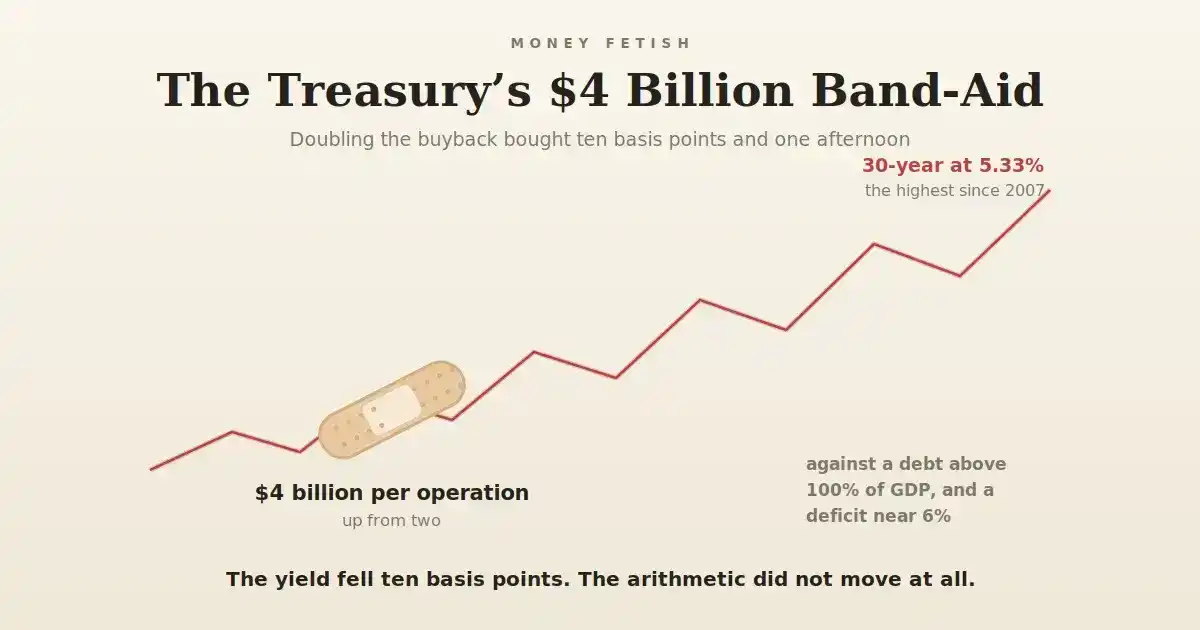
This is why Nunes refers to it as a "Band-Aid." Four billion dollars is enough to improve trading conditions for some long-term bonds, but it is unlikely to alter the overall supply and demand dynamics of the entire U.S. Treasury market.
What's Really Weighing on Long Bonds is the Growing Fiscal Supply

In Nunes's framework, the recent rise of the 30-year Treasury yield above 5% cannot be interpreted solely as a liquidity issue. More importantly, the amount the U.S. government needs to finance remains substantial.

In July 2026, the U.S. federal budget deficit reached $432 billion, a 48% year-over-year increase, setting a record high for any July. The cumulative deficit for the first 10 months of the fiscal year stands at approximately $1.8 trillion, already surpassing the total for the entire 2025 fiscal year.
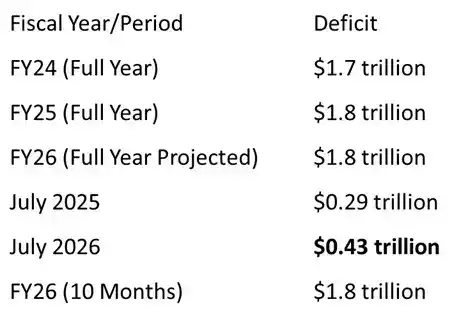
U.S. Federal Deficit – Year-on-Year Comparison

Meanwhile, total U.S. federal debt surpassed $40 trillion on August 19. As the debt stock grows and borrowing costs have risen in recent years, interest expenses are also climbing higher.

This means the core problem facing the U.S. Treasury is not that "old bonds are hard to trade," but rather: who will absorb the massive future supply of new bonds? If investors believe fiscal deficits will remain elevated in the future, they will demand higher yields to absorb the supply of long-term bonds.

From this perspective, the 30-year yield breaking through 5% may not be a temporary market malfunction, but rather a repricing of U.S. fiscal risk and duration risk.

The Buyer Problem Can't Be Solved by $4 Billion Either

Nunes also highlights the shift in foreign demand.

According to the U.S. Treasury's TIC data, foreign holdings of U.S. Treasuries decreased by approximately $72.1 billion month-over-month in June, with Japan, China, and the UK all seeing declines of varying degrees. This is not enough to prove foreign investors are "fleeing U.S. Treasuries en masse," as single-month holdings can be affected by exchange rates, custodian location changes, and asset allocation shifts. Furthermore, TIC data itself cannot fully identify the ultimate owners of securities. However, it at least indicates that previously stable foreign demand can no longer be taken for granted.
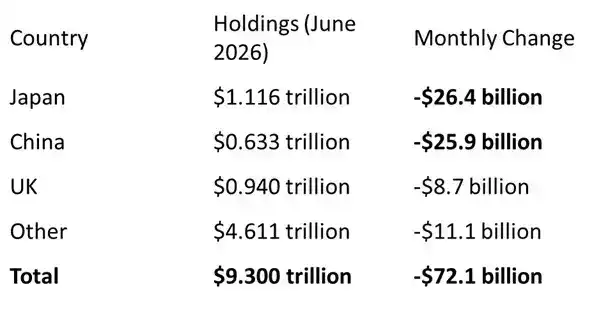
Foreign Holdings of U.S. Treasury Securities (June 2026)

More important is the buyer structure. If the willingness of foreign official institutions to absorb U.S. Treasuries declines, the U.S. will need to rely more on private investors. Private capital typically places greater emphasis on price and yield, meaning the market may require higher long-term interest rates to attract sufficient funds to take on the growing bond supply.

This is also why simply increasing buybacks doesn't solve the problem. The Treasury can buy back a portion of old debt, but it cannot dictate at what price other investors are willing to hold the large volumes of long-term bonds the U.S. will issue in the future.

The Real Divide: Is This a Liquidity Problem or a Fiscal Problem?

Supporters of expanding buybacks could argue that the Treasury is not attempting to solve the fiscal deficit. Buybacks are inherently a market liquidity tool. If they can improve the trading of old securities and reduce market friction, they have already achieved their policy objective. In this sense, criticizing buybacks with "$4 billion can't fix the deficit" might itself confuse the purpose of the policy tool.

But the real question Nunes poses is this: if the primary force driving long-end yields higher has shifted from liquidity to fiscal supply, then continuing to use liquidity tools will naturally have limited effectiveness.

These two explanations correspond to two completely different market judgments. If the recent selloff in long bonds was mainly due to insufficient market depth, deteriorating liquidity in old securities, and short-term positioning shocks, then the Treasury's expanded buyback might be enough to stabilize the market. However, if the rise in long-end yields primarily reflects persistent fiscal deficits, larger long-term bond supply, and higher term premia, then buybacks can only make the adjustment process smoother; they are unlikely to change the ultimate level of yields.

This is the article's core judgment: The Treasury can improve the "trading problem" in the Treasury market, but it cannot buy away America's "fiscal problem" through buybacks.

What truly needs to be watched next is not how much the Treasury increases its next buyback size, but whether long-term Treasury auctions continue to attract sufficient demand, whether the fiscal deficit narrows, and whether higher yields can re-attract foreign and private buyers.

If these variables do not improve, then the yield decline brought about by the $4 billion initiative is more likely to be a short-term buffer, rather than a true reversal of the pressure on U.S. long bonds.


Kripto yang Sedang Tren

Pertanyaan Terkait

QWhat is the main action taken by the U.S. Treasury according to the article, and what was its immediate market impact?

AThe U.S. Treasury announced an expansion of its long-term bond repurchase program, increasing the maximum single-operation size for 10–20 year and 20–30 year Treasuries from $2 billion to at least $4 billion. The immediate market impact was a rapid decline in long-term bond yields, particularly the 30-year yield which had previously reached a high, and a simultaneous strengthening of assets like stocks and gold.

QAccording to Marcus Nunes's perspective in the article, what fundamental problem does the Treasury's bond repurchase fail to address?

AAccording to Marcus Nunes, the Treasury's bond repurchase program addresses market liquidity issues but fails to address the fundamental problem of the U.S. government's large fiscal deficits and the associated high financing needs. The repurchase does not reduce the total amount the government ultimately needs to borrow.

QWhy does the author refer to the $4 billion repurchase increase as a 'Band-Aid' solution?

AThe author refers to it as a 'Band-Aid' because while the $4 billion increase can improve trading conditions for some long-term bonds, its scale is negligible compared to the broader financing needs (e.g., an estimated $739 billion in net borrowing needed for a single quarter). Therefore, it cannot meaningfully alter the overall supply and demand dynamics of the U.S. Treasury market driven by large fiscal deficits.

QWhat are the two main factors, beyond liquidity, that the article suggests are putting upward pressure on long-term bond yields?

ABeyond liquidity issues, the two main factors are: 1) The increasingly large supply of new bonds required to finance persistent and growing U.S. federal budget deficits. 2) Potential weakening in demand from traditional major buyers, such as foreign official institutions, which may require higher yields to attract sufficient private investor capital to absorb the supply.

QWhat does the article conclude about the true test for the U.S. long-term bond market, beyond the Treasury's repurchase actions?

AThe article concludes that the true test for the U.S. long-term bond market is not the size of Treasury repurchases, but whether upcoming long-term bond auctions continue to attract sufficient demand, whether the fiscal deficit narrows, and whether higher yields can successfully re-attract foreign and private investor buying. Without improvement in these underlying variables, the yield decline from the repurchase program is likely just a short-term buffer, not a fundamental reversal of pressure.

Bacaan Terkait

Analis Terkenal Buat Ramalan Sensasional: Bitcoin, Ethereum, dan Tiga Altcoin Ini Bisa Naik 5 Kali Lipat! Ini Detailnya

Setelah lompatan signifikan di pasar kripto yang dimulai semalam, ekspektasi bullish menguat. Analis kripto terkenal, Ansem, membuat prediksi baru yang menarik perhatian investor. Dalam sebuah postingan di akun X-nya, Ansem menyatakan bahwa portofolio dengan bobot setara yang terdiri dari Bitcoin (BTC), Ethereum (ETH), Solana (SOL), Hyperliquid (HYPE), dan token Pump Fun (PUMP) berpotensi menghasilkan keuntungan 3 hingga 5 kali lipat dalam dua tahun ke depan. Analis secara khusus menyoroti token HYPE dan PUMP, menilai mereka memiliki potensi risiko-imbal hasil yang paling menarik di antara lima aset tersebut dan berpotensi mengungguli aset lainnya, termasuk BTC, ETH, dan SOL, dalam waktu dekat. Strategi alokasi merata ini bertujuan untuk memanfaatkan pengaruh hype dan momentum pasar. Namun, strategi ini juga membawa risiko signifikan. Aset yang sangat volatil seperti HYPE dan PUMP, jika harganya turun drastis, dapat berdampak negatif pada kinerja keseluruhan portofolio. Penting untuk dicatat bahwa analisis ini merupakan ekspektasi pribadi sang analis dan bukan prediksi harga yang pasti. Arah pasar kripto ke depan bergantung pada banyak faktor seperti kondisi likuiditas global, kebijakan suku bunga, perubahan regulasi, minat investor institusional, dan tren pasar Bitcoin secara keseluruhan. *Ini bukan rekomendasi investasi.

cryptonews.ru23m yang lalu

Analis Terkenal Buat Ramalan Sensasional: Bitcoin, Ethereum, dan Tiga Altcoin Ini Bisa Naik 5 Kali Lipat! Ini Detailnya

cryptonews.ru23m yang lalu

Dukungan Likuiditas AS Tiba, Inilah Keuntungan Intinya

Tanggal 19 Agustus, Departemen Keuangan AS mengumumkan akan meningkatkan batas atas pembelian kembali likuiditas untuk obligasi jangka panjang (10-30 tahun) dari USD 2 miliar menjadi minimal USD 4 miliar per operasi. Penyesuaian ini berlaku mulai 9 September hingga 4 November. Pasar bereaksi positif, dengan imbal hasil obligasi 10-tahun dan 30-tahun turun. Hal ini memberi kelegaan bagi aset berisiko seperti saham teknologi, obligasi panjang, emas, dan aset kripto karena tekanan pada tingkat diskon berkurang. Penting untuk dicatat, operasi ini **bukan quantitative easing (QE)** ala Fed. Departemen Keuangan hanya membeli obligasi lama yang kurang likuid untuk memperbaiki fungsi pasar, bukan menciptakan uang baru atau mengurangi kebutuhan pendanaan pemerintah. Pasar merespons karena tindakan ini menunjukkan kesediaan pemerintah untuk meredakan tekanan likuiditas di ujung panjang kurva imbal hasil, yang memicu pembelian kembali posisi jual. Namun, dampak jangka panjangnya terbatas. Tiga faktor membatasi dampaknya: **1) Skala** (peningkatan USD ~14 miliar relatif kecil dibandingkan kebutuhan fiskal), **2) Sumber dana** (pembelian mungkin dibiayai dengan penerbitan utang jangka pendek baru), dan **3) Konteks makro** (tekanan inflasi dan kebijakan Fed tetap dominan). Kesimpulannya, langkah ini adalah **bantalan penyangga** yang memberi dukungan marginal bagi aset jangka panjang dan dapat memicu pemulihan valuasi jangka pendek. Namun, ketebalan dan keberlanjutan rally ini akan diuji oleh **pengumuman pembiayaan kembali triwulanan pada 4 November**, yang akan mengungkap struktur penerbitan utang dan komitmen pembelian kembali yang sebenarnya. Ini bukan awal dari narasi pelonggaran yang berkelanjutan.

marsbit47m yang lalu

Dukungan Likuiditas AS Tiba, Inilah Keuntungan Intinya

marsbit47m yang lalu

Peraturan Baru SEC Dirilis, Banteng Datang

SEC telah menerbitkan rancangan aturan baru yang mengizinkan proyek aset kripto awal mengumpulkan dana hingga $5 juta dalam empat tahun tanpa registrasi penuh sebagai sekuritas, dengan proyek lebih besar diperbolehkan mengumpulkan $20 juta atau $75 juta per 12 bulan. Aturan ini memperkenalkan mekanisme "Safe Harbor Kontrak Investasi," di mana penerbit dapat mengajukan Formulir TR untuk menyatakan diri bahwa mereka telah menyelesaikan atau menghentikan "upaya manajerial kunci" yang dijanjikan, meskipun SEC tetap berwenang menantang pernyataan ini di kemudian hari. Perubahan utama adalah pergeseran dari pendekatan regulasi berbasis penegakan hukum sebelumnya menjadi kerangka yang lebih terstruktur: penerbit harus membuktikan sendiri kapan token mereka "lulus" dari status kontrak investasi ke aset independen, berdasarkan janji yang dibuat selama penawaran. Hal ini mendorong tim proyek untuk lebih berhati-hati dalam membuat komitmen publik, karena janji-janji tersebut akan menjadi dasar penilaian kelulusan. Aturan ini juga mencakup pembatasan geografis, mengharuskan sebagian besar kegiatan penerbitan dan operasional berada di dalam AS, yang bertujuan mengembalikan aktivitas penggalangan dana aset kripto ke yurisdiksi AS. Sementara itu, pembagian token melalui airdrop dan hadiah jaringan juga dapat diperhitungkan dalam batas pengumpulan dana. Dengan Kongres AS yang lambat dalam mengesahkan undang-undang kripto seperti RUU CLARITY, SEC mengambil inisiatif untuk menetapkan aturan administratif ini. Jika diadopsi, aturan tersebut dapat memberikan kejelasan prosedural bagi proyek kripto mengenai transisi dari sekuritas ke aset mandiri, meskipun detail teknis masih memerlukan umpan balik publik.

marsbit56m yang lalu

Peraturan Baru SEC Dirilis, Banteng Datang

marsbit56m yang lalu

Trading

Spot

Artikel Populer

Cara Membeli 4

Selamat datang di HTX.com! Kami telah membuat pembelian 4 (4) menjadi mudah dan nyaman. Ikuti panduan langkah demi langkah kami untuk memulai perjalanan kripto Anda.Langkah 1: Buat Akun HTX AndaGunakan alamat email atau nomor ponsel Anda untuk mendaftar akun gratis di HTX. Rasakan perjalanan pendaftaran yang mudah dan buka semua fitur.Dapatkan Akun SayaLangkah 2: Buka Beli Kripto, lalu Pilih Metode Pembayaran AndaKartu Kredit/Debit: Gunakan Visa atau Mastercard Anda untuk membeli 4 (4) secara instan.Saldo: Gunakan dana dari saldo akun HTX Anda untuk melakukan trading dengan lancar.Pihak Ketiga: Kami telah menambahkan metode pembayaran populer seperti Google Pay dan Apple Pay untuk meningkatkan kenyamanan.P2P: Lakukan trading langsung dengan pengguna lain di HTX.Over-the-Counter (OTC): Kami menawarkan layanan yang dibuat khusus dan kurs yang kompetitif bagi para trader.Langkah 3: Simpan 4 (4) AndaSetelah melakukan pembelian, simpan 4 (4) di akun HTX Anda. Selain itu, Anda dapat mengirimkannya ke tempat lain melalui transfer blockchain atau menggunakannya untuk memperdagangkan mata uang kripto lainnya.Langkah 4: Lakukan trading 4 (4)Lakukan trading 4 (4) dengan mudah di pasar spot HTX. Cukup akses akun Anda, pilih pasangan perdagangan, jalankan trading, lalu pantau secara real-time. Kami menawarkan pengalaman yang ramah pengguna baik untuk pemula maupun trader berpengalaman.

1.0k Total TayanganDipublikasikan pada 2025.10.20Diperbarui pada 2026.06.02

Cara Membeli 4

Diskusi

Selamat datang di Komunitas HTX. Di sini, Anda bisa terus mendapatkan informasi terbaru tentang perkembangan platform terkini dan mendapatkan akses ke wawasan pasar profesional. Pendapat pengguna mengenai harga 4 (4) disajikan di bawah ini.

活动图片