Kalshi's Daily Stock Open Interest Hits Record High of $17.98 Million

cryptonews.ruDipublikasikan tanggal 2026-08-14Terakhir diperbarui pada 2026-08-14

Abstrak

Kalshi's daily open interest for its perpetual futures product hit a record $17.98 million on August 12th, just over two months after its launch. The CFTC-approved platform, which began with Bitcoin and Ethereum contracts in early June, now lists 13 crypto assets. Open interest remained below $5 million initially, saw mid-June spikes to $13-14 million, stabilized around $6-7 million, and has steadily climbed since July, consistently holding above $12 million in recent weeks. This growth indicates sustained trader engagement on a platform that recently offered only short-term binary contracts. Despite this rapid growth, Kalshi's total crypto perpetuals portfolio is small in scale, representing about 0.15% of rival Hyperliquid's $11.7 billion daily open interest. The comparison is structurally limited: each Kalshi contract requires federal regulatory pre-approval, resulting in a small list, whereas permissionless platforms like Hyperliquid support hundreds of pairs. The concentrated open interest on Kalshi's few approved contracts signals strong demand within its specific niche. Analysts suggest Kalshi is not cannibalizing existing decentralized exchange volume but is tapping a previously underserved pool of U.S.-based traders who lacked a legal, leveraged crypto platform. The true size of this new user pool remains unknown. While a market downturn could disrupt the trend, the open interest chart has so far shown consistent upward momentum.

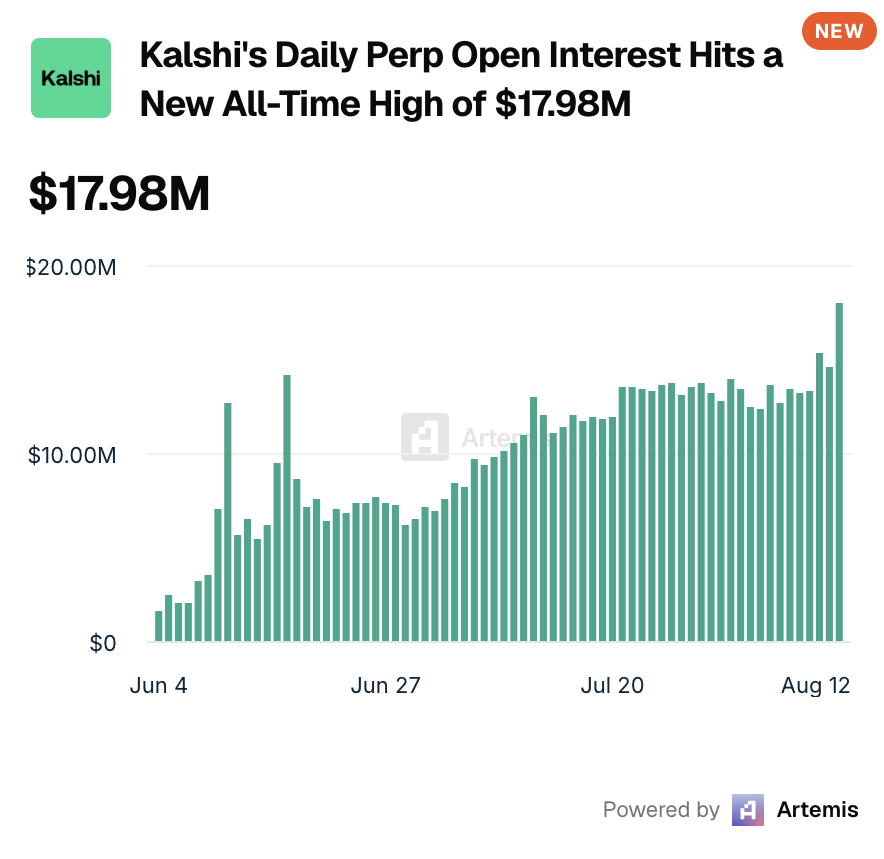
Kalshi's perpetual futures product launched on June 3rd, with BTCPERP becoming the first perpetual contract approved by the CFTC for traders from the US. Ether launched on June 4th, XRP on June 10th, and now the list covers 13 crypto assets. This week, on August 12th, daily open interest for perpetual futures closed at $17.98 million, a historic high for a product that didn't exist three months ago.
Source: Artemis

Open interest was under $5 million during the first week of June, with two peaks reaching $13 and $14 million mid-month, then dropped to the $6-7 million range where it stayed until the end of June. The following month, specifically in the second week of July, there was a jump as daily bars closed above $10 million, holding in the $12-14 million range for the last three weeks.

Interest Rate Hike More Important Than Election Results

A single large option on the new platform typically indicates several large positions that could have been closed over a few days. However, the chart doesn't show this. The lower bound of the range continues to rise, meaning traders are holding risk on a platform that just ten weeks ago only offered short-term binary contracts.

There is certainly demand for Kalshi's services, and another telling sign is sales volume. The notional value of Kalshi's services surpassed $1 billion within a week of launch. Compared to contracts on the events the platform built its reputation on, it took 40 months to reach that figure.

$17.98 Million Next to $11.7 Billion

Despite Kalshi Perps' impressive performance since launch, it's important to keep perspective. According to DefiLlama, Hyperliquid's 24-hour open interest is $11.7 billion with a daily trading volume of $7.17 billion. Kalshi's entire Perps portfolio is roughly 0.15% of that amount. Individual large players on Hyperliquid have positions exceeding Kalshi's total open interest across all its crypto markets combined.

The difference isn't just size. CoinGecko states Hyperliquid offers 377 perpetual trading pairs. Its HIP-3 segment, covering non-crypto markets created by a single developer, has over $4 billion in open interest. This is just one segment of one developer's markets and is more than 200 times larger than Kalshi's total markets.

Every New Stock Listing on Kalshi Starts with an Application

Kalshi's small contract list is for structural reasons. Every contract it lists must be vetted by a federal regulator before a single trade can be made. Hyperliquid deploys markets permissionlessly, so it can support 377 pairs and add new ones at a user's whim.

This is also a fair assessment of the $17.98 million figure. This number isn't low due to lack of demand. It's low because there's almost nothing to trade, and what there is took months of work with regulators to get on the exchange. Concentrating this much open interest on so few contracts is a very different signal than spreading it across hundreds.

In any case, the comparison everyone makes is wrong. Kalshi isn't taking flow from Hyperliquid. It's taking flow from US traders who previously had no legal venue at all to use crypto leverage, and who were either offshore, using a VPN, or just sitting on the sidelines. This pool is separate, and no one knows how large it is.

A period of stagnant or falling prices through the end of August could disrupt this trend. So far, the chart hasn't shown it.

end-content

Kripto yang Sedang Tren

Pertanyaan Terkait

QWhat is the significance of Kalshi's daily open interest reaching $17.98 million according to the article?

AThe $17.98 million daily open interest for Kalshi's perpetual futures is a historical high for a product that didn't exist three months prior. It signifies strong initial growth and sustained trader interest in the regulated platform.

QHow does Kalshi's open interest and volume compare to a platform like Hyperliquid?

AKalshi's entire perpetuals portfolio of approximately $17.98 million in open interest is about 0.15% of Hyperliquid's $11.7 billion 24-hour open interest. Individual large positions on Hyperliquid can exceed Kalshi's total crypto open interest.

QWhat key structural difference between Kalshi and platforms like Hyperliquid limits Kalshi's number of contracts?

AEach contract on Kalshi must be approved by federal regulators (CFTC) before trading can begin. In contrast, platforms like Hyperliquid deploy markets permissionlessly, allowing them to support hundreds of trading pairs.

QAccording to the article, where is Kalshi primarily drawing its trading volume from?

AKalshi is drawing volume primarily from US-based traders who previously had no legally compliant platform to use leverage for crypto trading. These traders were either trading overseas, using VPNs, or not trading at all.

QWhat does the article suggest about the nature of the open interest growth on Kalshi, based on the chart data?

AThe chart shows that the lower bound of the open interest range has been consistently rising. This indicates traders are maintaining risk positions over time, rather than the growth being driven by a few large, short-term option positions.

Bacaan Terkait

Agustus, 'Bull Market' Wall Street Kembali, 'Sifat Judi' Juga Kembali

August menyaksikan kembalinya "bull market" di Wall Street, dengan S&P 500 mencapai rekor tertinggi baru. Sentimen investor berbalik positif dengan cepat setelah penjualan Juli, didorong oleh musim laba korporat yang luar biasa kuat (laba Q2 naik >50%) dan data inflasi AS yang lebih lembut, yang mengurangi tekanan kenaikan suku bunga Fed. Uang mengalir deras kembali ke saham teknologi dan produk leverage seperti ETF leverage dan opsi call, menandakan kembalinya "semangat berjudi". Saham chip seperti Super Micro Computer melonjak ~38% pada Agustus. Strategi leverage pada indeks luas berkinerja baik, berbeda dengan leverage pada saham tunggal. Namun, kenaikan cepat ini juga menimbulkan kewaspadaan. Pasar saat ini mematok skenario "masa keemasan" yang hampir sempurna: pertumbuhan kuat, suku bunga terbatas, dan guncangan sementara. Sinyal yang saling bertentangan muncul: harga minyak melonjak, imbal hasil obligasi pemerintah jangka panjang tetap tinggi (menandakan kekhawatiran inflasi jangka panjang), sementara indeks ketakutan VIX turun. Para analis memperingatkan bahwa kondisi ini sangat rapuh dan tidak memberikan ruang untuk kesalahan. Intinya: Pasar saham merayakan prospek soft landing dan siklus laba AI, tetapi pasar obligasi mengisyaratkan risiko yang belum terselesaikan. Pertarungan antara narasi optimis "Goldilocks" dan kekhawatiran inflasi jangka panjang akan menjadi tema utama di paruh kedua 2026.

marsbit47m yang lalu

Agustus, 'Bull Market' Wall Street Kembali, 'Sifat Judi' Juga Kembali

marsbit47m yang lalu

Grayscale: «Jika Proposal Diterima, Harga Dua Altcoin Ini Bisa Naik»

Kepala Penelitian Grayscale, Zack Pandl, menyatakan bahwa jika perubahan tokenomik yang sedang dibahas dalam komunitas Ethereum ($ETH) dan Solana ($SOL) diimplementasikan, laju pertumbuhan pasokan kedua aset kripto tersebut dapat melambat secara signifikan. Hal ini berpotensi berdampak positif pada harga. Menurut Pandl, perubahan yang diusulkan dalam kode ekosistem Ethereum dan Solana bertujuan untuk mengurangi laju inflasi tahunan token $ETH dan $SOL. Dengan segala kondisi lain tetap sama, melambatnya pertumbuhan pasokan dapat mengurangi jumlah token baru yang masuk ke pasar, sehingga meningkatkan kelangkaan aset yang ada. Perkiraan Grayscale menunjukkan bahwa jika aturan ini diterapkan, inflasi pasokan tahunan Ethereum bisa turun menjadi sekitar 0,4% pada akhir 2031 — mendekati laju pertumbuhan pasokan Bitcoin. Inflasi pasokan tahunan Solana diproyeksikan turun menjadi sekitar 1,1%. Sebagai perbandingan, pasokan emas tumbuh sekitar 1,8% per tahun, sedangkan inflasi indeks harga konsumen AS sekitar 3,3%. Perubahan yang diusulkan untuk Ethereum dan Solana masih dalam diskusi komunitas dan belum disetujui secara final. Pandl mencatat bahwa proposal untuk Solana tampaknya mendapat dukungan lebih luas dan karena itu memiliki kemungkinan lebih besar untuk diimplementasikan. Namun, penurunan inflasi token juga dapat mengurangi imbalan bagi investor yang melakukan staking, karena sebagian besar pendapatan staking $ETH dan $SOL berasal dari penerbitan token baru. Pandl menekankan bahwa melambatnya pertumbuhan pasokan dapat meningkatkan kelangkaan, memberikan tekanan kenaikan pada harga $ETH dan $SOL, dan investor yang memegang token tanpa staking khususnya mungkin mendapat manfaat. *Ini bukan rekomendasi investasi.

cryptonews.ru5j yang lalu

Grayscale: «Jika Proposal Diterima, Harga Dua Altcoin Ini Bisa Naik»

cryptonews.ru5j yang lalu

Trading

Spot

Artikel Populer

Cara Membeli T

Selamat datang di HTX.com! Kami telah membuat pembelian Threshold Network Token (T) menjadi mudah dan nyaman. Ikuti panduan langkah demi langkah kami untuk memulai perjalanan kripto Anda.Langkah 1: Buat Akun HTX AndaGunakan alamat email atau nomor ponsel Anda untuk mendaftar akun gratis di HTX. Rasakan perjalanan pendaftaran yang mudah dan buka semua fitur.Dapatkan Akun SayaLangkah 2: Buka Beli Kripto, lalu Pilih Metode Pembayaran AndaKartu Kredit/Debit: Gunakan Visa atau Mastercard Anda untuk membeli Threshold Network Token (T) secara instan.Saldo: Gunakan dana dari saldo akun HTX Anda untuk melakukan trading dengan lancar.Pihak Ketiga: Kami telah menambahkan metode pembayaran populer seperti Google Pay dan Apple Pay untuk meningkatkan kenyamanan.P2P: Lakukan trading langsung dengan pengguna lain di HTX.Over-the-Counter (OTC): Kami menawarkan layanan yang dibuat khusus dan kurs yang kompetitif bagi para trader.Langkah 3: Simpan Threshold Network Token (T) AndaSetelah melakukan pembelian, simpan Threshold Network Token (T) di akun HTX Anda. Selain itu, Anda dapat mengirimkannya ke tempat lain melalui transfer blockchain atau menggunakannya untuk memperdagangkan mata uang kripto lainnya.Langkah 4: Lakukan trading Threshold Network Token (T)Lakukan trading Threshold Network Token (T) dengan mudah di pasar spot HTX. Cukup akses akun Anda, pilih pasangan perdagangan, jalankan trading, lalu pantau secara real-time. Kami menawarkan pengalaman yang ramah pengguna baik untuk pemula maupun trader berpengalaman.

1.2k Total TayanganDipublikasikan pada 2024.12.10Diperbarui pada 2026.06.02

Cara Membeli T

Diskusi

Selamat datang di Komunitas HTX. Di sini, Anda bisa terus mendapatkan informasi terbaru tentang perkembangan platform terkini dan mendapatkan akses ke wawasan pasar profesional. Pendapat pengguna mengenai harga T (T) disajikan di bawah ini.

活动图片