Holding 4% of Global Bitcoin! Market Closely Watches MSTR's "Bitcoin Selling Logic", Stock Price Has Fallen 75% in a Year

华尔街日报Dipublikasikan tanggal 2026-07-07Terakhir diperbarui pada 2026-07-07

Abstrak

MicroStrategy, the world's largest corporate holder of Bitcoin (approx. 4% of supply), faces mounting liquidity pressures, forcing a shift from its "never sell" pledge. The company recently sold 3,588 BTC for $216 million, its largest sale ever, to cover preferred stock dividends, marking a significant scaling up from a small, symbolic sale in May. This move underscores a fundamental challenge to its business model: using stock premium as "currency" to buy Bitcoin continuously. A key metric, mNAV (enterprise value vs. Bitcoin holdings), has fallen below 1, indicating the market values the company below its Bitcoin stash, eroding its core acquisition logic. With annual dividend obligations around $1.5 billion and software cash flow insufficient, MicroStrategy is caught in a mathematical bind. Its $2.55 billion cash buffer provides ~17 months of coverage, but if financing remains tight and mNAV stays depressed, the company may face pressure for larger Bitcoin sales, posing a potential systemic risk to the crypto market given its massive holdings.

MicroStrategy is using Bitcoin to pay for its capital structure. This company, the world's largest corporate holder of Bitcoin, is facing a mathematical dilemma triggered by its own business model — as the stock price premium vanishes and the financing window narrows, the "never sell" promise has quietly given way to the pressure of real-world liquidity.

An article by Wall Street Journal writes that MicroStrategy disclosed on July 6th that it sold 3,588 Bitcoins between June 29th and July 5th, raising approximately $216 million, to pay dividends for its preferred shares. This is the company's largest single Bitcoin sale in history, and its third sale since launching its Bitcoin strategy in 2020.

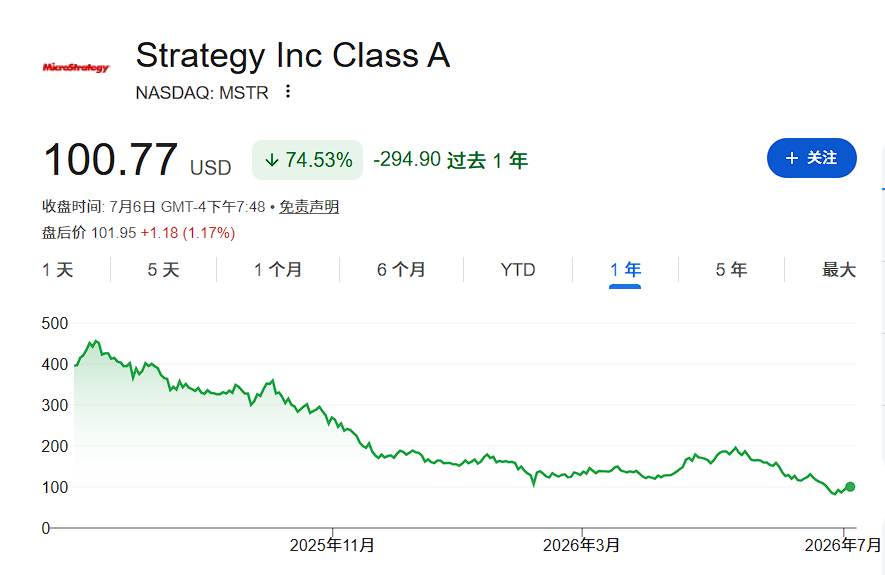
Following this announcement, MSTR's stock price fell over 5% intraday, and Bitcoin dropped to around $61,800, below the company's average holding cost of approximately $75,700. The company confirmed an $8.32 billion digital asset impairment loss for Q2, as Bitcoin prices fell 14% during the same period.

Market caution stems not only from the sale itself but also from the underlying shift in logic. MicroStrategy holds 843,775 Bitcoins, accounting for about 4% of the global Bitcoin supply. Any large-scale selling could significantly impact the coin's price.

According to Wall Street Journal analysis, MicroStrategy's core valuation metric, mNAV, has fallen below 1, meaning the market values the company at less than the value of its Bitcoin holdings. This fundamentally undermines its business logic of "exchanging premium stock for Bitcoin."

"Never Sell" Promise Softens, Sale Scale Expands by a Hundredfold

MicroStrategy had long regarded "never selling Bitcoin" as the cornerstone of its business model, but this promise has developed significant cracks.

In late May, the company broke precedent for the first time, selling 32 Bitcoins for about $2.5 million to pay preferred stock dividends, emphasizing it was merely fulfilling its promise to preferred stock investors and did not represent a strategic shift.

However, the latest sale scale has expanded to 3,588 Bitcoins, roughly a hundred times the amount sold in May. According to the company's disclosure, 1,363 were sold at an average price of about $59,300, with the remaining 2,225 sold at around $60,800.

An article by Wall Street Journal writes that proceeds from this sale will be specifically used to pay the Q2 dividends for four preferred securities (STRF, STRE, STRK, STRD) and the June monthly dividend for STRC. Selling Bitcoin is no longer a one-time, symbolic operation but is gradually being integrated into the company's routine financing system.

Notably, on June 29th, MicroStrategy officially announced that its board had authorized the sale of up to $1.25 billion worth of Bitcoin for stock buybacks and to pay interest and preferred stock dividends. This marks the company's formal abandonment at the official level of its "hold Bitcoin at all costs" philosophy.

It's worth noting that the capital structure supporting this business model is under increasing pressure.

Analyst Zach Pandl points out that MicroStrategy's annual preferred stock dividend payout alone is about $1.5 billion, far exceeding what its software business cash flow can cover. When cash reserves are insufficient, the company can only continue financing or sell Bitcoin.

As of July 5th, MicroStrategy holds 843,775 Bitcoins with a cash reserve of $2.55 billion. The company estimates this cash buffer provides about 17 months of runway for interest and preferred stock dividend payments without needing to tap its crypto assets.

MicroStrategy's operational logic is becoming clearer: continuously buy Bitcoin when financing is smooth; sell small amounts of Bitcoin to pay dividends when financing tightens, maintaining the closed loop of its capital operations system.

Although after its first sale in late May, the company quickly bought another 1,550 Bitcoins, and also completed large-scale purchases of $2.54 billion and $2 billion in April and May respectively, the sustainability of this system is being questioned as Bitcoin prices face downward pressure.

mNAV Falls Below 1, Core Business Logic Faces Fundamental Challenge

The core of MicroStrategy's business model lies in using its stock premium as "currency" to continuously buy Bitcoin. The quantitative anchor for this logic is precisely the company's self-created mNAV metric.

According to Wall Street Journal analysis, MicroStrategy defines mNAV as the multiple of the company's enterprise value relative to the value of its Bitcoin holdings. During its peak, this metric remained at a high premium level for a long time, allowing the company to continuously issue stock to buy more Bitcoin, operating similarly to traditional acquisition-driven companies using highly valued stock as currency for serial acquisitions.

However, as MSTR's stock price has fallen about 75% over the past year, mNAV fell below 1 last month, meaning the market values MicroStrategy at less than the book value of its Bitcoin holdings. This "snowball" logic has started to work in reverse.
More alarmingly, this metric itself has a systematic overvaluation problem. The Wall Street Journal points out that when calculating enterprise value, MicroStrategy uses the principal amount of debt and the face value of preferred stock, not their market value. However, as the company's bonds and preferred stock prices have fallen sharply along with the stock price, this calculation method has become severely distorted.

Taking June 26th as an example, MicroStrategy reported its mNAV was about 0.99, but if calculated using the market value of debt and preferred stock, the actual mNAV was only about 0.89. At that time, the company's debt was trading at a 7% discount, and its various series of preferred stock had a combined discount of about 28%.

As of last Thursday's close, MicroStrategy's website showed an mNAV of 1.09, but the actual figure calculated using market values was only about 1.04, leaving the premium space extremely limited.

Selling Pressure and Market Chain Reaction

The scale of MicroStrategy's Bitcoin holdings gives any selling action systemic significance at the market level.

MicroStrategy holds about 4% of the global Bitcoin supply. Even the small-scale operation in May, selling just 32 Bitcoins for $2.5 million, had a noticeable downward pressure on Bitcoin's price and MSTR's stock price.

Analysis suggests that although this sale of 3,588 Bitcoins is still a tiny fraction of its holdings, market concern about potential large-scale selling has significantly intensified.

According to MicroStrategy's own logic, when mNAV remains in a discounted state, the company should sell Bitcoin to buy back its own securities. Investors are closely watching whether this signal will evolve into large-scale action.

To stabilize preferred stock prices, MicroStrategy increased the dividend rate on its largest preferred stock series, STRC, to 12% on June 29th, trying to attract buyers and push the price back to par value. This move itself indicates the company's focus on the market price of its preferred stock far exceeds the attitude presented in its mNAV calculation.

The Wall Street Journal notes that if the market once again fixes MicroStrategy's valuation in the discount range and it persists, the company will face a scenario where its cash runs out, forcing it to tap its Bitcoin reserves on a large scale. MicroStrategy may have bought itself some time, but no one can be sure just how long that time will last.


Kripto yang Sedang Tren

Pertanyaan Terkait

QWhat is the core reason for MicroStrategy's recent change in its 'never sell bitcoin' policy?

AThe core reason is the increasing liquidity pressure stemming from its capital structure. With its stock premium disappearing and the financing window narrowing, MicroStrategy's commitment to holding bitcoin has given way to the reality of needing funds to pay substantial annual preferred stock dividends (approximately $1.5 billion), which its software business cash flow cannot cover.

QWhat is the mNAV metric, and why is it significant for understanding MicroStrategy's business model?

AmNAV (MicroStrategy Net Asset Value) is a company-created metric defined as the ratio of its enterprise value to the value of its bitcoin holdings. It is significant because MicroStrategy's core business model relies on using its stock as a 'currency' to buy more bitcoin, which only works when mNAV is above 1 (meaning the market values the company *more* than just its bitcoin). Its recent drop below 1 challenges this fundamental model.

QHow did the scale of MicroStrategy's latest bitcoin sale on July 6 compare to its first sale in May, and what was the purpose of the proceeds?

AThe latest sale of 3,588 bitcoin was approximately 100 times larger than the first sale of 32 bitcoin in May. The proceeds from the July sale, amounting to about $216 million, were specifically used to pay quarterly dividends on several series of its preferred securities (STRF, STRE, STRK, STRD) and a monthly dividend on the STRC preferred stock.

QAccording to the analysis in the article, what is the problem with MicroStrategy's calculation of its mNAV metric?

AThe article states that MicroStrategy's calculation of mNAV is systematically overestimated. It uses the face value (par value) of its debt and preferred stock in the enterprise value calculation, rather than their actual, lower market trading value. This inflates the mNAV figure. For example, when the official mNAV was 0.99, the 'real' mNAV calculated using market values was only about 0.89.

QWhy are market participants concerned about MicroStrategy's potential future bitcoin sales, despite its recent sale being a small fraction of its total holdings?

AMarket participants are concerned because MicroStrategy holds approximately 4% of the global bitcoin supply, making any significant sale potentially impactful on the price. Furthermore, if its mNAV remains below 1, the logical action for the company according to its own framework would be to sell bitcoin to buy back its discounted securities. The fear is that this could trigger a large-scale, sustained selling pressure.

Bacaan Terkait

Pemantauan Kripto Pekan Ini | 7 Proyek Termasuk Jupiter, NEAR, Jito Bertumpuk-tumpuk, Pahami Siapa yang Layak Diperhatikan dengan 'Kalender Katalis' Ini

**Observasi Crypto Pekan Ini: 7 Proyek Utama dengan Katalis Mendatang** Pekan ini, tujuh proyek kripto utama memiliki agenda katalis penting yang berpotensi memengaruhi harga asetnya. Berikut ringkasannya: 1. **Jupiter (JUP)**: Meluncurkan versi uji privat GUM (Giant Unified Market) pada 6 Juli, langkah strategis menuju visi pasar terpadu untuk berbagai aset. 2. **NEAR Protocol**: Mengadakan siaran langsung "The Big Reveal" pada 7 Juli, kemungkinan mengumumkan inisiatif baru terkait komputasi privat dan AI. 3. **Berachain (BERA)**: Hard fork besar "PoL Next" pada 7-8 Juli, menyederhanakan model token dengan menghapus BGT dan mengkonsolidasi nilai ke BERA. 4. **Zcash (ZEC)**: Upgrade "Ironwood" dijadwalkan 21 Juli, bertujuan memperbaiki kerentanan keamanan kritis dan memulihkan kepercayaan. 5. **Lighter (LIT)**: Tokenisasi saham direncanakan diluncurkan minggu depan, memanfaatkan integrasi dengan Robinhood Chain untuk eksposur pengguna yang luas. 6. **Jito (JTO)**: Platform perdagangan baru "JTX" dijadwalkan pertengahan Juli, menargetkan aliran pesanan dengan model pendapatan yang menguntungkan pemegang JTO. 7. **Ether.fi (ETHFI)**: Mengajukan proposal ke Aave DAO untuk menggunakan Aave V4 sebagai backend bagi kartu Visa EtherFi Cash, namun masih dalam tahap awal persetujuan. Setiap katalis membawa potensi sekaligus risiko tersendiri, seperti tekanan penjualan dari unlock token atau ketergantungan pada adopsi produk. Penting bagi investor untuk memahami konteks lengkap di balik setiap agenda.

marsbit15m yang lalu

Pemantauan Kripto Pekan Ini | 7 Proyek Termasuk Jupiter, NEAR, Jito Bertumpuk-tumpuk, Pahami Siapa yang Layak Diperhatikan dengan 'Kalender Katalis' Ini

marsbit15m yang lalu

Bitcoin Bangkit Kembali Karena Data Pekerjaan yang Lebih Lemah Meningkatkan Harapan Pemotongan Suku Bunga

Bitcoin Mengalami Pemulihan Setelah Data Tenaga Kerja AS yang Lebih Lemah Meningkatkan Harapan Pemotongan Suku Bunga Data ketenagakerjaan AS terbaru menunjukkan pasar tenaga kerja yang lebih dingin. Angka pekerjaan yang lebih lemah ini mendukung ekspektasi pasar bahwa Federal Reserve (The Fed) memiliki lebih banyak ruang untuk memotong suku bunga. Pemotongan suku bunga cenderung mendukung aset berisiko seperti Bitcoin, karena daya tarik tunai menurun dan ekspektasi likuiditas membaik. Namun, sisi hati-hatinya adalah bahwa data pekerjaan yang lemah juga dapat menandakan perlambatan ekonomi. Sementara Bitcoin sering merespons positif terhadap kebijakan moneter yang lebih longgar, aset kripto ini tidak selalu menyukai ketakutan akan resesi. Pemulihan dari faktor makroekonomi ini datang pada saat Bitcoin juga menghadapi tekanan pasokan dari transfer dompet pemerintah dan rencana pembayaran kembali Mt. Gox, yang membuat trader lebih waspada terhadap pergerakan BTC dalam jumlah besar. Dukungan dari data makro perlu bersaing dengan tekanan pasokan yang terlihat di on-chain. Untuk saat ini, pasar tampak menanggapi data tenaga kerja yang lebih lemah sebagai faktor pendukung. Tantangan selanjutnya adalah melihat apakah dukungan ini tetap kuat jika lebih banyak koin berpindah ke bursa atau jika pejabat The Fed menyatakan penolakan terhadap ekspektasi pemotongan suku bunga yang agresif.

bitcoinist20m yang lalu

Bitcoin Bangkit Kembali Karena Data Pekerjaan yang Lebih Lemah Meningkatkan Harapan Pemotongan Suku Bunga

bitcoinist20m yang lalu

Bagaimana Ekonomi Token Mengubah Aturan Bisnis 'Timbangan dan Ukuran' AI | Observasi Industri ToB

Ekonomi Token sedang mengubah aturan bisnis AI dengan menjadi "unit pengukur" baru. Dalam dua tahun, penggunaan harian Token di China melonjak lebih dari 1.000 kali lipat, mencerminkan pertumbuhan pasar MaaS yang pesat. Namun, muncul masalah mendasar: berapa nilai Token dan siapa yang menetapkan harganya? Nilai Token sangat bervariasi antar industri, dengan perbedaan hingga 100.000 kali lipat antara sektor seperti pengembangan obat-obatan dan aplikasi obrolan biasa. Untuk memahami dinamika ini, Presiden Strategi Tiongkok Lenovo, Ablimit (A Mu), mengusulkan "Tiga Hukum" ekonomi Token: 1. **Hukum Inersia:** Biaya per Token terus menurun karena inovasi teknologi, optimasi sistem, dan penjadwalan runtime yang cerdas. 2. **Hukum Akselerasi:** Nilai yang dihasilkan per Token meningkat pesat seiring dengan kedalaman integrasi AI dalam proses bisnis, kedalaman rekayasa pendukung, dan kesiapan infrastruktur serta tata kelola. 3. **Hukum Singularitas:** Titik di mana kurva nilai yang dihasilkan AI melampaui kurva biayanya, mengubah AI dari alat penghemat biaya menjadi generator nilai inovatif skala besar. Di sisi praktis, banyak perusahaan menghadapi kejutan anggaran karena biaya AI yang melonjak, seringkali didorong oleh penggunaan yang tidak optimal (seperti menulis laporan mingguan) atau "inflasi Token" dari agen cerdas yang kompleks. Tantangan lainnya termasuk kurangnya transparansi harga dan variasi kualitas Token. Industri merespons dengan upaya standardisasi (seperti kerangka "Layanan Token Berkualitas Tinggi" dari CAICT) dan solusi praktis seperti "Pabrik Token" Lenovo, yang bertujuan membuat produksi Token lebih efisien dan terukur. Intinya, masa depan ekonomi Token terletak pada memastikan setiap penggunaan AI memberikan nilai nyata, mengubah AI dari biaya menjadi mesin inovasi yang terukur.

marsbit28m yang lalu

Bagaimana Ekonomi Token Mengubah Aturan Bisnis 'Timbangan dan Ukuran' AI | Observasi Industri ToB

marsbit28m yang lalu

Trading

Spot

Artikel Populer

Cara Membeli 4

Selamat datang di HTX.com! Kami telah membuat pembelian 4 (4) menjadi mudah dan nyaman. Ikuti panduan langkah demi langkah kami untuk memulai perjalanan kripto Anda.Langkah 1: Buat Akun HTX AndaGunakan alamat email atau nomor ponsel Anda untuk mendaftar akun gratis di HTX. Rasakan perjalanan pendaftaran yang mudah dan buka semua fitur.Dapatkan Akun SayaLangkah 2: Buka Beli Kripto, lalu Pilih Metode Pembayaran AndaKartu Kredit/Debit: Gunakan Visa atau Mastercard Anda untuk membeli 4 (4) secara instan.Saldo: Gunakan dana dari saldo akun HTX Anda untuk melakukan trading dengan lancar.Pihak Ketiga: Kami telah menambahkan metode pembayaran populer seperti Google Pay dan Apple Pay untuk meningkatkan kenyamanan.P2P: Lakukan trading langsung dengan pengguna lain di HTX.Over-the-Counter (OTC): Kami menawarkan layanan yang dibuat khusus dan kurs yang kompetitif bagi para trader.Langkah 3: Simpan 4 (4) AndaSetelah melakukan pembelian, simpan 4 (4) di akun HTX Anda. Selain itu, Anda dapat mengirimkannya ke tempat lain melalui transfer blockchain atau menggunakannya untuk memperdagangkan mata uang kripto lainnya.Langkah 4: Lakukan trading 4 (4)Lakukan trading 4 (4) dengan mudah di pasar spot HTX. Cukup akses akun Anda, pilih pasangan perdagangan, jalankan trading, lalu pantau secara real-time. Kami menawarkan pengalaman yang ramah pengguna baik untuk pemula maupun trader berpengalaman.

777 Total TayanganDipublikasikan pada 2025.10.20Diperbarui pada 2026.06.02

Cara Membeli 4

Diskusi

Selamat datang di Komunitas HTX. Di sini, Anda bisa terus mendapatkan informasi terbaru tentang perkembangan platform terkini dan mendapatkan akses ke wawasan pasar profesional. Pendapat pengguna mengenai harga 4 (4) disajikan di bawah ini.

活动图片