Can the US Maintain Its Credibility? Ray Dalio's Vision of a 'Tribute-Style' New Order

marsbitDipublikasikan tanggal 2026-06-23Terakhir diperbarui pada 2026-06-23

Abstrak

Bridgewater founder Ray Dalio links declining U.S. credibility and rising Chinese influence to a modern "tribute system" – a hierarchical order based on power differentials, economic interests, and diplomatic pressure rather than direct control. This shift, he argues, makes U.S. commitments appear negotiable, prompting Asian nations to reassess security and economic alignments. A key market vulnerability is the advanced semiconductor supply chain concentrated in East Asia, which produces the majority of the world's most advanced chips. Dalio suggests that even without direct conflict, uncertainties over commitments, shipping, or supply chain reshoring can trigger asset price volatility in tech stocks, Asian markets, and RMB-denominated assets. While not predicting immediate extreme events, he warns that policy swings, miscalculations, and non-military pressure could reshape regional order, with market reactions preceding any outright confrontation.

Bridgewater founder Ray Dalio has recently, in interviews and media reports, linked the decline in trust from US allies and the rise in China's strength to a modern version of a 'tribute-style order'. For the markets, this is not merely a historical analogy. If the US's commitments to allies and key regions are seen as more negotiable, while China alters the choices of neighboring countries through economic, financial, and diplomatic influence, the first factors priced into the market are likely to be regional risks, AI chip supply chains, RMB assets, and sentiment in Asian markets.
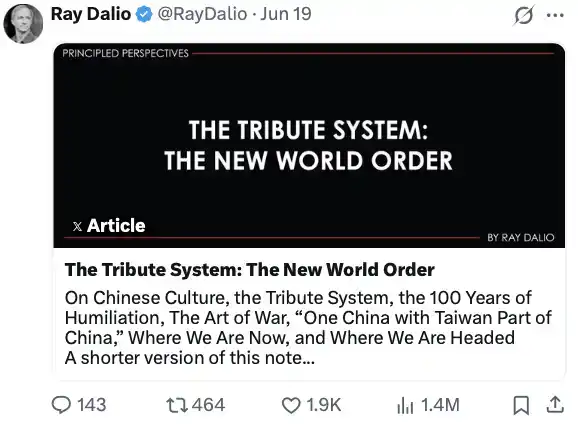
Dalio's assessment is sharp: as US relative deterrence declines and China's economic and financial influence rises, Asian countries may reassess who can provide security and economic order. He borrows the historical concept of the 'tribute system', referring not to simple direct control, but to a hierarchical relationship composed of power differentials, economic interests, diplomatic protocol, and pressure constraints.

One real-world focal point is East Asia's advanced semiconductor supply chain. Related regions hold key positions in the global manufacturing of advanced semiconductors, particularly AI-chip-related wafer fabrication. Public data widely indicates that this region produces over 60% of the world's semiconductors and over 90% of the most advanced chips. Even without extreme events, delays in commitments, shipping uncertainties, diplomatic pressure, or progress in supply chain self-sufficiency alone could be enough to cause related assets to fluctuate in advance.

US Commitments Becoming 'Negotiable' Is a Danger Signal in Dalio's Eyes

Dalio observes several recent events along the same line.

First is the Middle East conflict and risks in the Strait of Hormuz. Market reports surrounding Iran, energy transport, and the cost of US intervention are used by him as an analogy: the US public and government are increasingly unwilling to bear the cost of long-term, multi-front conflicts. This analogy is more of a macro investor's historical reference; it does not mean Middle East developments have already proven US decline. But it explains why a strait risk gets incorporated into narratives about shifts in Sino-US power.

Second is the pace of progress in some US external arrangements. According to reports from AP, *The Washington Post*, etc., planned arrangements involving around $14 billion have not yet been fully finalized. Concerned parties state they have not received suspension notices; a US acting Navy secretary stated that some external arrangements were delayed due to the Iran war and munitions needs. Trump also referred to related matters as a 'negotiating chip' in talks with China.

This is the part most sensitive to the market. If US commitments to key regions are understood by the outside world as negotiable, other Asian economies will reassess the reliability of US promises. Whether the related arrangements are ultimately implemented remains undecided, but 'uncertainty' itself already constitutes a signal.

Third is the change in tone from the US in Asian security forums. US Secretary of Defense Pete Hegseth's speech at the Shangri-La Dialogue on May 30th was interpreted by media compared to 2025 as toning down its hawkishness towards China, though he still emphasized the US would maintain a favorable balance of power in the Indo-Pacific and remain vigilant about China's military expansion. This may not represent a US withdrawal from Asia, but it deepens one question: when the US simultaneously faces pressures in the Middle East, Europe, and the Indo-Pacific, how much cost is it willing to bear for its regional commitments?

'Tribute-Style Order' Is Not a History Lesson, But an Explanation of Indirect Pressure

Dalio's argument sparks discussion because he does not explain China solely from a military perspective, but combines economics and finance, historical narratives, and political culture.

In his understanding, the traditional 'tribute system' was more like a set of regional order arrangements: surrounding states acknowledged power differentials in exchange for trade, protection, and stability; the central state maintained influence through rewards, punishments, protocol, and access rules, without frequently resorting to direct control.

This connects to the idea in *The Art of War* of 'subduing the enemy without fighting'. Truly effective pressure may not be firing shots, but forcing an opponent to adjust on their own in the face of economic, diplomatic, supply chain, and internal costs.

The advanced chip supply chain thus becomes the focal point of this logic. For global markets, key regions are where advanced chip production capacity is highly concentrated. Technology, capital, and regional order overlap here, amplifying any changes in pressure.

Dalio also notes that China's export profits, accumulation of capital surpluses, increased use of the RMB in trade and capital transactions, and the enhanced competitiveness of China's financial system will increase its appeal to neighboring countries. This is not equivalent to 'China's financial system has already replaced the US', but if more trade, financing, and supply chain arrangements revolve around China, regional economies' choices between security and economics will become more complex.

Advanced Chips Are the First Pressure Point Where Markets React

For investors, the most critical question is not 'will an extreme event immediately occur', but whether pressure will change asset prices before an extreme event happens.

Related regions produce the majority of the world's advanced chips. AI servers, cloud computing capital expenditures, semiconductor equipment, and consumer electronics supply chains are all highly tied to them. The AI chip supply chain does not only involve wafer fabrication but also includes HBM, advanced packaging, equipment, and materials. However, the most advanced process capacity is concentrated in key East Asian regions, which remains one of the most sensitive geopolitical risk exposures for global tech stocks.

This is also why Dalio emphasizes 'non-direct conflict'. Modern financial markets do not need to wait for the worst outcome to occur before adjusting. Shipping insurance, chip inventories, corporate capital expenditures, USD and RMB flows, and Asian equity, currency, and bond assets may all fluctuate as risk expectations change.

If China continues to advance self-sufficiency in advanced chips, the external constraints of key production capacity on the mainland supply chain may decrease; but in the short term, related regions remain a key link the global AI industry cannot bypass. The so-called 'threat-as-action' refers precisely to this: when critical capacity is concentrated in a high-pressure region, even just the possibility of blockade or sanctions is enough to affect global tech stock valuations and corporate procurement decisions.

The RMB and Chinese assets will also face dual impacts. On one hand, China's trade surplus and increased use in cross-border settlements will support the RMB internationalization narrative; on the other hand, if regional risks heat up, capital will also reassess the political risk and liquidity constraints of Chinese assets.

Policy Volatility and Miscalculation Are the Hardest Parts to Price

Dalio has not packaged his judgment as a definitive conclusion. His identity is that of a global macro investor; the advantage lies in observing historical cycles, monetary finance, and geopolitical shifts together; the limitation is also here—it's more of a macro scenario than an official policy roadmap.

US policy itself can be volatile. The Trump administration can treat some external arrangements as negotiating chips, but may also re-strengthen regional commitments under pressure from Congress, allies, or electoral politics. The open and contentious nature of US domestic politics increases short-term swings but may also create reverse constraints on key issues.

Internal regional factors will also influence the pace. Different approaches within regions emphasize communication, confrontation, and risk management differently. Election cycles around 2028, US midterms, and China's internal political schedule may all change the timing of actions by various parties.

Chip self-sufficiency is also not something that can be achieved by slogans alone. Advanced processes, equipment, materials, EDA software, and talent systems all require time. If China cannot significantly reduce external dependency in key links, the importance of East Asia's advanced chip capacity will only increase, and the cost of pressure maneuvers will be harder to control.

Indirect pressure does not equal low risk. The greater the reliance on deterrence, ambiguous signals, and diplomatic probing, the more prone the situation is to miscalculation. What the market fears may not be an extreme event suddenly occurring one day, but rather all parties repeatedly testing each other between commitments, exercises, blockades, sanctions, and negotiations, ultimately pushing the situation to a harder-to-manage point. What Dalio truly reminds investors is that changes in the Asian order may not begin with a clear conflict, but first manifest in wavering commitments, diplomatic alignment, chip anxiety, and shifts in capital flows.


Kripto yang Sedang Tren

Pertanyaan Terkait

QWhat is Ray Dalio's main concern regarding the changing world order?

ARay Dalio's main concern is a shifting global order where a perceived decline in the reliability of US commitments and the rise of China's economic/financial influence is leading to a modern 'tribute system' in Asia. This could cause regional instability, with financial markets reacting first to changes in risk, supply chains, and capital flows before any direct conflict occurs.

QAccording to the article, why are advanced semiconductor supply chains considered a primary pressure point?

AAdvanced semiconductor supply chains, particularly in a key East Asian region, are a primary pressure point because they produce over 90% of the world's most advanced chips. Their concentration in a geopolitically sensitive area makes global tech valuations and corporate investment decisions highly vulnerable to perceived risks of disruption, delay, or sanctions, even before any extreme events take place.

QHow does Ray Dalio use the historical concept of a 'tribute system' in his analysis?

ADalio uses the 'tribute system' concept not to suggest direct Chinese control, but as an analogy for a hierarchical regional order built on power differentials, economic benefits, diplomatic protocol, and pressure. It represents a scenario where neighboring countries might align with China based on economic and security calculations, with influence maintained through incentives, penalties, and access rather than outright military conquest.

QWhat are the specific examples the article gives of US commitments becoming 'negotiable'?

AThe article cites the delayed implementation of a planned $14 billion arrangement with a key partner, reports of its potential use as a 'negotiating chip' in US-China talks, and a perceived softening of rhetoric from the US Defense Secretary at a major Asian security forum. These instances create uncertainty about the cost and reliability of US security guarantees in Asia.

QWhat does the article suggest is the most difficult factor for financial markets to price in this situation?

AThe most difficult factor for markets to price is policy volatility and the risk of miscalculation. Both US and regional policies can swing due to domestic politics and election cycles. As各方 rely more on indirect pressure, deterrence, and ambiguous signals, the risk of an unintended escalation from repeated probes and counter-probes increases, creating an unstable environment that is hard to quantify.

Bacaan Terkait

Rincian Kasus Penipuan Parah yang Melanda Unicorn Kripto Blockstream

**Rangkuman: Tuduhan Penipuan dan Pertanyaan Seputar Blockstream** Tahun ini, Blockstream, perusahaan kripto yang didirikan oleh perintis Bitcoin Adam Back, menjadi sorotan. Awalnya, karena investasi Jeffrey Epstein pada 2014 dan spekulasi bahwa Back bisa jadi Satoshi Nakamoto. Namun, kontroversi utama muncul dari laporan investigasi oleh akun NatInfoSec yang menuduh skema obligasi penambangan Bitcoin Blockstream (BMN) berpotensi penipuan mirip Ponzi. **Titik Tuduhan Utama:** 1. **Kapasitas dan Pembayaran yang Dipertanyakan:** NatInfoSec menyatakan untuk memenuhi kewajiban BMN, Blockstream membutuhkan daya komputasi (hashrate) 20-45 EH/s, tetapi dashboard perusahaan hanya menunjukkan 15 EH/s. Tidak ada bukti publik yang memadai (data listrik, impor perangkat keras, atribusi pool penambangan) untuk mendukung skala yang diklaim. Klausul dalam kontrak BMN juga memungkinkan Blockstream membayar dengan Bitcoin dari sumber mana pun, mempertanyakan asal hasil yang dibayarkan kepada investor. 2. **Imbal Hasil Tinggi yang Mencurigakan:** Obligasi BMN menawarkan imbal hasil tetap hingga sekitar 20% per tahun, angka yang sulit dipertahankan di industri penambangan Bitcoin yang sangat fluktuatif. Beberapa penawaran juga diklaim melibatkan perpanjangan pokok ke obligasi baru dengan imbal lebih tinggi. 3. **Masalah Pengungkapan dan Masa Lalu Eksekutif:** Christopher William Cook, figur kunci di divisi penambangan Blockstream dan CEO Exacore (entitas operasional terkait), memiliki catatan kriminal. Ia dihukum pada 2008 karena penipuan surat (mail fraud) dan menjalani hukuman penjara. Informasi ini tidak diungkapkan dalam dokumen penawaran BMN. Materi pemasaran juga diduga membesar-besarkan keterkaitan Cook dengan NASA. 4. **Keterkaitan dengan BSTR dan SPAC:** NatInfoSec mempertanyakan apakah potensi liabilitas BMN dan latar belakang Cook telah diungkapkan dengan benar dalam proses persiapan IPO perusahaan terkait Bitcoin, Bitcoin Standard Treasury Company (BSTR), yang melibatkan Adam Back. **Tanggapan dan Debat Komunitas:** BitMEX Research menganalisis tuduhan tersebut, mengakui kemungkinan catatan kriminal Cook dan kekhawatiran atas imbal hasil tinggi. Namun, mereka berpendapat bahwa beberapa tuduhan kurang bukti atau menyesatkan, menekankan pemisahan struktur hukum antara BMN, Blockstream, dan BSTR. Perdebatan di komunitas berfokus pada **kemampuan untuk memverifikasi** hashrate dan hasil penambangan yang sebenarnya yang mendasari BMN. Para pendukung seperti Samson Mow membela operasi penambangan Blockstream, sementara para pengkritik meminta bukti verifikasi independen yang jelas. **Pertanyaan yang Belum Terjawab untuk BMN:** Kontroversi ini menyisakan beberapa pertanyaan kunci tentang BMN: skala sebenarnya dan batas tanggung jawab, kecukupan hashrate penambangan untuk mendukung pembayaran, sumber imbal hasil tetap yang tinggi, kemampuan memverifikasi aset Bitcoin yang digunakan untuk pembayaran, serta peran dan kepentingan Cook. Sampai saat ini, Blockstream belum memberikan tanggapan resmi yang menyeluruh terhadap berbagai tuduhan ini.

marsbit1j yang lalu

Rincian Kasus Penipuan Parah yang Melanda Unicorn Kripto Blockstream

marsbit1j yang lalu

Kelompok Reddit yang Pernah Memaksa Tembok Bursa Wall Street, Apakah Telah Menemukan GME Berikutnya?

**Ringkasan Artikel: Komunitas Reddit r/wallstreetbets Menargetkan Wendy's (WEN), Apakah Ini GME Berikutnya?** Pada 24 Juni, saham Wendy's (WEN) melonjak setelah sebuah postingan berjudul "We need to save Wendy's" viral di subreddit r/wallstreetbets (WSB), memicu spekulasi bahwa ini bisa menjadi "meme stock" atau sasaran "short squeeze" berikutnya, mirip dengan fenomena GameStop (GME) pada 2021. Postingan tersebut, yang menggunakan guyonan lama di komunitas WSB tentang bekerja di Wendy's setelah investasi gagal, berhasil menarik perhatian dan mendorong diskusi untuk membeli saham atau opsi beli (call options). Saham WEN naik lebih dari 20% dalam perdagangan pra-pasar, dengan volume perdagangan yang sangat tinggi. Artikel ini menganalisis apakah WEN memiliki potensi untuk menjadi "squeeze" sistematis seperti GME. Beberapa faktor pendukung yang teridentifikasi adalah: * **Rasio Short Interest yang Cukup Tinggi:** Sekitar 31.83% saham beredar dipinjam untuk dijual (short), yang dapat menjadi bahan bakar jika harga naik dan para pedagang short terpaksa membeli kembali saham. * **Perhatian Komunitas yang Kuat:** Wendy's memiliki identitas merek yang mudah dikenali dan cocok dengan budaya meme di WSB. Namun, analisis menunjukkan bahwa situasi WEN **tidak sama ekstremnya dengan GME tahun 2021**: * **Struktur Short yang Tidak Seekstrem GME:** Rasio short interest WEN (31.83%) jauh di bawah level GME yang pernah melebihi 100%, sehingga tekanan untuk menutup posisi short tidak separah saat itu. * **Bukti untuk "Gamma Squeeze" Masih Lemah:** Meski ada diskusi tentang opsi beli, belum ada bukti kuat bahwa pembelian opsi tersebut sudah cukup masif untuk memaksa market maker (penjual opsi) membeli saham dalam jumlah besar sebagai lindung nilai, yang dapat memicu akselerasi harga berkelanjutan. * **Sejarah sebagai Meme Stock:** WEN pernah mengalami lonjakan serupa pada 2021 yang akhirnya mereda, menunjukkan bahwa antusiasme komunitas tidak selalu diterjemahkan menjadi kenaikan harga yang berkelanjutan. * **Narasi Dasar yang Terbatas:** Kampanye "selamatkan Wendy's" lebih merupakan lelucon komunitas daripada didasarkan pada kesulitan finansial perusahaan yang nyata. **Kesimpulan:** Pergerakan harga WEN menunjukkan bahwa perhatian dari komunitas retail seperti WSB masih dapat dengan cepat menggerakkan harga saham. Namun, bukti saat ini lebih mengarah pada **"meme pop" jangka pendek atau "squeeze" ringan**, bukan tekanan short sistematis skala penuh seperti GME. Keberlanjutan rally akan bergantung pada apakah diskusi berkembang di luar satu postingan panas, volume perdagangan tinggi bertahan selama beberapa hari, dan aktivitas opsi beli meningkat secara signifikan untuk menciptakan putaran umpan balik yang memperkuat kenaikan harga.

marsbit1j yang lalu

Kelompok Reddit yang Pernah Memaksa Tembok Bursa Wall Street, Apakah Telah Menemukan GME Berikutnya?

marsbit1j yang lalu

Blockstream, Unicorn Kripto, Terjerat dalam Skandal Penipuan Berat: Kisah Lengkap

Sejak awal tahun, pionir Bitcoin Adam Back dan perusahaan yang didirikannya, Blockstream, berada di pusat perhatian komunitas kripto. Baru-baru ini, akun investigasi NatInfoSec menerbitkan artikel panjang yang menuduh Blockstream melakukan penipuan serius terkait penerbitan obligasi pertambangan Bitcoin (BMN). Tuduhan utama mencakup: 1. **Kapasitas dan Kemampuan Pembayaran yang Dipertanyakan**: Untuk memenuhi kewajiban BMN yang diterbitkan, Blockstream membutuhkan daya komputasi (hashrate) lebih dari 20 EH/s, bahkan hingga 45 EH/s. Namun, dasbor mereka hanya menunjukkan 15 EH/s. Tidak ada bukti publik yang sesuai (seperti data jaringan listrik, impor perangkat keras, atau atribusi kolam penambangan) untuk mendukung skala kewajiban tersebut. Klausul "Substitute Performance BTC" dalam BMN2 juga memungkinkan Blockstream menggunakan BTC dari sumber mana pun untuk pembayaran tanpa perlu mengungkapkan asalnya. 2. **Imbal Hasil Tinggi dengan Risiko Utang**: Beberapa tingkat obligasi BMN menawarkan imbal hasil tetap hingga sekitar 20% per tahun. Di industri pertambangan Bitcoin yang sangat siklis, imbal hasil tetap setinggi itu dianggap berisiko tinggi dan memerlukan penjelasan yang jelas. 3. **Masalah Pengungkapan dan Masa Lalu Chris Cook**: Christopher William Cook, seorang figur kunci di bisnis pertambangan Blockstream dan CEO Exacore (entitas operasional yang dipisahkan), memiliki catatan kriminal. Pada 2008, ia dihukum karena penipuan pos dengan hukuman penjara 41 bulan. Informasi ini tidak diungkapkan dalam dokumen penawaran BMN. Materi pemasaran juga disebutkan secara menyesatkan tentang pengalaman kerjanya di NASA. 4. **Keterkaitan dengan BSTR/SPAC**: NatInfoSec mempertanyakan apakah catatan Cook dan kewajiban potensial BMN seharusnya diungkapkan dalam dokumen SEC untuk Bitcoin Standard Treasury Company (BSTR), yang terkait dengan Adam Back dan berencana go public melalui SPAC. Namun, analis seperti BitMEX Research berpendapat bahwa karena struktur hukum yang terpisah dan tidak adanya jaminan grup, risiko BMN tidak serta merta menjadi risiko BSTR. BitMEX Research mengakui bahwa latar belakang Cook kemungkinan benar dan menyuarakan kekhawatiran tentang imbal hasil tinggi, tetapi menilai bukti untuk tuduhan lain tidak memadai. Debat komunitas berpusat pada **kemampuan untuk memverifikasi** daya komputasi sebenarnya, sumber pendapatan, dan asal BTC yang digunakan untuk pembayaran kupon BMN. Pertanyaan inti yang belum terjawab meliputi: skala pasti dan batas tanggung jawab BMN, kecukupan daya komputasi tambang untuk mendukung pembayaran, sumber imbal hasil tetap 20%, keterlibatan Cook, dan verifikasi aset cadangan untuk pembayaran. Hingga saat ini, Blockstream belum memberikan tanggapan sistematis terhadap kontroversi ini.

链捕手3j yang lalu

Blockstream, Unicorn Kripto, Terjerat dalam Skandal Penipuan Berat: Kisah Lengkap

链捕手3j yang lalu

Trading

Spot
Futures

Artikel Populer

Cara Membeli ORDER

Selamat datang di HTX.com! Kami telah membuat pembelian Orderly (ORDER) menjadi mudah dan nyaman. Ikuti panduan langkah demi langkah kami untuk memulai perjalanan kripto Anda.Langkah 1: Buat Akun HTX AndaGunakan alamat email atau nomor ponsel Anda untuk mendaftar akun gratis di HTX. Rasakan perjalanan pendaftaran yang mudah dan buka semua fitur.Dapatkan Akun SayaLangkah 2: Buka Beli Kripto, lalu Pilih Metode Pembayaran AndaKartu Kredit/Debit: Gunakan Visa atau Mastercard Anda untuk membeli Orderly (ORDER) secara instan.Saldo: Gunakan dana dari saldo akun HTX Anda untuk melakukan trading dengan lancar.Pihak Ketiga: Kami telah menambahkan metode pembayaran populer seperti Google Pay dan Apple Pay untuk meningkatkan kenyamanan.P2P: Lakukan trading langsung dengan pengguna lain di HTX.Over-the-Counter (OTC): Kami menawarkan layanan yang dibuat khusus dan kurs yang kompetitif bagi para trader.Langkah 3: Simpan Orderly (ORDER) AndaSetelah melakukan pembelian, simpan Orderly (ORDER) di akun HTX Anda. Selain itu, Anda dapat mengirimkannya ke tempat lain melalui transfer blockchain atau menggunakannya untuk memperdagangkan mata uang kripto lainnya.Langkah 4: Lakukan trading Orderly (ORDER)Lakukan trading Orderly (ORDER) dengan mudah di pasar spot HTX. Cukup akses akun Anda, pilih pasangan perdagangan, jalankan trading, lalu pantau secara real-time. Kami menawarkan pengalaman yang ramah pengguna baik untuk pemula maupun trader berpengalaman.

355 Total TayanganDipublikasikan pada 2024.12.10Diperbarui pada 2026.06.02

Cara Membeli ORDER

Diskusi

Selamat datang di Komunitas HTX. Di sini, Anda bisa terus mendapatkan informasi terbaru tentang perkembangan platform terkini dan mendapatkan akses ke wawasan pasar profesional. Pendapat pengguna mengenai harga ORDER (ORDER) disajikan di bawah ini.

活动图片