Web3 Wallets in a 'Turbulent Autumn': In the AI Era, How to Understand the Evolution of 'Spear and Shield' in Crypto Security?

marsbitPublié le 2026-08-19Dernière mise à jour le 2026-08-19

Résumé

The recent spate of incidents involving Coldcard, Trezor, and SafePal highlights a critical evolution in cryptocurrency wallet security, moving the focus beyond simple private key protection to a holistic, multi-layered attack surface. These events—spanning a random number generator flaw, supply chain data leaks, and plugin permission issues—underscore that vulnerabilities now exist across the entire wallet lifecycle: from secure element and code generation to logistics, user data, and daily interactions with dApps. This broadening threat landscape is accelerating with the advent of AI. Attackers are leveraging AI to automate and scale previously labor-intensive tasks like vulnerability discovery, sophisticated social engineering, and targeted phishing campaigns. This effectively lowers the cost of attacks, eroding the security margin once provided by the high effort required to find and exploit flaws. In response, defense strategies must also evolve by integrating AI. The future of wallet security lies not just in static rules and blacklists, but in proactive, AI-powered risk assessment. This includes pre-transaction simulation, behavioral analysis to detect anomalies (like sudden large approvals), and contextual awareness of dApps and counterparties. The goal is to transform wallets from passive signing tools into active guardians that can understand intent, predict outcomes, and clearly communicate risks to users—all while preserving user sovereignty and control through ...

In the past month, the security nerves of the Crypto community have been on edge again.

First, Coldcard was exposed to have a severe random number generation vulnerability, followed by Trezor and SafePal successively disclosing risk incidents involving user privacy data leaks.

At first glance, these three incidents don't seem to have much in common. However, if we extend the timeline slightly, we find they collectively point to an increasingly important question:

As AI begins to automate vulnerability discovery, attack development, and social engineering, how many places in a crypto wallet might become the next weak spot attackers look for?

1. With AI, Hacking Transforms from "Craftsmanship" to "Industrialization"

Objectively speaking, these three incidents exposed completely different attack surfaces.

Coldcard's issue lies in private key generation, which is a severe security problem; Trezor's problem stemmed from a third-party logistics service, and SafePal's from its order system and plugin permissions, both belonging to risk exposure associated with privacy leaks.

Although there is currently no evidence directly linking all three incidents to AI, it must be admitted that in the AI era, the hacker's "toolbox" is undergoing a massive transformation.

This is because many advanced cyberattacks in the past were fundamentally limited by a very real constraint—human time.

Studying a large codebase, understanding call relationships, and finding hidden logic vulnerabilities required experienced security researchers to invest significant time; collecting identity information on a specific user, researching their habits, and designing a sufficiently credible phishing email even required months to construct a complex social engineering script.

This led to a trade-off in past attacks: Either highly automated but with crude methods, casting a wide net to catch a few users; or meticulously designed for specific high-value targets but difficult to scale and replicate.

However, with AI capabilities rapidly evolving today, the hacker's toolbox has been thoroughly upgraded:

  • Automated Vulnerability Discovery: AI can assist attackers in quickly analyzing smart contracts, client code, and even firmware, automatically seeking zero-day vulnerabilities and logic flaws.
  • Scalable Social Engineering: Previously meticulously crafted phishing emails can now be automatically generated by AI based on leaked user identity data, creating highly customized, extremely persuasive phishing content, SMS, or even audio/video (Extended reading: "Spring Festival Asset Security Handbook: How to Guard Your Tokens While Relaxing with Family and Friends?");
  • Intelligent Attack Execution: From target selection to multi-channel concurrent deployment, the cost of the entire attack chain has dropped to a historical low point;

It can be said that capabilities once dispersed among different attackers—from target screening and vulnerability research to malicious code generation, social engineering, and attack content deployment—are gradually being compressed into a more automated workflow.
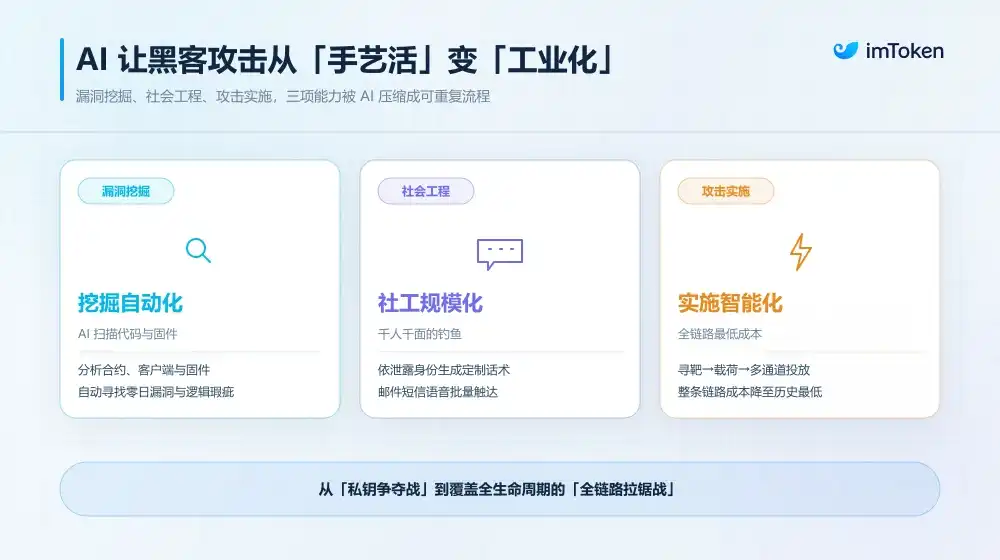
This is the truly profound impact of AI on cybersecurity.

It may not suddenly create a previously unseen attack method, but it is rapidly lowering the cost of existing ones—finding a vulnerability is cheaper, analyzing a target is faster, and generating a thousand different versions of phishing emails is also much easier than before.

In other words, the reason many systems weren't attacked in the past wasn't necessarily because vulnerabilities didn't exist, but sometimes because they were too hard to find, the attack cost was too high, or the target wasn't worth the effort. Now, that invisible security boundary that relied on "attackers not having that much time" is gradually thinning.

From this perspective, the security offensive and defensive game for crypto assets is also expanding from the relatively concentrated "private key battle" of the past into a full-chain tug-of-war covering code, devices, supply chains, user identities, and daily interactions.

AI is merely pressing the accelerator further.

2. A Wallet's True Attack Surface Extends Beyond a Recovery Phrase

This is also why looking at these recent events together is particularly representative.

They sequentially hit different positions in a wallet's lifecycle, reminding us that the risks wallets face have long surpassed the single dimension of "whether the private key is stolen," and are embedded in every step—from private key generation, hardware devices, and logistics supply chains to user privacy information.

Let's break it down simply.

Coldcard is the most typical example. Its problem occurred even before users truly started using the wallet.

The recovery phrase might still look like 12 or 24 normal words, the device could sign and transfer normally, and users might not even notice anything abnormal. However, if the random numbers generating this phrase weren't truly random, then even if you never told anyone your recovery phrase, you could still be at risk.

Because the premise of "safely storing the recovery phrase" is that the phrase was first generated in a sufficiently secure and unpredictable manner.

Then there are Trezor and SafePal.

Unlike Coldcard, their hardware itself wasn't compromised, and the recovery phrases remained intact. Yet, user purchase records were leaked—including name, phone number, email, and even shipping address.

This is like buying a top-grade explosion-proof safe. The safe wasn't cracked, but the logistics company's shipping slip was lost, clearly stating your name, email, phone number, address, and that you purchased a hardware wallet specifically for storing crypto assets.

What the attacker obtains is a list of potential high-value Crypto user leads. They can impersonate wallet customer service to send "urgent firmware update" notifications, customize phishing pages based on the purchase model, call claiming order anomalies, or even further associate users' social media, public identities, and on-chain addresses.

In other words, not being able to crack the cryptography doesn't mean an attack is impossible.

There's even an extreme saying circulating in the Crypto community for years—the "$5 Wrench Attack": No matter how strong the encryption algorithm, it cannot solve the problem of an attacker physically locating the asset holder.

This isn't purely a theoretical risk. According to data provided by Chainalysis to the Financial Times, as of mid-August 2026, at least 46 violent attacks targeting Crypto holders have been recorded this year, with kidnappings accounting for over half, and home invasions making up over a third.

So, looking back at these three incidents, we realize that today's so-called "wallet security" has actually become a long chain:

From wallet code, random numbers, and key generation, to chips, firmware, and devices, then to the official website, purchase channels, supply chain, logistics, and order database; after users truly start using it, it connects to RPCs, DApps, browser extensions, and smart contracts, subsequently involving authorizations, signatures, customer service, social media, and even AI Agents.

If any single link becomes the weakest point, it may bypass the security defenses built by all other links.

3. As Attacks Become Automated, Defense Must Integrate AI

If AI continues evolving at its current pace, the problems exposed today are likely just the beginning.

Because one of the things AI excels at is continuously searching for anomalies, repetitive patterns, and weak points within a vast system.

Attackers can have Agents continuously scan open-source code, batch-test websites, APIs, and extension permissions, automatically collect information from social media and public databases, and then filter for potential high-value targets.

Even phishing itself might evolve from the old, monotonous "your wallet is about to expire, please enter your recovery phrase" to real-time conversations that truly understand who you are:

  • If the attacker knows you just purchased a specific hardware wallet model, they can generate a corresponding "firmware security notification" for you;
  • If they know you recently participated in a DeFi protocol, they can impersonate the project team asking you to migrate to a new protocol treasury;
  • If they further obtain your social accounts and public posts, they can even mimic familiar team members, KOLs, or customer service personnel to communicate with you;

From this perspective, an important challenge wallets will face in the future is: when attacks have upgraded from "fixed rules" to systems that can analyze, judge, and adapt, can defense still rely solely on static rules?

After all, previous wallet security mechanisms are still relatively close to a set of "rule libraries": if an address is flagged as phishing, a pop-up reminder appears; if a domain enters a blacklist, access is blocked; if a certain authorization pattern is high-risk, an additional layer of warning is added.

These mechanisms remain important. However, facing increasingly dynamic attacks, relying solely on known past risks to identify the next one is clearly insufficient.
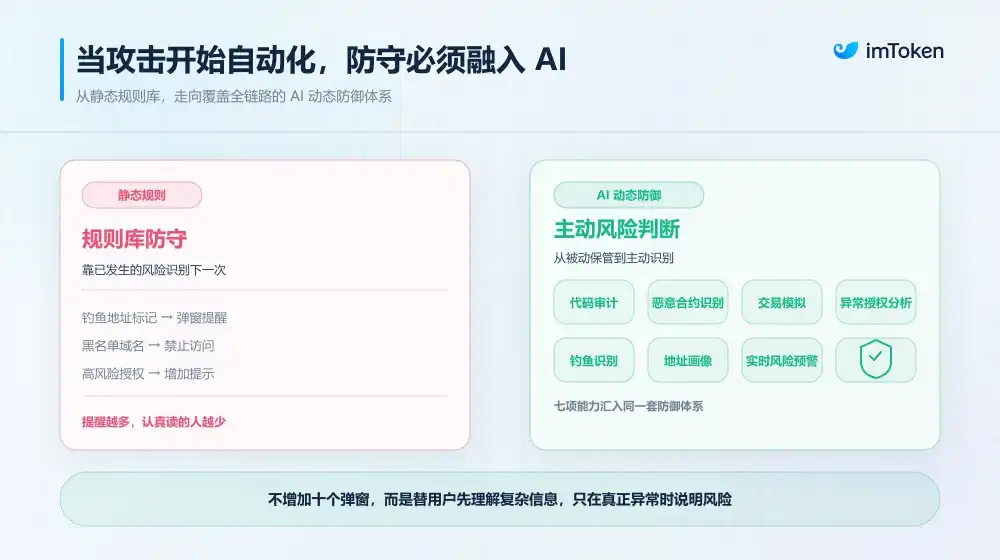
AI can precisely become a very important supplement on the defense side (Extended reading: "As Hackers Use AI 'More Efficiently', How Does the 'Spear and Shield' Arms Race in Web3 Escalate?"). In fact, this isn't a suddenly emerging new proposition.

Previously, in discussions surrounding "AI × Web3 Security," imToken proposed a similar direction: the security capabilities of future wallets should not remain limited to address blacklists, risk labels, and fixed pop-ups. Instead, by leveraging AI, security judgments can be further moved forward into the user's entire transaction process.

For example, before code enters the production environment, AI can continuously review code dependencies, call paths, and anomalous logic; when a user accesses a DApp, AI can combine domain history, frontend behavior, contract addresses, and on-chain relationships to determine if it's abnormal; before signing, it can simulate the actual execution result of a transaction, rather than just showing users a string of hard-to-understand hexadecimal data.

Going a step further, wallets could gradually establish dynamic security models for each user.

An account that has only been making transfers of a few hundred dollars suddenly preparing to approve all assets to a stranger contract deployed just two hours ago is itself an anomaly; an address a user has never interacted with suddenly requesting unlimited Approval should trigger a higher-priority risk warning; and an email claiming to be from the wallet's official source asking for the recovery phrase, no matter how convincingly written, should be directly judged as high-risk.

Thus, the change brought by AI might not just be "automatically helping users judge if an address is safe." It's more like enabling the wallet to gradually develop a layer of proactive risk assessment capability, evolving from a relatively passive key custodian and signing tool.

This also makes another layer of security boundary previously discussed by imToken even more crucial: AI can help users understand and execute complex operations, but asset control rights should not be infinitely surrendered because of it. For critical actions like large transfers, new address authorizations, and sensitive contract interactions, AI's capabilities must still be confined within clear authorization scopes through minimal permissions, human confirmation, pre-execution simulation, and clear explainability.

Especially in truly anomalous situations, clearly telling the user "why it's dangerous," "what will happen after execution," and "where the risk actually lies."

In other words, the significance of AI defense lies in propelling wallets from being passive signing tools to gradually possessing the ability to proactively understand transactions, identify anomalies, and constrain execution.

In Conclusion

The recent series of wallet security incidents do not mean self-custody has lost its value, nor do they mean users should hand over all asset control rights back to centralized platforms.

What they truly remind us is that self-custody never equates to inherent security; it merely returns absolute control of assets to the user.

Protecting this control requires a security system that can evolve with the times and continuously upgrade. Because security is not a one-time product delivery; it's a long-term, dynamic evolution requiring the joint efforts of users, project teams, and wallet manufacturers.

Attackers can use AI to understand code, users, and environments; defenders can do the same.

This will be a prolonged "spear and shield" upgrade race.

Cryptos en tendance

Questions liées

QWhat is the main impact of AI on crypto security, according to the article?

AThe main impact is that AI is drastically lowering the cost and complexity of attacks. It automates and scales tasks like vulnerability discovery, social engineering, and attack deployment, shifting attacks from 'artisanal' to 'industrialized.' This thins the security boundary that previously relied on the high cost and time investment required from attackers.

QBesides the private key itself, what other attack vectors for crypto wallets are highlighted in the article?

AThe article highlights that wallet security is a long chain. Key attack vectors include random number generation (like the Coldcard vulnerability), the hardware supply chain, logistics and order databases (leading to privacy leaks as with Trezor and SafePal), and user identity data. This data can enable targeted phishing or even real-world physical attacks ('$5 wrench attack').

QHow can AI be used defensively to improve wallet security, as suggested in the article?

AAI can be used defensively to move beyond static rule-based security. It can proactively analyze code dependencies and logic, assess DApp risks by combining domain history and on-chain behavior, simulate transaction outcomes before signing, and build dynamic user models to detect behavioral anomalies (like sudden large transfers to new contracts). This transforms the wallet into a tool with active risk assessment capabilities.

QWhat does the article imply by the phrase '$5 wrench attack' in the context of crypto security?

AThe '$5 wrench attack' is an extreme example illustrating that strong cryptography cannot protect against physical coercion. It refers to the theoretical (and, according to data cited, practical) risk where an attacker bypasses digital security entirely by physically threatening or attacking the asset holder to obtain their keys or access.

QWhat is the core principle the article emphasizes regarding self-custody and security after discussing recent wallet incidents?

AThe article emphasizes that self-custody does not equate to inherent security. It merely returns absolute control of assets to the user. Protecting that control requires a dynamic, evolving security system—a continuous 'arms race' where defenders must also leverage tools like AI to keep pace with increasingly automated and sophisticated attacks.

Lectures associées

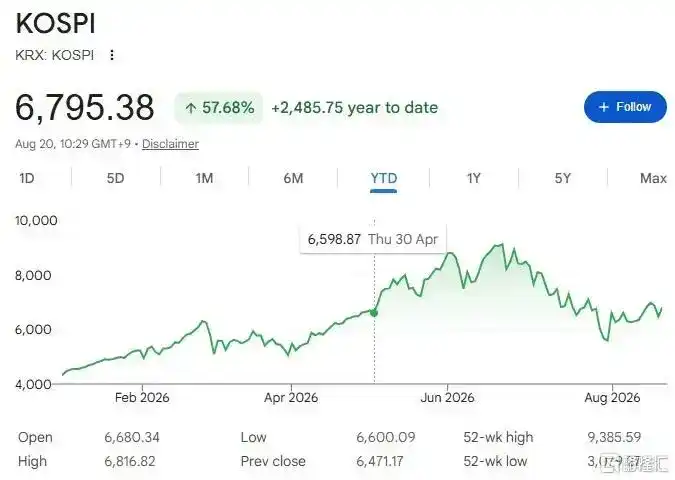
Bondissement violent des actions sud-coréennes, convergence de multiples facteurs positifs

Le marché coréen a connu un rebond vigoureux aujourd'hui, avec l'indice KOSPI en hausse de plus de 5%. Les actions de SK Hynix et de Samsung Electronics ont bondi de plus de 12% et 8% respectivement, contribuant largement à la performance du marché. Cette forte progression fait suite à plusieurs catalyseurs positifs. Le déclencheur immédiat a été l'annonce par le secrétaire au Trésor américain, Janet Yellen, d'un doublement du programme de rachat d'obligations à long terme, visant à modérer les rendements élevés. Cette mesure a renforcé l'appétit pour les actifs risqués à l'échelle mondiale. Sur le plan des entreprises, SK Hynix a dévoilé un programme massif de rachat d'actions de 40 billions de wons (environ 286 milliards de dollars) et a relevé ses objectifs de rétribution des actionnaires. Parallèlement, Samsung Electronics a augmenté les prix de certaines de ses puces de pointe et devrait annoncer prochainement un plan de retour aux actionnaires d'une ampleur historique, évalué à environ 100 billions de wons. Après une correction marquée depuis ses sommets de juin, le marché coréen, toujours en hausse de plus de 57% sur l'année, retrouve des faveurs. La banque HSBC a relevé sa recommandation sur la Corée à "surdimensionnée", estimant que la correction a éliminé un excès de levier. Les perspectives sectorielles restent solides, portées par la demande en mémoire pour l'IA, avec des prévisions de pénurie et de hausse des prix persistantes. Les analystes anticipent cependant une volatilité continue, influencée par les résultats trimestriels et la politique monétaire américaine.

marsbitIl y a 9 mins

Bondissement violent des actions sud-coréennes, convergence de multiples facteurs positifs

marsbitIl y a 9 mins

Arthur Hayes : En attendant le signal de la Fed, se préparer pour le bull run crypto

Dans son article « Yen-quake », Arthur Hayes, cofondateur de BitMEX, analyse les scénarios potentiels pour un renforcement significatif du yen japonais, qu’il estime largement sous-évalué. Il écarte deux options : une hausse importante des taux par la Banque du Japon (trop risquée pour le marché obligataire et les politiques budgétaires) et une vente massive d’actifs étrangers par les institutions japonaises (politiquement difficile et menaçant pour les marchés américains). Il retient une troisième voie, la plus probable : que le Ministère des Finances japonais (MOF) utilise le mécanisme FIMA de la Fed pour obtenir des prêts en dollars contre la garantie de ses bons du Trésor américains, puis vende ces dollars pour acheter des yens, faisant ainsi monter la devise. Hayes souligne que le Secrétaire au Trésor américain, Bassin, a explicitement plaidé pour une réforme de FIMA afin de permettre cette opération à grande échelle. Cette manœuvre, orchestrée par le Comité des changes de la Fed sous la direction de son président Warsh, injecterait massivement des liquidités en dollars. Selon Hayes, cette future expansion du bilan de la Fed, similaire à celle de la période Covid, serait très bullish pour les actifs comme le Bitcoin, l’or physique et les actions de mineurs d’or. Il conclut que le signal à surveiller est la convocation du sous-comité pour modifier les règles de FIMA. En attendant ce catalyseur macroéconomique, il juge le Bitcoin et l’Ethereum sous-évalués, et cite le token ENA (Ethena) comme un actif spéculatif pouvant potentiellement multiplier par 5 à 10 dans les mois à venir, si la liquidité dollar stimule les rendements du basis du Bitcoin et relance l’attrait du stablecoin USDe.

marsbitIl y a 54 mins

Arthur Hayes : En attendant le signal de la Fed, se préparer pour le bull run crypto

marsbitIl y a 54 mins

BTC enregistre la plus grande liquidation à découvert de son histoire en une seule journée : 1,1 milliard de dollars évaporés en une nuit, mais il est encore tôt pour crier au retour du bull market

Après un effondrement massif des positions vendeuses, le Bitcoin a enregistré hier sa plus grande liquidation de positions courtes de l'histoire, avec 1,19 milliard de dollars d'ordres vendeurs liquidés en 24 heures. Le prix a bondi d'environ 7 %, flirtant avec les 70 000 dollars, ce qui a déclenché un effet de cascade dans le marché des contrats à terme. Cette flambée est attribuée à deux facteurs principaux : une réunion à la Maison Blanche entre l'administration Trump et des dirigeants de l'industrie crypto, et une annonce du Trésor américain doublant le soutien à la liquidité des obligations à long terme, interprétée comme un signal de relâchement de la liquidité macroéconomique. Les données montrent des entrées nettes continues dans les ETF spot américains sur Bitcoin et un taux de financement à un plus haut depuis 20 mois. Les analystes soulignent que si une telle liquidation massive de positions courtes a historiquement marqué des creux de marché solides, elle est souvent suivie de plusieurs semaines de consolidation avant une tendance haussière durable. La prudence reste donc de mise, l'enthousiasme actuel du marché nécessitant encore d'être confirmé par une poursuite de la dynamique vers des niveaux plus élevés.

marsbitIl y a 1 h

BTC enregistre la plus grande liquidation à découvert de son histoire en une seule journée : 1,1 milliard de dollars évaporés en une nuit, mais il est encore tôt pour crier au retour du bull market

marsbitIl y a 1 h

Le sommet mondial Websea RWA s’achève avec succès : Mettre l’accent sur les nouvelles opportunités de l’économie numérique Chine-Kazakhstan, émettre un signal de synergie transfrontalière

Le « Sommet mondial RWA Websea » s'est tenu avec succès à Almaty, au Kazakhstan, le 18 août 2026. Cette conférence, axée sur la numérisation des actifs physiques (RWA), la coopération transfrontalière et les investissements, a rassemblé des représentants des secteurs industriel, financier et numérique de Chine, du Kazakhstan et du monde entier. Les discussions ont porté sur les opportunités de numérisation dans des secteurs clés comme les mines, l'agriculture, l'immobilier et les énergies vertes. Les participants ont souligné que la technologie RWA va au-delà du concept technique ; elle améliore la transparence, l'efficacité de la collaboration et la connectivité transfrontalière des actifs. Un accent particulier a été mis sur la création d'un « écosystème économique numérique » entre la Chine et le Kazakhstan, nécessitant un environnement commercial stable et une collaboration entre gouvernements, entreprises et plateformes. La plateforme d'actifs numériques Websea, partenaire de l'événement, a présenté sa vision centrée sur la confiance des utilisateurs, la sécurité des actifs et une expérience de transaction optimale. Le sommet a également vu le lancement d'initiatives communautaires comme la « Web3 Beauty Alliance » et une alliance de créateurs, illustrant l'élargissement de l'écosystème numérique. En résumé, l'événement a envoyé un signal fort en faveur d'une coopération économique numérique approfondie entre la Chine et le Kazakhstan. Il a mis en lumière le rôle du RWA pour moderniser les industries traditionnelles et a souligné que l'avenir du numérique se construit sur la confiance, une collaboration ouverte et la participation d'une large communauté d'acteurs.

marsbitIl y a 1 h

Le sommet mondial Websea RWA s’achève avec succès : Mettre l’accent sur les nouvelles opportunités de l’économie numérique Chine-Kazakhstan, émettre un signal de synergie transfrontalière

marsbitIl y a 1 h

À la manière de Soros pour sauver les obligations américaines : de la gestion des changes aux taux, Bessent peut-il gagner contre le marché ?

L'ancien bras droit de George Soros, Scott Bessent, aujourd'hui Secrétaire au Trésor américain, applique désormais une logique de gestion agressive des marchés pour tenter de maîtriser les coûts d'emprunt des États-Unis. Son intervention récente pour doubler le programme de rachat d'obligations d'État à long terme, après avoir soutenu l'intervention sur le yen aux côtés du Japon, vise directement à contenir la hausse des rendements. Bessent, qui a participé aux célèbres attaques spéculatives contre la livre sterling en 1992 et le yen en 2013, utilise aujourd'hui son instinct pour "trouver les failles" dans le but inverse : défendre le marché des Treasuries sous pression. Sa stratégie enchaîne l'intervention sur les devises (pour éviter que le Japon ne vende trop d'obligations), des signaux de réduction des émissions d'emprunts longs, et enfin des rachats massifs pour soutenir les prix. Cette approche active rompt avec le principe traditionnel du Trésor américain, basé sur des règles prévisibles. Si les marchés réagissent à court terme, les économistes doutent de l'efficacité durable de ces interventions face aux problèmes structurels : déficits budgétaires massifs, dépenses d'intérêts en forte hausse et attentes inflationnistes. Bessent mise sa crédibilité sur sa capacité à influencer les signaux du marché, mais il mène une "bataille extrêmement difficile" contre des forces macroéconomiques fondamentales que les opérations de rachat seules ne peuvent résoudre.

marsbitIl y a 1 h

À la manière de Soros pour sauver les obligations américaines : de la gestion des changes aux taux, Bessent peut-il gagner contre le marché ?

marsbitIl y a 1 h

Trading

Spot

Articles tendance

Comment acheter ERA

Bienvenue sur HTX.com ! Nous vous permettons d'acheter Caldera (ERA) de manière simple et pratique. Suivez notre guide étape par étape pour commencer votre parcours crypto.Étape 1 : Création de votre compte HTXUtilisez votre adresse e-mail ou votre numéro de téléphone pour ouvrir un compte sur HTX gratuitement. L'inscription se fait en toute simplicité et débloque toutes les fonctionnalités.Créer mon compteÉtape 2 : Choix du mode de paiement (rubrique Acheter des cryptosCarte de crédit/débit : utilisez votre carte Visa ou Mastercard pour acheter instantanément Caldera (ERA).Solde :utilisez les fonds du solde de votre compte HTX pour trader en toute simplicité.Prestataire tiers :pour accroître la commodité d'utilisation, nous avons ajouté des modes de paiement populaires tels que Google Pay et Apple Pay.P2P :tradez directement avec d'autres utilisateurs sur HTX.OTC (de gré à gré) : nous offrons des services personnalisés et des taux de change compétitifs aux traders.Étape 3 : stockage de vos Caldera (ERA)Après avoir acheté vos Caldera (ERA), stockez-les sur votre compte HTX. Vous pouvez également les envoyer ailleurs via un transfert sur la blockchain ou les utiliser pour trader d'autres cryptos.Étape 4 : tradez des Caldera (ERA)Tradez facilement Caldera (ERA) sur le marché Spot de HTX. Il vous suffit d'accéder à votre compte, de sélectionner la paire de trading, d'exécuter vos trades et de les suivre en temps réel. Nous offrons une expérience conviviale aux débutants comme aux traders chevronnés.

832 vues totalesPublié le 2025.07.17Mis à jour le 2026.06.02

Comment acheter ERA

Discussions

Bienvenue dans la Communauté HTX. Ici, vous pouvez vous tenir informé(e) des derniers développements de la plateforme et accéder à des analyses de marché professionnelles. Les opinions des utilisateurs sur le prix de ERA (ERA) sont présentées ci-dessous.

活动图片