ENS Founder Seeks to 'Seize Power' from DAO

Foresight NewsPublié le 2026-07-02Dernière mise à jour le 2026-07-02

Résumé

On June 29th, the ENS community entered the on-chain voting phase for a proposal to renew the ENS DAO Security Council's veto power for two more years. Shortly after voting began, ENS founder Nick Johnson used his substantial ENS holdings to cast over 3.55 million votes against the proposal, swinging the outcome despite initial strong support. The Security Council was established in July 2024 with a 4/8 multisig veto power to protect the DAO's treasury (valued over $350 million) from malicious proposals during a period of low voter participation. Its powers were limited to vetoing only harmful proposals, not normal ones. Nick Johnson's opposition stems from broader concerns about ENS DAO's governance. In late 2025, he and others expressed frustration that the DAO had become mired in political gamesmanship, with capable contributors leaving and leadership falling to less experienced or misaligned parties. This context set the stage for a major restructuring proposal by ENS COO Katherine Wu on June 19th, titled "Next Era of ENS DAO: Empowering the ENS Foundation." The controversial proposal aims to transfer daily operations, treasury management, and long-term strategy to a restructured ENS Foundation with a professional board, while the DAO would retain core protocol governance powers. Critics, including original ENS constitution author Brantly Millegan, argue this effectively transfers treasury control from token holders to ENS Labs (the core development team), undermining ...


Written by: Eric, Foresight News


On June 29, a proposal by the ENS community to extend the veto power of the ENS DAO Security Committee for two years entered the on-chain voting stage. Shortly after voting began, the over 800,000 votes in favor far exceeded the less than 300,000 votes against. However, ENS founder Nick Johnson used his substantial ENS holdings to significantly increase the opposing votes to 3.55 million in one go.
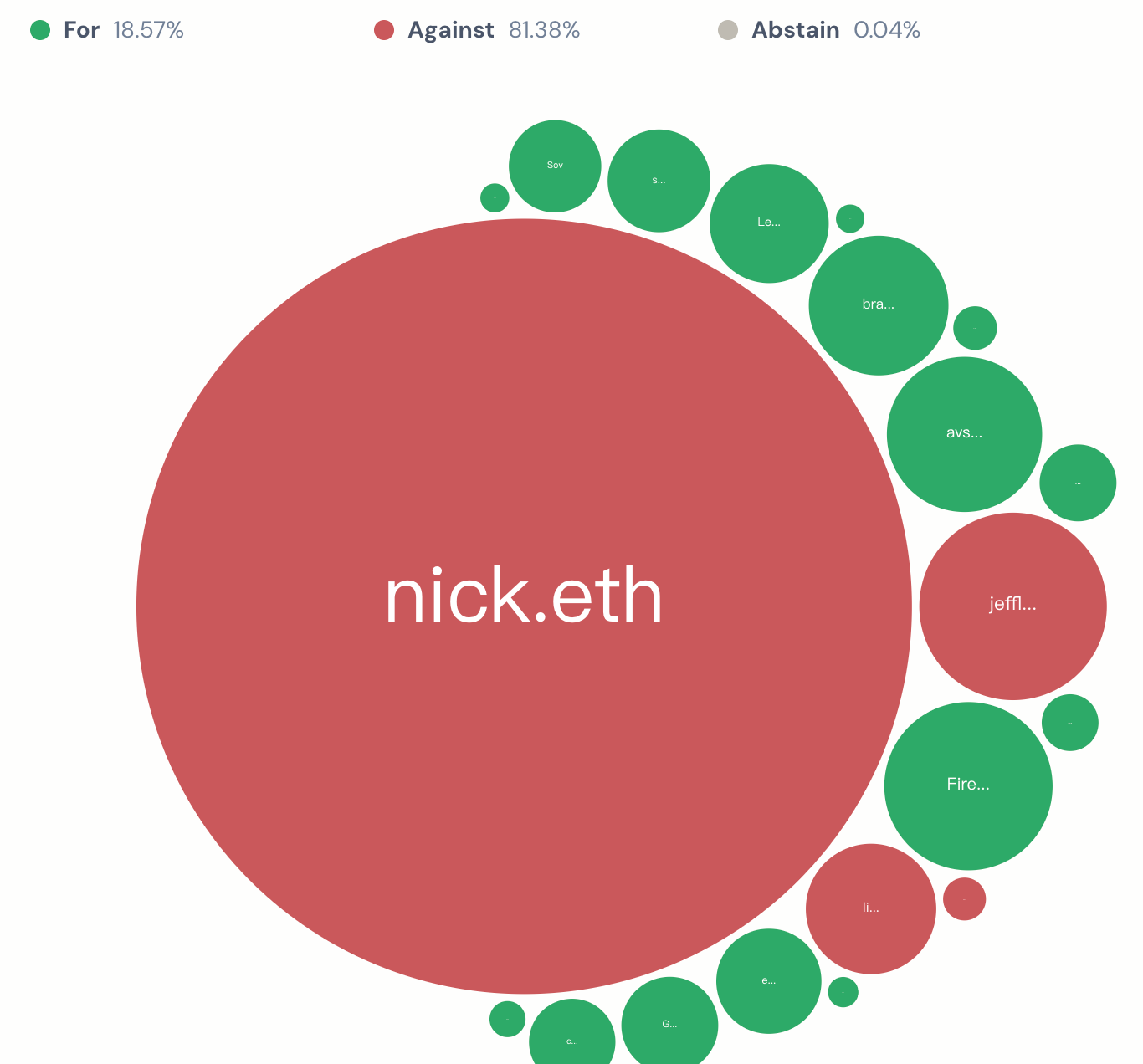


The ENS DAO Security Committee was established in July 2024. At that time, both active participants in ENS DAO proposals and the number of votes were relatively low. To prevent major holders from using this opportunity to launch malicious proposals that could jeopardize the ENS DAO treasury exceeding $350 million, the DAO chose to establish the Security Committee, granting it direct veto power over malicious proposals through a 4/8 multisig.


However, the committee's power is limited to vetoing malicious proposals. It cannot interfere with the process of normal proposals, nor can it initiate proposals. Its authority is retained for only two years at a time for easy adjustment.


Logically, renewing the authority of such an organization protecting the DAO treasury before its term ends should be quite normal. Why would the ENS founder personally step in to vote against a proposal designed to protect the DAO?


To understand this seemingly 'authoritarian' decision, we need to trace back to a discussion about ENS DAO governance in November last year.


I mentioned this incident in the article "Seeing ENS Struggling with Governance, I Think It's Time to Talk About DAO Problems" (https://foresightnews.pro/article/detail/93316): In November 2025, Nick Johnson wrote a meaningful post on the forum, roughly stating that the ENS DAO was now full of political infighting, capable people were gradually leaving, and the leadership of the DAO had fallen into the hands of inexperienced individuals, or even those whose interests were not aligned with the protocol.


Also in that month, ENS DAO Secretary Limes submitted a proposal suggesting that at the end of the sixth term, i.e., December 31, 2025, the operations of the three working groups—Metagovernance, Ecosystem, and Public Goods—be terminated. As for the reasons, firstly, because proposals had become a game of 'you support me, I support you,' with no one caring about what should actually be done; secondly, the lack of entry criteria led to the frequent phenomenon of 'bad money driving out good.' Limes believed that process improvements could not solve this structural deep-rooted problem, and shutting down was the only way out.


Although this proposal ultimately did not pass, Nick's desire for DAO reform was already clear.


On June 19, ENS COO Katherine Wu posted a new proposal on the ENS forum: "Next Era of ENS DAO: Empowering the ENS Foundation." The core contents of the proposal are twofold: first, to transfer daily operations, treasury management, and long-term capital strategy to a restructured ENS Foundation. The Foundation would be responsible for daily treasury operations, public goods grants, working group coordination, ecosystem strategy, trademark/brand assets, etc. Additionally, the Foundation would establish a 5-member board of directors to enhance professional execution and accountability.


Second, it commits that the DAO and token holders will retain core powers, including protocol-layer governance contract upgrades, registry control, fee structure, constitutional amendments, etc.


The biggest point of contention in this proposal is the DAO treasury. Critics believe this would allow the Foundation and, by extension, ENS Labs behind it, to effectively control the massive funds, weakening the direct influence of token holders. ENS original constitution author Brantly Millegan expressed strong opposition, arguing that it violates the DAO's original design where token holders should simultaneously control both the protocol and the treasury, essentially implying that ENS Labs wants direct control of the treasury.
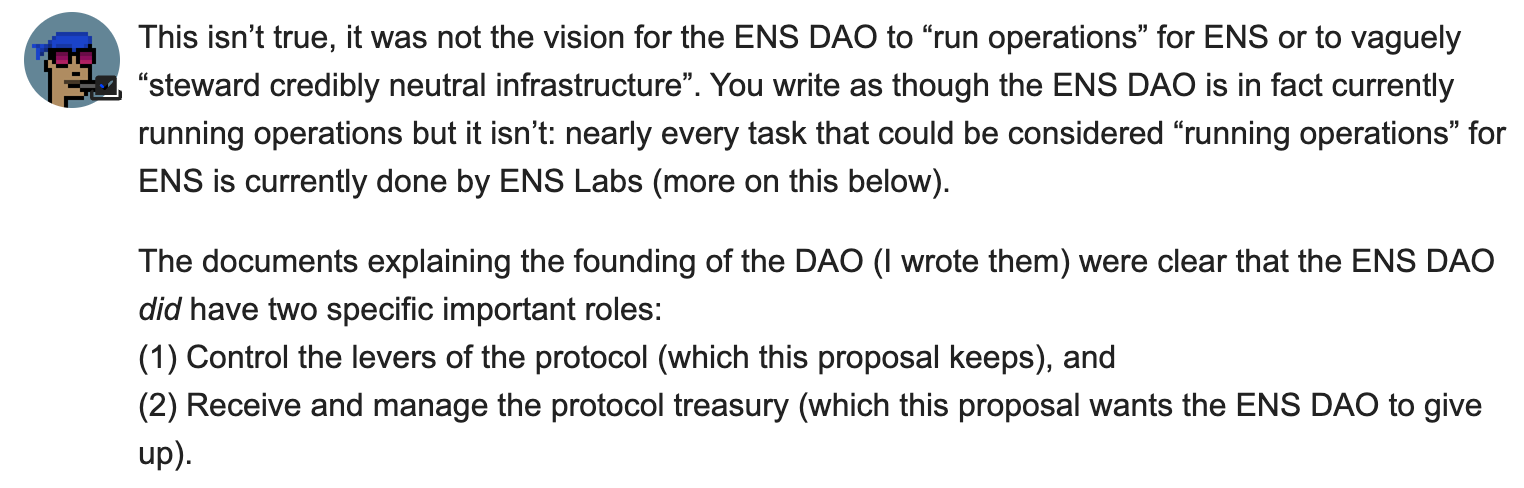


This is a conflict between decentralization fundamentalists and practical operators. One side does not believe inefficiency justifies the Foundation 'seizing power' from the DAO, while the other, after years of ups and downs, still believes that centralization, at least for now, is more beneficial for the project's development.


Nick's over 3 million opposing votes are seen as the first shot fired in the power war.


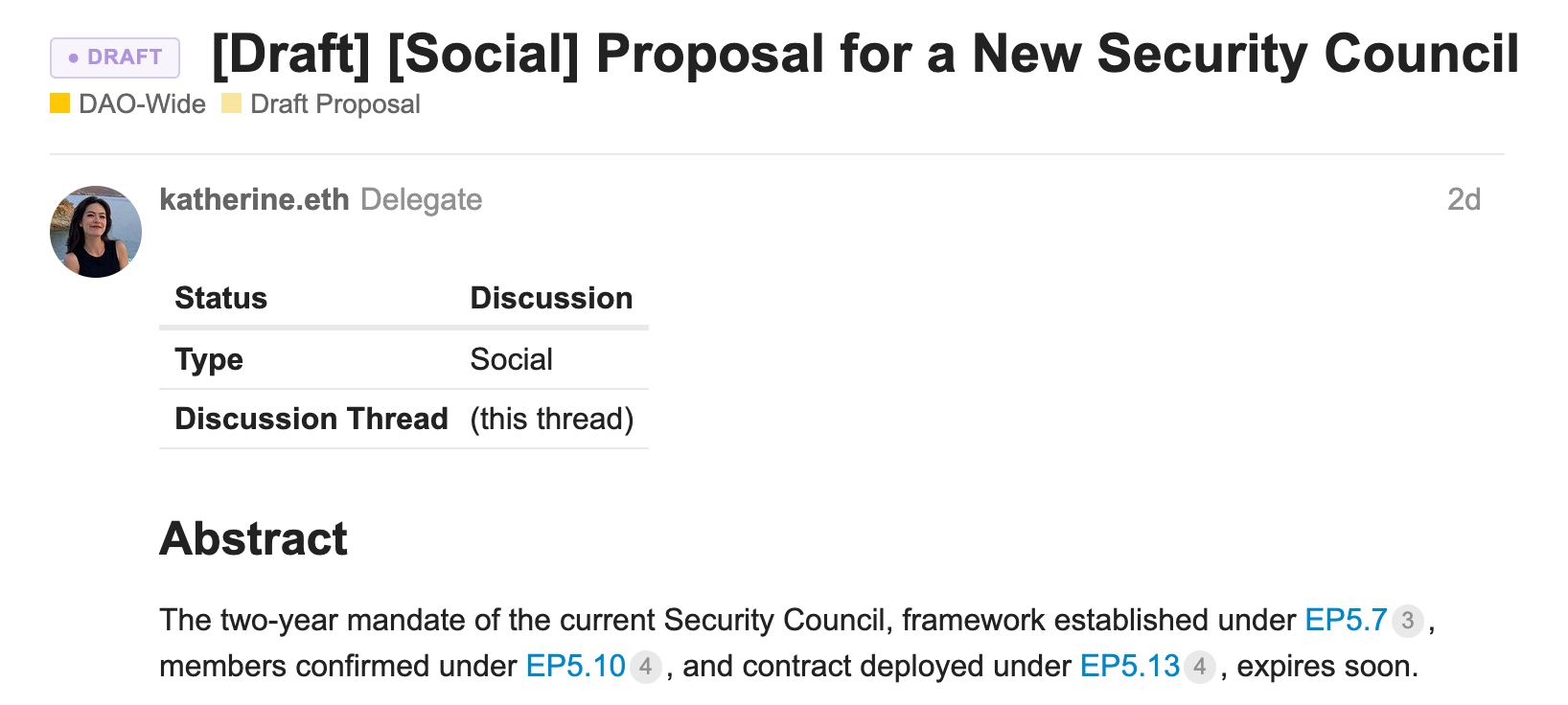
However, Nick himself also provided an explanation. His opposition stems from concerns that the current committee's power lacks sufficient checks and balances, and a two-year extension would solidify these issues. Additionally, he worries that some members might use the veto power for political purposes, blocking ordinary proposals they personally dislike, rather than limiting it to genuinely urgent situations.


In response, Katherine released a new proposal that raised the threshold for veto execution (from 4/8 to 5/8), implemented stricter power limitations, and added member removal mechanisms, among other things, to prevent power concentration.


Data shows ENS's annual revenue exceeded $10 million in 2023, declined to $7 million in 2024, and had fallen to less than $2 million in 2025. When there is enough money, no one cares how it is spent; but when the industry is in a downturn and revenue is falling, even assets worth several hundred million dollars require careful planning.


Nick's substantial holdings of ENS are enough for him to implement these changes, but the forced implementation of change via the token-holding 'bug' leaves Nick with no retreat. The new Foundation must perform at least better than the DAO. 'How to do it' is the problem Nick must solve in the next phase. Hopefully, the ENS core team already has the answer.


Cryptos en tendance

Questions liées

QWhy did ENS founder Nick Johnson vote against renewing the security committee's veto power?

ANick Johnson voted against the renewal because he was concerned about a lack of sufficient checks and balances on the committee's power. He worried that a two-year renewal would solidify these issues and that some members might misuse the veto for political purposes to block ordinary proposals they personally disliked, rather than only for genuine emergencies.

QWhat are the two main proposed changes in Katherine Wu's 'Next Era of ENS DAO' proposal?

AThe two main proposals are: 1) Transferring daily operations, treasury management, and long-term capital strategy to a restructured ENS Foundation, which would handle daily treasury operations, public goods grants, working group coordination, ecosystem strategy, and brand assets. 2) Ensuring that the DAO and token holders retain core powers, including protocol-level governance, contract upgrades, registry control, fee structure changes, and constitutional amendments.

QWhat was the core controversy surrounding the proposed new ENS Foundation?

AThe core controversy centered on the DAO treasury. Critics, including ENS's original constitution author Brantly Millegan, argued that the proposal would allow the Foundation (and by extension, ENS Labs) to gain practical control over the massive treasury funds, thereby weakening the direct influence of token holders. This was seen as a move away from the original DAO design where token holders controlled both the protocol and the treasury.

QWhat problems did Nick Johnson and Limes identify with ENS DAO's governance in late 2025?

AThey identified significant political infighting within the DAO, where competent people were leaving and leadership was falling into the hands of individuals who lacked experience or had interests misaligned with the protocol's. Limes specifically noted that proposal-making had become a reciprocal 'you support me, I support you' game, with a lack of focus on necessary work, and that the absence of entry standards led to a 'bad money driving out good' phenomenon.

QHow did Katherine Wu attempt to address the concerns about the security committee's power after Nick's vote?

AIn response to the concerns raised by Nick Johnson's vote, Katherine Wu submitted a new proposal to reform the security committee. The key changes included raising the threshold for executing a veto (from 4/8 to 5/8 members), implementing stricter power limitations, and adding a mechanism for removing committee members, all aimed at preventing the concentration of power.

Lectures associées

La Pologne est-elle toujours la porte d'entrée à bas coût vers le statut de CASP de l'UE ?

**La Pologne est-elle toujours l'entrée à faible coût vers l'UE pour les CASP ?** Depuis le 1er juillet 2026, l'ancien régime polonais d'enregistrement VASP n'est plus valable pour fournir des services sous le règlement MiCA. De plus, la législation polonaise d'application de MiCA est encore en cours d'ajustement, créant une incertitude procédurale. Par conséquent, le critère du « faible coût » n'est plus suffisant pour choisir la Pologne comme État membre d'origine d'un CASP. L'accent doit désormais se porter sur la certitude du processus d'agrément. MiCA introduit un changement majeur : un agrément obtenu dans un État membre permet de desservir toute l'UE via le mécanisme de « passporting ». Ainsi, pour un projet souhaitant accéder au marché polonais, une voie plus réaliste peut consister à obtenir d'abord un agrément CASP dans un pays au cadre stable (comme la Lituanie ou Malte), puis à l'étendre en Pologne. La Pologne conserve sa valeur comme marché important. Elle peut être un choix pertinent si le projet y a une présence opérationnelle réelle. Mais pour les projets cherchant principalement une identité réglementaire européenne à moindre coût, privilégier un État membre au processus d'agrément mature et prévisible est désormais plus stratégique. L'ère du « passeport réglementaire » facile via la Pologne est révolue.

marsbitIl y a 13 mins

La Pologne est-elle toujours la porte d'entrée à bas coût vers le statut de CASP de l'UE ?

marsbitIl y a 13 mins

Décryptage complet du sommet crypto de la Maison Blanche : Trump soutient l'entrée des échanges décentralisés aux États-Unis, le vote des nouvelles règles du 15 septembre est la ligne rouge

Le 19 août, le président Trump a réuni à la Maison Blanche des dirigeants de l'industrie crypto (Coinbase, Ripple, Kraken, etc.) et les responsables de la SEC et de la CFTC. Il a déclaré la fin de la "guerre contre la crypto" et évoqué un possible accroissement des réserves américaines de Bitcoin ainsi que l'introduction aux États-Unis de la plateforme décentralisée Hyperliquid. Le lendemain, le président de la CFTC, Michael Selig, a menacé : si le Congrès n'adopte pas le "CLARITY Act" d'ici le 15 septembre, l'agence établira ses propres règles pour structurer le marché des crypto-actifs, permettant potentiellement le trading avec effet de levier. Ces déclarations font suite à une proposition de la SEC (18 août) visant à assouplir les règles de financement pour les projets crypto. Tous les regards sont désormais tournés vers la date butoir du 15 septembre pour le vote au Sénat. Le principal obstacle au projet de loi n'est pas les dispositions sur les cryptomonnaies, mais un ajout sur l'éthique, visant à limiter les profits des responsables fédéraux issus d'entreprises crypto. Si l'annonce concernant Hyperliquid a fait monter son token (HYPE) de près de 20%, sa conformité réelle aux États-Unis, probablement via un modèle hybride, reste incertaine. Les acteurs du secteur espèrent qu'une loi claire ancrera durablement le cadre réglementaire.

marsbitIl y a 14 mins

Décryptage complet du sommet crypto de la Maison Blanche : Trump soutient l'entrée des échanges décentralisés aux États-Unis, le vote des nouvelles règles du 15 septembre est la ligne rouge

marsbitIl y a 14 mins

Le Bitcoin dépasse brièvement 75 000 $ : les rachats forcés font avancer le mouvement, les ETF et la Stratégie déterminent le potentiel

L'annonce de Trump, lors d'une conférence à la Maison Blanche, poussant au progrès du *CLARITY Act*, a rapidement amélioré les perspectives du marché concernant la régulation des crypto-monnaies aux États-Unis. Combinée à un assouplissement des conditions macroéconomiques, cette évolution a déclenché une vague de rachats forcés (couverture des positions vendeuses), propulsant le prix du Bitcoin au-dessus de 75 000 USD. Toutefois, cette dynamique initiale, alimentée par les dérivés, a besoin de capitaux institutionnels stables pour se transformer en une tendance haussière durable. L'attention se porte désormais sur deux canaux clés : 1. **Les FNB américains de Bitcoin spot** : Après trois jours consécutifs d'entrées nettes importantes, atteignant 517 millions USD le 19 août, ils commencent à prendre le relais. La poursuite de flux substantiels est essentielle pour soutenir le cours. 2. **Le cycle de financement et d'achat de Strategy** : Avec le Bitcoin dépassant le prix d'acquisition moyen de Strategy (~75 385 USD), la pression sur son bilan s'allège. La revalorisation de son titre privilégié (STRC) vers sa valeur faciale de 100 USD est un indicateur à surveiller, car elle pourrait permettre à Strategy de relancer ses émissions pour financer de nouveaux achats de Bitcoin. La durabilité de la hausse dépendra de la capacité de ces deux canaux à fournir des flux de capitaux constants. Si les entrées dans les FNB se maintiennent et que Strategy relance son cycle d'achat, le marché pourrait connaître une reprise plus structurelle. Dans le cas contraire, une phase de consolidation est probable. Pour les investisseurs souhaitant participer à une reprise éventuelle tout en diversifiant les risques, des stratégies d'investissement thématiques (comme les indices MAG7.SSI et DEFI.ssi de SoSoValue) offrent une exposition équilibrée aux actifs majeurs du secteur.

marsbitIl y a 17 mins

Le Bitcoin dépasse brièvement 75 000 $ : les rachats forcés font avancer le mouvement, les ETF et la Stratégie déterminent le potentiel

marsbitIl y a 17 mins

Trading

Spot

Articles tendance

Comment acheter DAO

Bienvenue sur HTX.com ! Nous vous permettons d'acheter DAO Maker (DAO) de manière simple et pratique. Suivez notre guide étape par étape pour commencer votre parcours crypto.Étape 1 : Création de votre compte HTXUtilisez votre adresse e-mail ou votre numéro de téléphone pour ouvrir un compte sur HTX gratuitement. L'inscription se fait en toute simplicité et débloque toutes les fonctionnalités.Créer mon compteÉtape 2 : Choix du mode de paiement (rubrique Acheter des cryptosCarte de crédit/débit : utilisez votre carte Visa ou Mastercard pour acheter instantanément DAO Maker (DAO).Solde :utilisez les fonds du solde de votre compte HTX pour trader en toute simplicité.Prestataire tiers :pour accroître la commodité d'utilisation, nous avons ajouté des modes de paiement populaires tels que Google Pay et Apple Pay.P2P :tradez directement avec d'autres utilisateurs sur HTX.OTC (de gré à gré) : nous offrons des services personnalisés et des taux de change compétitifs aux traders.Étape 3 : stockage de vos DAO Maker (DAO)Après avoir acheté vos DAO Maker (DAO), stockez-les sur votre compte HTX. Vous pouvez également les envoyer ailleurs via un transfert sur la blockchain ou les utiliser pour trader d'autres cryptos.Étape 4 : tradez des DAO Maker (DAO)Tradez facilement DAO Maker (DAO) sur le marché Spot de HTX. Il vous suffit d'accéder à votre compte, de sélectionner la paire de trading, d'exécuter vos trades et de les suivre en temps réel. Nous offrons une expérience conviviale aux débutants comme aux traders chevronnés.

460 vues totalesPublié le 2024.12.11Mis à jour le 2026.06.02

Comment acheter DAO

Discussions

Bienvenue dans la Communauté HTX. Ici, vous pouvez vous tenir informé(e) des derniers développements de la plateforme et accéder à des analyses de marché professionnelles. Les opinions des utilisateurs sur le prix de DAO (DAO) sont présentées ci-dessous.

活动图片