Why Does the Automated Market Maker (AMM) Mechanism Fail in the Prediction Market Field?

marsbitPublicado a 2026-04-14Actualizado a 2026-04-14

Resumen

The article explores why Automated Market Makers (AMMs), particularly the x*y=k model popularized by Uniswap, fail in prediction markets despite their success in decentralized finance (DeFi). AMMs excel in DeFi by enabling permissionless liquidity provision and continuous trading for tokens that fluctuate indefinitely. However, prediction markets involve binary outcomes where assets settle to either $1 or $0 at expiration. This structural difference causes inherent flaws: liquidity providers (LPs) inevitably suffer losses as pools automatically rebalance toward the losing side upon settlement—making "impermanent loss" permanent. Additionally, AMMs distort price discovery for probability-based markets due to slippage and low liquidity. Early prediction platforms like Polymarket and Augur experimented with AMMs but abandoned them for Central Limit Order Books (CLOBs), which better handle precise probabilistic pricing and binary settlements. The article concludes that while AMMs revolutionized token swaps, their mechanics are mismatched for prediction markets, requiring alternative infrastructure that accommodates binary outcomes and mandatory settlement.

Author: Melee

Compiled by: AididiaoJP, Foresight News

In July 2017, Hayden Adams was laid off by his employer Siemens, where he worked as a mechanical engineer. His college roommate Karl Floersch was working at the Ethereum Foundation at the time and often told him about smart contracts. Adams had previously paid no attention. Now unemployed and looking for something to do, he decided to listen.

The Birth of the Automated Market Maker (AMM)

Floersch recommended a blog post by Vitalik Buterin about running an on-chain exchange using a mathematical formula instead of an order book. The principle was not to match buyers and sellers, but to allow traders to exchange with a pool of assets, with the price automatically set based on the ratio of tokens in the pool. No working version existed at the time. Adams took it on as a learning project, received a $65,000 grant from the Ethereum Foundation, and launched Uniswap in November 2018.
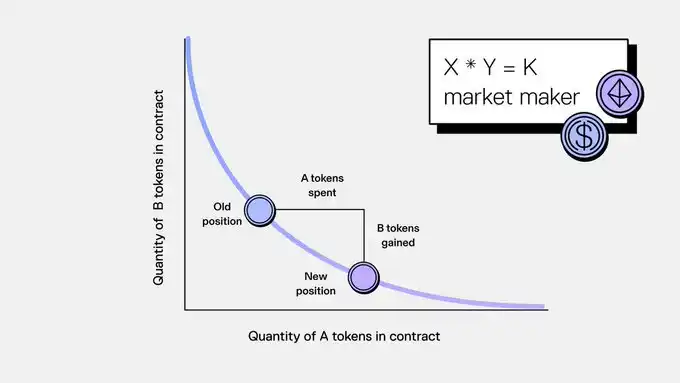
Its formula was deceptively simple: x * y = k.

Two tokens are placed in a pool, and the product of their quantities remains constant. When someone buys one token, they must deposit the other token, changing the ratio within the pool and adjusting the price accordingly. No order book, no matching engine, no professional market makers needed. Anyone can deposit tokens into the pool and earn fees from every transaction.

The automated market maker thus became the cornerstone of decentralized finance. Uniswap, Curve, Balancer, and dozens of other protocols handle billions of dollars in trading volume. On-chain order books are slow and expensive, and traditional market makers have no interest in tokens with only two hundred holders. Automated market makers allow anyone to create a liquid market for any asset at any time. Before AMMs, listing a new asset required permission and infrastructure. After AMMs, all you need is a liquidity pool.

The benefits were obvious. So, prediction markets naturally tried to adopt them too.

Automated Market Makers and Prediction Markets

Prediction markets face the same cold-start problem as token markets. You need liquidity before people are willing to trade, and you need traders before people are willing to provide liquidity. Little known is that Robin Hanson had proposed an automated market making solution for prediction markets years earlier in his 2002 Logarithmic Market Scoring Rule.

He thought he had theoretically solved the cold-start problem. However, in practice, the solution suffered from the same fundamental issue that every subsequent attempt to automate liquidity for prediction markets encountered: the formula couldn't distinguish between perpetually fluctuating tokens and equity certificates that expire.

Prediction market outcomes are binary. They ultimately settle to one or zero. In a token swap pool, both assets can fluctuate indefinitely, and the AMM formula works precisely because neither token is designed to go to zero.

Early Polymarket used an AMM based on the logarithmic market scoring rule. Augur also experimented with similar schemes. If automated liquidity pools worked for token swaps, they should, in theory, work for election betting too.

They didn't.

Why AMMs Fail in Prediction Markets

When a prediction market event settles, one side is worth one dollar, the other zero. For anyone providing liquidity to the pool, the mathematical outcome is nearly brutal. As the market moves towards settlement, the pool automatically rebalances towards the losing side.

Impermanent Loss

What decentralized finance traders call "impermanent loss" becomes completely "permanent" here. Every market settles, and every pool will eventually hold a pile of worthless shares.

In regular DeFi pools, trading fees can offset impermanent loss over time.
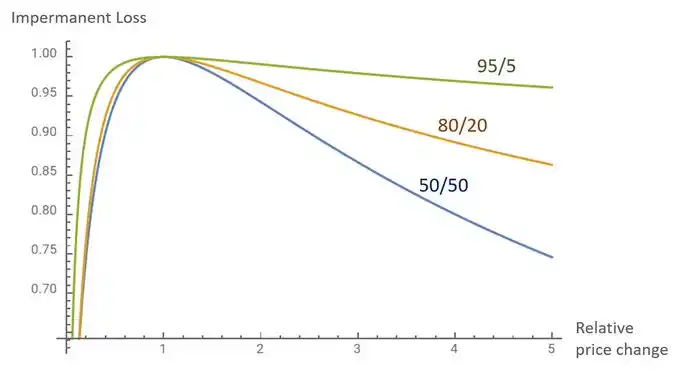
But in prediction markets, the loss is a structural certainty. The only question is how much the liquidity provider loses. Protocols have tried to persuade users to deposit assets into these pools through liquidity mining, reward programs, and various incentive structures. All of these are just different ways to subsidize users to lose money at a slower rate.

Price Discovery

Then there is the issue of price discovery. AMMs price assets based on the pool ratio and a fixed formula. For tokens, the "correct price" is a moving target, and a formula-driven approximation is sufficient. Prediction market prices are supposed to represent probabilities. The slippage introduced by the constant product curve distorts the signal, especially in low-liquidity markets, where a single trade can swing the implied probability by several basis points.

Is the Central Limit Order Book (CLOB) Better Than AMMs?

Polymarket realized this early on. In late 2022, the platform migrated from a logarithmic market scoring rule-based AMM to a central limit order book. AMMs were designed for continuous token swaps across a price range. Prediction markets require precise probability pricing on binary outcomes with known terminal values. They are entirely different problems.

The characteristics that made AMMs revolutionary for tokens—permissionless market creation, instant liquidity bootstrapping, no reliance on professional market makers—are exactly what prediction markets desperately need. The problem is that the specific mechanism, the constant function formula built for token swaps, breaks down when faced with the reality of binary outcomes and inevitable settlement.

The challenge for prediction markets is to replicate these effects with infrastructure that reflects how these markets actually settle.


Preguntas relacionadas

QWhat is the core mathematical formula behind the Automated Market Maker (AMM) mechanism introduced by Uniswap?

AThe core mathematical formula is x * y = k, where x and y represent the quantities of two tokens in the pool, and k is a constant product.

QWhy do AMMs fail in the prediction market space according to the article?

AAMMs fail in prediction markets because these markets involve binary outcomes that eventually settle to $1 or $0, causing structural and certain losses for liquidity providers, unlike in token swaps where both assets can fluctuate indefinitely and fees can offset impermanent loss.

QWhat did early prediction market platforms like Polymarket and Augur experiment with?

AEarly platforms like Polymarket used an AMM based on Robin Hanson's Logarithmic Market Scoring Rule, and Augur also experimented with similar automated liquidity solutions.

QWhat is the key difference between token trading and prediction markets that makes AMMs unsuitable for the latter?

AToken trading involves assets designed to never go to zero and allows for continuous price fluctuations, while prediction markets have binary outcomes that definitively settle to $1 or $0, making AMM-induced losses certain rather than 'impermanent'.

QWhat solution did Polymarket eventually adopt to address the limitations of AMMs?

APolymarket migrated from an AMM based on the Logarithmic Market Scoring Rule to a Central Limit Order Book (CLOB) to better handle precise probability pricing and binary settlement in prediction markets.

Lecturas Relacionadas

La CPU, regresando sigilosamente al centro del escenario de la potencia computacional de IA

En los últimos tres años, la narrativa del cómputo de IA se centró casi exclusivamente en las GPU. Sin embargo, a partir de 2026, esta visión está cambiando. A medida que las cargas de trabajo de IA evolucionan desde el entrenamiento de modelos a gran escala hacia la inferencia masiva y la ejecución de agentes inteligentes, surge un nuevo cuello de botella: la orquestación, la concurrencia y el flujo de datos. El CPU está recuperando un papel central, no como proveedor principal de cómputo paralelo, sino como el "plano de control" de la infraestructura de IA. Este cambio es impulsado por la necesidad de gestionar miles de tareas ligeras, peticiones de inferencia y agentes simultáneamente, tareas para las cuales la arquitectura de GPU no está optimizada. Un ejemplo concreto: en los centros de datos de IA avanzados, como el proyecto "Fairwater" de Microsoft para OpenAI, extensos clusters de CPU son necesarios para sostener y gestionar las operaciones de los masivos clusters de GPU, manejando el flujo de datos y la planificación de tareas. Intel, con su nuevo procesador Xeon 6+ (fabricado en su proceso Intel 18A y con hasta 288 núcleos de eficiencia -E-cores), apuesta precisamente por este nicho. Su diseño prioriza la alta densidad de núcleos y la eficiencia energética para manejar cargas de trabajo de alto rendimiento y alta concurrencia propias de la inferencia y los agentes de IA. Sin embargo, el éxito de este "regreso del CPU" no está garantizado para Intel. Enfrenta una competencia multifacética: las soluciones integradas "CPU+GPU" de NVIDIA, el avance de los CPU ARM de alta densidad de AMD y Ampere, y la tendencia de los principales proveedores de nube (AWS, Google, Microsoft, Alibaba) a desarrollar sus propios CPU ARM personalizados para estos mismos workloads. En conclusión, la redefinición del CPU como el plano de control orquestador en la infraestructura de IA es una tendencia industrial clara. Que Intel, con su Xeon 6+, logre capitalizar esta oportunidad dependerá de su capacidad para competir en un panorama donde la arquitectura, el proceso de fabricación y los ecosistemas están en constante disputa.

marsbitHace 22 min(s)

La CPU, regresando sigilosamente al centro del escenario de la potencia computacional de IA

marsbitHace 22 min(s)

Tras colaborar con más de 35 proyectos DeFi, Pink Brains descubre las nuevas reglas del marketing KOL para 2026

Tras tres años trabajando con más de 35 proyectos DeFi líderes, hemos invertido el enfoque de marketing tradicional. La estrategia más efectiva no parte de la perspectiva del proyecto, sino del usuario: cómo descubre productos, cómo genera confianza y cómo se involucra realmente. Los usuarios DeFi suelen descubrir oportunidades en redes sociales como X, pero su proceso de decisión está impulsado por datos (DefiLlama, DeBank, Artemis, etc.). Por tanto, el objetivo en esta fase no es solo ser mencionado por cuentas confiables, sino que los datos fundamentales del proyecto (TVL, auditorías) sean sólidos cuando el usuario los verifique. En 2026, los usuarios se centran en temas con mecanismos verificables, no en eslóganes de marketing: * **Nuevas narrativas:** Perpetuos de RWA (activos del mundo real), "perpification", y la intersección Crypto×IA, donde importan los ingresos y el uso real (ej. Opentensor, Virtuals, Venice). * **Airdrops más exigentes:** Recompensan contribuciones genuinas (actividad sostenida, creación de contenido) con fuertes filtros anti-Sybil. * **Rendimiento real (Real Yield):** Los usuarios prefieren rendimientos generados por ingresos reales (tasas, liquidaciones) frente a los inflacionarios. Plataformas como Pendle facilitan el acceso a estas estrategias. * **Tokens con captura de valor:** Modelos donde el valor del token está vinculado directamente al uso del producto mediante recompra y quema, reparto de ingresos o deflación (ej. HYPE de Hyperliquid, VVV de Venice). * **Nuevos espacios de intercambio:** Mercados de predicción, intercambio de cartas coleccionables (ej. Collector Crypt en Solana) y GambleFi, que generan volumen y actividad verificables. **¿Qué hace que un usuario se quede?** La retención se basa en la utilidad en la vida real (ej. productos bancarios cripto), una tokenómica que refleje el valor del producto, y un soporte al cliente receptivo. Los airdrops pueden atraer, pero la retención a largo plazo requiere contribuciones auténticas. **Marketing con KOLs:** Es un error tratar a todos los KOLs por igual. Existen diferentes tipos (educadores, creadores de contenido, especialistas en airdrops, expertos verticales) para cada etapa del viaje del usuario. El contenido más efectivo es concreto y verificable (hilos paso a paso, análisis equilibrados), no genérico. Los errores comunes incluyen trabajar con creadores que no entienden el producto, contenido vacío, falta de alineación con la audiencia y dependencia excesiva de unos pocos KOLs. **Conclusión:** El plan de marketing DeFi más efectivo refleja el comportamiento real del usuario: el descubrimiento viene de voces creíbles, el interés de mecanismos verificables, y la retención de una tokenómica y un diseño de producto sólidos, no solo de mensajes de marketing. Los protocolos más exitosos son aquellos donde los KOLs generan conciencia, la investigación valida los argumentos, los usuarios comparten resultados reales y los datos en cadena demuestran un valor duradero más allá de los incentivos.

marsbitHace 39 min(s)

Tras colaborar con más de 35 proyectos DeFi, Pink Brains descubre las nuevas reglas del marketing KOL para 2026

marsbitHace 39 min(s)

Trading

Spot
Futuros
活动图片




