The 'True and False Prosperity' of Perpetual Contracts: Can You See Through It?

marsbitPublicado a 2026-02-12Actualizado a 2026-02-12

Resumen

Perpetual futures (perps) have become a dominant force in crypto trading, with volumes surging to about 75% of spot trading activity. While cumulative perp trading volume doubled to $14 trillion in just the past six months—exceeding the total volume of the previous four years—this growth occurred even as the total crypto market cap fell nearly 40%. However, volume alone can be misleading. To better understand market depth and trader conviction, Open Interest (OI) is a critical metric. OI has tripled from ~$4B last February to ~$13B now, indicating increased capital commitment. The OI-to-volume ratio rose from 0.33x to 0.49x over the past year, though it fluctuated significantly—peaking at ~0.72x mid-year before dropping after a major liquidation event in October. At the protocol level, platforms like Hyperliquid show strong capital efficiency, converting over 45% of daily volume into open positions and generating a take rate of ~3.2 bps. Others, like Aster, prioritize capital retention over fee maximization. The key takeaway is that sustainable growth in perp markets depends not just on high volume, but on growing OI and converting trading activity into sticky, confident capital.

Original Author: Prathik Desai

Compiled and Edited by: BitpushNews

Just when you think finance has become dull, it always manages to surprise. Lately, it seems everyone is reshaping the financial system in ways few anticipated, even those from the entertainment and media industries.

Take Jimmy Donaldson (aka "MrBeast" on YouTube), for example. Not only does he have a snack empire, but he recently acquired a banking app aimed at promoting financial literacy and money management among teens and young adults. Why? Perhaps nothing is more straightforward than monetizing a subscriber base of 466 million with financial products.

This summer, the CME Group, the world's largest derivatives market, will launch single-stock futures, allowing users to trade futures on over 50 top U.S. stocks, including Alphabet, NVIDIA, Tesla, and Meta.

These transformations show how people's ways of engaging with finance are changing. And nothing illustrates this better than the explosion of the Perpetual Markets over the past few years.

Perpetual futures (or Perps) are a type of financial derivative contract that allows market participants to speculate on asset prices without an expiration date. Perps also enable people to express views on assets quickly and cheaply. They are more captivating than traditional markets because they offer instant access and leverage. Unlike traditional markets, they don't require broker onboarding processes, jurisdictional paperwork, or adherence to "traditional" market hours.

Furthermore, on-chain perpetual markets allow any asset (whether traditional or crypto) to be traded in a permissionless, highly leveraged manner. This makes speculation fun, especially when humans can't resist betting on the trajectory of volatile assets outside traditional trading hours. This enables risk to be priced in real-time.

Consider what happened two weeks ago. When traditional and crypto markets crashed simultaneously, traders flocked to Hyperliquid, driving perpetual gold and silver trading into a frenzy. On January 31st, Hyperliquid alone accounted for 2% of the global daily trading volume in its Silver perpetual market, which had been live for less than a month.

This explains why dashboards of perpetual contract trading volume are increasingly dominating crypto communities and forums. Volume is an absolute value. It looks large, refreshes every few minutes, and is perfect for leaderboards. But it misses a key nuance: volume might reflect movement that lacks meaning. A market with high volume might have depth, but it could also be due to rewards and incentives encouraging higher-frequency activity. This activity is often recursive and not very meaningful.

This week, I delved into other metrics of the perpetual trading market. When used alongside trading volume, these metrics add more dimensions and tell a completely different story from volume alone.

Let's begin.

A Few Data Points

The user-friendly interface of perpetual markets makes them a low-barrier, default platform for expressing views across various markets and global assets. The wide selection of highly leveraged derivative trading on both traditional and crypto assets on a single platform has led to perpetual contract volumes surpassing spot trading volumes on decentralized exchanges. From 44% in February 2025, the share of perpetual contract volume has surged to about 75% today (relative to spot volume).

This growth has been particularly significant in the past few months:

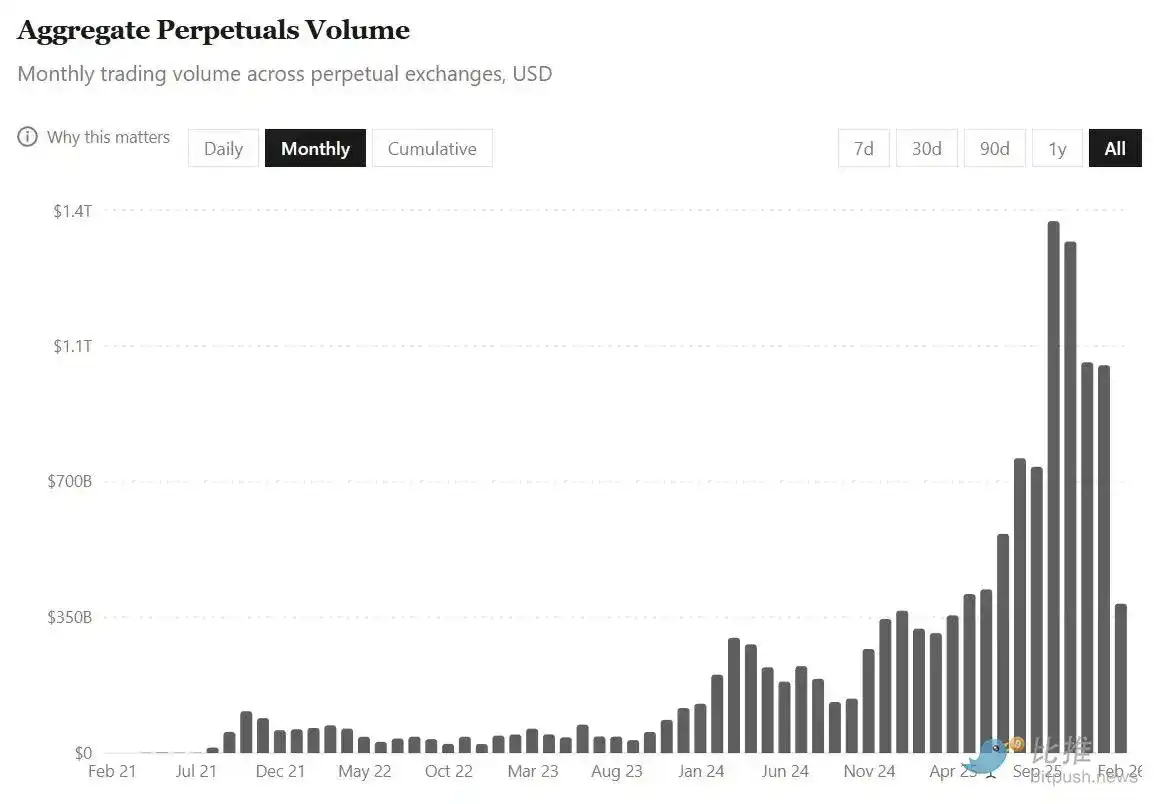
  • The cumulative total perpetual trading volume across all platforms over the four years ending July 31, 2025, was $6.91 trillion.
  • In just the past six months, this volume has doubled, reaching $14 trillion.
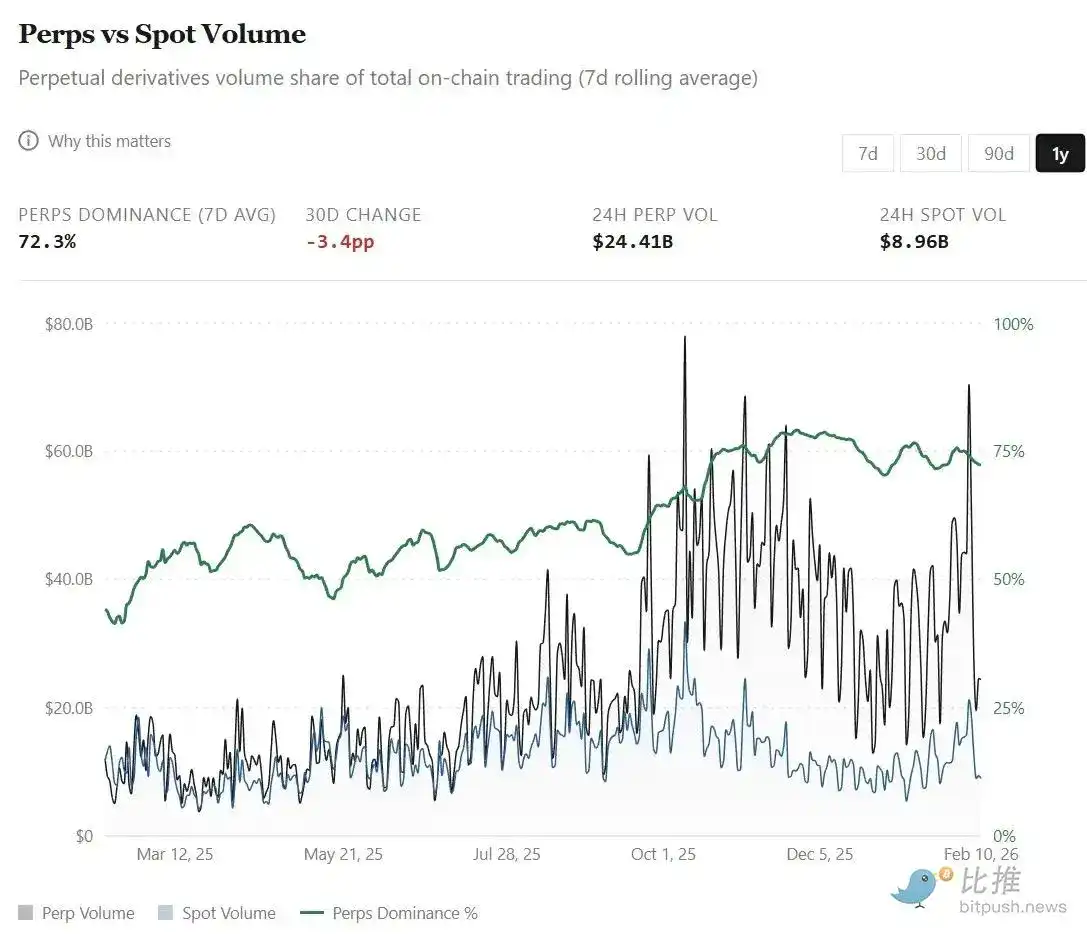
All this growth occurred against the backdrop of the total crypto market capitalization shrinking by nearly 40% between August 1, 2025, and February 9, 2026. This activity indicates that traders are increasingly leaning towards derivative trading, hedging, and short-term positioning, especially when spot markets become highly volatile and bearish.
But there's a catch. With such massive activity, it's easy to misread volume metrics. Especially because perpetual trading isn't just about buying and holding assets long-term; it involves repeatedly adjusting bet sizes using leverage over shorter timeframes.

Therefore, when market turnover accelerates rapidly, a question inevitably arises: Do record-breaking volumes reflect more capital inflow, or the same capital cycling faster?

This is where observing Open Interest (OI) becomes meaningful. If volume reflects capital flow, then OI measures outstanding risk exposure. On perpetual exchanges, OI refers to the total dollar value of active, unsettled long and short contracts held by traders.
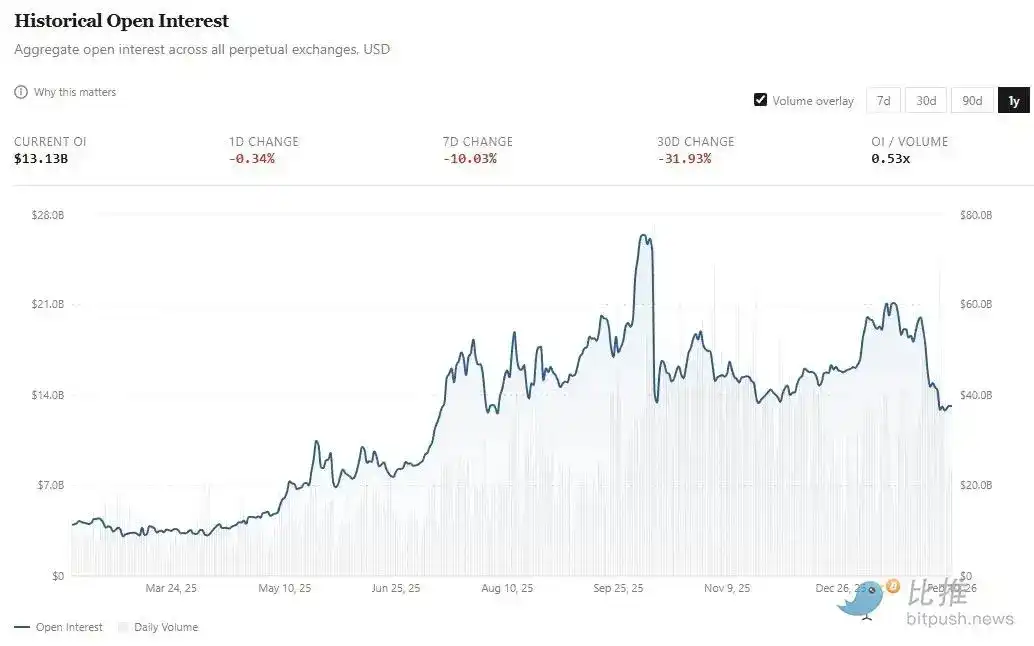
If perpetual trading is being adopted by the mass market, we would hope to see not just larger capital flows but also proportionally growing open interest.

  • Last February, OI averaged around $4 billion;
  • Now, that number has more than tripled to about $13 billion. In fact, the average for the entire January was about $18 billion before dropping roughly 30% in the first week of February.

While perpetual trading volume doubled in the past five months, OI grew by about 50% (from $13B to ~$18B, then back to $13B). To better understand this, I looked at the capital efficiency (the percentage of OI relative to daily volume) over the past year.
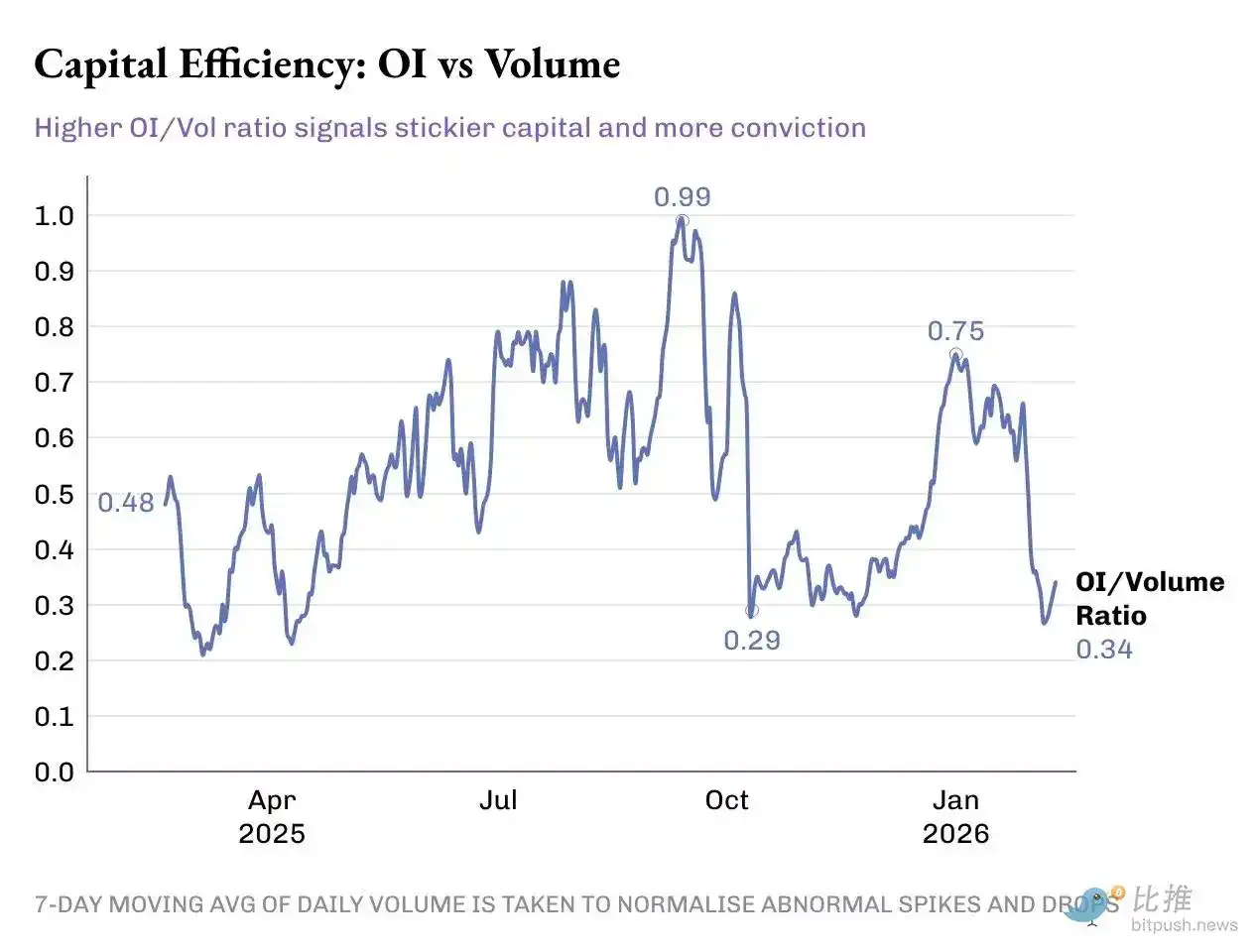
The OI/Volume ratio jumped 50% from last year's 0.33x to 0.49x today. But this progress wasn't smooth; the 50-basis-point increase in this ratio went through multiple peaks and troughs:

Phase 1 (Feb - May 2025): The Quiet Period. The OI/Volume ratio averaged ~0.46x, with average OI of ~$4.8B and average daily volume of ~$11.5B.

Phase 2 (June - Mid-Oct): The Leap. The ratio averaged ~0.72x. During this period, average OI rose to $14.8B, and average daily volume was $23B. This marked not only record-high volumes but also increased risk exposure and greater capital commitment to these derivatives.

Phase 3: Market Reversal. This phase began with the massive liquidation on October 10th, which wiped out over $19B in leveraged positions within 24 hours. From mid-October to late December, the OI/Volume ratio fell to ~0.38x, driven primarily by volume growth while open interest largely stagnated. October, November, and December saw the three highest monthly volumes of 2025, averaging over $1.2 trillion per month. During the same period, OI averaged around $15B, slightly below the previous three-month average.

Protocol Level

Here, I want to add more dimensions at the protocol level for perpetual markets. This helps us understand how efficiently perpetual exchanges convert trading activity into "sticky capital" and revenue.
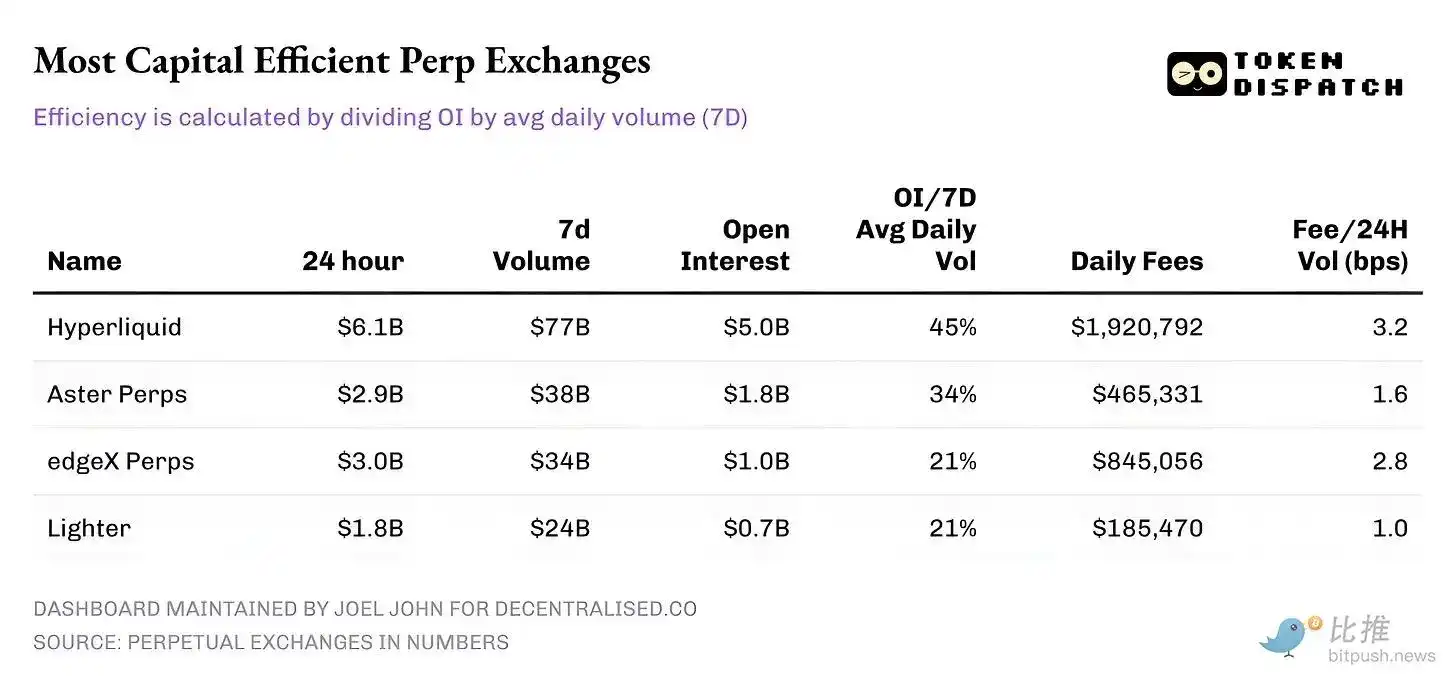
As of February 10th, here's how the top five perpetual exchanges by 24-hour volume performed:

Hyperliquid: Its ratio of OI to 7-day average daily volume is over 45%, able to convert a significant share of volume into lasting positions. This suggests that for every $10 traded on the platform, $4.50 is invested in active positions. This is important because a high OI ratio leads to tighter spreads, deeper liquidity, and confidence in scaling trades without slippage.

Hyperliquid's fee revenue reinforces this story. Its take rate is about 3.2 basis points, converting the largest share of 24-hour volume into fee income.

Aster: Currently ranked second, it maintains a decent capital efficiency (OI/Vol) of 34%, despite having almost half the volume of Hyperliquid. However, its monetization is noteworthy – with a lower take rate (~1.6 bps), Aster clearly prioritizes capital retention on its platform over fee maximization.
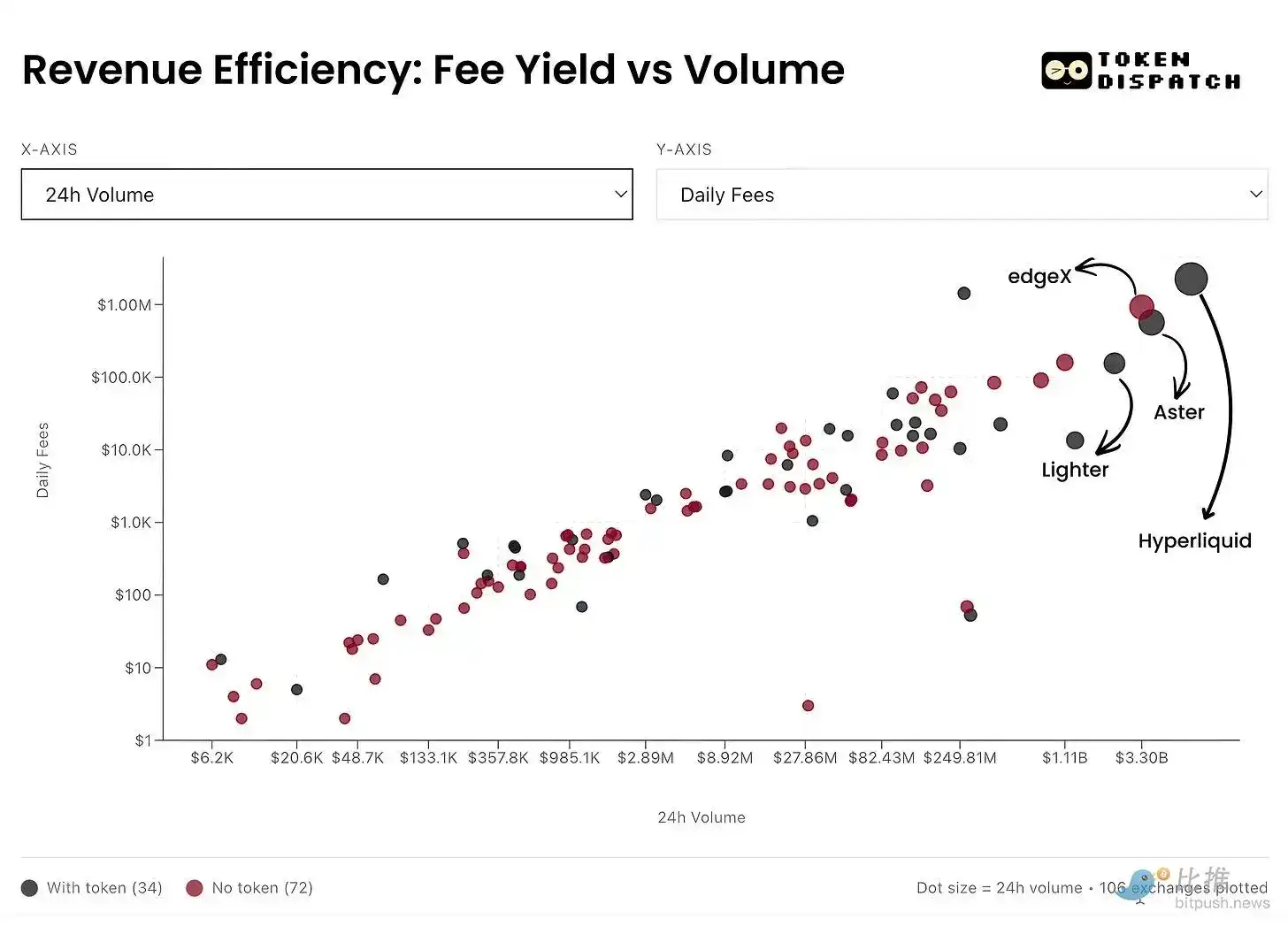
edgeX and Lighter: Both perform similarly on the capital efficiency ladder, with an OI/Vol of 21%. However, edgeX's fee monetization is comparable to Hyperliquid's at 2.8 bps.

Summary

Remarkably, the perpetual contract market today is no longer a simple growth story; it requires a nuanced reading of multiple metrics. At the macro level, volume is exploding: the growth in cumulative perpetual volume over six months exceeded the total of the previous four years. But the picture only becomes clear when OI is read alongside volume.

A clearer victory lies in the growth of the OI/Volume ratio. This is a direct signal that "patient capital" is willing to trust and bet on the variety of products and markets emerging in perpetual trading exchanges.

What's more worth watching in the future is how individual players evolve from here and what they choose to optimize. Over time, exchanges that can optimize "trading conviction" and achieve sustainable monetization will be far more important than those that merely rely on rewards and incentives to dominate volume leaderboards.


Preguntas relacionadas

QWhat are perpetual futures (Perps) and how do they differ from traditional futures contracts?

APerpetual futures (Perps) are a type of financial derivative contract that allows market participants to speculate on the price of an asset without an expiration date. They differ from traditional futures by offering instant access, leverage, no broker onboarding process, no jurisdictional paperwork, and they do not follow traditional market hours.

QAccording to the article, what key metric should be observed alongside trading volume to better understand the perpetual markets?

AThe key metric to observe alongside trading volume is Open Interest (OI). While trading volume reflects capital flow, OI measures the amount of outstanding risk exposure, representing the total dollar value of active, unsettled long and short contracts held by traders.

QWhat significant trend in the perpetual market's trading volume is highlighted for the period from February 2025 to February 2026?

AThe cumulative perpetual trading volume more than doubled in the last six months, reaching $14 trillion, which exceeded the total volume of the previous four years combined ($6.91 trillion), all while the total crypto market cap shrank by nearly 40%.

QWhich protocol, as of February 10th, had the highest capital efficiency (OI to 7-day average daily volume ratio) and what was its approximate ratio?

AAs of February 10th, Hyperliquid had the highest capital efficiency with an OI to 7-day average daily volume ratio of over 45%.

QWhat does the article suggest is a more important long-term focus for perpetual exchanges than just topping volume leaderboards?

AThe article suggests that a more important long-term focus for perpetual exchanges is optimizing for 'trading conviction' and achieving sustainable monetization, rather than just relying on rewards and incentives to top volume leaderboards.

Lecturas Relacionadas

Diálogo con Ray Dalio: Nos encontramos en una burbuja de IA actualmente, el 1% de mi cartera de inversiones está en Bitcoin

**Fuente: The Diary Of A CEO** **Resumen: Felix, PANews** Ray Dalio, fundador de Bridgewater Associates, advierte sobre una burbuja en la inteligencia artificial actual, comparable a burbujas históricas como la de Internet en 2000. Según Dalio, los signos clásicos están presentes: precios inflados, endeudamiento basado en ganancias especulativas y una posible corrección brusca si suben las tasas de interés o cambian las condiciones económicas. Dalio explica que esta burbuja se enmarca en un "gran ciclo" más amplio —de unos 80 años— caracterizado por tres dinámicas: creciente desigualdad interna, déficits fiscales gubernamentales y cambios en el orden geopolítico mundial. Estados Unidos y otros países occidentales se encuentran en una fase de declive relativo dentro de este ciclo. Para proteger la riqueza personal, Dalio recomienda diversificar las inversiones más allá del efectivo, incluyendo activos como oro, acciones y bonos. Aunque revela que alrededor del 1% de su cartera está en Bitcoin —considerándolo un activo escaso—, prefiere el oro físico por su seguridad histórica y su rol como reserva de los bancos centrales. Sobre el impacto laboral de la IA, Dalio prevé que aumentará la desigualdad, beneficiando sobre todo a los dueños de capital. Sin embargo, destaca que las habilidades humanas —como la intuición y la emoción— seguirán siendo valiosas y complementarias a la IA. En el ámbito geopolítico, Dalio anticipa un mundo más regionalizado, con EE.UU. y China como potencias líderes en sus respectivas esferas, y advierte que conflictos como el de Irán han expuesto debilidades estratégicas de Estados Unidos, acelerando un cambio en el equilibrio global de poder.

marsbitHace 2 hora(s)

Diálogo con Ray Dalio: Nos encontramos en una burbuja de IA actualmente, el 1% de mi cartera de inversiones está en Bitcoin

marsbitHace 2 hora(s)

¡Récord de compras netas extranjeras de 7,2 billones de wones en un solo día! Wall Street: Los vientos en contra de los flujos de capital en el mercado coreano se han disipado

La situación de los flujos de capital en el mercado de valores surcoreano está mostrando un cambio sustancial. El 31 de julio, la inversión extranjera realizó una compra neta récord de aproximadamente 7.2 billones de wones en acciones del KOSPI, marcando una reversión fundamental tras meses de importantes salidas de capital. Según análisis de Citi Research, las ventas netas mensuales de inversores extranjeros se redujeron drásticamente a 9.8 billones de wones en julio, comparado con 48.4 y 44.5 billones en junio y mayo, respectivamente. Paralelamente, los fondos de pensiones y fondos de inversión nacionales se convirtieron en compradores netos en julio (1.0 billón de wones), luego de ser vendedores netos en los dos meses anteriores. Además, la Comisión de Servicios Financieros de Corea implementó nuevas regulaciones que restringen el acceso de inversores minoristas a los ETF apalancados, lo que ha reducido significativamente su volumen de negociación y se espera que mitigue la volatilidad del mercado. Citi Research mantiene su objetivo para el KOSPI en 10,000 puntos, destacando fundamentos sólidos en el sector de chips de memoria, valoraciones históricamente bajas, una fuerte economía local y un entorno político favorable como factores de apoyo. La firma considera que los vientos en contra relacionados con los flujos de capital se están disipando, mientras que los impulsores fundamentales y políticos están ganando fuerza, creando condiciones para una mejora en el mercado.

marsbitHace 2 hora(s)

¡Récord de compras netas extranjeras de 7,2 billones de wones en un solo día! Wall Street: Los vientos en contra de los flujos de capital en el mercado coreano se han disipado

marsbitHace 2 hora(s)

Cómo Convertirse en Algo que la Inteligencia Artificial Jamás Podrá Reemplazar

**Resumen: Cómo ser irremplazable por la IA** Ante el temor de que la IA elimine trabajos, la solución no es resistirse, sino volverse "inempleable": un individuo autónomo que construya su propio proyecto vital y económico. El artículo critica la "esclavitud salarial"—depender de un empleo sin sentido—y propone escapar de ella desarrollando estas cinco capacidades clave: 1. **Agencia**: Capacidad de actuar sin pedir permiso. 2. **Gusto**: Criterio para discernir qué vale la pena crear. 3. **Persuasión**: Habilidad para conectar y lograr que otros valoren tu trabajo. 4. **Persistencia**: Resiliencia para ver los errores como aprendizaje. 5. **Iteración**: Proceso constante de ajuste basado en la retroalimentación. Estas habilidades se cultivan únicamente **haciendo**: creando algo propio. Se recomienda enfocarse en **crear contenido (medios)** más que solo en código, ya que el valor del contenido es subjetivo y requiere un criterio humano que la IA no puede replicar fácilmente, abriendo espacio para talentos auténticos. **Cómo empezar:** El cambio real requiere una transformación de identidad. Para ello: 1. Cambia radicalmente tu entorno (físico y digital). 2. Elige un "vehículo" (como crear contenido) que te dé retroalimentación real del mundo. 3. Dedica 15 minutos a responder preguntas introspectivas para encontrar tu "material en bruto" único y tu perspectiva contraria a la convencional. 4. **Publica tu primera idea mañana mismo.** La acción, el feedback y la iteración constante son el único camino. La conclusión es clara: en lugar de temer a la IA, conviértete en un creador que utilice todas las herramientas (incluida la IA) para construir una vida y un trabajo con significado, autonomía e impacto personal.

marsbitHace 5 hora(s)

Cómo Convertirse en Algo que la Inteligencia Artificial Jamás Podrá Reemplazar

marsbitHace 5 hora(s)

Los lanzamientos de dados mantienen las claves de Bitcoin en un modo aislado, pero no todo el mundo se molestará

El título sugiere que las claves de Bitcoin pueden almacenarse fuera de línea mediante lanzamientos de dados, aunque no todos los usuarios adoptarán este método. El artículo comienza explicando la entropía en la teoría de la información, utilizando ejemplos como monedas y dados. Tras un escándalo reciente con Coldcard, se popularizó la generación de semillas de billetera mediante dados. El texto explica que, aunque físicamente determinista, el lanzamiento es impredecible en la práctica, lo que lo hace útil para la seguridad. Se detalla cómo convertir los resultados en datos binarios, con métodos que van desde el simple "par/impar" hasta el uso de funciones hash para preservar más entropía. Para una frase de recuperación de 12 palabras (128 bits de entropía), se necesitan unos 50 lanzamientos; Coldcard recomienda 99 para mayor seguridad. La vulnerabilidad en Coldcard, relacionada con su generador de números aleatorios, puso en riesgo fondos. Las semillas generadas manualmente con dados no se vieron afectadas, pero el investigador Kevin Loaec señaló que otras funciones del dispositivo (como creación de billeteras de papel o claves de coproreseguridad) sí podían estar comprometidas, incluso si la semilla principal era segura. El artículo argumenta que, aunque técnicamente robusto, el proceso de lanzar dados es lento, propenso a errores y poco práctico para la mayoría, especialmente para nuevos usuarios. Concluye que, aunque debe ser una opción para expertos, el objetivo a largo plazo es que el hardware y software generen aleatoriedad fuerte de forma fiable y accesible. Se aconseja a los usuarios de Coldcard verificar su firmware y las funciones utilizadas, y se destaca la utilidad de las billeteras multisig con dispositivos de diferentes fabricantes para mitigar riesgos.

cryptonews.ruHace 8 hora(s)

Los lanzamientos de dados mantienen las claves de Bitcoin en un modo aislado, pero no todo el mundo se molestará

cryptonews.ruHace 8 hora(s)

Trading

Spot
活动图片




