Middle East Conflict Rekindles Rate Hike Expectations, Gold Suffers Worst Sell-off in 43 Years

marsbitPublicado a 2026-03-23Actualizado a 2026-03-23

Resumen

Gold suffered its worst weekly decline in 43 years, with spot prices falling for eight consecutive sessions—the longest losing streak since October 2023. Silver also plunged over 15%, while platinum and palladium followed lower. The sell-off was triggered by escalating Middle East conflicts, which drove up oil prices and reinforced expectations of Federal Reserve rate hikes rather than cuts. Market bets on a Fed hike by October rose to 50%, reducing the appeal of non-yielding gold amid higher real rate prospects. Technical indicators worsened, with RSI falling below 30, triggering stop-losses and self-reinforcing selling. Gold ETFs saw outflows for three straight weeks, losing over 60 tons. The situation echoes the 1983 crash when OPEC nations sold gold reserves to raise cash amid an oil price collapse. Despite a 4% year-to-date gain, macro conditions have deteriorated. Rising energy prices may reduce global GDP by 0.3% and lift inflation by 0.5-0.6%, increasing stagflation risks. Gold’s future trajectory hinges on real rates and geopolitical developments—further rate hike expectations could sustain pressure, while any de-escalation may revive safe-haven demand.

Gold recorded its worst weekly decline in 43 years this week, with historical echoes sending chills through the market.

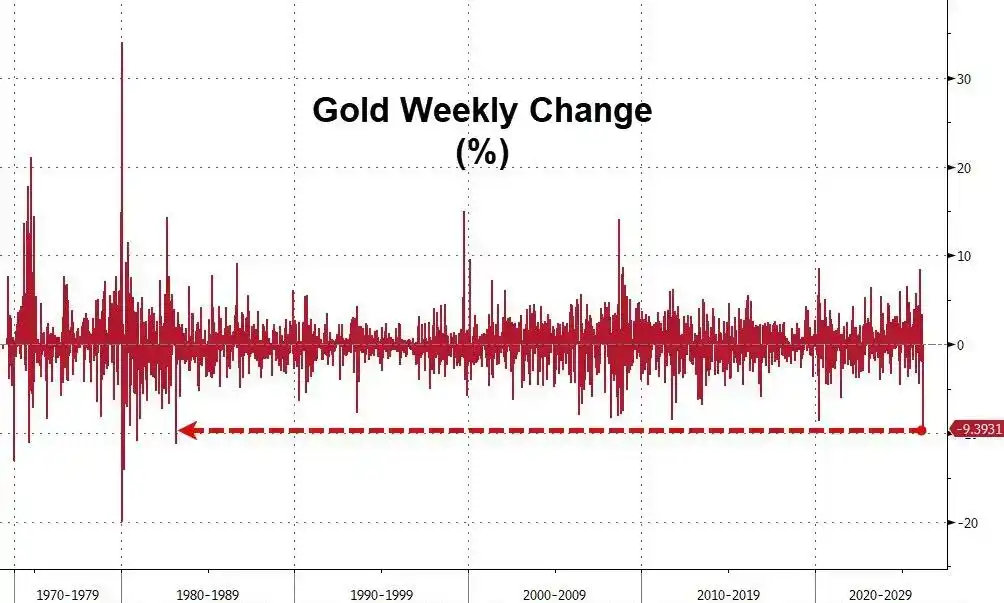
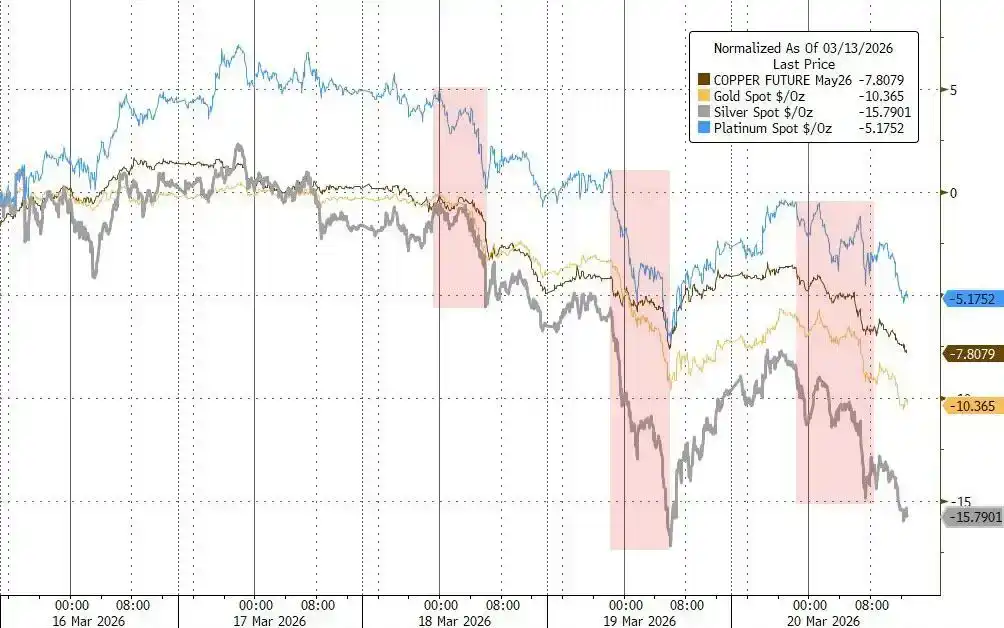
This week, gold posted its largest weekly drop since March 1983, with the spot price falling for eight consecutive days, marking the longest losing streak since October 2023. Meanwhile, silver fell more than 15% this week, with palladium and platinum also moving lower.
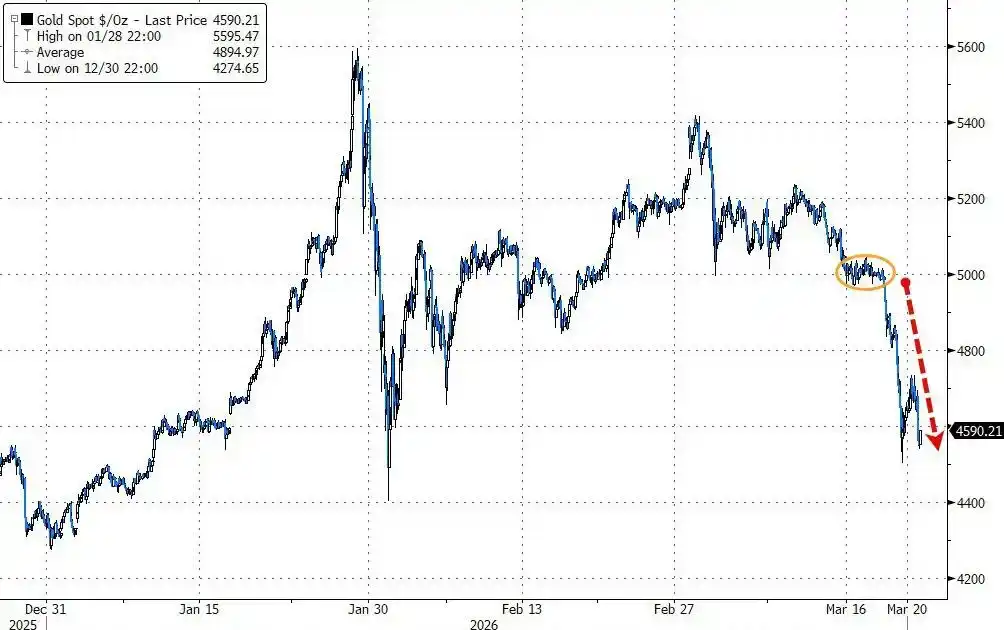
The trigger for this sharp decline was the escalating Middle East conflict, which pushed up energy prices and, in turn, suppressed expectations for interest rate cuts. Market bets on a Federal Reserve rate hike have risen to 50%, fueling this wave of selling in precious metals.

More alarmingly for the market, the current situation bears a striking resemblance to the historic crash in March 1983, which was triggered by massive gold sales by Middle Eastern oil producers—back then, OPEC members, facing plummeting oil revenues, were forced to sell their gold reserves for cash, causing the gold price to plunge over a hundred dollars in a matter of days.

It is worth noting that, according to historical data, this week's decline in gold is the most severe since that "sell-gold-for-cash" storm 43 years ago.
Rate Cut Expectations Unravel, Gold's Safe-Haven Logic Fails

Since the US and Israel launched attacks on Iran last month, gold has been declining for several weeks, a stark contrast to its traditional role as a "safe-haven asset."

The reason is that the war brings not expectations of easing but inflationary pressures. Currently, the market's prediction of the Fed's policy path has undergone a fundamental reversal.

Traders are now pricing in a 50% probability of a Fed rate hike by October. Soaring energy prices are boosting inflation expectations, and gold, as a non-yielding asset, becomes significantly less attractive in an environment of rising real interest rates.

At the same time, there are signs of tightening US dollar liquidity. Cross-currency basis swaps began to widen noticeably this week, indicating a degree of dollar funding pressure.

This phenomenon may explain the deeper logic behind the gold sell-off—when dollar liquidity tightens, gold is often one of the first assets investors liquidate.

It is noteworthy that the most severe declines in the metals market this week were concentrated during Asian and European trading hours, consistent with the pattern of dollar shortage pressures first appearing in offshore markets.
Technical Stop-Losses Triggered, Selling Becomes Self-Reinforcing

Amid the sustained decline, gold's technical indicators have deteriorated significantly, with the 14-day Relative Strength Index (RSI) falling below 30, entering a zone some traders consider oversold.

Rhona O'Connell, an analyst at StoneX Financial, pointed out that this gold correction is the result of profit-taking and liquidity liquidation. She stated that the price above $5,200 had attracted substantial buying, making the market积累相当的回调脆弱性 (accumulated considerable vulnerability to a correction).

Once prices started to fall, a large number of investors' stop-loss orders were automatically triggered, rapidly forming a self-reinforcing spiral of selling. Technical signals like moving averages further exacerbated the downward pressure.

Meanwhile, passive selling triggered by falling stock markets also spilled over into gold.

O'Connell noted that forced liquidations related to equity assets may have dragged down gold prices, while slowing central bank gold purchases and continued outflows from gold ETFs further dampened market sentiment. According to Bloomberg data, gold ETFs have seen net outflows for three consecutive weeks, with combined holdings dropping by more than 60 tonnes over those three weeks.

The Ghost of the 1983 Middle East "Sell-Gold-for-Cash"

The current situation reminds market participants of the oil crisis-induced gold crash 43 years ago.

Historical data shows that around February 21, 1983, British and Norwegian oil producers led price cuts, putting pressure on OPEC to follow suit, abruptly intensifying the global oil market's oversupply. Facing a sharp contraction in oil revenues, Middle Eastern oil producers (mainly OPEC members) were forced to sell their gold reserves on a large scale to raise cash, triggering a gold price crash.

Reporting from The New York Times at the time corroborates this. According to a March 1, 1983, New York Times report, traders explicitly stated that sales by Middle Eastern oil producers were the direct trigger for the gold price plunge and warned that if oil revenues fell further, these Arab countries might sell more gold. At that time, the gold price plunged more than $105 from its high in less than a week, with the largest single-day drop reaching $42.50, the worst in nearly three years.
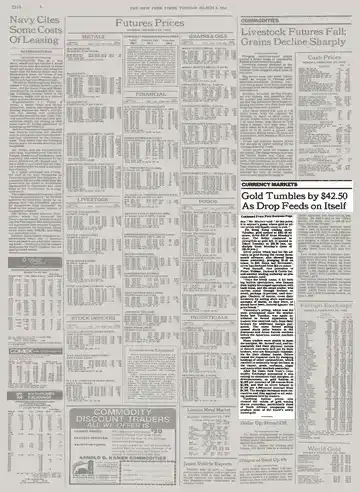
According to the New York Times report at the time, the proceeds from the Middle Eastern sales immediately flowed into Eurodollars and other short-term investment vehicles, causing short-term interest rates to soften, which in turn sent a warning signal to the global gold market. Since February 21 coincided with the US Presidents' Day holiday, with New York markets closed, the full impact wasn't felt until the following week, subsequently triggering chain-reaction forced liquidations that also affected commodity markets like copper, grains, soybeans, and sugar.

ZeroHedge pointed out that the 1983 gold crash marked the entry of the oil market into a bear market cycle that lasted for years—OPEC discipline frayed, market share was continuously lost, and oil prices remained under pressure throughout the 1980s.

Stagflation Clouds Loom, Can Gold Prices Stabilize?

Despite this week's heavy losses, gold is still up about 4% year-to-date. The price hit a record high of nearly $5,600 per ounce in late January, supported then by investor enthusiasm, central bank buying sprees, and market concerns about Trump interfering with Fed independence.

However, the current macroeconomic environment has significantly deteriorated. According to a Bloomberg report, Goldman Sachs economist Joseph Briggs expects that rising energy prices will drag global GDP down by 0.3 percentage points over the next year and push overall inflation up by 0.5 to 0.6 percentage points. Rising stagflation risks are severely compressing central banks' policy space.

Goldman Sachs analyst Chris Hussey noted that the blockade of the Strait of Hormuz has entered its fourth week, and hopes for a quick resolution of the conflict are fading. If the conflict continues, the longer oil prices remain high, the harder it becomes for the "look-through the short-term pain" narrative in stock and bond markets to hold, and the vulnerability of global assets will be further exposed.

For gold, the path of real interest rates will be a key variable. If the conflict drags on, inflation expectations continue to heat up, and the Fed's rate hike path becomes clearer, pressure on gold may persist; whereas, once signals of a easing in geopolitical tensions emerge, whether suppressed safe-haven demand can be released again remains the market's biggest悬念 (suspense).


Preguntas relacionadas

QWhat was the sharpest weekly decline in gold prices since 1983 triggered by?

AThe sharpest weekly decline in gold prices since 1983 was triggered by escalating Middle East conflicts, which raised energy prices and suppressed expectations for interest rate cuts, leading to increased bets on Federal Reserve rate hikes.

QHow does the current gold market situation parallel the historical event of 1983?

AThe current situation parallels the 1983 event where OPEC members, facing a sharp drop in oil revenue, were forced to sell off their gold reserves to raise cash, causing a historic crash in gold prices.

QWhy did the traditional 'safe-haven' logic for gold fail during the recent Middle East tensions?

AThe traditional safe-haven logic failed because the war brought inflationary pressure instead of expectations for monetary easing. Rising energy prices increased inflation expectations, making gold, a non-yielding asset, less attractive as real rates rose.

QWhat technical indicator signaled that gold had entered oversold territory during the sell-off?

AThe 14-day Relative Strength Index (RSI) fell below 30, which is a level some traders consider to indicate an oversold market.

QAccording to Goldman Sachs analysis, what is the expected economic impact of rising energy prices?

AGoldman Sachs economists estimated that rising energy prices would reduce global GDP by 0.3 percentage points over the next year and raise overall inflation by 0.5 to 0.6 percentage points, increasing stagflation risks.

Lecturas Relacionadas

Diálogo con Ray Dalio: Nos encontramos en una burbuja de IA actualmente, el 1% de mi cartera de inversiones está en Bitcoin

**Fuente: The Diary Of A CEO** **Resumen: Felix, PANews** Ray Dalio, fundador de Bridgewater Associates, advierte sobre una burbuja en la inteligencia artificial actual, comparable a burbujas históricas como la de Internet en 2000. Según Dalio, los signos clásicos están presentes: precios inflados, endeudamiento basado en ganancias especulativas y una posible corrección brusca si suben las tasas de interés o cambian las condiciones económicas. Dalio explica que esta burbuja se enmarca en un "gran ciclo" más amplio —de unos 80 años— caracterizado por tres dinámicas: creciente desigualdad interna, déficits fiscales gubernamentales y cambios en el orden geopolítico mundial. Estados Unidos y otros países occidentales se encuentran en una fase de declive relativo dentro de este ciclo. Para proteger la riqueza personal, Dalio recomienda diversificar las inversiones más allá del efectivo, incluyendo activos como oro, acciones y bonos. Aunque revela que alrededor del 1% de su cartera está en Bitcoin —considerándolo un activo escaso—, prefiere el oro físico por su seguridad histórica y su rol como reserva de los bancos centrales. Sobre el impacto laboral de la IA, Dalio prevé que aumentará la desigualdad, beneficiando sobre todo a los dueños de capital. Sin embargo, destaca que las habilidades humanas —como la intuición y la emoción— seguirán siendo valiosas y complementarias a la IA. En el ámbito geopolítico, Dalio anticipa un mundo más regionalizado, con EE.UU. y China como potencias líderes en sus respectivas esferas, y advierte que conflictos como el de Irán han expuesto debilidades estratégicas de Estados Unidos, acelerando un cambio en el equilibrio global de poder.

marsbitHace 3 hora(s)

Diálogo con Ray Dalio: Nos encontramos en una burbuja de IA actualmente, el 1% de mi cartera de inversiones está en Bitcoin

marsbitHace 3 hora(s)

¡Récord de compras netas extranjeras de 7,2 billones de wones en un solo día! Wall Street: Los vientos en contra de los flujos de capital en el mercado coreano se han disipado

La situación de los flujos de capital en el mercado de valores surcoreano está mostrando un cambio sustancial. El 31 de julio, la inversión extranjera realizó una compra neta récord de aproximadamente 7.2 billones de wones en acciones del KOSPI, marcando una reversión fundamental tras meses de importantes salidas de capital. Según análisis de Citi Research, las ventas netas mensuales de inversores extranjeros se redujeron drásticamente a 9.8 billones de wones en julio, comparado con 48.4 y 44.5 billones en junio y mayo, respectivamente. Paralelamente, los fondos de pensiones y fondos de inversión nacionales se convirtieron en compradores netos en julio (1.0 billón de wones), luego de ser vendedores netos en los dos meses anteriores. Además, la Comisión de Servicios Financieros de Corea implementó nuevas regulaciones que restringen el acceso de inversores minoristas a los ETF apalancados, lo que ha reducido significativamente su volumen de negociación y se espera que mitigue la volatilidad del mercado. Citi Research mantiene su objetivo para el KOSPI en 10,000 puntos, destacando fundamentos sólidos en el sector de chips de memoria, valoraciones históricamente bajas, una fuerte economía local y un entorno político favorable como factores de apoyo. La firma considera que los vientos en contra relacionados con los flujos de capital se están disipando, mientras que los impulsores fundamentales y políticos están ganando fuerza, creando condiciones para una mejora en el mercado.

marsbitHace 3 hora(s)

¡Récord de compras netas extranjeras de 7,2 billones de wones en un solo día! Wall Street: Los vientos en contra de los flujos de capital en el mercado coreano se han disipado

marsbitHace 3 hora(s)

Cómo Convertirse en Algo que la Inteligencia Artificial Jamás Podrá Reemplazar

**Resumen: Cómo ser irremplazable por la IA** Ante el temor de que la IA elimine trabajos, la solución no es resistirse, sino volverse "inempleable": un individuo autónomo que construya su propio proyecto vital y económico. El artículo critica la "esclavitud salarial"—depender de un empleo sin sentido—y propone escapar de ella desarrollando estas cinco capacidades clave: 1. **Agencia**: Capacidad de actuar sin pedir permiso. 2. **Gusto**: Criterio para discernir qué vale la pena crear. 3. **Persuasión**: Habilidad para conectar y lograr que otros valoren tu trabajo. 4. **Persistencia**: Resiliencia para ver los errores como aprendizaje. 5. **Iteración**: Proceso constante de ajuste basado en la retroalimentación. Estas habilidades se cultivan únicamente **haciendo**: creando algo propio. Se recomienda enfocarse en **crear contenido (medios)** más que solo en código, ya que el valor del contenido es subjetivo y requiere un criterio humano que la IA no puede replicar fácilmente, abriendo espacio para talentos auténticos. **Cómo empezar:** El cambio real requiere una transformación de identidad. Para ello: 1. Cambia radicalmente tu entorno (físico y digital). 2. Elige un "vehículo" (como crear contenido) que te dé retroalimentación real del mundo. 3. Dedica 15 minutos a responder preguntas introspectivas para encontrar tu "material en bruto" único y tu perspectiva contraria a la convencional. 4. **Publica tu primera idea mañana mismo.** La acción, el feedback y la iteración constante son el único camino. La conclusión es clara: en lugar de temer a la IA, conviértete en un creador que utilice todas las herramientas (incluida la IA) para construir una vida y un trabajo con significado, autonomía e impacto personal.

marsbitHace 5 hora(s)

Cómo Convertirse en Algo que la Inteligencia Artificial Jamás Podrá Reemplazar

marsbitHace 5 hora(s)

Los lanzamientos de dados mantienen las claves de Bitcoin en un modo aislado, pero no todo el mundo se molestará

El título sugiere que las claves de Bitcoin pueden almacenarse fuera de línea mediante lanzamientos de dados, aunque no todos los usuarios adoptarán este método. El artículo comienza explicando la entropía en la teoría de la información, utilizando ejemplos como monedas y dados. Tras un escándalo reciente con Coldcard, se popularizó la generación de semillas de billetera mediante dados. El texto explica que, aunque físicamente determinista, el lanzamiento es impredecible en la práctica, lo que lo hace útil para la seguridad. Se detalla cómo convertir los resultados en datos binarios, con métodos que van desde el simple "par/impar" hasta el uso de funciones hash para preservar más entropía. Para una frase de recuperación de 12 palabras (128 bits de entropía), se necesitan unos 50 lanzamientos; Coldcard recomienda 99 para mayor seguridad. La vulnerabilidad en Coldcard, relacionada con su generador de números aleatorios, puso en riesgo fondos. Las semillas generadas manualmente con dados no se vieron afectadas, pero el investigador Kevin Loaec señaló que otras funciones del dispositivo (como creación de billeteras de papel o claves de coproreseguridad) sí podían estar comprometidas, incluso si la semilla principal era segura. El artículo argumenta que, aunque técnicamente robusto, el proceso de lanzar dados es lento, propenso a errores y poco práctico para la mayoría, especialmente para nuevos usuarios. Concluye que, aunque debe ser una opción para expertos, el objetivo a largo plazo es que el hardware y software generen aleatoriedad fuerte de forma fiable y accesible. Se aconseja a los usuarios de Coldcard verificar su firmware y las funciones utilizadas, y se destaca la utilidad de las billeteras multisig con dispositivos de diferentes fabricantes para mitigar riesgos.

cryptonews.ruHace 8 hora(s)

Los lanzamientos de dados mantienen las claves de Bitcoin en un modo aislado, pero no todo el mundo se molestará

cryptonews.ruHace 8 hora(s)

Trading

Spot
活动图片




