Hyperliquid Rally Stalls Near $30, Will HYPE Slide Further or Recover Toward $35?

bitcoinistPublicado a 2026-02-19Actualizado a 2026-02-19

Resumen

Hyperliquid's (HYPE) rally has stalled after failing to hold a breakout above $31, pulling back to a key support zone between $28 and $30. The token is now in a consolidation phase, with the $27.50–$28.50 region being critical support. A hold above this level could pave the way for a retest of $32.28 or even $35. However, a breakdown may lead to further declines toward $25–$26. Bearish signals are emerging, including a bearish MACD crossover and a more than 50% drop in weekly protocol revenue. Despite this, traders are watching for a potential bounce from support or a breakdown, which could determine the next directional move. Market sentiment remains cautious as volume declines, with price action near current levels seen as a decision zone.

Momentum around Hyperliquid cooled quickly this week after HYPE failed to hold a breakout above $31, sending the token back to a familiar battleground between buyers and sellers. With price hovering near key support, traders are now watching closely for signals that could define the next directional move.

Related Reading: Crypto Lobby Group Sounds Alarm Over Senate’s Crypto Bill Threat

The recent pullback reflects a broader consolidation trend that has defined price action for months, as shifting market sentiment, weakening technical momentum, and cooling network activity reshape short-term expectations.

Data tracked across major market platforms shows HYPE fluctuating within a well-established range, roughly $28 to $30. While the structure has offered predictable trading levels, repeated rejection near resistance suggests buyers are becoming cautious after recent gains.
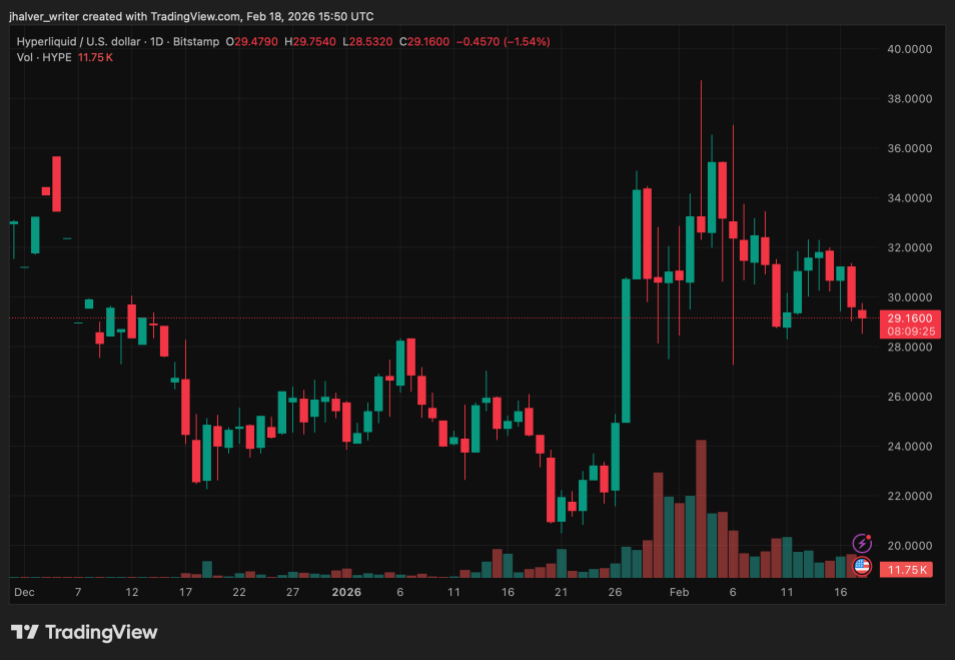
HYPE's price trends to the downside on the daily chart. Source: HYPEUSD on Tradingview

Range Trading Defines the Current Market

Hyperliquid (HYPE) briefly moved above $31 earlier this week before retracing, supporting resistance between $32 and $35. Analysts note that the $27.50–$28.50 region remains the most important support area, where buyers have consistently stepped in during recent volatility.

Holding above roughly $28.98 is viewed as critical for maintaining bullish continuation. A successful defense could allow a renewed attempt toward $32.28 and potentially $35 if momentum returns.

However, failure to hold this zone may expose the token to deeper downside, with projections pointing toward $25–$26 as the next support band. The consolidation comes after the token declined nearly 25% from its yearly high near $37.8, reflecting broader crypto market weakness and reduced risk appetite across digital assets.

Bearish Signals Emerge as Hyperliquid’s Activity Slows

Technical indicators are sending mixed signals. A bearish MACD crossover and weakening momentum readings suggest selling pressure has increased, while neutral RSI levels indicate the market has not yet reached oversold conditions.

Fundamentals have also softened. Weekly protocol revenue recently dropped more than 50%, alongside a decline in total value locked. Lower activity reduces the platform’s capacity to fund token buybacks, easing deflationary pressure that previously supported price recovery.

Despite this, market participants continue to monitor institutional developments around Hyperliquid, including expanding liquidity access through integrations and growing participation from larger traders.

Can HYPE Reclaim Momentum?

Short-term direction now depends largely on whether support near $28 holds. A bounce from this region could trigger renewed buying interest and reopen the path toward $34–$35. Conversely, a confirmed breakdown may accelerate losses if broader crypto market conditions remain weak.

Related Reading: Bitcoin ‘Ghost Whale’ Emerges: New Hong Kong Filer Tops Q4 IBIT Buys

Declining volume and cautious sentiment suggest traders are waiting for clearer confirmation. Price action near current levels is increasingly viewed as a decision zone, one that may determine whether HYPE resumes its upward trend or enters a deeper corrective phase.

Cover image from ChatGPT, HYPEUSD chart on Tradingview

Preguntas relacionadas

QWhat is the critical support level for Hyperliquid (HYPE) to maintain bullish continuation, according to the article?

AHolding above roughly $28.98 is viewed as critical for maintaining bullish continuation.

QWhat are the two potential price targets mentioned for HYPE if it successfully defends its key support and momentum returns?

AA renewed attempt toward $32.28 and potentially $35.

QWhat fundamental metrics have recently softened for the Hyperliquid protocol, contributing to the bearish pressure?

AWeekly protocol revenue recently dropped more than 50%, alongside a decline in total value locked.

QWhat technical indicator is mentioned as having a bearish crossover, suggesting increased selling pressure?

AA bearish MACD crossover.

QWhat broader market condition is cited as a factor in HYPE's decline from its yearly high?

ABroader crypto market weakness and reduced risk appetite across digital assets.

Lecturas Relacionadas

¿Por qué vendió Strategy 32 Bitcoins? El CEO revela la verdadera razón

El CEO de Strategy, Phong Le, explicó que la venta de 32 Bitcoin por parte de la empresa no se debió a necesidades de liquidez, sino a un esfuerzo deliberado para mostrar al mercado que la firma puede vender BTC cuando sea necesario y para probar su proceso interno de ejecución. Estas declaraciones se produjeron después de que Strategy comprara más de 1.500 BTC aproximadamente una semana después de esa pequeña venta, su primera enajenación desde 2022. En una entrevista con CNBC, Le rechazó la idea de que la venta marcara un cambio en su estrategia de acumulación a largo plazo. Subrayó que la empresa sigue siendo un comprador neto de Bitcoin, como lo demuestra la adquisición de unos 1.500 BTC en el último mes. Le detalló las dos razones principales para la venta: "inocular" al mercado haciéndole ver que están dispuestos a vender si es necesario, y realizar una prueba operativa de sus sistemas, ya que vender es operativamente más complejo que comprar. También aclaró que la venta no fue para financiar dividendos, ya que pueden cubrirlos con otras actividades. Reconoció que la transacción causó frustración entre algunos inversores minoristas que adhieren a una postura de "nunca vender", pero argumentó que Strategy debe responder a un conjunto más amplio de partes interesadas, incluidos accionistas comunes, preferentes y tenedores de deuda. Concluyó que los accionistas institucionales no se mostraron perturbados por la venta, y que la compañía, como el mayor tenedor y comprador mundial de Bitcoin, mantiene su compromiso con el activo.

bitcoinistHace 3 hora(s)

¿Por qué vendió Strategy 32 Bitcoins? El CEO revela la verdadera razón

bitcoinistHace 3 hora(s)

¿Cuánto tiempo puede sostenerlo el último gran comprador de Ethereum?

A medida que el mercado de criptomonedas continúa cayendo, Bitmine se mantiene como el comprador marginal más constante y agresivo de ETH, a pesar de sufrir pérdidas no realizadas de más de 10.000 millones de dólares. La empresa planea alcanzar su objetivo de poseer el 5% del suministro total de ETH para fines de 2026, faltando menos de 400.000 ETH. Para financiar sus compras, Bitmine emitió acciones preferentes perpetuas con un dividendo del 9,5%. Su ventaja clave sobre competidores como Strategy es el ingreso por staking de ETH, que actualmente genera entre 230 y 296 millones de dólares anuales, suficiente para cubrir los dividendos de la emisión inicial. Sin embargo, si la emisión de acciones preferentes se expande, este rendimiento del ~3-4% del staking no podrá cubrir el dividendo del 9,5%, dependiendo entonces del aumento del precio del ETH. El análisis plantea tres escenarios: pesimista (caída a 1.000 USD si se detienen las compras), base (consolidación entre 1.500-2.000 USD) y optimista (recuperación impulsada por inclusión en índices y adopción institucional, con precio objetivo a largo plazo de 40.000 USD para 2030 según Standard Chartered). La pregunta central es quién sostendrá el precio del ETH una vez que Bitmine complete su objetivo del 5% y reduzca sus compras, dado el flujo saliente de los ETF y la retirada de algunas instituciones, mientras que la demanda incremental de stablecoins y RWA es aún un factor a largo plazo.

marsbitHace 7 hora(s)

¿Cuánto tiempo puede sostenerlo el último gran comprador de Ethereum?

marsbitHace 7 hora(s)

Trading

Spot
Futuros
活动图片





