High-Frequency Trading, $100K Annual Income: The Most 'Boring' Profit Myth on Polymarket

marsbitPublicado a 2026-02-11Actualizado a 2026-02-11

Resumen

A user known as planktonXD (0x4ffe49ba2a4cae123536a8af4fda48faeb609f71) has generated over $106,000 in profit on Polymarket within a year by executing more than 61,000 predictions—averaging around 170 trades per day. This high-frequency, automated strategy focuses on exploiting small, certain opportunities rather than betting on high-risk, high-reward outcomes. The approach is characterized by market-making and micro-arbitrage: placing orders on both sides of the order book to capture spreads or profiting from mispriced options in low-liquidity markets. The largest single win was only $2,527, illustrating a disciplined, risk-managed method that avoids large drawdowns. The bot operates across diverse categories—sports, weather, crypto prices, politics—constantly scanning for pricing inefficiencies. Notable examples include buying heavily undervalued options in niche markets, such as esports matches or extreme crypto price movements, where probability is mispriced due to emotional trading or thin order books. For instance, a $16 bet on SOL falling to $130 (priced at 0.7¢, implying <1% chance) returned $1,574 during a volatile period. Key takeaways: The strategy highlights the power of compounding small gains, the necessity of automation and API tools, and the superiority of high-probability opportunities over high-risk bets. In prediction markets, the most advanced approach isn’t forecasting—it’s managing probability and liquidity.

Original Author: Ma He, Foresight News

Another miracle has emerged on Polymarket.

Through extensive monitoring and frenzied betting, an address has netted $100,000 in just one year by compounding small profits.

The address we are reviewing, planktonXD (0x4ffe49ba2a4cae123536a8af4fda48faeb609f71), is an extremely typical high-frequency quantitative trader. From February 2025 to the present, in just one year, it has generated a net profit of $106,000 through over 61,000 predictions.
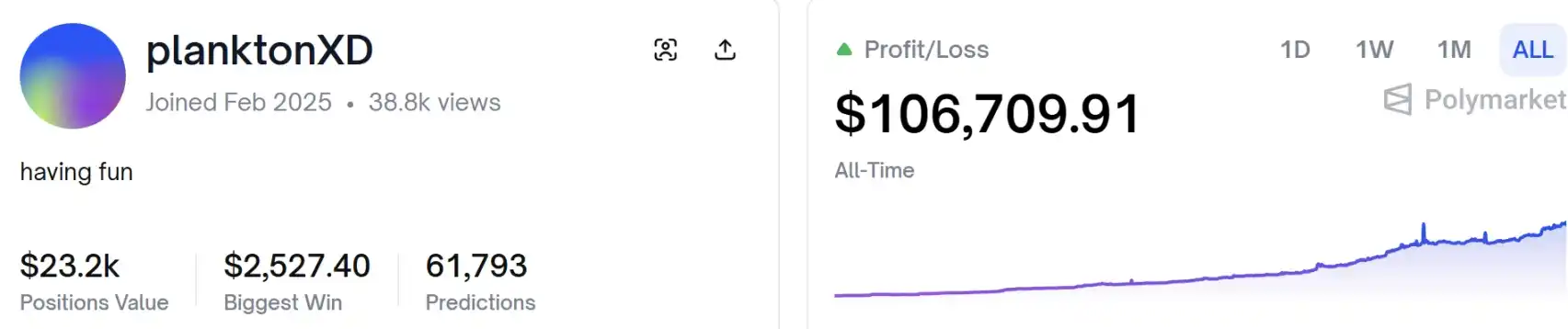
In prediction markets, most people are gambling on "black swans" or chasing big news, but planktonXD takes a completely different path: extreme certainty and terrifying execution frequency.

Looking at planktonXD's historical trading data, the most astonishing aspect is its 61,000 predictions. From February 2025 to February 2026, it averages about 170 transactions per day.

This frequency far exceeds the limits of manual human operation, confirming that this player uses an automated trading script (Bot). It is not "predicting" outcomes but "harvesting" price differences.

A very interesting phenomenon is that planktonXD's "Biggest Win" is only $2,527.4. Compared to its total profit of $100,000, this single largest gain appears very "small" (only about 2% of the total profit).

Some retail players always hope to make a big score, betting all their chips on a confident judgment.

Winning is good, of course, but losing makes it hard to get back to the table.

Even if every ALL-IN could win, just one loss would mean a big defeat.

Reviewing its trading history, it never goes all-in on a single extreme event, nor does it bet on high odds. Its profit curve shows a perfect 45-degree smooth rise with almost no significant drawdowns. This indicates it employs a market-making strategy: placing orders on both sides of the order book to earn the bid-ask spread, or performing micro-arbitrage using price fluctuations between different markets.
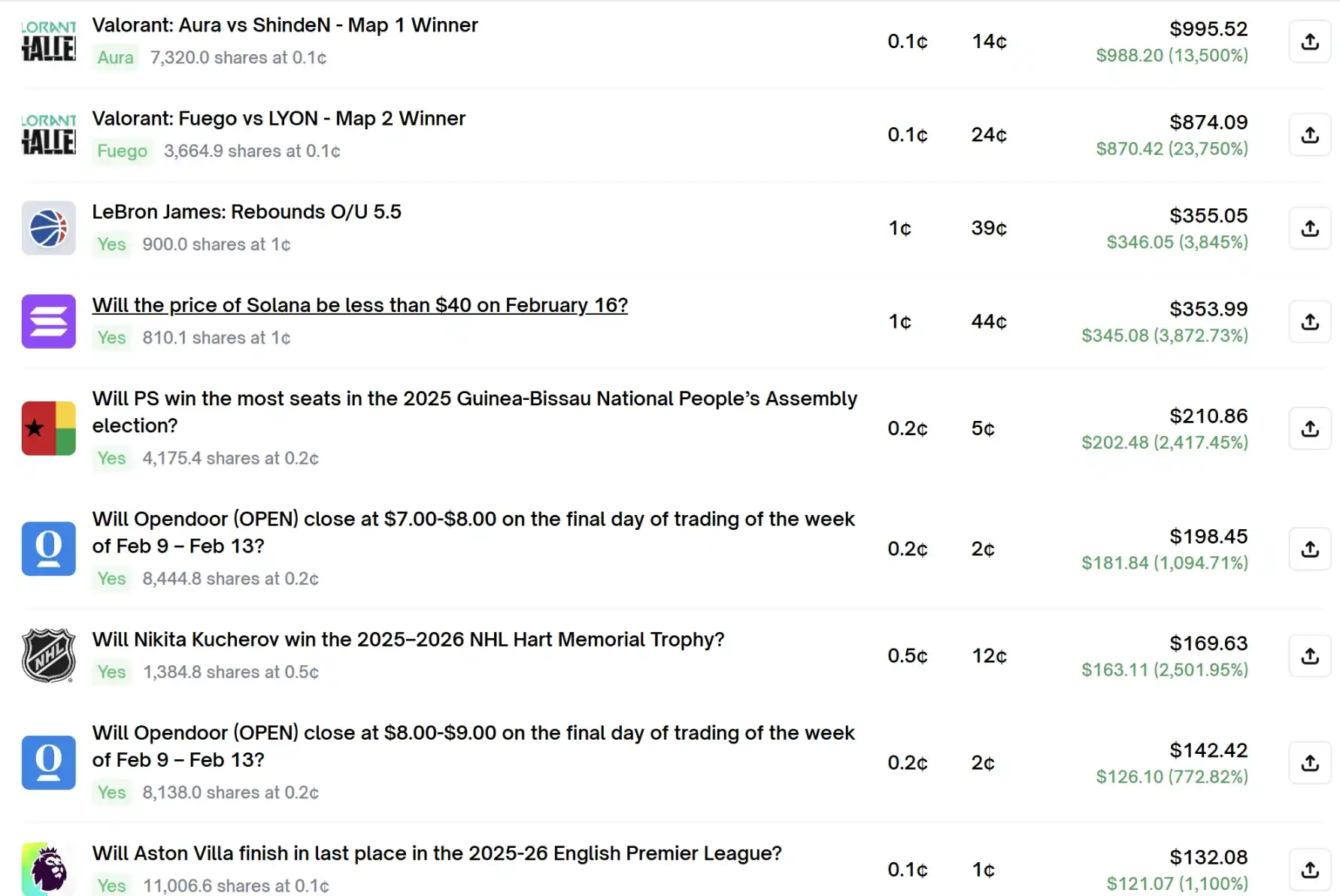
It does not always hold positions long-term (Buy and Hold) but frequently enters and exits the market. This "light position, fast turnover" approach greatly reduces single-point risk. Even if an unexpected event occurs in a prediction market (like a sudden election result change), its impact on the total capital pool is minimal.

This quantitative robot does not specialize in trading vertical sectors like weather but places bets across multiple sectors: sports, weather, coin prices, politics, etc. It monitors thousands of prediction markets on the platform 24/7, looking for moments of pricing inefficiency.

VALORANT Challengers is a classic实战 case study for this trader.

You can think of it as the "minor league" or "regional league" of the esports circle. Fuego and LYON are professional teams in the Latin American region. Because such matches have a small audience and extremely high information asymmetry, they become a "套利天堂" (arbitrage paradise) for quantitative robots.

It bought 3,664.9 shares of Fuego winning at a unit price of $0.001, and this trade ultimately yielded a return of $874.09, with a staggering return rate of 23,750%!

This is a typical "small position, big odds" play. In long-tail markets with extremely poor liquidity or where the public is extremely bearish on a certain option (like the round results of esports matches), it uses a Bot to monitor options that are mispriced to near "zero." It doesn't need to predict who will win; it only needs to know that Fuego's probability of winning is definitely not 0.1%. This is essentially harvesting the market's "extreme sentiment" and "lack of liquidity."

When it comes to sentiment, coin prices embody it most vividly.
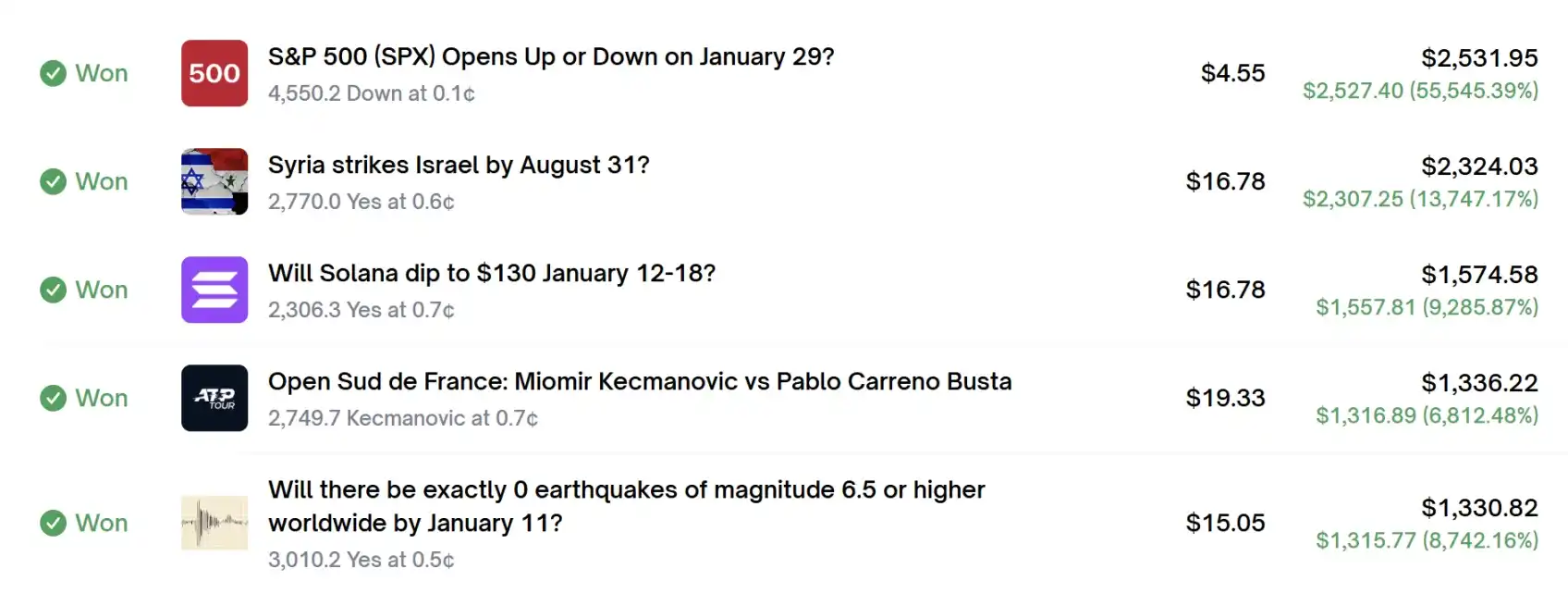
Will the SOL price drop to $130 between January 12-18?

It invested about $16 at $0.007 (the market believed the probability of success was less than 1%) and ultimately took away $1,574, with an amazing return rate of 9,285%.

Why did this "almost impossible" prediction allow it to make big money at that time?

During periods of剧烈波动 (sharp volatility) in the cryptocurrency market, mainstream predictions tend to be bullish or sideways. planktonXD would捕捉 (capture) those "extremely bearish" options priced at $0.001 - $0.01 around the clock. These options are like worthless paper to ordinary people, but they are extremely cheap insurance to quant traders. As long as the market experiences a deep wick or sudden bad news, these "worthless papers" can instantly surge thousands of times. Additionally, in specific price ranges (e.g., SOL < $40), because the current price is far from the predicted price, the order book is often very thin. planktonXD uses automated scripts to place orders in these "no-man's land," eating up the cheap shares抛出的 (thrown out) due to panic or misoperation, essentially acting as a probability搬运工 (mover).

planktonXD's SOL strategy shows that on Polymarket, buying the "impossible" does not mean it believes it will happen, but because the "probability of it happening" is underestimated by the market. It uses a few dollars to buy out the market's one-in-ten-thousand possibility of panic. This is a typical "antifragile" trade.

planktonXD's success offers three core启示 (insights) for ordinary retail users:

The power of compound interest should not be underestimated. Earning 0.5% daily through high-frequency trading yields much more stable returns after a year than betting on a 10x coin. Technology is the killer skill. In the Crypto era, quantitative tools and API capabilities are standard for top players. Finally, certainty is greater than odds. In prediction markets,寻找 (finding) those small profit opportunities with extremely high probability (e.g., 90%+ certainty) is easier to survive than gambling on 50/50 major events.

After all, the highest level of play in prediction markets is not predicting the future, but managing probability and liquidity.


Preguntas relacionadas

QWhat is the key strategy used by the address planktonXD to earn over $100,000 on Polymarket in a year?

AThe key strategy is high-frequency automated trading (using a bot) that focuses on small, certain profits through market making and micro-arbitrage, rather than betting on high-risk, high-reward events. It executed over 61,000 predictions in a year, averaging about 170 trades per day.

QHow does planktonXD achieve such a smooth profit curve with minimal drawdowns?

AIt achieves this by using a market maker strategy: placing orders on both sides of the order book to capture the bid-ask spread, and engaging in micro-arbitrage across different markets. This 'light position, fast turnover' approach minimizes single-point risk and avoids large bets on volatile outcomes.

QWhat type of markets does planktonXD typically target for its trades?

AIt targets multiple sectors including sports, weather, cryptocurrency prices, and politics. It monitors thousands of prediction markets 24/7 to identify mispriced opportunities, especially in illiquid or emotionally driven markets where extreme mispricing occurs.

QCan you give an example of a high-return trade made by planktonXD and explain why it was successful?

AOne example is buying 3,664.9 shares of Fuego winning a VALORANT Challengers match at 0.1¢ each, which resulted in an 874.09 USD profit with a 23,750% return. The success came from exploiting extreme mispricing in a low-liquidity, information-asymmetric market where the probability of Fuego winning was significantly higher than the market price reflected.

QWhat are the three key lessons for retail traders from planktonXD's success on Polymarket?

A1. The power of compounding: small daily gains through high-frequency trading can yield more stable returns than betting on high-risk events. 2. Technology is essential: automated tools and API capabilities are crucial for top performers. 3. Certainty over odds: seeking high-probability, small-profit opportunities is more sustainable than gambling on 50/50 outcomes.

Lecturas Relacionadas

¿Qué tiene que ver Huang Zheng, el creador de Pinduoduo, con la blockchain?

Resumen: La conexión entre Huang Zheng, fundador de Pinduoduo, y la blockchain En su artículo "Voltear el capitalismo", Huang Zheng, fundador de Pinduoduo, expone la lógica central de su plataforma: no es solo sobre productos baratos, sino un "negocio de seguros" que gestiona la incertidumbre. Argumenta que la riqueza fluye hacia los ricos porque estos asumen la "incertidumbre" (riesgos como enfermedades o pérdidas) por otros. La gente común paga por certeza (seguros, ahorros), transfiriendo valor hacia arriba. Pinduoduo intenta "voltear" esto mediante un "seguro inverso": agrega la demanda masiva de consumidores a través de funciones como "compras en grupo" para crear pedidos certeros y a gran escala. Esta "certeza agregada" permite a los fabricantes reducir los costos de riesgo y ofrecer precios más bajos. Huang señala que el eslabón final para hacer viable este modelo a gran escala podría ser la **blockchain**. El problema clave del "seguro inverso" es que las promesas individuales carecen de valor: son fáciles de romper. La blockchain, mediante **contratos inteligentes**, puede hacer que los compromisos sean creíbles, ejecutables y con un coste por incumplimiento. Transforma la confianza, pasando de depender de personas o intermediarios a depender de reglas codificadas e inmutables. Así, mientras Pinduoduo crea certeza mediante la **agregación masiva** de voluntades dispersas, la blockchain (ejemplificada por sistemas como Bitcoin) la crea mediante **reglas predefinidas e inalterables**. Ambas son caminos distintos para generar confianza y reducir la incertidumbre en las transacciones económicas.

链捕手Hace 1 hora(s)

¿Qué tiene que ver Huang Zheng, el creador de Pinduoduo, con la blockchain?

链捕手Hace 1 hora(s)

El gigante del almacenamiento que forjó un imperio de billones, al final no pudo convertirse en el hombre más rico

**Resumen en español (cerca de 1500 caracteres):** **Título: El magnate del almacenamiento que construyó un imperio billonario, pero que nunca será el más rico** El artículo analiza la trayectoria de Zhu Yiming, fundador de dos gigantes chinos de chips de memoria: GigaDevice (兆易创新) y ChangXin Memory Technologies (长鑫科技). Aunque ChangXin se prepara para una OPV que podría valorarla en más de un billón de yuanes, Zhu, con una participación indirecta de menos del 3%, no se convertirá en uno de los individuos más ricos de China. Su estrategia se centró en un enfoque pragmático y "oportunista". En 2005, fundó GigaDevice con capital limitado. En lugar de competir directamente en el segmento premium, la compañía se especializó inteligentemente en productos de memoria de baja y media gama (como NOR Flash y SLC NAND), nichos que los grandes actores globales (Samsung, Micron) fueron abandonando. Más tarde, GigaDevice se diversificó hacia microcontroladores (MCU), sensores y chips analógicos, principalmente a través de adquisiciones. A pesar de la fuerte ciclicidad del sector, GigaDevice ha demostrado ser una compañía sólida, manteniendo márgenes brutos superiores al 40% y controlando estrictamente sus gastos, lo que le ha permitido generar beneficios operativos consistentemente. Sin embargo, Zhu comprendió que el modelo "fabless" (sin fábricas propias) de GigaDevice tenía limitaciones inherentes en la industria de la memoria, donde la expansión anticíclica y las enormes inversiones en fabricación (modelo IDM) son claves para sobrevivir a largo plazo. Por ello, en 2016, colaboró con el gobierno de Hefei para fundar ChangXin, un proyecto IDM masivo enfocado en DRAM. Para atraer la confianza y la financiación masiva necesaria (préstamos a largo plazo superiores a 100.000 millones de yuanes), Zhu tomó decisiones poco comunes: no cobró un sueldo como CEO de ChangXin hasta que la empresa fuera rentable, utilizó la mitad de sus opciones sobre acciones (valoradas en más de 10.000 millones de yuanes) para recompensar a los empleados, y extendió su periodo de bloqueo de acciones a 10 años. Este compromiso, que diluyó significativamente su participación y control personal, fue fundamental para que ChangXin acumulara activos de planta y equipo por valor de casi 170.000 millones de yuanes, superando incluso a gigantes como BYD en este aspecto. En conclusión, la historia de Zhu Yiming es la de un visionario que, a través de una estrategia astuta y un sacrificio personal significativo (renunciando a un potencial patrimonio personal mucho mayor), logró construir dos pilares fundamentales para la industria china de semiconductores, priorizando el éxito industrial a largo plazo sobre la riqueza individual máxima.

marsbitHace 1 hora(s)

El gigante del almacenamiento que forjó un imperio de billones, al final no pudo convertirse en el hombre más rico

marsbitHace 1 hora(s)

Exploit de gobernanza de Token of Power drena $1.58 millones en WETH, según TRM

La empresa de inteligencia de blockchain TRM Labs ha detallado un ataque de toma de control de gobernanza contra el protocolo Token of Power, que drenó aproximadamente 1,58 millones de dólares en WETH. Según el análisis, el atacante explotó una debilidad en la configuración de la DAO de Aragon del protocolo: la ausencia de un timelock. Esto permitió al atacante proponer, votar y ejecutar una acción de gobernanza maliciosa en un solo bloque. El atacante financió la operación con 662 ETH retirados de Tornado Cash, compró suficientes tokens TOP para obtener poder de voto mayoritario, acuñó 10 mil millones de nuevos TOP y los cambió por WETH a través de un grupo de Balancer antes de devolver los fondos mediante Tornado Cash. La explotación ejemplifica cómo el diseño de gobernanza puede convertirse en un riesgo de seguridad directo. Los timelocks están diseñados para dar tiempo a los usuarios y equipos de seguridad para reaccionar antes de que una propuesta sea ejecutable. Para los usuarios de DeFi, este caso recuerda que el riesgo no se limita a los errores de código; los parámetros de gobernanza y los controles del tesoro son igual de cruciales. El siguiente paso será monitorear si los fondos robados se mueven nuevamente y si el protocolo, Aragon o los proveedores de liquidez afectados publican más detalles sobre remediación. Este informe se basa en datos del reporte de seguridad de TRM Labs.

bitcoinistHace 4 hora(s)

Exploit de gobernanza de Token of Power drena $1.58 millones en WETH, según TRM

bitcoinistHace 4 hora(s)

Los honorarios diarios de XRP Ledger caen por debajo de los 400 dólares mientras resurge el debate sobre la actividad de la red

El libro mayor de XRP vuelve a ser analizado después de que datos de tarifas mostraran que las comisiones diarias de la red cayeron por debajo de los 400 dólares. Aunque las tarifas bajas son un diseño fundamental de XRPL y suelen considerarse una fortaleza, la generación de comisiones también puede utilizarse como indicador de la actividad, la demanda y el uso de transacciones pagadas en la red. La quema semanal de aproximadamente 3.100 dólares subraya el contraste con cadenas de altas comisiones como Ethereum y Bitcoin. Para los partidarios, las tarifas bajas significan que XRPL sigue siendo eficiente y accesible, mientras que para los críticos, una generación de tarifas muy baja puede plantear dudas sobre si la red está experimentando suficiente demanda de alto valor en relación con su capitalización de mercado y su narrativa de pagos de larga data. Esta tensión es la que hace que los datos importen. La historia de XRP a menudo depende de los pagos, la liquidez y la adopción empresarial; los datos de tarifas en cadena ofrecen a los operadores una forma de evaluar si la red está viendo actividad transaccional significativa. Es importante no exagerar la conclusión: un día de tarifas bajas no significa que la red esté fallando, sino que agrega un punto de datos al debate sobre el uso de XRPL. También crea un contraste útil con el impulso más amplio de Ripple hacia RLUSD, pagos con agentes de IA e infraestructura de liquidación empresarial. Se debe observar si la cifra de tarifas se recupera, si los recuentos de transacciones cuentan una historia diferente y si exploradores nativos como Bithomp confirman la misma tendencia. La historia pertenece a la conversación diaria del mercado, destacando cómo las fuertes narrativas en cripto provienen cada vez más de datos en cadena y actualizaciones de protocolos, no solo de comentarios.

bitcoinistHace 6 hora(s)

Los honorarios diarios de XRP Ledger caen por debajo de los 400 dólares mientras resurge el debate sobre la actividad de la red

bitcoinistHace 6 hora(s)

Trading

Spot
Futuros
活动图片




