Dogecoin Tries to Hold $0.09370 – Is 2026 the Doge Year or Will $MAXI Take Over?

bitcoinistPublicado a 2026-02-10Actualizado a 2026-02-10

Resumen

Dogecoin is currently testing a critical support level at $0.09370, which is seen as a key determinant of its near-term price direction. If this level holds, analysts project a potential rally toward $0.20 by 2026, supported by oversold technical indicators and historical accumulation patterns. However, a breakdown below $0.088 could trigger a decline toward $0.060. Meanwhile, liquidity is shifting toward newer, high-risk meme tokens like Maxi Doge ($MAXI), which has raised $4.58M in its presale. $MAXI targets a high-leverage trading culture with features like holder-exclusive competitions and a dedicated treasury fund. Whale activity indicates growing interest, though the token remains a speculative play. The broader meme coin market remains sensitive to macroeconomic liquidity conditions, with Dogecoin’s performance tied to Bitcoin’s movements and central bank policies. The article highlights both the technical outlook for DOGE and the emerging appeal of narrative-driven altcoins like $MAXI for risk-seeking investors.

Trusted Editorial content, reviewed by leading industry experts and seasoned editors. Ad Disclosure

Quick Facts:

  • ➡️ Dogecoin must hold the $0.09370 support level to maintain its bullish structure and target $0.20 by 2026.
  • ➡️ A breakdown below $0.088 would invalidate the current reversal thesis, risking a drop to $0.060.
  • ➡️ Market liquidity is rotating toward thematic projects like Maxi Doge, which integrates trading competitions and leverage culture for high-risk ROI hunters.
  • ➡️ Macroeconomic shifts in global liquidity remain the primary catalyst for the next leg of the meme coin supercycle.

Dogecoin is fighting a critical battle at $0.09370.

That price point, once just a blip on the technical chart, has hardened into a psychological line in the sand for the entire meme sector. With Bitcoin stuck in consolidation, high-beta assets like DOGE are being forced to test their liquidity floors. The real question for traders isn’t just about surviving the current dip. It’s about whether this retest can trigger a parabolic run deep into 2026.

Why does this specific level matter? It aligns perfectly with historical accumulation zones where retail panic usually meets institutional buying. While volume indicators suggest ‘weak hands’ are folding, on-chain metrics reveal a quiet divergence in wallet growth.

Someone is accumulating. The market is currently trying to price in macro uncertainty alongside the hope for a ‘meme supercycle.’ If support holds, the structure points toward a reversal that could challenge year-to-date highs.

But the liquidity landscape is shifting. Legacy giants like Dogecoin are battling the law of large numbers, it takes massive capital just to move the needle 5%. Consequently, speculative cash is beginning to fragment. Traders chasing asymmetric returns are increasingly hedging major positions with newer, narrative-driven projects.

This rotation explains why assets like Maxi Doge ($MAXI) are gaining traction. They offer a totally different risk-reward profile for anyone betting on the next wave of retail euphoria.

Learn more about Maxi Doge.

Analysts Eye $0.20 Reversal if Key Support Holds

The technical case for Dogecoin hinges entirely on holding the $0.09000–$0.09370 zone. A breakdown here would be ugly—, likely triggering a cascade of long liquidations down to the $0.075 region. But a successful defense?

That confirms a ‘higher low’ macro structure (a classic reversal signal). Plus, the daily RSI is hovering in oversold territory. Historically, that’s exactly where impulsive bounces in the meme sector start.

Fundamentally, DOGE remains tied to payment narratives. Yet, what most analysts miss is the link between global liquidity cycles and meme performance. As central banks signal rate adjustments, risk-on assets react first. Liquidity usually flows into Bitcoin, then rotates into heavyweights like DOGE.

If the $0.09370 support holds through this volatility, charts point to immediate resistance at $0.12, with a medium-term target of $0.20 by early 2026.

Scenario Analysis:

  • Bull Case: DOGE reclaims the 50-day EMA, confirming $0.09370 as a cycle bottom. Buying pressure targets $0.14 initially, with a breakout to $0.22 imminent if volume holds up.
  • Base Case: The asset chops sideways between $0.090 and $0.105 for 3-5 weeks, shaking out leverage before making a decisive move.
  • Bear Case (Invalidation): A daily candle close below $0.088 invalidates the bullish thesis, exposing the asset to a retest of 2023 lows around $0.060.

$MAXI is available here.

Smart Money Rotates: $MAXI Targets High-Leverage Culture

While Dogecoin relies on broad sentiment, Maxi Doge ($MAXI) is carving out a niche by targeting the aggressive trading culture defining this cycle.

Early adopters call it the ‘Left-Curve’ play. It positions itself not just as a currency, but as the embodiment of the 1000x leverage mentality. That distinction is key. While DOGE wants mass adoption, Maxi Doge targets the high-frequency trader and the ‘gym-bro’ aesthetic dominating crypto Twitter.

The project stands out with a ‘Leverage King’ ecosystem, featuring holder-only trading competitions and a ‘Maxi Fund’ treasury. The numbers seem to back the hype.

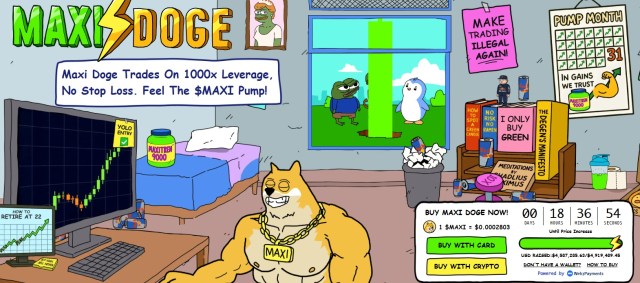
According to the presale page, Maxi Doge has raised exactly $4.58M, with tokens currently priced at $0.0002803. This influx suggests retail investors are hunting for volatility and outsized returns, gains that mature assets like $DOGE struggle to deliver these days due to their massive caps.
Smart money is watching this rotation. On-chain data from Etherscan reveals that 2 whale wallets scooped up $628K ($314K, $314K) in recent transactions.

That signals high-net-worth players are positioning themselves before the project moves to open markets. View whale activity on Etherscan.

Still, caution is required. As an ERC-20 token focused on high-octane culture, Maxi Doge carries early-stage volatility risks. The ‘never skip leg-day’ branding and competitive staking APY are attractive, sure, but this remains a high-risk allocation. It’s for those looking to diversify into speculative narratives, not safe havens.

Watch the liquidity rotation, Maxi Doge ($MAXI) presale is live here. It represents the aggressive edge of the current meme market.

Buy your $MAXI here.

The information provided in this article is for educational purposes only and does not constitute financial advice. Crypto assets, including Dogecoin and presale tokens like Maxi Doge, are highly volatile and unregulated. Always conduct your own independent research and consult a professional advisor before making investment decisions.

Editorial Process for bitcoinist is centered on delivering thoroughly researched, accurate, and unbiased content. We uphold strict sourcing standards, and each page undergoes diligent review by our team of top technology experts and seasoned editors. This process ensures the integrity, relevance, and value of our content for our readers.

patrubogdan

Follow

Full Profile

Related Posts

Government Shutdown Fears Trigger 2% Crypto Dip, But Bitcoin Hyper Remains Unshaken

US Debt Spiral Eyes $39T: Why Bitcoin Hyper ($HYPER) Is The Hedge to Watch

Crypto Exchange Backpack Targets Token Launch Soon, as BMIC Fires Up Quantum Defense

Ethereum Foundation Backs SEAL Initiative as LiquidChain L3 Protocol Gains Traction

Vitalik Buterin Outlines Ethereum’s AI Future, While SUBBD Token Targets the Creator Economy

Binance Dominates Trump’s USD1 Supply as Bitcoin Hyper Breaks Records

Preguntas relacionadas

QWhat is the critical support level for Dogecoin mentioned in the article, and why is it important?

AThe critical support level for Dogecoin is $0.09370. It is important because it aligns with historical accumulation zones where retail panic often coincides with institutional buying. Holding this level is crucial for maintaining its bullish structure and targeting a price of $0.20 by 2026.

QWhat are the potential price targets for Dogecoin if the $0.09370 support holds?

AIf the $0.09370 support holds, the immediate resistance target is $0.12, with a medium-term target of $0.20 by early 2026.

QWhat is Maxi Doge ($MAXI), and how does it differentiate itself from Dogecoin?

AMaxi Doge ($MAXI) is a newer, narrative-driven project that targets high-leverage trading culture. It differentiates itself by integrating trading competitions and a 'Maxi Fund' treasury, focusing on high-risk ROI hunters and the aggressive trading mentality, unlike Dogecoin, which aims for broader mass adoption.

QWhat on-chain activity suggests smart money is interested in Maxi Doge?

AOn-chain data from Etherscan reveals that two whale wallets purchased $628K (split as $314K each) in $MAXI tokens, indicating high-net-worth players are positioning themselves before the project moves to open markets.

QWhat is the bear case scenario for Dogecoin if it fails to hold the key support level?

AThe bear case scenario involves a daily candle close below $0.088, which would invalidate the bullish thesis and expose Dogecoin to a retest of its 2023 lows around $0.060.

Lecturas Relacionadas

Respuesta del cofundador de ZEC a la vulnerabilidad de Orchard: sin rastros de robo por ahora, se cerrará el pool de Orchard

El cofundador de ZEC responde a la vulnerabilidad de Orchard: Sin rastros de robo por ahora, se cerrará el pool de Orchard Recientemente se descubrió una vulnerabilidad de seguridad en el módulo Orchard de Zcash. El equipo evaluó cuatro preguntas clave: 1. **¿Se ha explotado la vulnerabilidad?** Es poco probable. Fue descubierta proactivamente por un investigador especializado, no por una explotación. El equipo actuó rápidamente para contenerla. No hay evidencia de movimientos sospechosos típicos de un ataque. 2. **¿Se pueden recuperar los fondos legítimos en Orchard?** Sí, si la vulnerabilidad no fue explotada. En el improbable caso de que se crearan fichas falsas, el mecanismo de salida limitaría el total retirable al monto depositado originalmente. Los usuarios pueden optar por trasladar sus fondos, pero deben sopesar las implicaciones de privacidad y riesgos operativos. 3. **¿Pueden los usuarios verificar la oferta total de ZEC?** Actualmente no, debido a esta vulnerabilidad. Sin embargo, la próxima actualización de red **Ironwood** resolverá esto. Cerrará permanentemente el pool de Orchard, permitiendo solo la salida de fondos por los canales existentes, cuyo límite total es igual a los depósitos legítimos originales. Después, cualquiera podrá verificar de forma independiente que no hay inflación de la oferta. 4. **¿Hay otras vulnerabilidades de falsificación?** Tras una exhaustiva auditoría por múltiples equipos, incluyendo el uso de herramientas de IA avanzadas, no se han encontrado otras vulnerabilidades similares. Esto aumenta la confianza en que no existen fallas de este tipo sin descubrir. **Conclusión:** El riesgo de explotación es bajo, los fondos de los usuarios están seguros y no se han encontrado otras vulnerabilidades similares. La actualización Ironwood restablecerá la capacidad de los usuarios para verificar de forma independiente la oferta total de monedas, un pilar fundamental para la credibilidad a largo plazo de Zcash.

Foresight NewsHace 11 min(s)

Respuesta del cofundador de ZEC a la vulnerabilidad de Orchard: sin rastros de robo por ahora, se cerrará el pool de Orchard

Foresight NewsHace 11 min(s)

El banco central de Japón subirá los tipos pronto, ¿soportará el mercado alcista de la IA?

**TL;DR** La atención del mercado se centra en la próxima reunión del Banco de Japón (BoJ). Históricamente, el yen ha sido una moneda de financiamiento global barata, facilitando operaciones de *carry trade* (pedir prestado en yenes a bajo costo para invertir en activos de mayor rendimiento). Esto ha inflado la liquidez global y la tolerancia al riesgo, beneficiando activos de alta volatilidad como las acciones tecnológicas de IA y las criptomonedas. El BoJ está saliendo de su política de tasas ultrabajas, y se espera que suba su tasa clave al 1.0% el 16 de junio, con perspectivas de llegar al 1.25% a fin de año. Si bien 25 puntos base parecen poco, el riesgo radica en el cambio de dirección: el "dinero barato" comienza a encarecerse, lo que podría desencadenar el desapalancamiento de operaciones de carry trade. Esto forzaría a los inversores a vender activos de riesgo (como acciones de IA y cripto) para recomprar yenes, amplificando la volatilidad del mercado a través del apalancamiento y las expectativas cambiarias. El mercado no está apostando a que la suba de tasas mate el *bull market* de la IA o las cripto, cuya narrativa fundamental permanece. En cambio, está evaluando el aumento del costo global del financiamiento y la reducción de la tolerancia a pagar múltiplos de valoración elevados por crecimiento futuro. La clave a observar después del anuncio del BoJ será la correlación: si un yen más fuerte coincide con la debilidad de activos de alta beta (tecnología, criptomonedas) y un aumento de la volatilidad, será una señal de que el mapa global del "dinero barato" se está reescribiendo, elevando el umbral de financiamiento para todos los activos de riesgo.

marsbitHace 19 min(s)

El banco central de Japón subirá los tipos pronto, ¿soportará el mercado alcista de la IA?

marsbitHace 19 min(s)

¿Existe realmente la «maldición del Mundial» en los mercados?

El "maleficio del Mundial", una idea extendida en los mercados que sugiere un peor rendimiento bursátil durante la Copa del Mundo, parece tener cierto respaldo en datos históricos. Entre 1950 y 2022, el S&P 500 registró una rentabilidad media negativa del -1.5% a -2.11% en 11 de los 19 torneos. En China, el índice Shanghai Composite cayó en el 71% de las ediciones desde 1994. La criptomoneda Bitcoin mostró un patrón mixto. Los estudios, como uno del BCE de 2010, confirman que la actividad bursátil desciende notablemente durante los partidos, especialmente cuando juega la selección nacional, con una caída del volumen de hasta el 55%. Además, las derrotas de la selección pueden generar rendimientos negativos al día siguiente en la bolsa local. Sin embargo, el impacto directo del evento puede ser limitado. El período tradicional del Mundial (junio-julio) coincide con la estación estacionalmente débil para los mercados ("Sell in May and go away"). El Mundial de 2022 en Qatar (invierno) presentó una caída de volumen menor (-18%) que en verano (-33%), lo que sugiere que el contexto estacional es un factor clave. Para Bitcoin, sus movimientos durante los Mundiales estuvieron más influenciados por eventos específicos del ecosistema (hackeos, regulación) o por ciclos macroeconómicos que por el propio torneo. Respecto a las oportunidades de inversión, los sectores beneficiarios han evolucionado. Los medios de transmisión han pasado de la televisión tradicional a las plataformas de streaming. Sectores clásicos como la cerveza y el equipamiento deportivo mantienen cierta resiliencia, aunque enfrentan cambios en los hábitos de consumo. Emergen nuevas tendencias como la tokenización de objetos coleccionables (ej. cromos de jugadores). En conclusión, aunque los datos muestran una correlación entre el Mundial y una menor actividad y rendimiento del mercado, gran parte de este efecto puede atribuirse a patrones estacionales preexistentes. El torneo puede actuar más como un amplificador de tendencias estacionales o de eventos macroeconómicos concurrentes que como una causa única. La estrategia más natural para algunos inversores durante este período de posible menor liquidez podría ser simplemente disfrutar del evento.

marsbitHace 36 min(s)

¿Existe realmente la «maldición del Mundial» en los mercados?

marsbitHace 36 min(s)

Trading

Spot
Futuros
活动图片





